


I remember staring at a EUR/USD chart in 2018, completely paralyzed.

David van der Merwe
Emerging Markets Trader ·  South Africa
☕ 12 min read
What you'll learn:
- 1What Naked Forex Actually Is (And Isn't)
- 2The Core Concepts: Your Naked Trading Toolkit
- 3Setting Up Your Clean Chart: A South African Trader's Guide
- 4A Simple, Repeatable Naked Forex Strategy
- 5Risk Management: Your Safety Net in a Naked World
- 6Common Pitfalls Every Beginner Faces (And How to Avoid Them)
- 7Getting Started as a South African Naked Trader
- 8When You're Ready: Advanced Naked Concepts
I remember staring at a EUR/USD chart in 2018, completely paralyzed. I had 14 indicators open: RSI was oversold, MACD was bearish, but the Stochastic was turning up. The moving averages were all tangled. I entered long anyway, got stopped out for a R1,200 loss, and watched the price rocket up without me. That was the day I ripped everything off my screen except the raw price bars. Naked forex isn't about trading without clothes on (though the feeling is similarly liberating). It's about trading without the clutter of indicators, learning to read what the market is actually telling you through pure price action. For us trading in South Africa, with the ZAR's unique volatility, this clarity is everything.
Let's clear this up first. Naked forex, or price action trading, means making decisions based solely on the price movement you see on a clean chart. No moving averages, no Bollinger Bands, no RSI cluttering your view. It's just you, the candlesticks or bars, and the story they're telling.
It's not a magic system. It's a framework for understanding market psychology. You're looking for patterns in how buyers and sellers battle it out. Is the price making higher highs and higher lows? That's an uptrend. Is it struggling to break past a certain level multiple times? That's a resistance zone. The chart becomes a map of fear and greed.
I made the switch after that messy 2018 trade. My first month was rough - I felt blind. But by month three, I started seeing things. I noticed how often price would 'test' a previous low before moving up, or how a sudden, wide-ranging bar often signaled exhaustion. My win rate didn't skyrocket overnight, but my confidence did. I was reacting to the market, not to a lagging indicator.

Warning: Naked trading requires more screen time and patience at the start. You're training your eye to see what the indicators were calculating for you. It's a skill, not a shortcut.
Support and Resistance
This is the bedrock. Support is a price level where buying interest is strong enough to overcome selling pressure, causing the price to bounce back up. Resistance is the opposite - where selling pressure overcomes buying, pushing the price down. Draw these as horizontal lines where price has reversed multiple times. In the ZAR pairs, like USD/ZAR, these levels can be wider due to volatility, but they're just as valid.
Candlestick Patterns
These are your sentences in the market's story. You don't need to memorize 50 patterns. Focus on a few high-probability ones:
- Pin Bars (or Hammer/Shooting Star): A bar with a long wick and small body. A pin bar at resistance after an uptrend can signal a reversal down.
- Engulfing Patterns: A large candle that completely 'engulfs' the body of the previous candle. A bullish engulfing at support is a strong buy signal.
- Inside Bars: A bar completely within the range of the previous bar. It shows consolidation and often precedes a big breakout.
Market Structure
This is the grammar. Is the market making Higher Highs (HH) and Higher Lows (HL)? That's an uptrend. Lower Highs (LH) and Lower Lows (LL)? That's a downtrend. Your main goal in naked forex is to trade in the direction of this structure. A classic setup is waiting for a pullback to a trendline or a previous support-turned-resistance level in an uptrend, then looking for a bullish pin bar or engulfing candle to enter.

Example: On GBP/ZAR, you see a clear uptrend (HH & HL). Price pulls back to a previous resistance level that should now act as support, around R23.50. A bullish pin bar forms on the 4-hour chart. That's a high-probability long entry, with a stop loss placed just below the low of the pin bar.

💡 Winston's Tip
The market's most important story is its structure - the sequence of highs and lows. A clean chart makes this story impossible to ignore.
“I was right on the market, but wrong on the spread and volatility, and I broke my 1% rule trying to make the position size work.”
Simplicity is key. Here’s exactly how I set up my MT5 platform for naked trading on ZAR pairs.
- Choose Your Broker Wisely: You need a broker with tight spreads, especially on exotic pairs like USD/ZAR or EUR/ZAR. Every pip matters more when you're not relying on indicators to give you a huge edge. I use IC Markets for their raw spreads and Pepperstone for their execution speed. Both are FSCA-regulated, which is non-negotiable for protecting your capital.
- The Bare Chart: Open a new chart. Remove EVERY indicator. Start with a simple candlestick chart. I prefer a white background (less eye strain) with black candle outlines and hollow bodies.
- Timeframes: Naked forex works across timeframes, but you need context. I use a top-down approach:
- Daily Chart: I spend 10 minutes here every morning. It tells me the major trend and key weekly support/resistance levels.
- 4-Hour Chart: My primary decision-making chart. I find the best balance between noise and signal here.
- 1-Hour Chart: For fine-tuning entry points. I never take a trade that looks bad on the 4-hour, even if the 1-hour looks perfect.
- Drawing Tools: This is your only "indicator." Use horizontal lines for support/resistance, trendlines for... well, trends, and maybe a simple horizontal ray to mark current price. That's it. Don't turn your chart into a spiderweb of lines.

Pro Tip: Save this blank chart as a template. I've got mine set up with my preferred colors and a few horizontal lines pre-drawn at key psychological levels (like R19.00 on USD/ZAR). It saves time and keeps me disciplined.
Let's make this practical. Here's the exact 4-step process I've used for years. I'll use a real example from last month on EUR/USD (the principles are identical for ZAR pairs, just adjust for higher volatility).
The "Structure Retest" Setup:
- Identify the Trend on the 4-Hour Chart: Is it clearly up or down? If it's choppy, stay out. In early March, EUR/USD was in a clear daily uptrend, making HH and HL.
- Mark Key Support/Resistance: I saw a strong resistance-turned-support level at 1.0820. Price had bounced off it twice before.
- Wait for the Retest and Signal: Price pulled back from 1.0950 down to that 1.0820 level. It didn't just touch it and bounce; it lingered. This is important. Then, on March 14th, a clear bullish engulfing candle closed on the 4-hour chart right at that support.
- Enter and Manage the Trade:
- Entry: I went long at 1.0840 (a few pips above the engulfing candle's close).
- Stop Loss: Placed at 1.0795, just below the recent swing low and the key 1.0820 support. Risk: 45 pips.
- Take Profit: I set my first target at the previous high near 1.0950. I used a position size calculator to ensure this risk was only 1% of my account.
The trade worked. Price moved up to 1.0940 within two days. I closed half my position there (banking +100 pips) and trailed the rest, eventually getting stopped out on the remainder at 1.0900 for a smaller gain. Total win: about +80 pips on the full position size. The key was patience and letting the price action at a clear level give the signal.
This strategy works for swing trading setups. For faster moves, you can apply the same logic to the 1-hour or even 15-minute charts, but the risk/reward must be impeccable.
💡 Winston's Tip
Your first 100 trades on a clean chart should be in a demo account. Your goal isn't profit, it's pattern recognition. Treat it like flight school.
“The journey of a naked forex trader is a journey of simplification.”
Without indicators to (falsely) reassure you, rock-solid risk management is your only true safety net. This is doubly true in South Africa, where brokers can offer high use. The FSCA caps use for major pairs at 1:30 for retail clients, but it's still enough to blow an account if you're careless.
The Non-Negotiables:
- 1% Rule: Never risk more than 1% of your trading capital on a single trade. On a R10,000 account, that's R100. If your stop loss is 50 pips away on USD/ZAR, your position size must be small enough that a 50-pip loss equals R100. Use a calculator every single time.
- Stop Loss Placement: Your stop isn't a suggestion. In naked trading, place it logically: just beyond the support/resistance level that invalidates your trade idea. If you're buying at a support level, your stop goes below it. Period.
- Beware the ZAR Volatility: Pairs like USD/ZAR can move 200 pips in a day easily. Your stop needs to be wide enough to not get taken out by normal noise, which means your position size must be correspondingly smaller. A 100-pip stop on USD/ZAR is tight; 150-200 is more realistic.
I learned this the hard way in 2019. I took a perfect-looking pin bar setup on GBP/ZAR. My analysis was right, but I placed my stop loss too tight - just 80 pips in a pair that regularly swings 150. Price spiked down, took me out for a loss, and then rallied 400 pips in my original direction. I was right on the market, but wrong on the spread and volatility, and I broke my 1% rule trying to make the position size work. That loss stung more than any indicator-based mistake.
Automating this process is a game-saver. A tool that lets you set a stop loss and multiple take-profit levels as soon as you enter the trade removes emotion. It's the digital equivalent of writing down your plan and sticking to it.
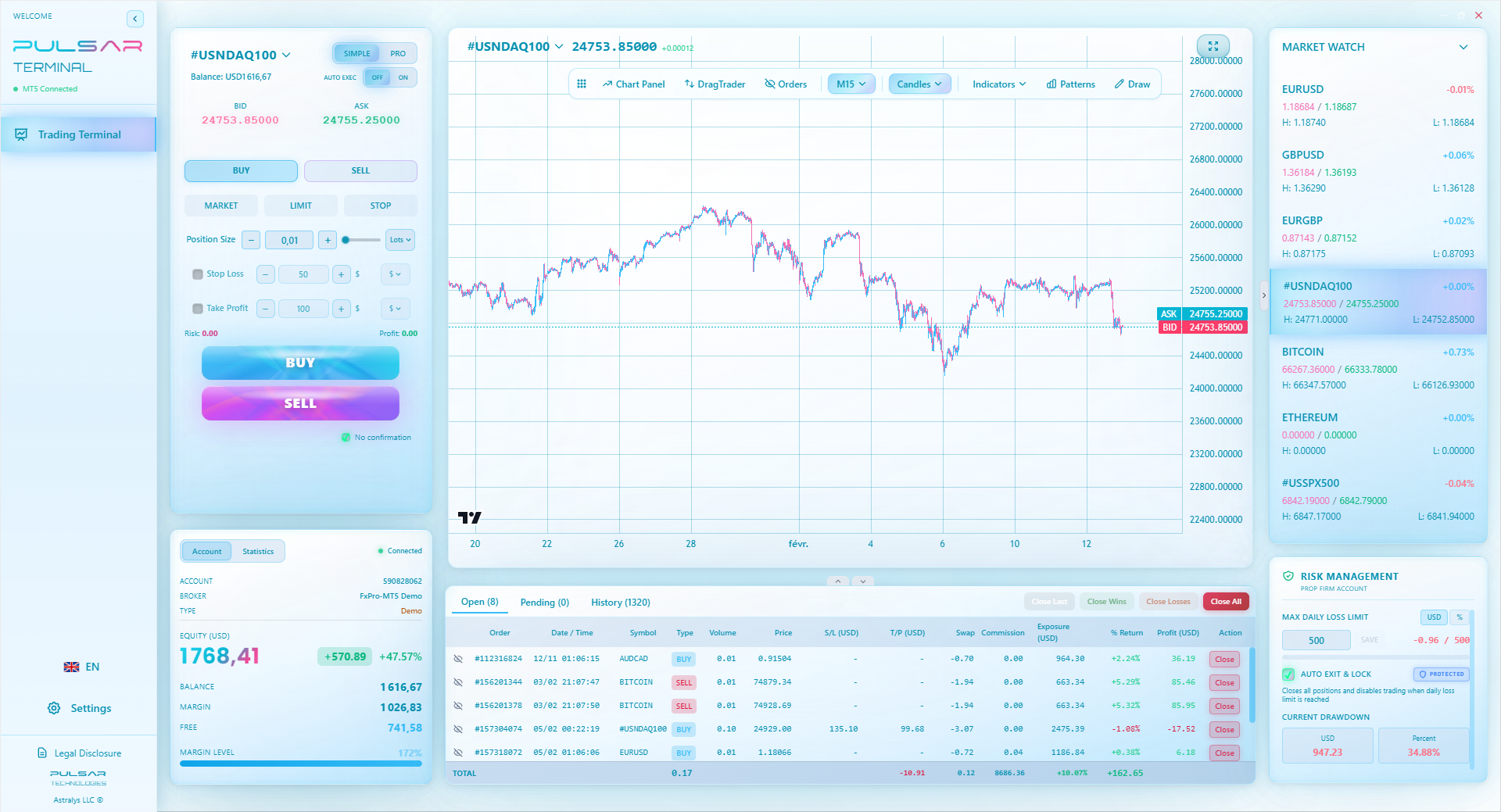
When trading naked, precise order entry and rock-solid trade management are your primary tools, which is why a platform like Pulsar Terminal that offers drag-and-drop orders and automated multi-TP/SL directly on MT5 is so valuable.
Pulsar Terminal
The all-in-one MT5 companion: drag-and-drop orders, multi-TP/SL, trailing stop, grid trading, Volume Profile, and prop firm protection. Used by 1,000+ traders daily.
I've fallen into these traps so you don't have to.
1. Over-trading on Lower Timeframes: A clean 5-minute chart looks so clear! You see patterns everywhere. This is an illusion. Lower timeframes are noisy and costs (spreads, commissions) eat a larger percentage of your potential profit. Stick to the 1-hour and 4-hour until you're consistently profitable. Scalping naked is an expert's game.
2. Seeing Patterns That Aren't There: This is called pareidolia - like seeing faces in clouds. You'll want every three-candle move to be a head and shoulders. Fight this. Only trade the clearest, most obvious setups that align with the higher timeframe trend. If you have to squint or justify it, it's not a valid setup.
3. Revenge Trading After a Loss: A stop loss gets hit. You immediately jump back in on the same pair, trying to win back the loss. This is a guaranteed account killer. When you get stopped out, walk away. Close the platform. The market will still be there tomorrow.
4. Ignoring Fundamentals Completely: Naked forex focuses on price, but price reacts to news. If the South African Reserve Bank (SARB) is announcing an interest rate decision, step away. The price action will be chaotic and your clean support lines can vaporize in seconds. Use an economic calendar.
My biggest pitfall was #2. I'd draw a trendline connecting two minor wicks and treat it like gospel. Price would break it, I'd lose, and only then see the actual major trendline it had been respecting all along. Lesson learned: keep your drawings minimal and only on significant swing points.
“If you have to squint or justify a setup, it's not a valid setup.”
Here's your action plan:
- Open a Demo Account: Don't touch real money yet. Pick an FSCA-regulated broker like XM or Exness that offers ZAR accounts or low-cost USD accounts. They have great demo platforms. Practice the "Structure Retest" strategy for a minimum of 100 trades. Track every trade in a journal - entry, exit, why you took it, and what you learned.
- Start Small for Real: When you switch to live, start with a micro or cent account if possible. Khwezi Trade, for instance, is a local FSCA broker with a ZAR 500 minimum. That's all you need. Your goal in the first six months is to preserve capital and build consistency, not get rich.
- Focus on One Major Pair First: I recommend starting with EUR/USD or GBP/USD. They have the tightest spreads and most predictable liquidity. Once you're comfortable, then try applying the same rules to USD/ZAR. Jumping straight into the volatile ZAR pairs is like learning to drive in a hurricane.
- Join a Community (Carefully): Find other price action traders. But be wary of "gurus" selling secret systems. Look for communities that focus on reviewing charts and discussing market structure, not flashing their Lamborghinis.
Remember, regulation is your friend. The FSCA is there to ensure brokers handle your money properly. Always check their website to confirm your broker's license status. Trading with an unregulated entity is the ultimate risk, naked or not.
💡 Winston's Tip
In volatile ZAR pairs, your stop loss is a function of market noise, not your pain threshold. If 150 pips is the minimum logical stop, your position size must shrink to match.
After a year or so of nailing the basics, you can explore these concepts to refine your edge.
Order Flow and Volume: While true forex volume is hard to get, some brokers provide tick volume (the number of price changes), which can be a useful secondary confirmation. A breakout from a consolidation pattern on high tick volume is more convincing than on low volume.
Market Profile & Volume Profile: These are advanced charting methods that show where price spent most of its time, revealing high-volume nodes (value areas) and low-volume nodes (areas where price can move fast). They are fantastic for identifying key support/resistance and understanding the market's accepted value for a currency pair. This is where tools that integrate this data directly into your MT5 platform can save you hours of manual analysis.
Multiple Timeframe Analysis (MTA): We touched on this, but you can deepen it. For instance, a bullish setup on your 1-hour chart that sits right on a major daily support level is a much higher-probability trade than the same setup in the middle of nowhere on the daily. Always know what the bigger picture is saying.
The journey of a naked forex trader is a journey of simplification. You start by adding everything to your chart, then you slowly remove it all until only the essential truth - the price - remains. It's a more challenging path at first, but it leads to a deeper, more intuitive understanding of the markets that no indicator can ever give you.
FAQ
Q1Is naked forex trading legal in South Africa?
Absolutely. Forex trading itself is legal and regulated by the Financial Sector Conduct Authority (FSCA). Naked forex is simply a methodology - a way of analyzing the markets. There's no law against using a clean chart. The key is to use an FSCA-regulated broker to ensure your funds are protected.
Q2What's the best timeframe for naked forex trading?
There's no single 'best,' but most successful retail traders using price action focus on the 1-hour and 4-hour charts. These timeframes offer a good balance: they filter out the noise of lower timeframes (like the 5-minute) but provide more opportunities than the daily chart. Always start your analysis on a higher timeframe (like the daily) to see the trend.
Q3Can I use naked trading for ZAR pairs like USD/ZAR?
Yes, but you must adjust for higher volatility. Support and resistance levels still work, but price moves are larger and faster. This means you need wider stop losses, which in turn requires smaller position sizes to keep your risk at 1% of your account. It's more challenging than starting with EUR/USD, but the principles are identical.
Q4Do I need a special broker for naked trading?
You need a broker with tight, reliable spreads and fast execution. Since you're not using indicators, every pip of spread is a direct cost against your potential profit. Look for FSCA-regulated brokers known for low costs, like IC Markets, Pepperstone, or Tickmill. A wide or slippage-prone broker will cripple a naked trading strategy.
Q5How long does it take to become profitable with naked forex?
Be prepared for a long learning curve. It takes most dedicated traders at least 6-12 months of consistent practice on a demo account and then a live micro account to stop losing money consistently. Becoming reliably profitable often takes 2-3 years. It's a skill like any other - it requires practice, patience, and good risk management.
Q6What's the biggest advantage of naked forex?
Clarity and adaptability. You're not waiting for a lagging indicator to cross. You're reading the market's current psychology directly from the price. This allows you to make faster decisions and adapt to changing market conditions. It also works on any market and any timeframe, from stocks to crypto, without needing to adjust settings.
Prof. Winston's Lesson
Key Takeaways:
- ✓Trade only the clearest price action setups in line with the higher timeframe trend.
- ✓Never risk more than 1% of your capital on a single trade, period.
- ✓Place stop losses beyond key support/resistance, not based on arbitrary pip amounts.
- ✓Start with major pairs like EUR/USD before tackling volatile ZAR crosses.
How useful was this article?
Click a star to rate
Weekly Trading Insights
Free weekly analysis & strategies. No spam.
About the Author
David van der Merwe
Emerging Markets Trader
Johannesburg-based trader with 11 years in emerging market currencies. Specializes in ZAR pairs, FSCA-regulated trading, and South African market analysis.
Comments
Risk Disclaimer
Trading financial instruments carries significant risk and may not be suitable for all investors. Past performance does not guarantee future results. This content is for educational purposes only and should not be considered investment advice. Always conduct your own research before trading.
You Might Also Like

Cara Trading Forex Sukses: 7 Prinsip dari Trader Profesional
Cara trading forex sukses dengan 7 prinsip trader pro: manajemen modal, disiplin, journal trading, backtest. Data nyata, bukan janji profit palsu.
Jam Trading Forex Terbaik untuk Trader Indonesia: Panduan Lengkap dengan Tabel Waktu
Panduan jam trading forex untuk trader Indonesia. Tabel 4 sesi dunia, jam emas 20:00-00:00, sesi mana yang harus dihindari. Data akurat + tips dari trader berpengalaman.
Top 5 Sàn Forex Uy Tín Nhất 2026: Review Jujur dari Trader Indonesia
Top 5 sàn forex uy tín 2026 untuk trader Indonesia. Review jujur: spread, deposit, withdraw, dukungan lokal. Exness, XM, IC Markets & lebih.
Get Pulsar Terminal
All these calculators are built into Pulsar Terminal with real-time data from your MT5 account. One-click position sizing, automatic risk management, and instant calculations.
Get Pulsar Terminal