


Here's a hard truth: over 70% of retail traders lose money.

David van der Merwe
Emerging Markets Trader ·  South Africa
☕ 10 min read
What you'll learn:
- 1What Exactly Is a Neckline in Forex?
- 2Trading the Head and Shoulders Neckline: A Step-by-Step Plan
- 3The Inverse Pattern & Trading ZAR Pairs
- 4Mistakes I've Made (So You Don't Have To)
- 5Making It Stronger: Integrating With Other Tools
- 6The South African Context: Regulations, Tax & Brokerage
- 7Putting It All Together: Your Trading Checklist
Here's a hard truth: over 70% of retail traders lose money. I was part of that statistic for my first two years. The single biggest reason? I chased breakouts and ignored reversals. I'd see a price smash through a level and pile in, only to watch it reverse and wipe out my account. It wasn't until I learned to respect the 'neckline' in forex patterns that my trading turned a corner. In the volatile ZAR pairs we deal with, understanding this simple line can mean the difference between catching a trend reversal and getting stopped out repeatedly.
Forget the complex jargon. A neckline is simply a support or resistance level that connects the lows (in a head and shoulders top) or the highs (in an inverse head and shoulders) of a reversal pattern. It's the finishing line for the pattern. When price breaks through it, the race - the trend reversal - is officially on.
Think of it like this: price forms a series of peaks and troughs that look like a head with two shoulders. The neckline is the baseline connecting the troughs between these shoulders. It's not always perfectly horizontal. In fact, it's often slanted, which trips up a lot of new traders. A downward-sloping neckline in a head and shoulders top is actually a sign of increasing weakness.

Warning: Don't get hung up on drawing a perfect straight line. The market isn't perfect. Your neckline should connect the most significant reaction points, even if it's at a slight angle. The validity of the break is more important than the line's aesthetic.
I learned this the hard way trading USD/ZAR. I spotted what I thought was a perfect head and shoulders top with a flat neckline around 18.7500. I shorted the break. Price dipped, then rallied straight back above my line, stopping me out. My mistake? I forced a horizontal line. The true neckline, connecting the two significant lows, had a slight upward slope. The break wasn't valid. That one trade taught me more about neckline forex analysis than any textbook.

💡 Winston's Tip
A slanted neckline is more common than a flat one. A descending neckline in a topping pattern screams weakness - pay attention.
“The neckline is the finishing line for the pattern. When price breaks through it, the trend reversal is officially on.”
Spotting the Pattern
First, you need to see the sculpture in the marble. Look for three peaks: a higher peak (the head) between two lower, roughly equal peaks (the shoulders). The troughs between them should connect to form your neckline. Volume should ideally decline on each successive peak, especially on the right shoulder. This shows buying pressure is drying up.
The Entry Trigger
Patience is everything here. Do NOT short when the right shoulder forms. Wait for the close of a 4-hour or daily candle (depending on your timeframe) BELOW the neckline. This is your signal. That's your entry. Some traders wait for a retest of the neckline from below (which becomes new resistance) for a better entry. I use both methods, but the initial break is where I take a partial position.
Setting Your Stop Loss
This is critical. Your stop loss should be placed just above the right shoulder. Why? Because if price rallies back past that point, the entire pattern structure is invalidated. Never place your stop just above the neckline; a common retest will wipe you out. Using a proper position size calculator here is non-negotiable.
Profit Target: The Measured Move
The classic target is derived from the pattern's height. Measure the vertical distance from the top of the head down to the neckline. Then, project that same distance downward from the point where price broke the neckline. It's a guideline, not a guarantee. I often take 50% of my position off at this target and let the rest run with a trailing stop.
Let me give you a real example from my journal. On EUR/USD (a cleaner chart for learning), I identified a head and shoulders on the daily chart. Head at 1.1275, neckline at 1.1150. Pattern height: 125 pips. Price broke the neckline at 1.1148. I entered a short. Stop above the right shoulder at 1.1230 (82 pips risk). My first target was 1.1148 - 125 pips = 1.1023. Price hit it within a week. I banked 125 pips on half my position. The rest I trailed and caught another 80 pips. That's the power of a structured neckline forex trade.
“I learned more from one failed neckline trade on USD/ZAR than from any textbook.”
The inverse head and shoulders is just the bullish mirror image. Three troughs: a lower head between two higher shoulders. The neckline connects the highs. A break above this neckline signals a potential bullish reversal. All the same rules apply, just flipped.
Now, for us in South Africa, trading pairs like USD/ZAR, EUR/ZAR, or GBP/ZAR adds a layer of complexity. The ZAR is a volatile, sentiment-driven currency. Patterns form, but they can be messy and prone to false breaks due to sudden shifts in commodity prices or local political news.
My adjusted approach for ZAR pairs:
- Use Higher Timeframes: I stick to the 4-hour and daily charts exclusively. The noise on lower timeframes is a killer.
- Wider Stops: Volatility demands it. A 100-pip stop on EUR/USD might need to be 200-300 pips on USD/ZAR. Size your position accordingly.
- Confirm with Fundamentals: Is a neckline break on USD/ZAR coinciding with a SARB interest rate decision or a major shift in gold prices? That confluence adds conviction. A break on pure technicals during a quiet period is more suspect.
- Broker Choice Matters: You need a broker with reliable execution and tight spreads on these pairs. Slippage on the break can ruin your risk/reward. I've had good experiences with the local spreads from Khwezi Trade and the raw accounts from IC Markets for international brokers.
Remember, the FSCA's 30:1 use limit is a blessing in disguise for this. Trading volatile ZAR pairs with high use is a shortcut to a margin call. The limit forces more sensible position sizing.
💡 Winston's Tip
The measured move target is a minimum. In a strong trend reversal, price can go much further. Use a trailing stop to capture it.
“I learned more from one failed neckline trade on USD/ZAR than from any textbook.”
We learn more from our losses. Here are my most expensive neckline lessons.
Mistake 1: Premature Entry. Jumping in as price approaches the neckline, not after it breaks. I've sat through 20-pip profits turn into 80-pip losses countless times. Wait for the close.
Mistake 2: Ignoring Volume. A neckline break on low volume is a trap. It lacks conviction. I now use volume as a filter. No significant increase in volume on the break? I pass or take a much smaller position.
Mistake 3: The "Almost" Pattern. You want a pattern to be there so badly that you see it in random noise. If the shoulders aren't roughly symmetrical in time and price, or the neckline requires artistic interpretation, it's not a valid pattern. Walk away.
Mistake 4: Forgetting the Trend Context. A head and shoulders pattern is a reversal pattern. It works best at the end of a sustained uptrend. Trying to find one in the middle of a ranging market leads to failure. I use a simple 200-period moving average to gauge the broader trend first.

Pro Tip: Combine your neckline break with a momentum indicator divergence. If you see a bearish RSI divergence on the head and the right shoulder, then the neckline breaks, your probability of success shoots up. Check out our guide on the RSI indicator for how to spot these divergences correctly.
“A neckline break on low volume is a trap. It lacks conviction.”
A neckline break shouldn't work in a vacuum. It needs friends.
Momentum Oscillators: As mentioned, RSI or MACD divergence at the right shoulder is a powerful confirming signal. A break of the neckline alongside a bearish crossover on the MACD indicator adds another layer of evidence.
Support & Resistance Confluence: Is the neckline sitting at a major round number (like 19.0000 for USD/ZAR) or a previous swing high/low? That's a confluence zone. A break there carries more weight.
Time of Day: For major pairs like EUR/USd, a neckline break during the low-volume Asian session is less reliable than one during the London or New York overlap. Be aware of the session.
For my swing trading setups, I use a three-step confirmation: 1) Pattern visually identified, 2) Volume spike on break, 3) Momentum indicator in agreement. If I only get two out of three, I reduce my position size by half.
💡 Winston's Tip
Your first profit target is the measured move. Close half your position there. It locks in gains and removes emotion from the rest of the trade.
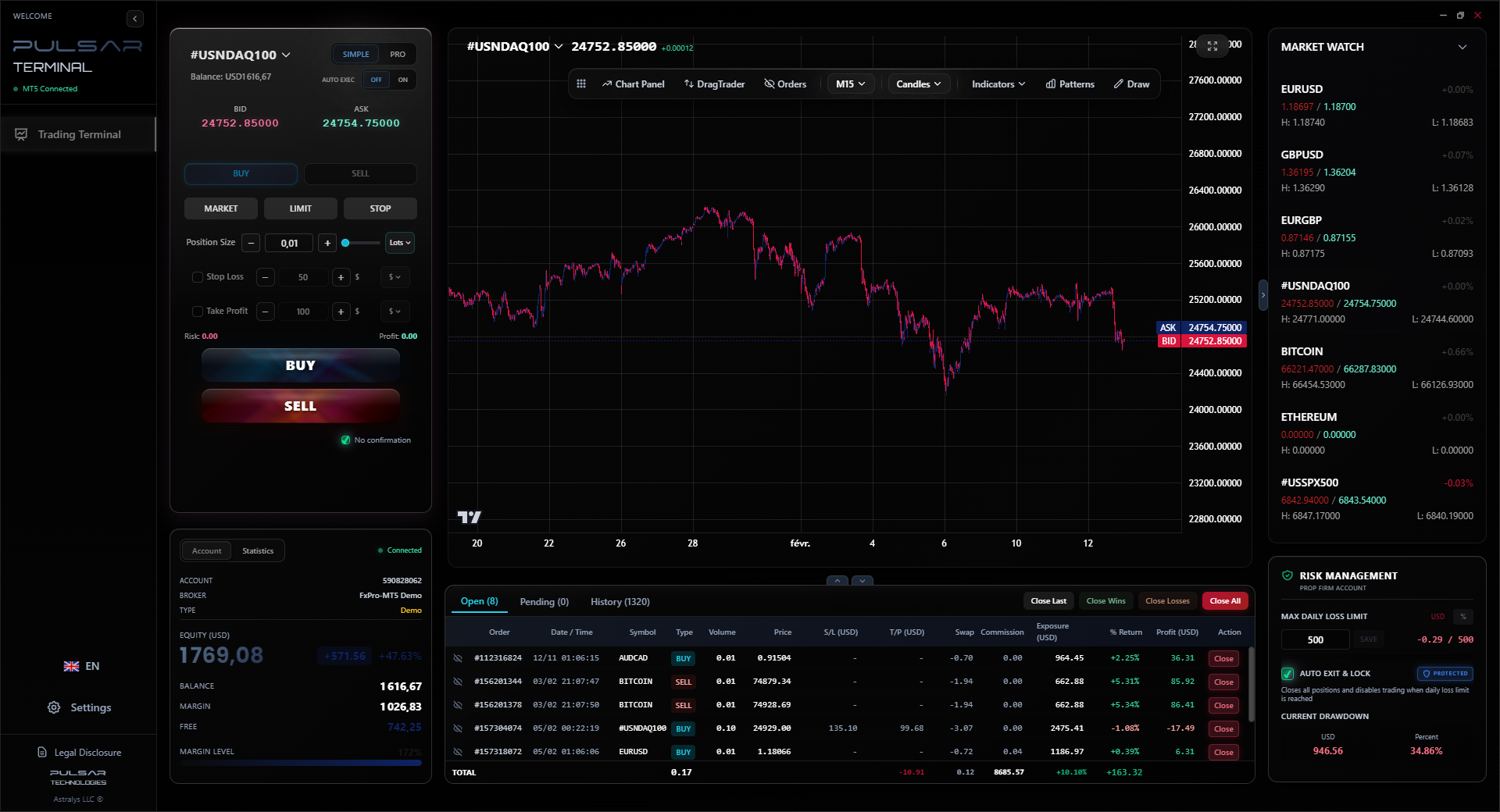
Managing multiple profit targets and trailing stops on a neckline breakout is complex, but Pulsar Terminal automates it all directly within your MT5 platform.
Pulsar Terminal
The all-in-one MT5 companion: drag-and-drop orders, multi-TP/SL, trailing stop, grid trading, Volume Profile, and prop firm protection. Used by 1,000+ traders daily.
“A neckline break on low volume is a trap. It lacks conviction.”
Trading neckline patterns here isn't just about charts. You've got practical realities to manage.
Regulation & Safety: Always, and I mean always, check your broker is FSCA regulated. That FSP number is your first line of defence for fund security. It also means you're protected by the 30:1 use cap, which honestly saved my account in the early days from my own overconfidence.
Tax (The SARS Question): This is crucial. SARS views your trading profits as income, not capital gains. You're taxed at your marginal income tax rate. That means you need to keep impeccable records: every trade statement, every deposit and withdrawal. A profitable neckline trade isn't truly profitable until you've accounted for tax. I use a simple spreadsheet logging date, pair, P/L in USD, and the ZAR conversion rate at the time of the trade.
Choosing a Broker: You need a broker that offers MT4/MT5 (where you'll be drawing all these necklines) with stable ZAR deposits/withdrawals. Consider:
| Broker | Key Feature for SA Traders | Minimum Deposit |
|---|---|---|
| Khwezi Trade | Local FSCA reg, ZAR accounts | 500 ZAR |
| XM | Low $5 min deposit, ZAR accounts | $5 |
| Exness | Tight spreads, popular locally | $10 |
| Tickmill | Low raw spreads, FSCA regulated | $100 |
Do your own research on our detailed Exness review and XM review pages. Look for low spreads on the pairs you trade, because a 5-pip spread on USD/ZAR eats directly into your profit target from the measured move.
“Your stop loss belongs above the right shoulder, not the neckline. A common retest will wipe you out.”
Here’s the condensed checklist I run through before taking any neckline trade:
- Trend: Is the pattern forming at the end of a clear prior trend? (Yes/No)
- Pattern Shape: Are the shoulders roughly symmetrical? Is the head clearly the highest/lowest point? (Yes/No)
- Neckline: Can I draw a clear line connecting at least two reaction points? (Yes/No)
- Volume: Did volume decline on the head/right shoulder and expand on the break? (Yes/No/Partial)
- Break: Did price close decisively beyond the neckline on my chosen timeframe? (Yes/No)
- Confluence: Is there support/resistance or indicator divergence agreeing? (Yes/No)
- Risk: Have I calculated my position size so my risk is 1-2% of my capital, with my stop placed above the right shoulder/below the right shoulder? (Yes/No)
If I get 6 or 7 'Yes' answers, I take the trade. 4 or 5, I might take a half-size position. Anything less, I ignore it and wait for the next setup. This discipline, built on understanding the neckline in forex, is what finally moved me from the 70% who lose to the 30% who have a chance.

Example: Capital: 50,000 ZAR. Risk per trade: 1% = 500 ZAR. USD/ZAR trade. Stop loss distance: 250 pips. Pip value for a standard lot: ~100 ZAR (varies). Position size = (500 ZAR risk) / (250 pips * ~10 ZAR per pip per mini lot) = ~0.2 mini lots. I'd trade 0.2 lots. Never just guess.
FAQ
Q1Is the neckline always a horizontal line?
No, not at all. This is a common misconception. A neckline can be ascending or descending. An ascending neckline in a head and shoulders top actually indicates underlying weakness, as each trough is higher. The key is that it connects the significant reaction lows (for a top) or highs (for a bottom).
Q2How do I handle a false break of the neckline?
False breaks (or 'stop hunts') happen. Your main defence is your stop loss placement. If you place it just above the neckline, a false break will take you out. By placing it above the right shoulder, you give the trade more room to breathe. If price breaks the neckline, retraces back above it, and then takes out your stop above the shoulder, the pattern is failed. Accept the loss and move on. Re-entering is dangerous.
Q3What's the best timeframe to trade neckline patterns?
They can work on any timeframe, but for reliability, I don't go below the 1-hour chart. The 4-hour and daily charts are my sweet spot, especially for swing trading. Patterns on lower timeframes like 15-minute are noise-prone and better suited for very experienced scalping where you're in and out quickly.
Q4Can I trade neckline patterns on Gold (XAU/USD)?
Q5As a South African, can I trade ZAR pairs like USD/ZAR with an international broker?
You can trade them as CFDs, which is what you're doing on most forex platforms. However, you generally cannot speculate on the ZAR for actual delivery - that requires a bank. For CFD trading on USD/ZAR, yes, most international brokers like Pepperstone or IC Markets offer it. Just ensure they are FSCA regulated for your protection.
Q6How important is volume in confirming a neckline break?
It's very important, but not always available in the forex spot market (which is decentralized). On MT4/MT5, the 'volume' is usually tick volume. An increase in tick volume on the break is a good secondary confirmation. If you're trading through a broker that provides actual volume data (like on futures), a clear volume spike adds significant credibility to the breakout.
Prof. Winston's Lesson
Key Takeaways:
- ✓Wait for the candle close below the neckline. Never enter on the approach.
- ✓Place your stop loss above the right shoulder, not the neckline.
- ✓The measured move target is a guide. Take partial profits there.
- ✓For ZAR pairs, use higher timeframes and wider stops.
- ✓Always confirm with volume or momentum divergence.
How useful was this article?
Click a star to rate
Weekly Trading Insights
Free weekly analysis & strategies. No spam.
About the Author
David van der Merwe
Emerging Markets Trader
Johannesburg-based trader with 11 years in emerging market currencies. Specializes in ZAR pairs, FSCA-regulated trading, and South African market analysis.
Comments
Risk Disclaimer
Trading financial instruments carries significant risk and may not be suitable for all investors. Past performance does not guarantee future results. This content is for educational purposes only and should not be considered investment advice. Always conduct your own research before trading.
You Might Also Like

Cara Trading Forex Sukses: 7 Prinsip dari Trader Profesional
Cara trading forex sukses dengan 7 prinsip trader pro: manajemen modal, disiplin, journal trading, backtest. Data nyata, bukan janji profit palsu.
Jam Trading Forex Terbaik untuk Trader Indonesia: Panduan Lengkap dengan Tabel Waktu
Panduan jam trading forex untuk trader Indonesia. Tabel 4 sesi dunia, jam emas 20:00-00:00, sesi mana yang harus dihindari. Data akurat + tips dari trader berpengalaman.
Top 5 Sàn Forex Uy Tín Nhất 2026: Review Jujur dari Trader Indonesia
Top 5 sàn forex uy tín 2026 untuk trader Indonesia. Review jujur: spread, deposit, withdraw, dukungan lokal. Exness, XM, IC Markets & lebih.
Get Pulsar Terminal
All these calculators are built into Pulsar Terminal with real-time data from your MT5 account. One-click position sizing, automatic risk management, and instant calculations.
Get Pulsar Terminal