


So you're looking at the Nedbank forex trading platform, wondering if it's the right way to get into the markets? Let's clear this up right away.

David van der Merwe
Emerging Markets Trader ·  South Africa
☕ 12 min read
What you'll learn:
- 1What Nedbank Actually Offers (It's Not MT5)
- 2The Real Cost: Nedbank's Fees & Spreads
- 3SA Regulations: Your Annual Allowances & FSCA Safety
- 4Nedbank vs. Real Forex Brokers: A Side-by-Side Look
- 5When It *Does* Make Sense to Use Nedbank Forex
- 6Where to Go for Real Trading in South Africa
- 7Common Pitfalls & How to Dodge Them
- 8Final Verdict & Your Next Steps
So you're looking at the Nedbank forex trading platform, wondering if it's the right way to get into the markets? Let's clear this up right away. Nedbank doesn't offer a speculative retail trading platform like MetaTrader where you can click to buy and sell EUR/USD for a quick profit. What they offer are essential banking services: international payments, foreign currency accounts, and hedging tools for businesses. It's a crucial distinction, and confusing the two can cost you a lot in unnecessary fees. I'll walk you through exactly what Nedbank provides, what it costs, the regulations you need to know, and where you should actually go if you want to trade forex actively.
If you're picturing charts, indicators, and one-click orders, you need to reset that expectation. Nedbank's 'forex' services are built for moving money and managing currency risk, not for speculative day trading. Their digital platforms (Online Banking and the Money App) are where you handle these services.
Their core offerings are about access and protection:
Foreign Currency Accounts (FCAs): You can hold money in currencies like USD, GBP, or EUR. This is useful if you receive income from abroad or are saving for an international expense. The rates aren't great for converting in and out frequently, but it's a safe place to park foreign cash. As of late 2023, you could earn a bit of interest too - around 3.20% on USD, which is better than nothing.
International Transfers & Travel Money: This is their main retail forex function. You can order foreign cash, get a travel card, or send money overseas. It's convenient, but as we'll see in the fees section, that convenience has a price tag.
Corporate & Hedging Tools: For businesses, Nedbank provides Forward Exchange Contracts (FECs) and access to trade Currency Futures on the JSE. These are legitimate tools for locking in an exchange rate for a future date, eliminating the risk of the rand moving against you. This is serious finance, not for dabbling.

Warning: Don't use Nedbank's travel card or spot currency buy/sell for trying to 'trade' by guessing rate movements. The spreads (the difference between buy and sell price) are massive compared to a real broker. You'll be fighting an uphill battle from the start.
The bottom line? Nedbank is your bank for forex services. It is not your broker for forex trading. For that, you need to look at FSCA-regulated entities like Exness, IC Markets, or Pepperstone which offer the actual trading platforms.
This is where the rubber meets the road. Nedbank's pricing is structured for occasional use, not frequent trading. If you treat it like a trading platform, the costs will eat you alive. Here are the numbers you must know, effective from January 2025.
For Buying Foreign Currency (Travel/Trips)
- Commission: 2.15% (minimum R135).
- For Physical Cash Notes: 2.60% (minimum R145).
- On a R20,000 currency purchase for a holiday, that's a R430 fee right off the top, before any exchange rate margin.
For International Money Transfers
This is a fee layer cake. Sending R50,000 abroad online could easily cost you:
- Commission: 0.66% (R330, but minimum is R179.01).
- SWIFT Fee: R125 flat.
- Exchange Rate Margin: This is the hidden killer. Nedbank adds a margin to the interbank rate - around 2.5% for major currencies (USD, EUR, GBP) and potentially over 5% for others. On R50,000, a 2.5% margin is another R1,250.
- Correspondent Bank Fee: Can be R150 to R1,500, deducted from the amount your recipient gets.
Total estimated cost on R50,000? Around R1,554 to R2,000+. That's a 3-4% haircut before your money even arrives.

Example: I needed to send $3,000 to a supplier once. Using my bank (similar to Nedbank's structure), the total fees and poor rate cost me about R1,800. The next time, I used a specialist international payment provider with a better rate and lower fee. The cost was R700. Lesson learned the hard way.
The 'Spread' Compared to Real Trading
On a real forex trading platform, the spread on EUR/USD might be 0.6 pips (0.00006). On a R1,000,000 notional position, that's a cost of about R120. Nedbank's effective spread via its exchange rate margin is 2.5% or 25,000 pips on the same amount - a cost of R25,000. The difference is staggering. It makes active trading through them completely non-viable.

💡 Winston's Tip
A bank's exchange rate margin is the silent fee. If they quote you a rate, go to XE.com and check the mid-market rate. The difference is your real cost, often 2-3%. That's not a trading spread; it's a toll.
“Nedbank is your bank for forex services. It is not your broker for forex trading.”
Trading or moving money internationally in South Africa isn't a free-for-all. You operate within a framework designed by the SARB and overseen by the Financial Sector Conduct Authority (FSCA). Ignoring these can get your accounts frozen.
The FSCA is Your Protector: Any company offering discretionary forex trading advice or execution to you must be licensed by the FSCA as a Financial Services Provider (FSP). This is non-negotiable. Always check the FSP number on their website. This is why I only consider brokers like XM or IC Markets that hold this license for South African clients - it's your first line of defence against scams.
Your SARB Allowances (The Big Two):
- Single Discretionary Allowance (SDA): R1 million per calendar year. You can use this for most legal purposes abroad (travel, gifts, online subscriptions) without tax clearance. You just declare it.
- Foreign Investment Allowance (FIA): R10 million per calendar year. This is for investing offshore - like funding an international brokerage account to trade global markets. You must get a Tax Compliance Status (TCS) PIN from SARS first.
I use my SDA for travel money and smaller international payments. For funding my main trading account with an international broker, I use the FIA. It's a bit of paperwork, but it's completely above board and protects you from future headaches with SARS.
A Personal Mistake: Early on, I didn't keep clear records of my FIA transfers. When SARS asked questions years later, it was a nightmare to reconstruct. Now, I save every TCS PIN, SWIFT confirmation, and broker statement in a dedicated folder. Boring, but essential.
Let's make this crystal clear. Here’s how Nedbank’s service stack compares to a dedicated retail forex broker.
| Feature | Nedbank Forex Services | FSCA-Regulated Forex Broker (e.g., Pepperstone, IC Markets) |
|---|---|---|
| Primary Purpose | International Payments, Hedging, Currency Holding | Speculative Trading for Profit |
| Platform | Online Banking / Money App | MetaTrader 4/5, cTrader, Proprietary Platforms |
| Typical Spread on EUR/USD | ~2.5% (25,000 pips equivalent) | 0.1 - 1.5 pips |
| Commission | Percentage-based fees (0.66%+) + fixed fees | Often zero commission on raw spread accounts, or low $ per lot |
| use | Not applicable for services | Offered (e.g., 1:30 for retail under FSCA rules) |
| Charts & Analysis | Basic rate charts | Full suite: multiple timeframes, dozens of indicators like RSI and MACD, drawing tools. |
| Order Types | Simple buy/sell at current rate | Market, Limit, Stop, Trailing Stop, OCO (One-Cancels-Other) |
| Best For... | Sending money abroad, holding forex, business hedging. | Active scalping, swing trading, technical analysis. |
Think of it this way: Nedbank is like a currency exchange bureau at the airport - essential for a specific need, but you'd never day trade there. A forex broker is the professional trading floor.
If your goal is to analyse a chart, place a stop-loss, and try to profit from price movements, you need the right tool for the job. That means an FSCA-regulated broker with a proper platform. Trying to 'trade' through Nedbank is like trying to win Formula 1 with a family sedan.
💡 Winston's Tip
Your R1m SDA is perfect for funding a local SA broker. Your R10m FIA is your key to global markets. Use them strategically. Mixing them up or forgetting the paperwork invites scrutiny nobody needs.
“Trying to 'trade' through Nedbank is like trying to win Formula 1 with a family sedan.”
I'm not saying avoid Nedbank entirely. For specific, non-trading needs, it's a logical and safe choice. Here’s when I use my bank’s forex services:
- Funding Your Local Broker Account: Most SA brokers need ZAR deposits. You’ll use Nedbank's EFT service to send Rands to the broker's local trust account. This is simple and usually free.
- Withdrawing Profits: When you withdraw profits from your SA broker, the Rands land back in your Nedbank account. Easy.
- Hedging a Known Future Expense: This is a pro move. Let's say you're a freelancer and you know you'll need to pay $5,000 for software in 6 months. You're worried the Rand will weaken. You could use a Nedbank Forward Exchange Contract (FEC) to lock in today's rate for that future date. It's insurance, not speculation.
- Convenience for Travel: Loading a travel card or ordering a small amount of cash for a trip is fine. You pay for the convenience, but for R5,000-R10,000, the absolute fee is acceptable for the peace of mind.

Pro Tip: For larger international payments (like funding an international broker account via your R10m FIA), shop around. Compare Nedbank's total cost (fee + rate) against specialists like Standard Bank's Shyft, Investec, or global services like Wise. The difference on R500,000 can be thousands of Rands.
The key is intentionality. Use Nedbank for banking. Use a broker for trading. Don't mix the two objectives.
Alright, so if Nedbank isn't for trading, what is? Your path is straightforward: find a reputable, FSCA-licensed broker that offers the tools you need.
Step 1: Choose Your Broker. Look for brokers that are transparent about their FSCA license. I have experience with a few:
- IC Markets: My go-to for raw spreads and the cTrader platform. Their execution is fantastic for scalping.
- Pepperstone: Excellent all-rounder, great customer service, and strong on MetaTrader.
- Exness: Known for flexible account types and very accessible for smaller deposits.
Do your own due diligence. Read our detailed IC Markets review and others to compare.
Step 2: Fund Your Account. Use your Nedbank account to EFT ZAR to your chosen broker's South African trust account. This is usually free and takes a day. If you're using your R10m FIA to fund an international entity, you'll do an international SWIFT transfer (and now you understand those fees!).
Step 3: Choose Your Platform & Strategy. This is where the fun begins. Most brokers offer MetaTrader 4 or 5 (MT4/MT5). MT5 is more powerful. Don't just jump in. Have a plan. Will you be a swing trader holding for days? Or a day trader? Your strategy dictates your broker choice, your position size, and your risk management.
A Trade Example: Last year on IC Markets, I went long on XAU/USD (Gold) at $1815. My analysis (using tools beyond basic MT5) showed a strong support zone. I used a tight stop-loss at $1809 and a take-profit at $1835. The spread was about 30 cents. The trade ran in my favour for two days and hit TP. A R20,000 margin commitment netted a R2,800 profit after spreads. That granular control - the specific entry, the tight stop - is impossible on a bank platform.
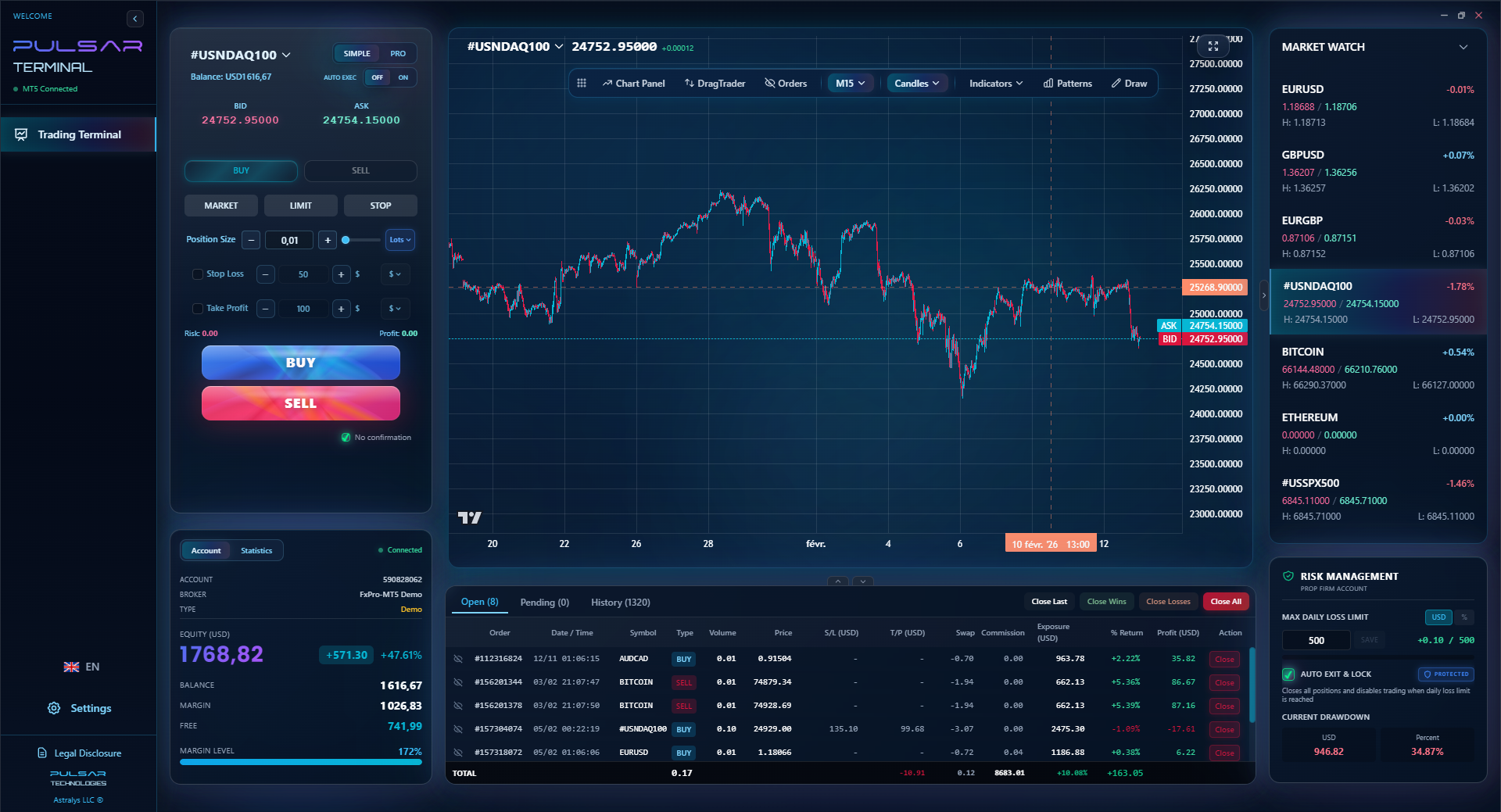
Once you're on a real platform like MT5, tools like Pulsar Terminal supercharge it with drag-and-drop orders and automated risk management, turning a basic chart into a professional cockpit.
Pulsar Terminal
The all-in-one MT5 companion: drag-and-drop orders, multi-TP/SL, trailing stop, grid trading, Volume Profile, and prop firm protection. Used by 1,000+ traders daily.
“The buy/sell spread on a bank's currency service can be 25,000 pips. On a real broker, it's often less than 1.”
I've seen these mistakes cost traders, especially when they're confused about platforms like Nedbank's.
Pitfall 1: Using Travel Cards as a 'Trade'. You think the Rand is going to weaken, so you load USD onto your Nedbank travel card, hoping to convert it back later for a profit. The problem? The buy/sell spread is so wide (that 2.5%+ margin each way) that the Rand needs to move over 5% just for you to break even. It's a terrible 'trade'.
Pitfall 2: Ignoring the Total Cost of Transfers. People see the 0.66% commission and think it's cheap. They forget the SWIFT fee and, most importantly, the massive exchange rate margin. Always ask for the final amount in the foreign currency that will be delivered, and work out the total cost percentage.
Pitfall 3: Trading Without Understanding use & Margin. When you move to a real broker, you get access to use. This amplifies both gains and losses. I learned this painfully early. I put R10,000 in an account, used 1:50 use, and effectively controlled R500,000. A 2% move against me (which happens fast) wiped my entire deposit - a margin call. Now, I rarely use more than 1:10, and I always use a stop-loss. A position size calculator is your best friend.
Pitfall 4: Not Keeping SARS/SARB Paperwork. When you use your R10m FIA, keep that TCS PIN forever. When you withdraw profits from international trading, you may need to prove the original capital outflow was legal. Disorganized records lead to tax audits and potential penalties.
💡 Winston's Tip
The moment you think, 'I'll just use my travel card to bet on the Rand,' you've already lost. You're playing a game where the house edge is 5% from the start. Casinos offer better odds.
Let's be blunt: the Nedbank forex trading platform, as a concept for active speculation, doesn't exist. What exists is a suite of banking forex services that are expensive for trading but necessary for certain financial tasks.
Verdict: Use Nedbank for what it's good at: as your home-base ZAR bank account, for convenient travel money, and for executing approved international transfers under your SARB allowances. It's part of your financial infrastructure.
For trading, step into the dedicated arena. Open an account with an FSCA-regulated broker. Start with a demo account. Learn what a pip really costs, how the spread affects you, and practice risk management without real money.
Your action plan:
- Define Your Goal: Am I making an international payment, or am I trying to profit from market movements?
- If Trading: Research FSCA brokers, open a demo, and learn one platform (MT5 is a great start).
- Understand the Costs: Know the all-in cost of every transaction, whether it's a bank transfer or a forex trade.
- Respect the Regulations: Know your SDA and FIA limits, and keep every piece of documentation.
The world of forex is vast and accessible from South Africa. You just need to start in the right place. Nedbank is the on-ramp for your money. A real trading platform is the highway.
FAQ
Q1Can I trade forex for profit on the Nedbank platform?
No, not in the way a retail trader thinks of it. Nedbank does not offer a speculative trading platform with live charts, use, and instant order execution. Their services are for currency exchange, international payments, and hedging, which carry costs (spreads and fees) far too high to make short-term trading profitable.
Q2What is the difference between a Nedbank FCA and a forex trading account?
A Nedbank Foreign Currency Account (FCA) is a savings-style account to hold a foreign currency. A forex trading account with a broker is a margin account used to speculate on currency price movements. The FCA is for storage with minimal interest; the trading account is for active buying and selling with tools for analysis and risk management.
Q3How much does it cost to send money overseas with Nedbank?
Costs are layered. You typically pay a commission (0.66%, min ~R179), a SWIFT fee (R125), and an exchange rate margin (~2.5%+). On a R100,000 transfer, total costs can easily exceed R3,000. Always ask for the final delivered amount to calculate the true percentage cost.
Q4Is Nedbank regulated by the FSCA for forex trading?
Nedbank as a bank is regulated by various authorities, but its forex services (payments, accounts) are not licensed for discretionary speculative trading under the FSCA's FSP regime. For active forex trading, you must use an entity that holds a specific FSCA FSP license for such services.
Q5Can I use my Nedbank account to fund a real forex broker?
Yes, absolutely. For South African-based brokers, you use a normal EFT from your Nedbank account to the broker's local trust account. To fund an international broker, you would use your Foreign Investment Allowance (R10m per year) and make an international SWIFT transfer from your Nedbank account.
Q6What are better alternatives to Nedbank for currency exchange?
For international payments, compare rates and fees on specialist platforms like Wise, Standard Bank Shyft, or Investec Global. For actual forex trading, your alternatives are FSCA-licensed brokers such as IC Markets, Pepperstone, or Exness, which offer professional trading platforms like MetaTrader.
Prof. Winston's Lesson
Key Takeaways:
- ✓Nedbank's forex costs are 2.5%+ per transaction.
- ✓Use your R1m SDA for travel and local broker funding.
- ✓Use your R10m FIA for global trading accounts.
- ✓Real trading spreads are under 1 pip, not 25,000.
How useful was this article?
Click a star to rate
Weekly Trading Insights
Free weekly analysis & strategies. No spam.
About the Author
David van der Merwe
Emerging Markets Trader
Johannesburg-based trader with 11 years in emerging market currencies. Specializes in ZAR pairs, FSCA-regulated trading, and South African market analysis.
Comments
Risk Disclaimer
Trading financial instruments carries significant risk and may not be suitable for all investors. Past performance does not guarantee future results. This content is for educational purposes only and should not be considered investment advice. Always conduct your own research before trading.
You Might Also Like

Cara Trading Forex Sukses: 7 Prinsip dari Trader Profesional
Cara trading forex sukses dengan 7 prinsip trader pro: manajemen modal, disiplin, journal trading, backtest. Data nyata, bukan janji profit palsu.
Jam Trading Forex Terbaik untuk Trader Indonesia: Panduan Lengkap dengan Tabel Waktu
Panduan jam trading forex untuk trader Indonesia. Tabel 4 sesi dunia, jam emas 20:00-00:00, sesi mana yang harus dihindari. Data akurat + tips dari trader berpengalaman.
Top 5 Sàn Forex Uy Tín Nhất 2026: Review Jujur dari Trader Indonesia
Top 5 sàn forex uy tín 2026 untuk trader Indonesia. Review jujur: spread, deposit, withdraw, dukungan lokal. Exness, XM, IC Markets & lebih.
Get Pulsar Terminal
All these calculators are built into Pulsar Terminal with real-time data from your MT5 account. One-click position sizing, automatic risk management, and instant calculations.
Get Pulsar Terminal