


For years, trading the Nigerian Naira was a wild gamble, not an investment.

Olumide Adeyemi
West African Trading Pioneer ·  Nigeria
☕ 10 min read
What you'll learn:

For years, trading the Nigerian Naira was a wild gamble, not an investment. The massive gap between official and black-market rates made a mockery of price discovery. But I'll say this straight: the reforms since 2024 are the most serious attempt to fix this mess in over a decade. It's not perfect, but the nigerian naira forex market improvement is real and creating opportunities we haven't seen before. Let me walk you through what changed, how it affects your trading, and where the traps still are.
To understand why the current nigerian naira forex market improvement matters, you need to know what we dealt with. Before 2024, Nigeria had a classic multiple exchange rate system. The CBN had an official rate (around ₦460/$1 for ages), the NAFEX/I&E window for investors, and the roaring parallel market (the 'black market'). The gap was insane - sometimes over 60%. This wasn't just a spread; it was a canyon.
As a trader, this created a perverse incentive. The real trade wasn't on charts; it was in sourcing currency. I knew guys who made fortunes simply buying dollars at the official rate from connected banks and selling them on the street. That's not trading; that's arbitrage fueled by dysfunction. It killed confidence. No serious foreign investor would touch Nigerian assets when they couldn't get their money out at a predictable rate. The spread definition in the official market was meaningless because the real price was somewhere else entirely.
I learned this the hard way in early 2023. I tried to structure a longer-term swing trading idea based on Naira bonds, betting on yields. The theory was solid. The reality? By the time I wanted to exit, the liquidity at the I&E window had dried up, and the effective exit rate was 25% worse than my model assumed. I took a loss not on the trade's merit, but on market structure failure. That experience taught me more about systemic risk than any textbook ever could.

“The Naira has graduated from being an un-tradeable paradox to a volatile, but analyzable, emerging market currency.”
So what did the CBN actually do? They didn't tinker; they went for a full overhaul. The goal was clear: unify rates, boost transparency, and attract foreign money back.
Unifying the Windows
The big one. Starting mid-2024, they began collapsing the official, I&E, and parallel rates into one market-driven rate under the Nigerian Autonomous Foreign Exchange Market (NAFEM). By early 2025, this was largely the reference point. Letting the rate float was painful at first - the Naira sank to around ₦1,600/$1 in April 2025 - but it was necessary medicine. A single price means price discovery actually works.
The Electronic System (EFEMS)
Introduced in October 2024, this is the backbone. All licensed transactions (banks, BDCs) now go through this electronic matching platform. Every trade is timestamped and reported. This kills a lot of the shady, off-book deals that distorted the old system. Transparency isn't a buzzword here; it's a forced protocol.
Bringing Back the BDCs (The Right Way)
This February 2026 move was clever. After banning them in 2021, the CBN re-admitted Bureau de Change operators but with handcuffs. They can buy up to $150k weekly from banks at the market rate, but they must sell it within 24 hours. No hoarding. Plus, 75% of the settlement must be digital, not cash. This funnels street demand into the official system, narrowing the parallel market gap for good.

Warning: Don't confuse rate stability with low volatility. A unified, transparent market can still be volatile based on oil prices, politics, or global risk sentiment. The improvement is in predictability, not the absence of movement.
The numbers tell the story. The gap between official and parallel rates collapsed from over 60% to under 2% by late 2025. That's a monumental shift. For the first time in 13 years, the Naira ended 2025 with an annual gain, closing at ₦1,429/$1.

💡 Winston's Tip
In a newly reformed market, the first rally often fails. Wait for the first major pullback and a higher low to confirm the new trend is durable. Patience pays more than being first.
“The gap between official and parallel rates collapsed from over 60% to under 2%. That's a monumental shift.”
All these stats about reserves and GDP are nice, but what does it mean for your screen? Let's translate.
Liquidity is Better, But Not Perfect: With reserves climbing from $33bn to over $50bn by early 2026, the CBN has more firepower to smooth out wild swings. This reduces the risk of a sudden, gap-down move that blows through your stop loss before you can blink. However, liquidity isn't like the EUR/USD guide. You can't throw $50 million at the market without moving the price. It's improving, but it's still an emerging market currency.
Volatility Has Changed Shape: Look at the path: ₦1,600 (Apr '25) to ₦1,429 (Dec '25) to ₦1,380 (Apr '26). That's a 14% appreciation from the low, but with pullbacks. The wild, one-way collapses are less likely. Now, it's more about trading ranges and reacting to data - like the CBN's interest rate decisions (they cut from 27.5% to 26.5% in early '26 as inflation fell). This suits a different style. The manic, panic-driven moves might be giving way to more technical trading.
A Real Example From My Book: In Q4 2025, with the Naira at ₦1,500, I saw a classic bullish divergence on the weekly RSI indicator while inflation data came in cooler than expected. I went long, targeting a move back to ₦1,400. My entry was ₦1,502, stop at ₦1,550. The key? I used a ridiculously small position - 0.5% of my risk capital - because while the setup was good, the market's depth was still an unknown. It worked, hitting ₦1,425 five weeks later. The profit was decent, but the real win was executing a plan in a market that previously wouldn't allow for one.

Example: Let's talk risk. If you risk 1% of a $10,000 account ($100) on a long Naira trade at ₦1,380 with a stop at ₦1,420, your position size is calculated as: $100 / (₦1,420 - ₦1,380) = $100 / 40 = $2.5. So you'd buy $2.5 worth of the USD/NGN pair (which means selling dollars, buying Naira). Always use a position size calculator.
“The gap between official and parallel rates collapsed from over 60% to under 2%. That's a monumental shift.”
The improved structure opens doors, but the house still has some shaky foundations.
The Opportunities:
- Trend Following: For the first time, you can realistically trade Naira trends without a structural disconnect invalidating your analysis. The 2025 appreciation was a tradable macro trend.
- Carry Trade Potential: With CBN rates still high (26.5% as of Feb '26) and inflation falling, the positive real interest rate could attract yield-seeking capital. This is a slow, fundamental play, but it's now on the table.
- Corporate Hedging Flow: As real businesses use the unified market to hedge imports/exports, their flow adds predictable volume and creates technical levels.
The Persistent Risks:
- Political Will: This whole project depends on the government staying the course. An election cycle or a sharp drop in oil prices could tempt them back to old habits of fixing or manipulating the rate.
- External Shocks: Nigeria's reserves look healthier, but they're still largely oil-backed. A global recession hitting oil demand? That's an instant test.
- Market Depth: Yes, it's better. But during times of global stress (like a strong USD bull run), liquidity can still evaporate faster than in major pairs. This amplifies moves against you.
I made a mistake in early 2024, just as reforms were announced. I assumed 'unification' meant 'instant stability.' I went long the Naira too early, too big, and got caught in the inevitable volatility as the currency found its new, weaker equilibrium. I ignored the market's need to price in pent-up devaluation pressure. The lesson? Structural reforms create a new trading environment, but they don't suspend the laws of price action. You still need confirmation.
💡 Winston's Tip
When trading a market known for gaps, never place your stop loss at a round number. Place it a few pips beyond a clear technical swing point where others are likely not clustered.

“I took a loss not on the trade's merit, but on market structure failure.”
Okay, so you want to put this nigerian naira forex market improvement to work. Here's a pragmatic approach.
1. Choose Your Instrument Carefully: Most international traders access the Naira via the USD/NGN pair. You'll find it at brokers with good EM coverage like IC Markets review or Exness review. Check their spreads and liquidity provisions. It won't be as tight as majors.
2. Frame Your Analysis:
- Macro is King: Your primary dashboard is oil prices, CBN meeting dates, inflation reports (now trending down from 32% to 15%), and monthly external reserve figures.
- Technicals Support: Use longer timeframes. Daily and weekly charts to identify the broader trend established by these macro flows. The 2025 low of ~₦1,600 and the 2026 high (so far) near ₦1,380 are key zones.
3. Risk Management is Non-Negotiable:
- Wider Stops: Expect more noise. A 2% daily move is still possible. Place stops based on support/resistance, not arbitrary pip counts.
- Smaller Size: Treat USD/NGN as a high-volatility exotic. Reduce your standard position size by at least 50% compared to your usual major forex trade.
- Beware of Gaps: While reduced, liquidity gaps can still happen over weekends if big news breaks. Avoid holding overly large positions into major political announcements.
4. A Simple Strategy Framework: Look for confluence. Is oil rallying (bullish for Naira)? Is the CBN holding or raising rates (bullish)? Is the USD/NGN pair testing a major weekly support level with an oversold MACD indicator? That's a setup worth a small, calculated risk. This isn't for scalping strategy. This is swing trading macro shifts.

Pro Tip: Follow the data. The single most important sign of sustained health is the continued narrowing of the parallel market premium. If it starts creeping back above 5%, it's a red flag that the reforms are cracking. Let that be your canary in the coal mine.

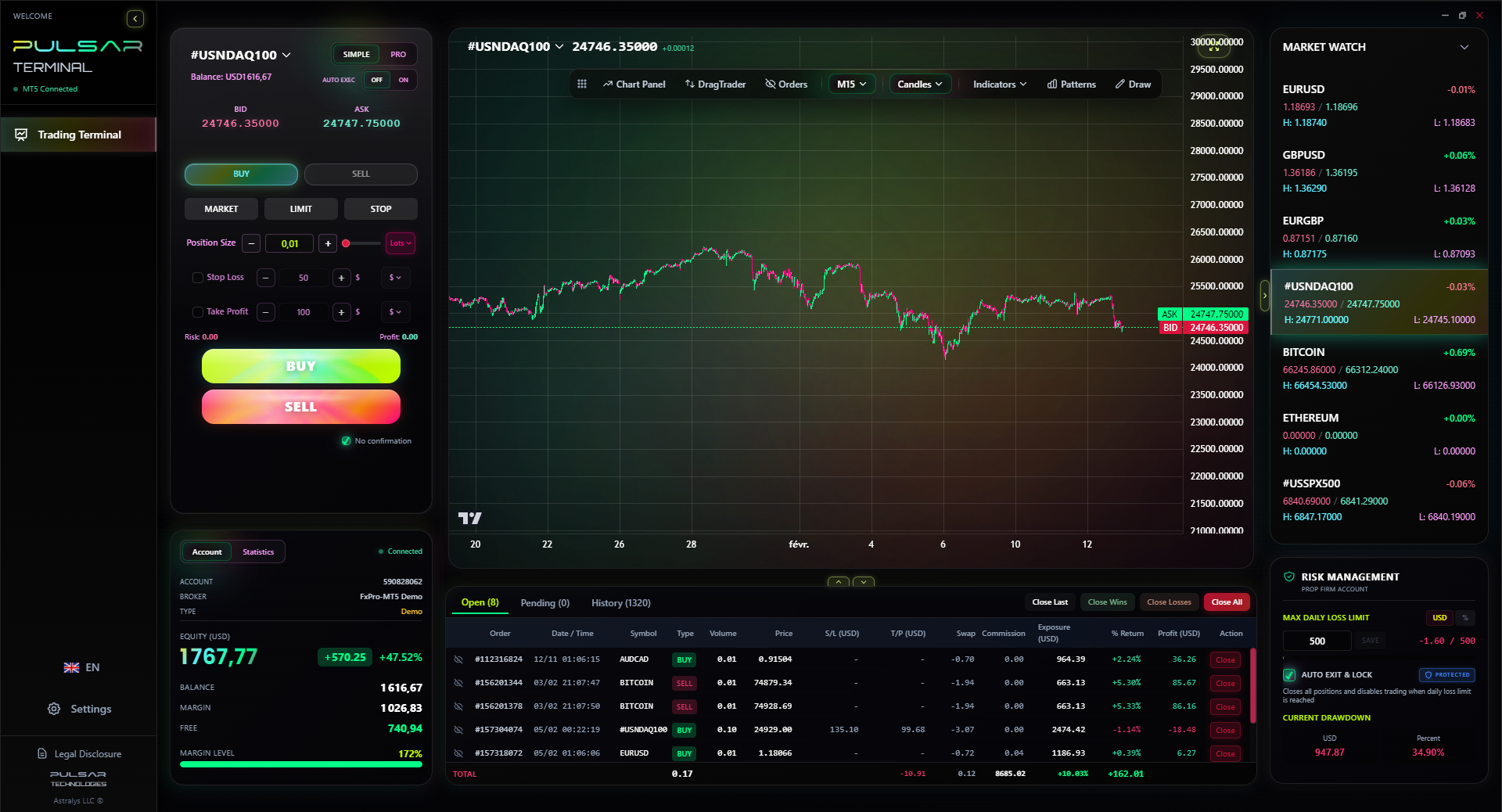
Managing complex trades in a volatile market like USD/NGN is easier with tools that let you set multiple take-profit levels and move stops to breakeven automatically, features built into Pulsar Terminal.
Pulsar Terminal
The all-in-one MT5 companion: drag-and-drop orders, multi-TP/SL, trailing stop, grid trading, Volume Profile, and prop firm protection. Used by 1,000+ traders daily.
“I took a loss not on the trade's merit, but on market structure failure.”
For traders based in Nigeria itself, this change is even more profound.
The nightmare of trying to fund an international broker with a black-market rate that bore no relation to your local bank's rate is fading. With unified rates, the cost of acquiring dollars for margin is clearer. The re-admission of BDCs under strict rules means there's a more legal, traceable channel for genuine trading capital movement.
However, the fundamental challenges remain. Local brokers offering CFD trading on these pairs are rare and often have prohibitive conditions. Most serious Nigerian traders I know still use international brokers. The key now is that your local Naira has a more stable, transparent relationship with the dollar you need for margin. It reduces one layer of financial uncertainty.
You still must navigate the broader regulatory environment. But the existential currency risk - the risk that the market you're trading in doesn't functionally exist - has been greatly reduced. That's the core of the nigerian naira forex market improvement. It allows you to focus on trading the currency's value, not gaming a broken system.
💡 Winston's Tip
Your position size in a market like this should be determined by the distance to your stop, not your account size alone. If you need a 500-pip stop for sanity, your lot size must be tiny.
“Transparency isn't a buzzword here; it's a forced protocol.”
So, is it fixed? It's being fixed. The 2024-2026 reforms have put the Nigerian forex market on a credible path for the first time in years.
The real test is sustainability. Can this system survive the next oil price crash? Can it hold through political pressure? The CBN has shown discipline by starting to cut rates (to 26.5% in Feb '26) only as inflation convincingly fell, rather than panicking. That's a good sign.
For us traders, the implication is clear. The Naira has graduated from being an un-tradeable paradox to a volatile, but analyzable, emerging market currency. The opportunities for informed, risk-aware traders are genuine. The days of easy arbitrage are over, but the days of technical and fundamental analysis actually meaning something have begun.
My final thought? Watch the convergence. If that parallel market gap stays within 2-3%, and reserves hold above $45 billion, then this isn't a temporary fix. It's a new market. And in this new market, the old rules of chaos no longer apply. You need new rules, tighter discipline, and a healthy respect for what's been built - and what could still go wrong. Don't get complacent. The margin call doesn't care about historic reforms.

FAQ
Q1Can I actually trade the Nigerian Naira (USD/NGN) on major forex platforms?
Yes, but not all brokers offer it. You'll find USD/NGN at many international brokers that specialize in a wide range of instruments, particularly those with a strong presence in emerging markets. Always check the broker's instrument list first. The spreads will be wider than for major pairs like EUR/USD.
Q2What is the most important indicator to watch for the Naira's health now?
The single best indicator is the gap between the official NAFEM rate and the parallel ('black') market rate. The reforms aim to unify this. A gap under 5% shows the system is working. A widening gap is the first sign of stress and potential regression to old habits. Second to that are Nigeria's foreign exchange reserve levels.
Q3Has the volatility in USD/NGN decreased because of these reforms?
Not exactly. The nature of the volatility has changed. The extreme, one-way collapse moves driven by market fragmentation have reduced. However, the Naira can still be very volatile based on oil prices, CBN policy, and global dollar strength. It's now more of a 'normal' volatile currency, rather than a dysfunctional one.
Q4How do the new BDC rules help stabilize the Naira?
By bringing Bureau de Change operators back into the official market with strict rules (sell within 24 hours, mostly digital settlements), the CBN channels a huge portion of everyday retail and small business dollar demand through the transparent system. This pulls liquidity away from the black market, starving it and forcing its rate to converge with the official rate.
Q5As a Nigerian, is it easier to fund my international trading account now?
In theory, yes. With a more unified exchange rate, the cost of purchasing dollars for international transfers is clearer and less subject to wild arbitrage. The process itself (bank transfers, etc.) still has its hurdles, but the fundamental currency conversion is less of a unpredictable, loss-making step than it was before the reforms.
Q6What's the biggest risk to these market improvements?
Political will and external shocks. If the government faces pressure and reverts to artificially propping up the Naira with unsustainable measures, or if oil prices crash severely draining reserves, the entire reform structure could be tested. The market is healthier but not yet immune to major crises.
Prof. Winston's Lesson
Key Takeaways:
- ✓A unified exchange rate is the foundation of a tradeable currency.
- ✓Watch the parallel market gap: under 5% is healthy, over 10% is danger.
- ✓Reduce position size by 50% vs. major pairs for the Naira.
- ✓Macro factors (oil, CBN rates) drive 70% of the price action.
How useful was this article?
Click a star to rate
Weekly Trading Insights
Free weekly analysis & strategies. No spam.
About the Author
Olumide Adeyemi
West African Trading Pioneer
One of Nigeria's most active forex trading educators. 8 years of experience trading from Lagos. Specializes in low-capital strategies and prop firm challenges for African traders.
Comments
Risk Disclaimer
Trading financial instruments carries significant risk and may not be suitable for all investors. Past performance does not guarantee future results. This content is for educational purposes only and should not be considered investment advice. Always conduct your own research before trading.
You Might Also Like

Cara Trading Forex Sukses: 7 Prinsip dari Trader Profesional
Cara trading forex sukses dengan 7 prinsip trader pro: manajemen modal, disiplin, journal trading, backtest. Data nyata, bukan janji profit palsu.
Jam Trading Forex Terbaik untuk Trader Indonesia: Panduan Lengkap dengan Tabel Waktu
Panduan jam trading forex untuk trader Indonesia. Tabel 4 sesi dunia, jam emas 20:00-00:00, sesi mana yang harus dihindari. Data akurat + tips dari trader berpengalaman.
Top 5 Sàn Forex Uy Tín Nhất 2026: Review Jujur dari Trader Indonesia
Top 5 sàn forex uy tín 2026 untuk trader Indonesia. Review jujur: spread, deposit, withdraw, dukungan lokal. Exness, XM, IC Markets & lebih.
Get Pulsar Terminal
All these calculators are built into Pulsar Terminal with real-time data from your MT5 account. One-click position sizing, automatic risk management, and instant calculations.
Get Pulsar Terminal