


Let's get one thing straight right now.

Olumide Adeyemi
West African Trading Pioneer ·  Nigeria
☕ 10 min read
What you'll learn:
- 1What Exactly Is a No Deposit Bonus? (And Why It's a Trap)
- 2The Nigerian Reality: Regulations, Banks, and Finding Real Offers
- 3The Brutal Mathematics of Bonus Withdrawal
- 4Better Alternatives for Nigerian Traders (Forget the Bonus)
- 5A Step-by-Step Guide to Using a Bonus (If You Insist)
- 6Final Verdict: Is It Worth It for a Nigerian Trader?
Let's get one thing straight right now. That shiny 'no deposit bonus forex $100' ad you keep seeing? It's not free money. It's a marketing hook designed to get you in the door so you can lose your own cash faster. I've seen too many traders in Lagos and Abuja get excited, sign up, and then get absolutely wrecked by the fine print. They focus on the 'free' $100 and ignore the 30-page terms document that makes it nearly impossible to withdraw a single kobo. Today, I'm tearing down the fantasy and showing you the real game. We'll look at which brokers actually offer something usable, the brutal mathematics behind the withdrawal rules, and whether you should even bother.
A no deposit bonus is exactly what it sounds like: a broker gives you a small amount of trading capital - sometimes $10, $30, or the coveted $100 - without you needing to deposit your own money first. Sounds perfect for a beginner in Port Harcourt or Ibadan, right? Test the platform, maybe make a few bucks. Here's the catch: it's not a gift. It's a loan with strings attached so tight they could strangle an elephant.
The broker's goal isn't generosity. It's acquisition cost. Getting a new client through ads is expensive. Giving you $100 in virtual funds to play with is cheap if it gets you to sign up, experience the 'thrill' of a winning trade, and then deposit your own real money. The psychology is powerful. Once that bonus is in your account, you're emotionally invested. The entire structure is built to convert you into a depositing client.

Warning: The bonus money is almost always 'non-withdrawable'. You can trade with it, but you can't just withdraw it as cash. Your real mission is to generate enough profit from trading that bonus to meet the broker's withdrawal conditions. That's where they get you.
Let me give you a personal example from my early days. I took a $50 no-deposit bonus, got lucky on a GBP/USD trade, and turned it into $300 in the account. I felt like a king. Then I read the terms: to withdraw my $250 profit, I needed to trade a total volume of 5 standard lots (that's 500,000 units of currency). With my tiny profit margin, that meant I had to risk my entire profit over and over again, dozens of times. I blew the account on the 15th trade. The broker lost nothing; I lost my time and got a harsh lesson.
Trading from Nigeria adds extra layers of complexity that those bonus ads don't mention. First, the regulatory landscape. The Central Bank of Nigeria (CBN) doesn't really license international forex brokers for retail trading in the way the FCA does in the UK. Your protection comes from the broker's offshore regulator - think Cyprus (CySEC), Seychelles (FSA), or South Africa (FSCA). This means if there's a dispute over your bonus terms, you're dealing with a foreign entity. Good luck with that from Abuja.
Then there's funding. The CBN restricts using official forex channels for trading deposits. Many banks have also clamped down on Naira card transactions for international brokers. So, even if you want to deposit after trying the bonus, it can be a headache. You might need to use cryptocurrencies or specialized payment processors, which have their own fees.
So, do $100 no-deposit bonuses even exist here? Yes, but they're rare as hen's teeth. You're more likely to find offers in the $5 to $30 range. A true, no-strings-attached $100 bonus is virtually non-existent in 2024/2025. Any ad promising that is either a straight-up scam or has turnover requirements so high they're mathematically improbable to hit. Your first job is verification. Always check the broker's official website and read the promotion terms line by line. If it's not clearly written there, it's not real.
Broker Reputation is Everything
When chasing these bonuses, you must prioritize the broker's reputation over the bonus size. A $5 bonus from a well-regulated broker like Exness or XM (who do offer small no-deposit promotions occasionally) is infinitely more valuable than a '$100 bonus' from an unknown offshore bucket shop that will disappear with your eventual deposit. I'd take a trusted broker with a tiny bonus over a shady one with a big promise any day of the week.

💡 Winston's Tip
A broker's most generous gift is a stable platform and tight spreads, not a 'bonus' with a 50-page rulebook. Prioritize execution over entertainment.
“Your time is better spent mastering a demo account than decoding bonus withdrawal rules.”
This is where most traders fail. They see "Trade 1 lot to withdraw bonus profits." Sounds simple. It's not. Let's break down a typical, and actually somewhat reasonable, set of terms for a $30 no-deposit bonus.
- Bonus Amount: $30 (non-withdrawable)
- Withdrawal Condition: You must trade a volume of 20 lots before you can withdraw any profits earned from the bonus.
- Maximum Withdrawal: Often capped at a certain amount, say $500.
Now, let's do the math. One standard lot is 100,000 units. 20 lots is 2,000,000 units traded. If you're trading mini lots (0.1 lots), that's 200 trades. If your average profit per trade is a generous 10 pips, and you're trading EUR/USD where a pip on a mini lot is roughly $1, your profit per trade is about $10.
To generate just $200 in withdrawable profit, you'd need to execute 200 perfect trades without a single significant loss wiping out your bonus capital. The pressure to trade that volume forces overtrading, which leads to mistakes. The broker knows this. The terms are designed so that only a tiny fraction of users ever succeed. They're counting on you to either blow the bonus account or deposit your own money to try and meet the volume target.

Example: You get a $30 bonus. You trade well and grow it to $130. You have $100 in potential profit. To withdraw that $100, you must trade 20 lots. If your average trade size is 0.1 lots, you need 200 trades. The probability of executing 200 trades without a margin call on a $130 account is near zero for a retail trader.
The table below shows how volume requirements make success statistically unlikely:
| Bonus Amount | Required Turnover (Lots) | Avg. Trade Size | # of Trades Needed | Chance of Success (Est.) |
|---|---|---|---|---|
| $30 | 20 | 0.1 (Mini) | 200 | < 5% |
| $50 | 35 | 0.1 (Mini) | 350 | < 2% |
| $100 | 50 | 0.1 (Mini) | 500 | < 1% |
This is why I call it a trap. It warps your trading psychology from "let's learn" to "I must hit this volume target." That's a surefire path to losses.
If your goal is to start trading forex with minimal risk, chasing a no deposit bonus forex $100 is the wrong strategy. Here’s what you should do instead. It’s less sexy, but it actually works.
- Use a Proper Demo Account: Every reputable broker offers a full-featured demo account with virtual money. This is a true no-risk environment. You can test strategies, get used to the platform, and learn about position sizing without a single psychological trap. I spent my first six months on demo. It’s the most valuable ‘bonus’ there is.
- Start with a Cent Account: Brokers like XM and Exness offer cent accounts where 1 USD = 100 cents in the account. This means you can deposit $50 (5,000 cents) and trade micro lots where the financial risk per trade is literally cents. It’s real money, so you learn real psychology, but a total loss won’t break you. This is infinitely better than a bonus with crazy terms.
- Look for a First-Deposit Bonus: These are more common and often more reasonable. You deposit your own money (e.g., $200), and the broker adds a 50% bonus ($100). The key? Your deposit is yours and can be withdrawn (subject to normal processing). The bonus portion has turnover requirements, but you’re trading with a more realistic capital base. Always, always read the terms.
- Focus on Low Spreads, Not Bonuses: Your long-term cost is the spread. A broker offering a $30 bonus with a 3-pip spread on EUR/USD is costing you more per trade than a broker with a 0.1-pip spread and no bonus. Compare brokers like IC Markets and Pepperstone for their raw trading conditions.

Pro Tip: Allocate a tiny portion of your planned startup capital - say, $20 - to ‘bonus hunting’ for fun and education. Use the rest to fund a proper cent or micro account. This way, you experience the bonus game without relying on it.
💡 Winston's Tip
If you must play the bonus game, calculate the required turnover before your first trade. If it's more than 10 lots per $10 of bonus, walk away. The math is already against you.
“A $5 bonus from a reputable broker is worth more than a '$100 bonus' from a shadowy offshore outfit.”
Alright, I can see you're still tempted. Maybe you want to see the trap for yourself. Fine. If you're going to go for a no-deposit bonus, here’s how to do it with your eyes wide open. This is damage control.
Step 1: Find a Legitimate Offer. Go to the websites of known brokers in Nigeria. Don't Google "free $100 forex bonus Nigeria" - that's a one-way ticket to Scamville. Look in the 'Promotions' section of brokers like Exness, XM, or FBS. As of now, you might find offers like "$5 No Deposit Bonus" or "$30 Welcome Bonus." Document the exact terms URL.
Step 2: Dissect the Terms & Conditions. Print them out. Highlight these key points:
- Turnover Requirement (Most Important): How many lots must you trade?
- Time Limit: Do you have 30 days? 90 days?
- Maximum Withdrawal: Is your profit capped at 5x the bonus? 10x?
- Trading Restrictions: Are there banned strategies like scalping or using EAs?
- Eligible Instruments: Can you only trade major forex pairs, or can you use gold or indices?
Step 3: Plan Your Military-Grade Trade Strategy. You are not trading to get rich. You are trading to satisfy a volume requirement with minimal risk. This means:
- Trade the smallest allowed lot size. Usually micro or nano lots.
- Aim for low-risk, high-probability setups. Think longer-term swing trading on major pairs, not frantic scalping.
- Use a strict stop-loss every single time. Your goal is survival, not heroics.
- Track your cumulative volume traded like a hawk. This is your true P&L.
Step 4: Withdraw Immediately and Leave. If, by some miracle, you meet the conditions and have a withdrawable profit, withdraw it immediately. Don't get greedy and think "the system works!" and deposit more. Take the win, close the account, and walk away. The bonus has served its purpose for you, just as you have served your purpose for the broker.
Managing this process manually on MT5 is a pain. You're constantly calculating volume and adjusting stops. This is where a tool that automates trade management becomes useful.
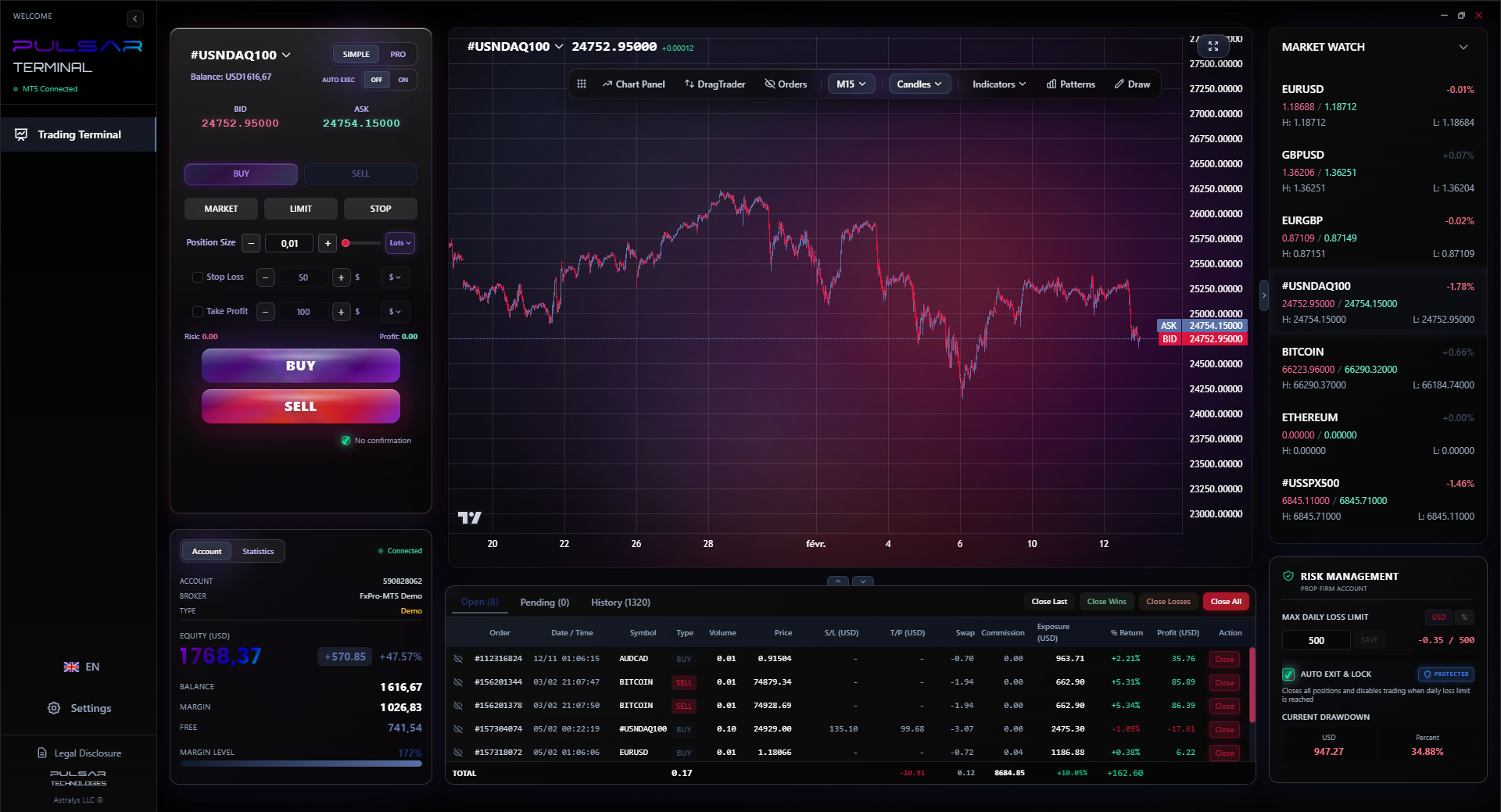
Manually tracking complex bonus volume targets while trading is a nightmare; Pulsar Terminal's trade panel lets you set and monitor exact lot volume goals directly on your MT5 chart.
Pulsar Terminal
The all-in-one MT5 companion: drag-and-drop orders, multi-TP/SL, trailing stop, grid trading, Volume Profile, and prop firm protection. Used by 1,000+ traders daily.
No.
Let me be clearer: Hell no.
The time, mental energy, and psychological risk you expend chasing a $30 or $100 no-deposit bonus is wildly disproportionate to the potential reward. You will learn bad habits - overtrading, ignoring risk to hit volume - that will poison your real trading later. The mathematical odds are deliberately stacked against you.
For a Nigerian trader, the challenges are already significant: funding issues, regulatory grey areas, and economic volatility. Adding a broker's bonus trap on top of that is like trying to learn to swim with weights tied to your ankles.
Invest that energy instead. Spend 100 hours on a demo account mastering a single strategy, like using the RSI indicator or MACD indicator in a clear way. Save up $50 and open a cent account. That $50 of your own money, under your full control, is a more powerful learning tool than any $100 bonus with strings attached.
I learned this the hard way so you don't have to. The market is tough enough. Don't make it tougher by falling for the shiny lure of 'free' money that comes with an invisible leash. Your greatest asset is your disciplined mind. Don't rent it out to a broker's marketing department for the low, low price of a hypothetical $100.
FAQ
Q1Can I actually withdraw money from a no deposit bonus in Nigeria?
Technically yes, but practically, it's extremely difficult. You can only withdraw the profits you generate from the bonus, and only after meeting strict trading volume (turnover) requirements. Most traders fail to meet these conditions without losing the bonus capital first. Always assume the bonus itself is non-withdrawable play money.
Q2Which forex brokers offer real no-deposit bonuses to Nigerians?
Brokers like Exness and XM have historically offered small, legitimate no-deposit bonuses (e.g., $5, $30) to new clients in Nigeria. However, offers change constantly. Never trust third-party ads. Go directly to the broker's official website, check their 'Promotions' section, and read the full terms and conditions before signing up.
Q3What's the catch with a 'no deposit bonus forex $100' offer?
The main catch is the trading volume requirement. To withdraw any profits, you must trade a huge number of lots (e.g., 20, 50, or more). This forces you to take excessive risk, often leading to the loss of the bonus. Other catches include time limits, maximum withdrawal caps, and restrictions on trading strategies like scalping.
Q4Are no deposit bonuses taxable in Nigeria?
The bonus itself likely isn't taxable as it's not real profit. However, any actual profit you manage to generate and withdraw from trading the bonus is considered capital gains. In Nigeria, you are subject to a 10% Capital Gains Tax on your gross forex trading profits, payable to the Federal Inland Revenue Service (FIRS).
Q5Is it better to use a bonus or a demo account?
A demo account is almost always better. It's truly risk-free with no psychological traps or withdrawal conditions. You can learn platform mechanics and test strategies in peace. A no-deposit bonus adds pressure and complex rules that distort your learning process. Use a demo to learn, then switch to a real cent account with your own small capital.
Q6What should I look for in the bonus terms and conditions?
Focus on these four things: 1) The Turnover Requirement (how many lots you must trade), 2) The Time Limit, 3) The Maximum Withdrawal amount, and 4) Any Trading Restrictions (e.g., "minimum trade duration of 2 minutes" bans scalping). If these aren't clear, avoid the offer.
Prof. Winston's Lesson
Key Takeaways:
- ✓Assume any no-deposit bonus is non-withdrawable play money.
- ✓Turnover requirements of 20+ lots make profit withdrawal a <5% probability.
- ✓Always prioritize broker regulation and spreads over bonus size.
- ✓Use a cent account with $50 of your own money instead of a bonus.
How useful was this article?
Click a star to rate
Weekly Trading Insights
Free weekly analysis & strategies. No spam.
About the Author
Olumide Adeyemi
West African Trading Pioneer
One of Nigeria's most active forex trading educators. 8 years of experience trading from Lagos. Specializes in low-capital strategies and prop firm challenges for African traders.
Comments
Risk Disclaimer
Trading financial instruments carries significant risk and may not be suitable for all investors. Past performance does not guarantee future results. This content is for educational purposes only and should not be considered investment advice. Always conduct your own research before trading.
You Might Also Like

Cara Trading Forex Sukses: 7 Prinsip dari Trader Profesional
Cara trading forex sukses dengan 7 prinsip trader pro: manajemen modal, disiplin, journal trading, backtest. Data nyata, bukan janji profit palsu.
Jam Trading Forex Terbaik untuk Trader Indonesia: Panduan Lengkap dengan Tabel Waktu
Panduan jam trading forex untuk trader Indonesia. Tabel 4 sesi dunia, jam emas 20:00-00:00, sesi mana yang harus dihindari. Data akurat + tips dari trader berpengalaman.
Top 5 Sàn Forex Uy Tín Nhất 2026: Review Jujur dari Trader Indonesia
Top 5 sàn forex uy tín 2026 untuk trader Indonesia. Review jujur: spread, deposit, withdraw, dukungan lokal. Exness, XM, IC Markets & lebih.
Get Pulsar Terminal
All these calculators are built into Pulsar Terminal with real-time data from your MT5 account. One-click position sizing, automatic risk management, and instant calculations.
Get Pulsar Terminal