


It was October 2022, and the GBP/NGN pair was doing its usual chaotic dance.

Olumide Adeyemi
West African Trading Pioneer ·  Nigeria
☕ 10 min read
What you'll learn:
It was October 2022, and the GBP/NGN pair was doing its usual chaotic dance. I had a short position from ₦980, watching the Central Bank of Nigeria's latest policy statement send shockwaves through the chart. My phone buzzed with alerts from three different trader WhatsApp groups, all screaming different directions. That's the Nigerian forex market for you: volatile, emotional, and packed with opportunity if you know how to sidestep the landmines. I've traded here for over a decade, through multiple CBN governors and at least three different 'forex crises.' This isn't a theoretical guide; it's a survival manual written from the trenches of Lagos, Abuja, and Port Harcourt.
When most people think of forex, they picture the Euro and Dollar. For the Nigerian trader, your world is fundamentally different. Your base currency is the Naira, and that changes everything about your risk, your psychology, and the pairs you should actually care about.
The first thing you need to understand is the parallel market rate, or what we call the 'black market' rate. The official CBN rate is a fantasy for most practical purposes. The real price of dollars, pounds, and euros is set on the streets of Ikeja and in the bureaux de change. This creates a massive spread between the official and parallel rates, which is both a risk and, occasionally, an arbitrage opportunity for the savvy. Your broker's quoted price for USD/NGN will never match what you see on AbokiFX or Nairaland forums. Don't fight it; just know the disconnect exists.
Your most important pairs will likely be the Naira crosses: USD/NGN, GBP/NGN, and EUR/NGN. Trading these requires a different mindset. You're not just trading global macro; you're trading local sentiment, CBN pronouncements, and the price of diesel. I learned this the hard way in 2016. I was long USD/NGN based on pure technicals, ignoring the political rumblings. The CBN suddenly 'floated' the Naira (sort of), and my tidy 50-pip profit turned into a 300-pip loss faster than you can say 'monetary policy committee.'

Warning: Never, ever trade Naira pairs with the same position size calculator settings you use for majors like EUR/USD. The volatility is in another league. A 100-pip stop-loss on USD/NGN is a tiny margin for error compared to the same on EUR/USD.
Then there are the majors and commodities. Many Nigerian traders flock to XAU/USD (Gold) because it's seen as a 'safe haven' from Naira depreciation. It's a valid play, but remember you're converting your profit back to a weakening currency. This currency risk overlay is the constant background noise of online forex trading in Nigeria.

💡 Winston's Tip
Your first profitable system will be boring. It will involve waiting for days for a setup. Embrace the boredom; it's more profitable than excitement.
Let's be blunt: the regulatory environment for the average Nigerian retail trader is the Wild West. The Securities and Exchange Commission (SEC) Nigeria is the official regulator, but their oversight of international forex brokers is limited. The Central Bank of Nigeria (CBN) has, at times, made it very difficult to fund international trading accounts.
The Funding Headache
This is your biggest operational challenge. International wire transfers are expensive, slow, and often questioned by your bank. You'll be asked for endless documentation to prove the transfer is for 'trade services' or 'personal investment.' Many have turned to cryptocurrencies as a funding bridge. You buy USDT with Naira on a local P2P platform, send it to your broker that accepts crypto, and convert. It's faster, but adds another layer of exchange rate risk and complexity. I once lost 2% of a deposit just in the spread between buying USDT and the broker's conversion rate.
Choosing Your Broker: The Real Deal
You need a broker that accepts Nigerian clients, processes withdrawals reliably, and doesn't treat Africa as a second-tier region. I've had accounts frozen for 'review' for weeks with some big names. Based on my experience and that of my network, here’s the breakdown:
| Broker | Why it Works for Nigeria | The Catch |
|---|---|---|
| Exness | Excellent local deposit/withdrawal options, accepts Naira. | Spreads can widen on exotic pairs. |
| IC Markets | Raw spreads, reliable execution. A favorite for serious scalping. | Funding can be slower, mostly international transfers. |
| XM | Strong local support, lots of educational resources for beginners. | Not the tightest spreads for high-volume traders. |
| Pepperstone | Top-tier regulation and platforms. | Less focus on local payment methods. |
Your number one due diligence task? Go beyond the website. Talk to actual Nigerian traders. Join forums (with a grain of salt) and ask about withdrawal times for amounts over $1,000. That's where the truth comes out.

Pro Tip: Always start with a small deposit to test the withdrawal process. If you can't get $50 out smoothly, you'll never get $5,000 out. I test every new broker with a $100 deposit and an immediate $50 withdrawal before trading a single lot.
“Your trading account is not your rent money. Separate your financial survival from your trading P&L.”
Copy-pasting a strategy from a YouTube guru in London or New York is a recipe for blowing your account in Lagos. The Nigerian trading environment demands adaptation.
Embrace the Swing, Not the Scalp
With our internet reliability issues (don't tell me you've never traded during 'light off'), high-frequency scalping is a path to heartbreak. A generator switch-over can take 90 seconds. That's a lifetime in the market. I learned this after a perfect setup on the MACD indicator divergence vanished during a power outage in Surulere. I favour swing trading over days or weeks. It aligns with the fundamental drivers of Naira pairs and forgives occasional connectivity drops.
The News Is Your Chart
In Nigeria, news isn't just background noise; it's the main driver. CBN MPC meeting dates are circled in red on my calendar. FAAC allocation announcements move the Naira. Even rumours about Dangote Refinery starting production can cause ripples. You need a local news feed alongside your Bloomberg terminal. I set alerts for keywords: 'CBN', 'FX', 'MPC', 'Dollar'. My most profitable trade last year was shorting GBP/NGN after a surprisingly hawkish CBN statement, netting 420 pips over four days.
Simple Tools, Applied Well
Forget the 20-indicator mess. In our volatile market, simplicity cuts through the noise. I use three things:
- Price Action & Support/Resistance: Clean charts. Draw your lines.
- The RSI Indicator: But I use it differently. On USD/NGN, overbought/oversold levels are less reliable. I look for failure swings and divergences, which often precede big CBN-inspired moves.
- A Reliable Volume Profile: To see where the real market interest is.
Here's a real example from my journal: In Jan 2023, USD/NGN was consolidating around ₦745. The RSI indicator showed a clear bearish divergence on the 4H chart while price was hitting the same resistance. Local news was quiet, suggesting no imminent CBN intervention. I went short at ₦744.50, stop at ₦752 (a wide 75-pip stop because of the pair's nature). Target was the previous support at ₦735. It hit target in 3 days. Risk: 0.5% of account. Reward: Nearly 1.3%. That's the patience game.
This might be the most important section. Your psychology is poisoned from the start by the environment you live in. The Naira is constantly losing value. This creates a desperate, get-rich-quick pressure that is utterly toxic for trading. You're not just trying to make profits; subconsciously, you're trying to beat hyperinflation and escape economic pressure. That leads to overtrading, massive position size errors, and holding losers hoping for a miracle.
I've been there. In 2020, frustrated by a string of small losses, I quadrupled my normal lot size on a EUR/USD trade trying to 'make it all back.' A routine 25-pip stop-loss cost me 8% of my account. I felt sick for a week. It was a classic margin call in the making. You must separate your self-worth and financial survival from your trading P&L. Trade with capital you can truly afford to lose. Your trading account is not your rent money.
Another unique pressure: the 'family and friends' fund. Once people know you 'trade forex,' you'll get proposals to manage their money. Just say no. The emotional burden of losing someone else's Naira is ten times worse. Stick to your own capital, develop your process, and keep your mouth shut about your wins.
💡 Winston's Tip
If you wouldn't explain the full risk of a trade to your mother in plain language, you shouldn't take it. Clarity precedes profit.
“A generator switch-over can take 90 seconds. That's a lifetime in the market. Plan accordingly.”
Given our unique challenges, the right software isn't a luxury; it's a force multiplier. You need tools that automate what they can to compensate for infrastructure issues.
A basic MT4/MT5 platform isn't enough. You need advanced order management. Let's say you get a great entry on USD/NGN, but then 'NEPA takes light.' A trailing stop that automatically moves to lock in profit is the difference between a win and a breakeven. Manually moving stop-losses as you juggle power banks and spotty data is a nightmare.
Similarly, setting multiple take-profit levels is crucial for managing the violent swings in our market. You want to bank partial profits at logical levels because a retracement can wipe you out fast. Doing this manually on a lagging mobile app is asking for trouble.
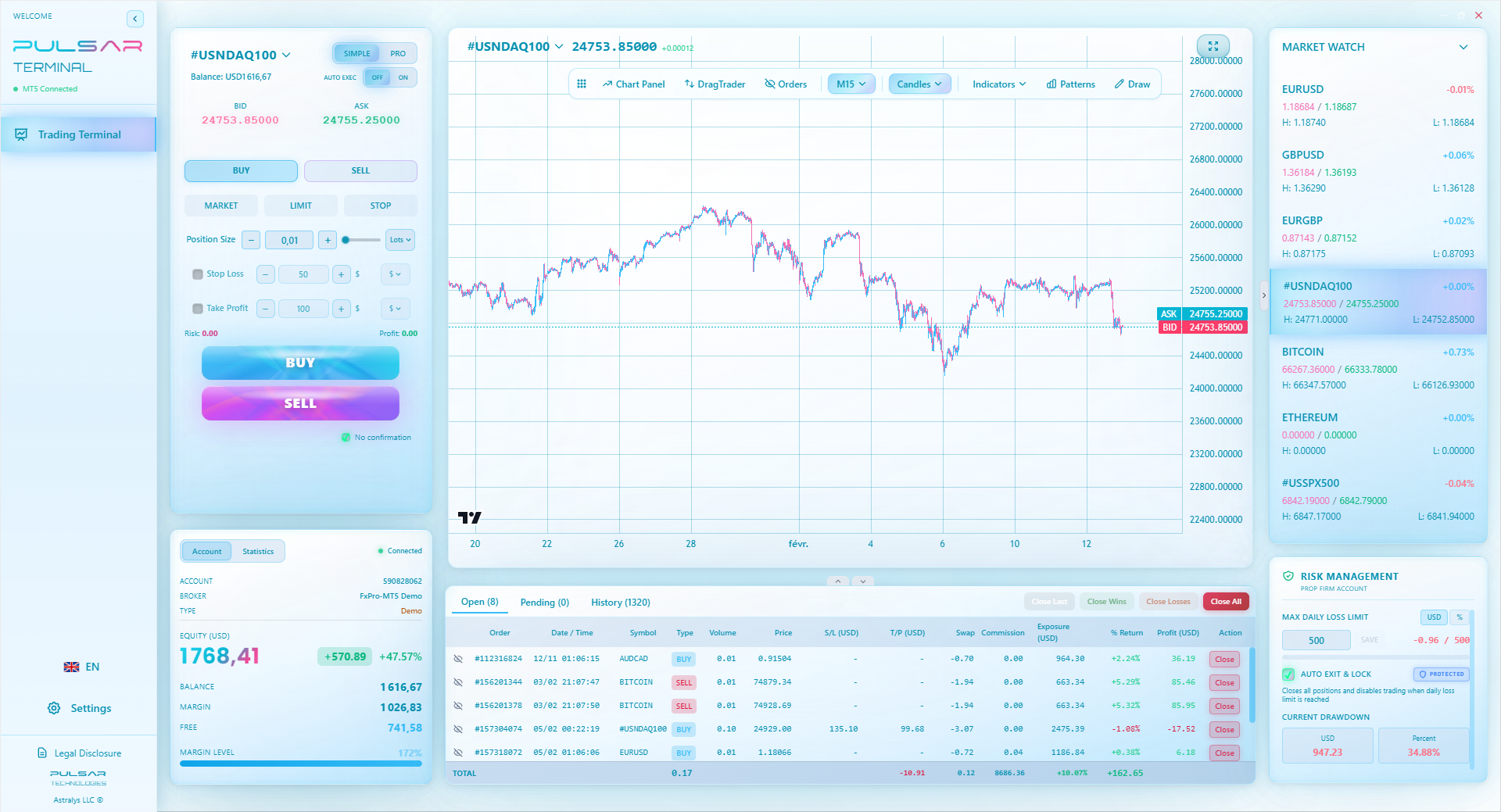
This is where dedicated trading terminals that plug into MT5 become essential. They let you set complex trade plans with a few clicks before you even enter. Think of it as setting your defensive line before the market opens, so you're not scrambling when volatility hits - or when your generator starts sputtering.

Example: You buy GBP/NGN at ₦1,200. With the right tool, you can set: TP1 at ₦1,210 for 30% of position, TP2 at ₦1,225 for 50%, and let a trailing stop of 50 pips manage the final 20%. All of this runs automatically on the broker's server, independent of your internet connection. This is how you sleep at night.
Managing complex trades and protecting profits during Nigeria's frequent power or internet outages is why tools like Pulsar Terminal, which automate advanced orders directly on MT5, are non-negotiable for serious traders here.
Pulsar Terminal
The all-in-one MT5 companion: drag-and-drop orders, multi-TP/SL, trailing stop, grid trading, Volume Profile, and prop firm protection. Used by 1,000+ traders daily.
If you're new to online forex trading in Nigeria, here's a blunt, step-by-step plan. Skip a step, and you'll pay for it.
Months 1-2: Education & Paper Trading Don't deposit a single Naira. Open a demo account with a broker like XM or Exness. Learn what a pip is, how spread works, and how use can murder you. Practice the simple swing trading strategy I mentioned. Track your demo trades in a journal as if it were real money. If you can't be profitable in a demo for two months, you have zero chance with real cash.
Month 3: The Live Test Deposit the minimum amount with your chosen broker - maybe ₦50,000. Your goal is not to make money. Your goal is to execute 20-30 micro-lot trades (0.01 lots) with perfect discipline on your strategy. Then, withdraw your money. The entire purpose is to prove to yourself that the funding and withdrawal process works.
Months 4-6: Building the Process Now, fund an account with capital you can afford to lose. I'm talking about an amount that, if gone, doesn't change your life. Start trading with a maximum risk of 1% per trade. Your sole focus is on following your plan, not the monetary outcome. Review your journal weekly. After three months, analyze your results. Are you consistently profitable? If yes, you can consider scaling very slowly. If not, go back to the demo. This business is a marathon, not a 100-meter dash against the Naira's fall.
FAQ
Q1Is online forex trading in Nigeria legal?
Yes, trading forex with international brokers is legal for individuals. However, the CBN restricts banks from processing payments for 'speculative' forex purposes, which creates the funding headache. You are not breaking the law by having an account with a regulated offshore broker.
Q2What is the minimum amount to start forex trading in Nigeria?
Technically, you can start with as little as $10 (about ₦15,000) with some brokers thanks to micro accounts. Practically, I advise a minimum of $200 (₦300,000+) for proper position size management and to absorb the transaction costs of funding and withdrawals without them eating your capital.
Q3Which forex pair is best for Nigerian beginners?
Start with major pairs like EUR/USD or GBP/USD on a demo. They have lower spreads and more predictable liquidity than Naira pairs. Once you understand the basics, then you can cautiously explore USD/NGN with tiny position sizes to learn its unique rhythm.
Q4How do I avoid forex scams in Nigeria?
Avoid any 'broker' or 'investment manager' that guarantees profits, operates only on WhatsApp, asks for direct bank transfers to a personal account, or promises weekly returns of 20%+. Only use internationally regulated brokers with a long track record. If it sounds too good to be true in this economy, it's a scam.
Q5Can I use my local bank account for forex trading?
For funding international brokers, it's difficult. Banks often block or question such transfers. Most traders use intermediaries, crypto (USDT), or specific brokers that have built local payment partnerships for deposits and withdrawals in Naira.
Q6What time is best to trade forex in Nigeria?
The London session (1 pm - 4 pm Nigerian time) offers the best combination of high liquidity and lower spreads. The overlap with the US session (3 pm - 5 pm Nigerian time) is the most volatile. Avoid trading major news releases if your internet is unstable.
Prof. Winston's Lesson
Key Takeaways:
- ✓Trade Naira pairs with 3x wider stops than majors.
- ✓Test withdrawals with $50 before depositing $5,000.
- ✓Swing trade, don't scalp, with Nigerian infrastructure.
- ✓Risk a maximum of 1% per trade, no exceptions.
How useful was this article?
Click a star to rate
Weekly Trading Insights
Free weekly analysis & strategies. No spam.
About the Author
Olumide Adeyemi
West African Trading Pioneer
One of Nigeria's most active forex trading educators. 8 years of experience trading from Lagos. Specializes in low-capital strategies and prop firm challenges for African traders.
Comments
Risk Disclaimer
Trading financial instruments carries significant risk and may not be suitable for all investors. Past performance does not guarantee future results. This content is for educational purposes only and should not be considered investment advice. Always conduct your own research before trading.
You Might Also Like

Cara Trading Forex Sukses: 7 Prinsip dari Trader Profesional
Cara trading forex sukses dengan 7 prinsip trader pro: manajemen modal, disiplin, journal trading, backtest. Data nyata, bukan janji profit palsu.
Jam Trading Forex Terbaik untuk Trader Indonesia: Panduan Lengkap dengan Tabel Waktu
Panduan jam trading forex untuk trader Indonesia. Tabel 4 sesi dunia, jam emas 20:00-00:00, sesi mana yang harus dihindari. Data akurat + tips dari trader berpengalaman.
Top 5 Sàn Forex Uy Tín Nhất 2026: Review Jujur dari Trader Indonesia
Top 5 sàn forex uy tín 2026 untuk trader Indonesia. Review jujur: spread, deposit, withdraw, dukungan lokal. Exness, XM, IC Markets & lebih.
Get Pulsar Terminal
All these calculators are built into Pulsar Terminal with real-time data from your MT5 account. One-click position sizing, automatic risk management, and instant calculations.
Get Pulsar Terminal