


Thinking about trading with a prop firm's capital instead of your own? You're not alone.

James Mitchell
Senior Trading Analyst
☕ 12 min read
What you'll learn:
- 1What a Prop Firm Actually Is (And Isn't)
- 2The Rules That Will Make or Break You
- 3The Real Numbers: Costs, Fees, and What You Actually Keep
- 4How to Pick a Firm in 2025 (The Landscape Has Changed)
- 5A Realistic Strategy to Pass the Challenge
- 6What Happens After You Get Funded?
- 7Is a Prop Firm Your Only Option? (Honest Alternatives)
Thinking about trading with a prop firm's capital instead of your own? You're not alone. The promise is huge: trade big money without risking your life savings. But here's the brutal truth most guides won't tell you: 95% of traders fail the evaluation. The industry is built on that fact. So, is it worth it? Can you be in the 5%? I've been through it - passed a few, failed more, and learned what actually separates the funded from the frustrated. Let's cut through the hype and talk about what an only prop firm path really looks like for a US trader.
First, let's clear up the biggest misconception. When you see ads for 'Get a $100,000 account!', they're not talking about a traditional Wall Street proprietary trading desk. Those are for institutional pros. The 'prop firms' you and I deal with are a different animal entirely.
They're talent scouts with a very specific, and profitable, business model. You pay a fee (anywhere from $15 to a few hundred bucks) to take a 'challenge' or 'evaluation'. This is almost always done on a simulated account. If you hit their profit target without breaking their rules (more on those later), they may offer you a 'funded' account. That's when you trade their capital and split the profits, usually 80/20 in your favor.
Here's the critical part: they are not brokers. They don't hold your money in a segregated account like Exness or IC Markets would. Your challenge fee is gone the second you pay it. They're also not registered investment advisors. Most operate in what lawyers call a 'regulatory gray area' by selling an 'educational service' or a 'talent assessment'. This is why your protections as a trader are minimal. If they vanish tomorrow, your challenge fee and any unpaid profits are likely gone for good.

Warning: Don't confuse a prop firm with a broker. You're not a client; you're an applicant. Your rights are defined by their terms of service, not by FINRA or the SEC. Read every word.
The model works for them because the math is ugly for us. With a 5% pass rate, 95 out of 100 traders are paying for a very expensive trading simulator. That's their primary revenue stream. The successful 5% who become consistently profitable are a cost of doing business, but a manageable one.
I learned this the hard way early on. I blew $300 on two separate challenges with different firms, convinced my scalping strategy would crush it. I hit the profit target on one, but violated a 'maximum daily loss' rule I'd skimmed over. Poof. Fee gone. Lesson burned in: this is a test of rule-following as much as it is of trading skill.
This is where dreams go to die. Prop firm rules are designed to find disciplined, risk-averse traders, not market wizards. You can be the best chart reader in the world, but if you break these, you're out.
The Big Three: Profit Target, Drawdown, and Time
Every challenge has a profit target (e.g., 8% in 30 days). It seems straightforward. The real killers are the drawdown rules. You'll usually have two:
- Overall Drawdown: A cap on total losses from your starting balance or peak equity. Hit this, and you fail.
- Daily Drawdown: A smaller, daily loss limit. This is the silent assassin. A bad morning can trigger this rule and end your challenge before lunch, even if you're miles from your overall limit.
There's often a time limit, too. No slow-and-steady swing trading here if you need 10% in 30 days.
The Hidden Traps: Consistency and News Trading
Some firms have 'consistency rules'. You can't make 90% of your target profit on one trade. Others ban trading during major news events (like NFP). They can and will check your trade timestamps.

Pro Tip: Your first tool isn't a chart. It's a position size calculator. Before you take a single trade, calculate the maximum lot size you can use so that a full stop-loss hit won't even come close to your daily drawdown. I risk no more than 0.5% of my daily loss limit per trade.
Let me give you a real example from a $50,000 challenge I passed. Rules: 10% profit target ($5,000), 5% max drawdown ($2,500), 3% daily drawdown ($1,500). My daily danger zone was $1,500. I set my personal red line at $1,000. If my losses hit $1,000 in a day, I was done, no questions asked. This meant my per-trade risk was tiny - often just $50-$75. It felt painfully slow, but that discipline is the only reason I got funded.

💡 Winston's Tip
The market doesn't know you're in a challenge. Trade the price action, not your P&L. A desperate trade is always a bad trade.
“Passing a prop challenge is a test of rule-following as much as it is of trading skill.”
Let's talk dollars and cents, because the marketing blurbs are misleading.
Upfront Costs:
- Challenge Fee: This is your ticket. It can be as low as $15 for a tiny account or over $500 for a $200k+ evaluation. The average is around $100-$200 for a standard $50k-$100k account. This fee is almost always non-refundable.
- Reset/Retry Fee: You fail. Want to try again with the same firm? That's another fee, often slightly cheaper than the first.
Ongoing & Hidden Costs:
- Platform/Data Fees: Once funded, you might pay for real-time data, especially for futures. I paid $130/month for CME data with one firm. It comes out of your profits.
- Commissions: On futures accounts, you'll pay per side. A common rate is ~$4 per contract per side. So a full trade (in and out) costs about $8. That eats into small wins fast.
The Payout Structure: This is the famous 80/20 split (you get 80%). But it's not that simple.
- You usually have to hit a 'minimum payout' threshold first (e.g., $1,000 in profits).
- The firm calculates your split from the net profit after their commissions and fees.
- Payouts are often monthly or bi-weekly.

Example: You make $2,000 in gross profit on a futures account. They deduct $200 in commissions and data fees. Your net profit is $1,800. Your 80% split is $1,440. That's what hits your bank account, not $1,600.
And remember that industry stat: only about 7% of all traders who buy a challenge ever see a payout. The average successful trader makes about 4% of their account size per payout. So on a $100k account, an average payout is around $4,000 before your split. This is not a get-rich-quick scheme. It's a grueling, low-margin grind for most.
A year ago, I'd have given you a list of 10 firms. Today, it's different. The 'prop firm shakeout' of 2024 was real. MetaQuotes (the company behind MT4 and MT5) cracked down, forcing firms offering their platforms in the US to stop. Overnight, about 100 firms shut down or had to scramble.
Now, you need to look for stability and legitimacy. Here’s your checklist:
1. What Platform Do They Use? Avoid any firm still offering MT4/MT5 for US traders - it's a red flag they're not up to date. Look for firms using cTrader, DXtrade, Tradovate, or NinjaTrader. These are sustainable platforms for the US market.
2. Are They Broker-Backed? This is a huge plus. It means a real, regulated broker (like ThinkMarkets or DNA Markets) is behind them, handling the actual trade execution. It adds a layer of security. Firms like ThinkCapital and DNA Funded fit this model.
3. Read the Terms. Then Read Them Again. Specifically look for:
- Payout procedures and timing.
- Rules about trading during news.
- How they calculate drawdown (is it from starting balance or peak equity?). Peak equity is slightly more forgiving.
- Any weird, subjective rules about 'over-trading' or 'lot size consistency'.
4. Regulatory Clouds on the Horizon Know this: the CFTC is sniffing around. They're debating whether these firms should be registered as Commodity Trading Advisors (CTAs). The SEC also tweaked some 'dealer' definitions. This doesn't mean don't join one, but it means only prop firm with a clear, transparent structure and a plan for regulatory changes is worth your time. Prioritize firms that are already partnered with regulated entities.
I made the mistake of ignoring platform warnings in early 2024. I was halfway through a challenge on a firm using MT5 when they emailed saying the challenge was void and offered a partial credit to restart on a new platform. I lost two weeks of work. Now, platform choice is my first filter.
“The 'funded' account is not a victory lap; it's a job interview that never ends.”
Forget your usual trading. Passing a prop challenge is a unique, constrained game. You need a 'challenge-specific' strategy.
Phase 1: The Grind (First 50% of Target) Your only goal here is survival. Risk 0.25%-0.5% of your daily drawdown per trade. Your edge doesn't need to be huge; it needs to be consistent. Use simple, high-probability setups. I often use a basic support/resistance bounce with a tight stop. The RSI indicator can help identify overbought/oversold conditions in a ranging market. The goal is to slowly grind up 4-5% without a single major drawdown day.
Phase 2: The Climb (Next 30%) You have a buffer now. You can slightly increase position size, but never to the point where one loss threatens your daily limit. This is where patience is key. Don't get greedy because you're 'close'.
Phase 3: The Finish (Final 20%) This is the most dangerous part psychologically. You're so close you can taste it. This is when you revert to Phase 1 rules. Go back to your smallest size. Take only the absolute best setups. If you have a 10% target and you're at 9.2%, you're done. Wait for a no-doubt, textbook trade. Sometimes, the right trade to take is no trade at all.
The Mental Game: You will have losing days. Your job is to ensure they are small, controlled losses. A 1% loss day is fine. A 2.9% loss day (when your limit is 3%) is a catastrophic failure of discipline, even though you 'passed' the rule. It means you were one bad tick from blowing up.
Pro Tip: Use a trading journal and track your progress against the FIRM'S rules, not just your P&L. Create a simple spreadsheet that shows your current equity, your distance from the max drawdown, and your distance from the daily loss limit. This is your dashboard. Ignore it at your peril.
Automation can be a lifesaver here. Manually moving stops to breakeven or trailing a winner is stressful and error-prone. Having a tool that manages trade mechanics lets you focus on the decision to enter or exit.
💡 Winston's Tip
Your first funded account isn't for buying a Lamborghini. It's for proving you can do it again. Withdraw your first few payouts and put them in the bank. That's real validation.
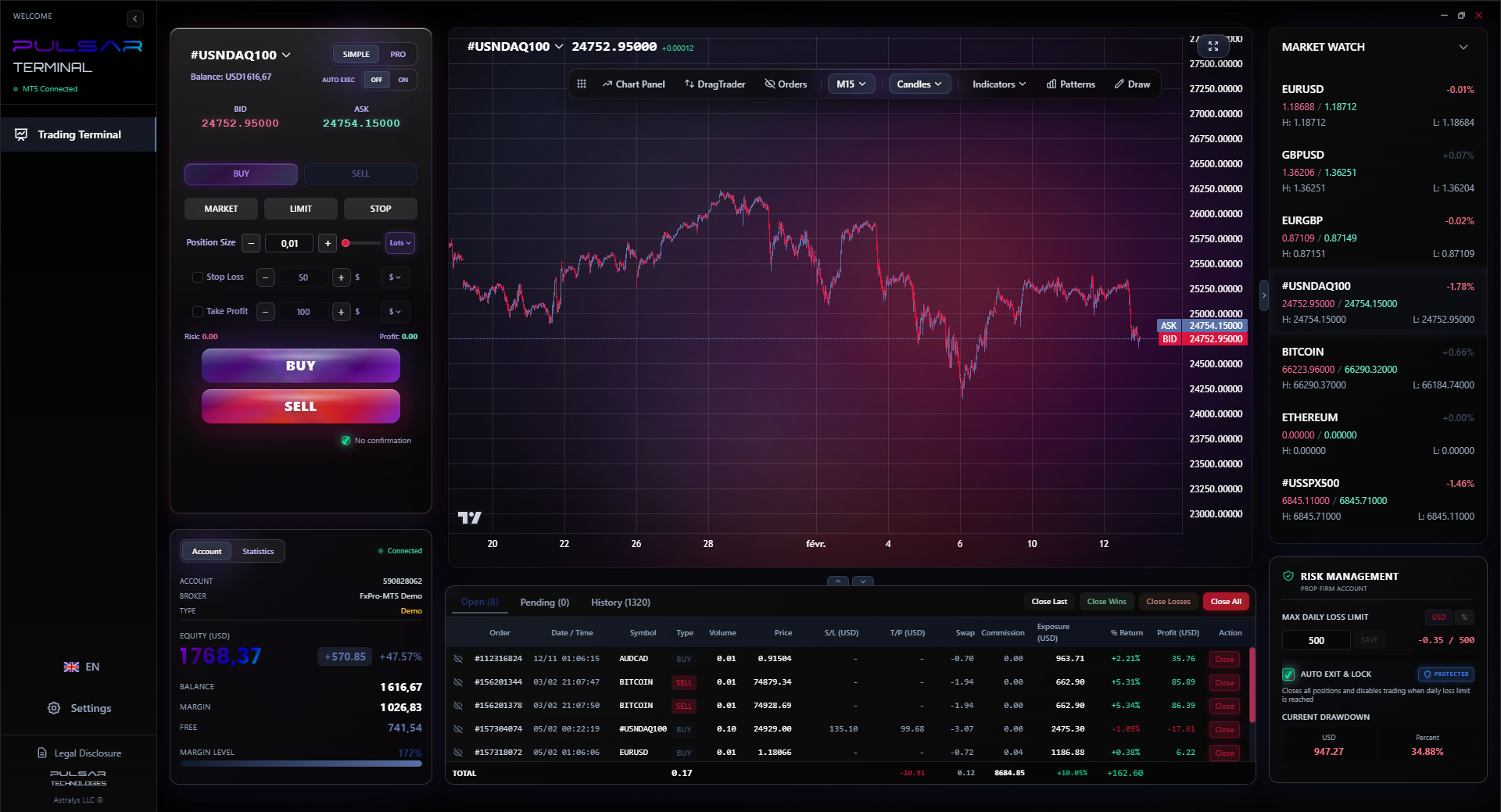
Managing multiple take-profit levels and a trailing stop manually during a high-pressure challenge is a recipe for error; Pulsar Terminal automates these mechanics on MT5 so you can focus on your strategy.
Pulsar Terminal
The all-in-one MT5 companion: drag-and-drop orders, multi-TP/SL, trailing stop, grid trading, Volume Profile, and prop firm protection. Used by 1,000+ traders daily.
You passed. Congrats! Now the real work begins. The 'funded' account is not a victory lap; it's a job interview that never ends.
The First Payout Hurdle: Most firms have a 'first payout' rule. You might need to generate a certain profit (e.g., 1-2% of the account) before you can request your first withdrawal. This ensures you're not just going to withdraw a sign-up bonus and vanish.
Scaling Plans: Some firms offer to increase your capital if you perform well (e.g., grow the account by 10% and they'll add more). These plans come with new, often stricter, drawdown rules. Read them carefully.
The Psychological Shift: Trading with 'real' firm money feels different than the challenge, even though it's all simulated until payout. The pressure to not lose the opportunity is immense. You must stick to the exact same strategy that got you there. This is where most funded traders fail - they get the capital, get overconfident, increase risk, and blow up.
I've been through two scaling plans. The first time, I broke my rules. I had a $100k account, made $8k in two weeks, and thought I was a genius. I tripled my position size on a EUR/USD play, got caught in a reversal, and triggered a drawdown rule. Account closed. The second time, I treated the scaled $200k account like it was a new $50k challenge. Small, consistent risks. It's boring. It works.
Your relationship with the firm is now transactional. You make money, they take their cut, you get paid. Keep impeccable records of your trades and your payout calculations. Trust, but verify.
“If you can't grow a $5,000 personal account, you almost certainly won't pass a prop firm challenge.”
The 'only prop firm' path isn't for everyone. In fact, it's not for most people. Let's be real: if you can't grow a $5,000 personal account consistently, you almost certainly won't pass a prop firm challenge with its restrictive rules.
Consider these paths first:
1. Master Your Own Small Account: This is the purest test. Take $1,000-$5,000 (money you can afford to lose) with a reputable low-cost broker like Pepperstone or XM. Your goal isn't to get rich. It's to achieve a 5-10% return per quarter with max drawdowns under 5%. If you can do that for a year, you have a real edge. Then you can compound it or seek outside capital from a place of strength.
2. Join a Trading Community or Find a Mentor: The $200/month you might spend on prop firm retries could be spent on a quality educational community. Learning to read price action or master the MACD indicator in confluence with other tools is a better long-term investment than buying failure after failure.
3. Specialize in a Low-Capital Instrument: You don't need $100k to make money. You can trade micro-futures (MES, MNQ) or specific forex pairs with tight spreads with a few thousand dollars. The skills you build are transferable.
The prop firm route makes sense for one type of trader: someone with a proven, disciplined strategy who is absolutely capital-constrained. If you have a system that can reliably make 1% a month with low drawdowns, but you only have $2,000 to your name, then a prop firm can provide the use to make that skill pay meaningful bills. For everyone else, it's an expensive distraction.
I've done both. Growing my own account from $3k to $15k over 18 months was harder, slower, and more educational than any prop challenge. It also gave me the unshakeable confidence to later pass those challenges. Build your foundation first.
FAQ
Q1Are prop firms legal in the United States?
It's a gray area. They aren't illegal, but most operate as 'evaluation services' to avoid direct regulation by the SEC or CFTC. This means you, the trader, have very few legal protections if they don't pay out. Their legality is under increased scrutiny, so always choose a firm that partners with a real, regulated broker for execution.
Q2What's the single biggest reason traders fail prop firm challenges?
Lack of risk discipline, specifically violating the daily loss limit. Traders focus on the profit target and the overall drawdown, but one bad morning where they double down on a losing trade can trigger the daily loss rule and end the challenge instantly. It's a test of loss prevention first, profit second.
Q3Can I trade gold (XAU/USD) or crypto with a prop firm?
It depends entirely on the firm. Many forex-focused prop firms offer XAU/USD (gold). Crypto is less common but offered by some. You must check their list of allowed instruments. Never assume. Trading a banned instrument is an instant failure.
Q4How often do prop firms actually pay out?
The reputable ones pay on time, every time. Their entire business model depends on it to attract new applicants. However, there are countless stories of shady firms closing accounts on technicalities or delaying payments. This is why due diligence is critical - stick to well-established, broker-backed firms with a long track record of testimonials about smooth payouts.
Q5What happens if I get a margin call on a prop firm account?
On a simulated evaluation account, a margin call will almost certainly mean an immediate fail. On a funded account, it would likely violate your drawdown rules and result in account termination. Prop firms typically provide high use, but you should use a tiny fraction of it to avoid ever coming close to a margin call. Your risk management should make a margin call impossible.
Q6Is it better to go for one big account or multiple smaller accounts?
Start with one smaller account. The rules are the same, but the psychology is easier. Losing a $10k challenge fee hurts less than a $500 one. Use a small challenge to prove you can navigate their rule set. Once you have a funded account and are consistently profitable, then consider using your profits to fund larger challenges. Don't put all your eggs in one expensive basket.
Prof. Winston's Lesson
Key Takeaways:
- ✓Treat the daily loss limit as your absolute, non-negotiable red line.
- ✓The average payout is just 4% of account size - manage your expectations.
- ✓Platform choice (cTrader, DXtrade) is now a primary stability filter.
- ✓Your challenge fee buys an education in discipline, not a funded account.
How useful was this article?
Click a star to rate
Weekly Trading Insights
Free weekly analysis & strategies. No spam.
About the Author
James Mitchell
Senior Trading Analyst
Based in New York with over 9 years of trading experience. Focuses on major USD pairs, prop firm challenges, and the US regulatory landscape.
Comments
Risk Disclaimer
Trading financial instruments carries significant risk and may not be suitable for all investors. Past performance does not guarantee future results. This content is for educational purposes only and should not be considered investment advice. Always conduct your own research before trading.
You Might Also Like

Cara Trading Forex Sukses: 7 Prinsip dari Trader Profesional
Cara trading forex sukses dengan 7 prinsip trader pro: manajemen modal, disiplin, journal trading, backtest. Data nyata, bukan janji profit palsu.
Jam Trading Forex Terbaik untuk Trader Indonesia: Panduan Lengkap dengan Tabel Waktu
Panduan jam trading forex untuk trader Indonesia. Tabel 4 sesi dunia, jam emas 20:00-00:00, sesi mana yang harus dihindari. Data akurat + tips dari trader berpengalaman.
Top 5 Sàn Forex Uy Tín Nhất 2026: Review Jujur dari Trader Indonesia
Top 5 sàn forex uy tín 2026 untuk trader Indonesia. Review jujur: spread, deposit, withdraw, dukungan lokal. Exness, XM, IC Markets & lebih.
Get Pulsar Terminal
All these calculators are built into Pulsar Terminal with real-time data from your MT5 account. One-click position sizing, automatic risk management, and instant calculations.
Get Pulsar Terminal