


Thinking about opening a forex account in Nigeria? You're not alone.

Olumide Adeyemi
West African Trading Pioneer ·  Nigeria
☕ 10 min read
What you'll learn:
Thinking about opening a forex account in Nigeria? You're not alone. With over 300,000 retail traders here, mostly young people looking for a way forward, the market's buzzing. But let me be straight with you: I've seen too many people rush in, pick the wrong broker, blow their first deposit on crazy use, and quit before they even understand what a pip definition is. This isn't just a sign-up tutorial. It's the guide I wish I had when I started, one that talks about the real hurdles - like funding your account when your bank card keeps getting declined - and the specific, often overlooked, rules that apply to us here.
This is the first question everyone asks, and the answer is yes, it's legal for you to trade. The Central Bank of Nigeria (CBN) and the Securities and Exchange Commission (SEC) oversee the financial markets. However, the specific rules for online retail forex trading are still a work in progress. This creates a unique situation where you, as an individual, are perfectly within your rights to open an account and trade, but you'll likely be doing it with an international broker regulated abroad.
Here's the critical part most beginners miss: while trading is legal, funding your account is where you hit the first major roadblock. The CBN explicitly prohibits using official foreign exchange windows to fund trading accounts. On top of that, many Nigerian banks have limits or have outright stopped Naira debit cards from processing international merchant payments. I learned this the hard way in 2022. I spent two days trying to fund a new account with three different bank cards, each transaction failing. I finally got one through, but the frustration was unreal.
Then there's the tax man. You need to know that any profit you make is subject to a 10% Capital Gains Tax, payable to the Federal Inland Revenue Service (FIRS). It's your responsibility to report it. I didn't think much about this in my first profitable year, and it came back to bite me. Keep a simple trading journal; it'll save you headaches later.

Warning: The regulatory landscape is shifting. In late 2024, the CBN issued revised guidelines aiming to consolidate and bring more transparency to the forex market. Expect more scrutiny and clearer rules by 2025. Always verify a broker's current status before you deposit.

💡 Winston's Tip
Your first deposit isn't trading capital. It's tuition. Expect to pay it to learn. The goal is to make the lessons as cheap as possible.
“use isn't a tool for making money; it's a tool for losing it faster.”
When you're ready to open a forex account, the broker choice is everything. Forget the flashy ads promising 100% deposit bonuses. I fell for that once. The bonus came with trading volume requirements so high I could never withdraw my own money. Focus on these concrete factors instead.
Regulation is Your Safety Net
Since local online forex regulation is developing, you're relying on the broker's international license. Look for reputable authorities like the FSCA (South Africa), CySEC (Cyprus), or ASIC (Australia). A broker like Exness or XM will onboard Nigerian clients under their Seychelles (FSA) or other global entities. This is standard and, for now, the practical reality.
The Numbers That Actually Matter
Let's talk real costs. The spread - the difference between the buy and sell price - is your primary trading cost. Here's a quick comparison for a standard EUR/USD account:
| Broker | Typical Spread (EUR/USD) | Min. Deposit |
|---|---|---|
| IC Markets | From 0.0 pips* | $200 |
| Capital.com | ~0.64 pips | $20 |
| XM | From 0.8 pips | $5 |
| Exness | From 1 pip | $10 |
| HFM | ~1.4 pips | $0 (₦4,000 via processor) |
*Commission applies on raw spread accounts.
A tight spread like IC Markets' 0.0 pips is fantastic for a scalping strategy, but remember, you often pay a commission per trade. For a beginner, a simple, low-minimum account from XM or Exness might be a less intimidating way to start.

Pro Tip: Always check if the broker offers a Naira (NGN) account. It can simplify things mentally, even though you're still trading currency pairs. It removes one layer of exchange rate confusion when you view your balance.
“Funding your account is the first real test of a Nigerian trader's patience and problem-solving skills.”
Brokers offer different accounts: Standard, Raw/ECN, Micro, etc. The Standard account is usually commission-free with slightly higher spreads. The Raw/ECN account has razor-thin spreads but charges a commission. As a beginner, start with a Standard or Micro account. Your goal is to learn, not to minimize commission costs on a $100 deposit.
Now, let's talk about the siren song of Nigerian forex: high use. I've seen brokers offer 1:2000 or even 1:3000 to Nigerian clients. It looks like a shortcut to massive profits. It's not. It's a shortcut to a margin call.
Here's my painful lesson. In 2019, I deposited $500 into an account with 1:1000 use. In my mind, I controlled $500,000! I took a 0.5 lot trade on GBP/USD (a $50,000 position). The market moved 20 pips against me - a very normal fluctuation. I lost $100. Just like that, 20% of my account was gone on a tiny move. I felt sick. use amplifies losses just as fast as it amplifies gains. For your first real account, I beg you, don't go above 1:50. Maybe 1:100 if you're incredibly disciplined. Use a position size calculator for every single trade. It forces you to confront the real risk.

Example: With a $200 account at 1:50 use, you control up to $10,000. A 1% risk on your account ($2) on a EUR/USD trade means your position size should be roughly 0.02 lots. That's a sane, survivable size.
“Funding your account is the first real test of a Nigerian trader's patience and problem-solving skills.”
This is the most practical, frustrating, and crucial step. You've picked a broker, now you need to get money in and, hopefully, out.
Deposits: Because of the CBN restrictions, you'll use alternative payment methods. The most common for Nigerians are:
- Cryptocurrency (BTC, USDT): This is becoming the default. It's fast, bypasses bank restrictions, and most major brokers accept it. The downside? Crypto volatility between the time you buy it and send it.
- International Money Transfers: Services like Wise (formerly TransferWise) can work, but they have their own checks and can be slow.
- Local Payment Processors: Some brokers partner with local payment gateways that accept Naira. This is the ideal scenario if available (check brokers like HFM or OctaFX).
My advice? Start small. Make a test deposit of the minimum amount, say $10 or $20. Then immediately request a withdrawal of that same amount. This isn't about making money; it's about testing the broker's withdrawal process. If you can't easily get a small amount back, imagine trying to withdraw profits.
Withdrawals: They typically mirror the deposit method. If you deposited with crypto, you'll withdraw to your crypto wallet. Plan for this. Have a reliable, secure crypto wallet set up (like Trust Wallet or MetaMask) and know how to convert crypto back to Naira on a local peer-to-peer platform. This entire environment is part of the job for a Nigerian trader in 2026.
💡 Winston's Tip
When testing a broker, the withdrawal process is ten times more important than the deposit process. Always do a test withdrawal first.
“Your first ten trades should only risk 0.5% of your account. You're trading for experience, not profit.”
Let's walk through the actual clicks. It's straightforward if you have your documents ready.
- Visit the Broker's Website: Go to the global site of your chosen broker (e.g., exness.com, xm.com). Ensure you select your country as Nigeria during sign-up so you get the correct entity and available payment methods.
- Click 'Open an Account' or 'Register': You'll be asked for an email and a password. Use a secure, dedicated email for trading.
- Fill Out the Application Form: This is detailed. You'll need:
- Full name (exactly as on your ID).
- Date of birth.
- Phone number.
- Residential address.
- Employment status and estimated annual income. (Be honest, but this is for their compliance, not a job application).
- Trading experience and knowledge. (Again, be honest. If you're a beginner, say so. They might limit your use, which is a good thing).
- Account Verification (KYC): This is mandatory. You'll need to upload:
- A clear photo or scan of a valid International Passport, National ID Card, or Driver's License.
- Proof of address. This must be recent (within 3-6 months) and show your name and address. A utility bill (PHCN, water), bank statement, or tenancy agreement works. I used a dated bank statement PDF.
- Account Approval: This can take from a few hours to a couple of days. Once approved, you'll get login details for their client portal (often called a 'Members Area' or 'Trader's Room').
- Download the Trading Platform: From your portal, download MT4 or MT5. This is where the real magic happens. Log in using the server, login ID, and password provided in your portal - not the website login details.
- Fund Your Account: Go to the 'Deposit' section of your portal, choose your method, and follow the instructions. Remember, start with that test deposit.
“Your first ten trades should only risk 0.5% of your account. You're trading for experience, not profit.”
Your account is funded, MT5 is open, and the charts are moving. The temptation to jump in is overwhelming. Don't. Not yet.
First, get familiar with the platform in a risk-free environment. Every broker offers a demo account. Use it. Practice placing market orders, pending orders, setting stop-loss and take-profit levels. Understand how to read the basic info: Bid/Ask price, spread, margin used, free margin.
When you're ready for your first real trade, here's my ironclad rule: Your first ten trades should only risk 0.5% of your account per trade. If you have a $100 account, that's 50 cents per trade. You're not trading for profit here; you're trading to feel the psychology of real money on the line without blowing up.
My biggest early mistake was trading exotic currency pairs because they 'moved more.' I got chopped up in USD/TRY and USD/ZAR. The spreads were huge, and the moves were erratic. Stick to the major pairs, especially at the start. The EUR/USD guide is a great place to begin - it's the most liquid pair with the tightest spreads. If you're interested in commodities, gold (XAU/USD) has clear trends but requires a different mindset; check our XAU/USD guide before diving in.
Another classic error: revenge trading after a loss. You'd be amazed how quickly a 0.5% loss turns into a 5% loss when you double down trying to win it back immediately. Have a plan for the day, and when you hit your daily loss limit (set one!), walk away. The market will be there tomorrow.
Pro Tip: Don't ignore the tools at your disposal. Learn one or two indicators deeply, like the RSI indicator for overbought/oversold conditions or the MACD indicator for trend momentum. Use them to confirm your ideas, not as a crystal ball.
💡 Winston's Tip
If you feel a rush of excitement or fear when clicking 'buy' or 'sell,' your position size is too large. Scale down until the click feels boring.
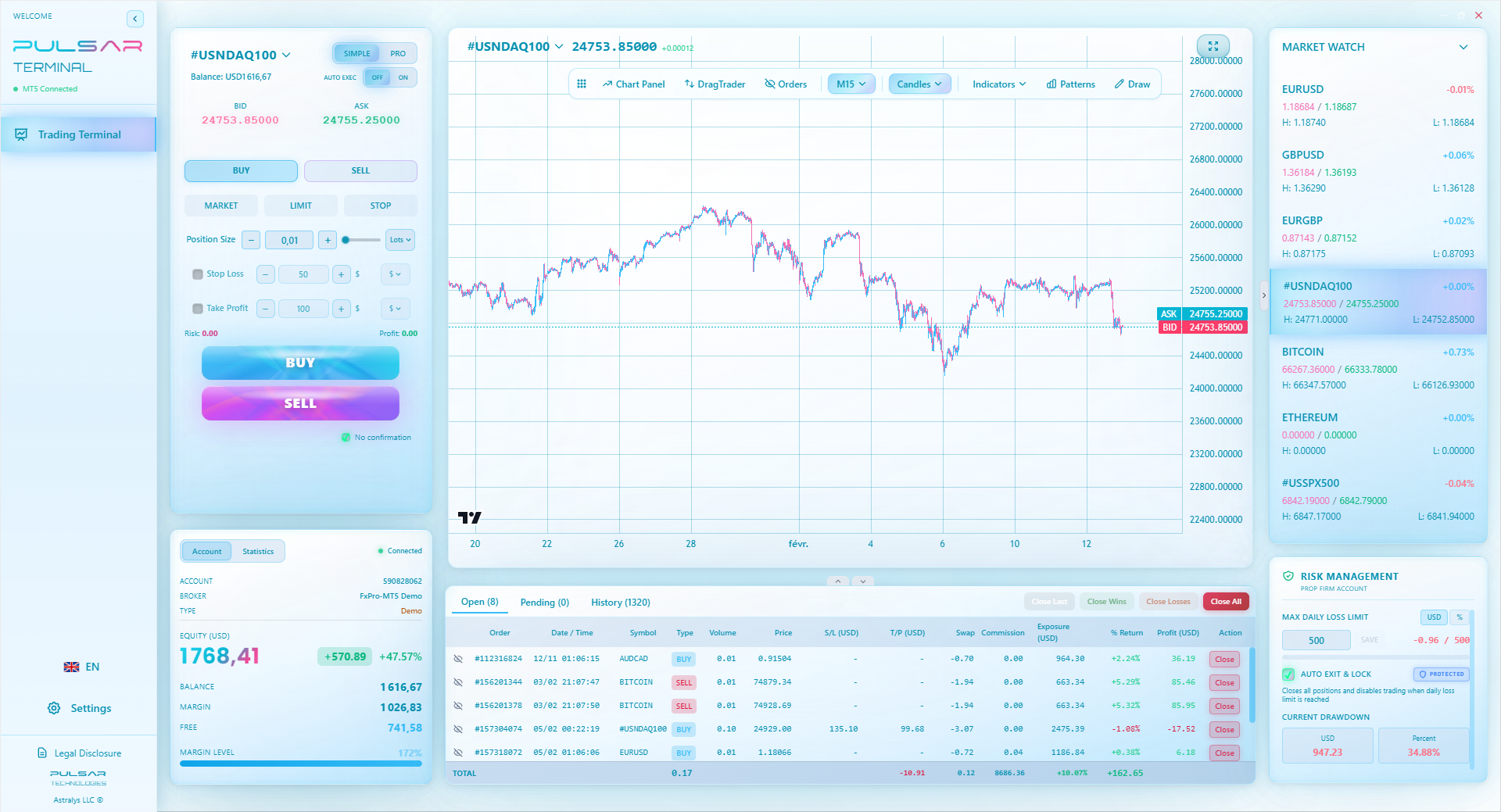
Managing multiple trades and strict risk rules is complex, but tools like Pulsar Terminal automate this directly on your MT5 platform.
Pulsar Terminal
The all-in-one MT5 companion: drag-and-drop orders, multi-TP/SL, trailing stop, grid trading, Volume Profile, and prop firm protection. Used by 1,000+ traders daily.
“The goal isn't to get rich from your first $100 deposit. The goal is to learn, survive, and develop a skill.”
Opening the account is just the ticket to the game. The real work begins now.
Develop a Strategy: Are you a scalper, in and out in minutes? A day trader? Or a swing trading patient enough to hold for days? Your personality dictates this. I'm a terrible scalper - I get impatient. I found my edge in swing trading, holding trades for 2-5 days based on higher time frame analysis.
Keep a Trading Journal: This is non-negotiable. Note the pair, entry/exit price, reason for the trade (e.g., 'bounce off daily support'), your emotional state, and the outcome. Review it weekly. You'll start to see your own patterns, both good and bad.
Manage Your Growth: When you grow your account by 25%, consider withdrawing your initial deposit. Trade with the 'house money.' It's a huge psychological boost. Also, as your account grows, your strategy might evolve. You might move from a Standard account to a Raw Spread account to lower your costs on larger positions.
Finally, understand that this is a marathon. The goal isn't to get rich from your first $100 deposit. The goal is to learn, survive, and develop a skill that can last a lifetime. The Nigerian forex market is growing, with turnover hitting billions. There's opportunity here, but it's reserved for the disciplined, the patient, and the prepared.
FAQ
Q1What is the absolute minimum amount I need to open a forex account in Nigeria?
Technically, you can start with as little as $1 with some brokers like FBS. More commonly, brokers like XM or Exness have minimums of $5 or $10. However, I strongly advise starting with at least $100. This gives you enough buffer to make small, sensible trades and actually learn without being wiped out by a single, tiny market move or a rounding error on fees.
Q2Can I use my Nigerian Naira debit card to fund my forex account?
It's very unlikely to work directly. Most Nigerian banks have blocked or severely restricted international merchant transactions on Naira cards, precisely to prevent forex trading deposits due to CBN guidelines. You will almost certainly need to use alternative methods like cryptocurrency (USDT is very common) or a broker's partnered local payment processor that accepts Naira.
Q3Which broker is the best for beginners in Nigeria?
There's no single 'best,' but for a total beginner, I often point people towards XM or Exness. Why? Their minimum deposits are low ($5 and $10), their platforms are straightforward, they offer Naira account options, and they have extensive educational materials. They provide a low-stakes environment to make your first mistakes. You can read our detailed XM review and Exness review to compare them directly.
Q4Is the 10% capital gains tax on forex profits enforced? How do I pay it?
Yes, it is a legal requirement. Enforcement has been inconsistent, but with the FIRS improving digital systems, it's becoming riskier to ignore. You pay it by declaring your total annual trading profits in your tax returns and calculating 10% of that figure. Keep detailed records of all your trades and withdrawals. It's boring, but it's part of being a professional.
Q5How long does it take to verify my account and start trading?
If you have clear, valid documents ready (Passport/ID and proof of address), the verification process can be as quick as a few hours. In some cases, it might take 1-2 business days. You can usually make a deposit while your documents are being verified, but you often won't be able to withdraw until verification is fully complete.
Q6What's more important for a beginner, low spreads or low minimum deposit?
Low minimum deposit. Hear me out. As a beginner with a small account, the difference between a 1-pip spread and a 0.6-pip spread on a 0.01 lot trade is about 40 cents. That's not what will make or break you. What will break you is poor risk management and psychology. Use a low minimum to get real experience without significant financial fear. Once you're consistently profitable and trading larger sizes, then you can optimize for lower spreads with a broker like IC Markets or Pepperstone.
Prof. Winston's Lesson
Key Takeaways:
- ✓Test withdrawals before large deposits.
- ✓Never use use above 1:50 as a beginner.
- ✓Keep 10% of profits aside for capital gains tax.
- ✓Your first $100 is tuition, not investment capital.
How useful was this article?
Click a star to rate
Weekly Trading Insights
Free weekly analysis & strategies. No spam.
About the Author
Olumide Adeyemi
West African Trading Pioneer
One of Nigeria's most active forex trading educators. 8 years of experience trading from Lagos. Specializes in low-capital strategies and prop firm challenges for African traders.
Comments
Risk Disclaimer
Trading financial instruments carries significant risk and may not be suitable for all investors. Past performance does not guarantee future results. This content is for educational purposes only and should not be considered investment advice. Always conduct your own research before trading.
You Might Also Like

Cara Trading Forex Sukses: 7 Prinsip dari Trader Profesional
Cara trading forex sukses dengan 7 prinsip trader pro: manajemen modal, disiplin, journal trading, backtest. Data nyata, bukan janji profit palsu.
Jam Trading Forex Terbaik untuk Trader Indonesia: Panduan Lengkap dengan Tabel Waktu
Panduan jam trading forex untuk trader Indonesia. Tabel 4 sesi dunia, jam emas 20:00-00:00, sesi mana yang harus dihindari. Data akurat + tips dari trader berpengalaman.
Top 5 Sàn Forex Uy Tín Nhất 2026: Review Jujur dari Trader Indonesia
Top 5 sàn forex uy tín 2026 untuk trader Indonesia. Review jujur: spread, deposit, withdraw, dukungan lokal. Exness, XM, IC Markets & lebih.
Get Pulsar Terminal
All these calculators are built into Pulsar Terminal with real-time data from your MT5 account. One-click position sizing, automatic risk management, and instant calculations.
Get Pulsar Terminal