


Most traders think you need complex indicators and expensive software to win.

Rajesh Sharma
Senior Forex Analyst ·  India
India
☕ 10 min read
What you'll learn:
- 1What is the ORB Trading Strategy? Forget Everything You've Heard
- 2The Core Rules: Your Blueprint for Every Trade
- 3Where and When to Use the ORB: Not All Markets Are Created Equal
- 4Why Traders Fail: The Three Mistakes I Made (So You Don't Have To)
- 5Boosting Your Edge: How to Combine the ORB with Other Tools
- 6ORB vs. Scalping vs. Swing Trading: Where It Fits in Your Arsenal
- 7Broker Choice is Critical: What You Need for ORB Success
- 8Your Action Plan: How to Start Trading the ORB Tomorrow
Most traders think you need complex indicators and expensive software to win. They're wrong. One of the most profitable strategies I've ever used is also one of the simplest: the Opening Range Breakout, or ORB. It's a pure price action play that cuts through the noise. But here's the kicker: 90% of traders who try it fail because they don't understand its core, unforgiving logic. I'll show you the right way to trade it, the mistakes that cost me real money, and how you can use it to find high-probability trades in just the first hour of the market.
The Opening Range Breakout (ORB) strategy is brutally simple. You define a price range for the first 'X' minutes of a trading session - that's your opening range. The rule is then straightforward: you only take a trade when the price breaks cleanly out of that range. You're betting that the initial momentum will continue for the rest of the session.
It's not a fancy indicator. It's not a secret algorithm. It's a recognition that the first move of the day often sets the tone. The magic (and the pain) comes from its discipline. It forces you to wait for a clear signal and ignore all the chop that happens inside the range. I learned this the hard way early on, jumping in on fake moves before the range was truly broken. I'd get stopped out for a 15-pip loss, only to watch the real breakout happen without me. That frustration taught me more about patience than any book ever could.

Warning: The ORB isn't about predicting direction. It's about reacting to a confirmed move. If you try to guess which way it will break, you'll lose. Your job is to wait for the market to show its hand.

💡 Winston's Tip
The market's first impression is often its truest. The ORB capitalizes on this by removing your opinion and forcing you to listen.
Let's get specific. Vague rules lead to blown accounts. Here’s the exact framework I use.
Defining the Opening Range
For most Indian traders focusing on forex or global indices, the first 15 or 30 minutes after the major session opens is key. For the London session (1:30 PM IST), I use the first 30-minute range (1:30 PM to 2:00 PM IST). For the New York open (7:00 PM IST), I often use a 15-minute range. You need to test what works for your instrument. Draw a rectangle on your chart from the high to the low of that period. That's your battlefield.
The Entry Signal
You enter a long trade only when the price closes a 5-minute candle above the high of the opening range. You enter a short trade only on a close below the low. Not a wick, not a spike - a candle close. This is non-negotiable. It filters out the false breaks that will eat your capital.
Placing Your Stop Loss and Take Profit
Your stop loss goes on the opposite side of the opening range. For a long trade, place the stop just below the range's low. For a short, just above the range's high. Your profit target should be a minimum 1:1.5 risk-to-reward ratio. I often aim for a 1:2. If my stop is 20 pips away, my target is at least 40 pips.

Example: On EUR/USD, the London session 30-min range high is 1.0850, low is 1.0830. Price closes a 5-min candle at 1.0853. You go long. Stop loss at 1.0829 (just below 1.0830). Take profit at 1.0893 (a 40-pip target for a 20-pip risk).
This structure makes every trade's outcome binary and removes emotion. You can use a position size calculator to determine exactly how much to risk based on your stop distance.
“Vague rules lead to blown accounts.”
The ORB strategy thrives on liquidity and volatility. It dies in sleepy, range-bound markets. You have to pick your battles.
The best instruments are major forex pairs during their corresponding session opens. Think EUR/USD during London, or USD/JPY during Tokyo. Major indices like the Nifty 50 (if you're trading futures) during the Indian market open (9:15 AM IST) can also work, but beware of gap openings. I've had less consistent results with commodities like XAU/USD using a pure ORB, as gold often has its own erratic opening moves.
For timeframes, I use a 5-minute chart for execution. The opening range is defined on the 30-minute or 15-minute chart, but I watch for the breakout candle on the 5-min. This gives me a precise entry. Higher timeframes like the 1-hour are too slow and give back too much profit.
Here’s a quick table of my personal preferences:
| Instrument | Best Session | Opening Range Period | Notes |
|---|---|---|---|
| EUR/USD | London (1:30 PM IST) | 30 minutes | Highest reliability, clean breaks |
| GBP/USD | London (1:30 PM IST) | 30 minutes | Volatile, can have wider stops |
| Nifty 50 Futures | India Open (9:15 AM IST) | 15 minutes | Watch for gap-ups/downs |
| USD/INR | India Open (9:00 AM IST) | 30 minutes | Good for scalping strategy |
The key is consistency. Don't jump from instrument to instrument. Master the ORB on one pair, like EUR/USD, first.
I wish someone had slapped me with these lessons years ago. They cost me real money.
Mistake 1: Trading the Fakeout. This was my biggest sin. The price would spike 3 pips above the range high and I'd FOMO in, only for it to reverse and stop me out. The rule is a candle close. Not a tick, not a one-second spike. Wait for the candle to close firmly outside the range. This one rule improved my win rate by at least 30%.
Mistake 2: Ignoring the Overall Trend. An ORB against the higher timeframe trend is a lower-probability trade. If the daily chart on EUR/USD is in a strong downtrend, and we get a bullish ORB breakout at London open, I'm very cautious. I might still take it, but I'll reduce my position size or tighten my profit target. The trend is your friend, even in intraday plays.
Mistake 3: Moving the Stop Loss. You set your stop on the other side of the range. That's it. Do not move it further away because you're scared of being stopped out. I did this on a GBP/USD trade. The breakout failed, price came back into the range, and instead of taking my planned 25-pip loss, I moved my stop. The move continued against me and I took a 75-pip loss. That single trade wrecked my week. The ORB is a mechanical strategy. If you break the mechanics, you break the strategy's edge.
These mistakes often lead to a margin call for undisciplined traders. The ORB requires iron discipline, more than any complex system.
💡 Winston's Tip
A strategy that doesn't allow for losses is a fantasy. The ORB's strength is in its defined, acceptable loss on every single trade.
“The magic (and the pain) comes from its discipline.”
A pure ORB is strong. An ORB with confluence is stronger. You don't need ten indicators. One or two for confirmation is plenty.
I use the 200-period Simple Moving Average (SMA) on the 5-minute chart as a dynamic support/resistance filter. If we get a bullish ORB breakout and the price is already above the 200 SMA, that's a green light. If the breakout is trying to push up to the 200 SMA from below, I'm more skeptical.
For momentum confirmation, I glance at the RSI indicator (set to 14). I don't need it to be oversold or overbought. I just want to see it moving in the direction of the breakout. If price breaks above the range but RSI is flat-lining or falling, that's a potential divergence warning.
The MACD indicator on a slightly higher timeframe can show if the session's momentum is aligning. A bullish crossover on the 15-minute MACD as the London ORB triggers long? That's a beautiful confluence.

Pro Tip: Keep it simple. Add one confirmation tool at a time. Start with the pure ORB, then add the 200 SMA filter. See how it affects your results for 50 trades before adding anything else. More tools often just lead to more confusion and hesitation.
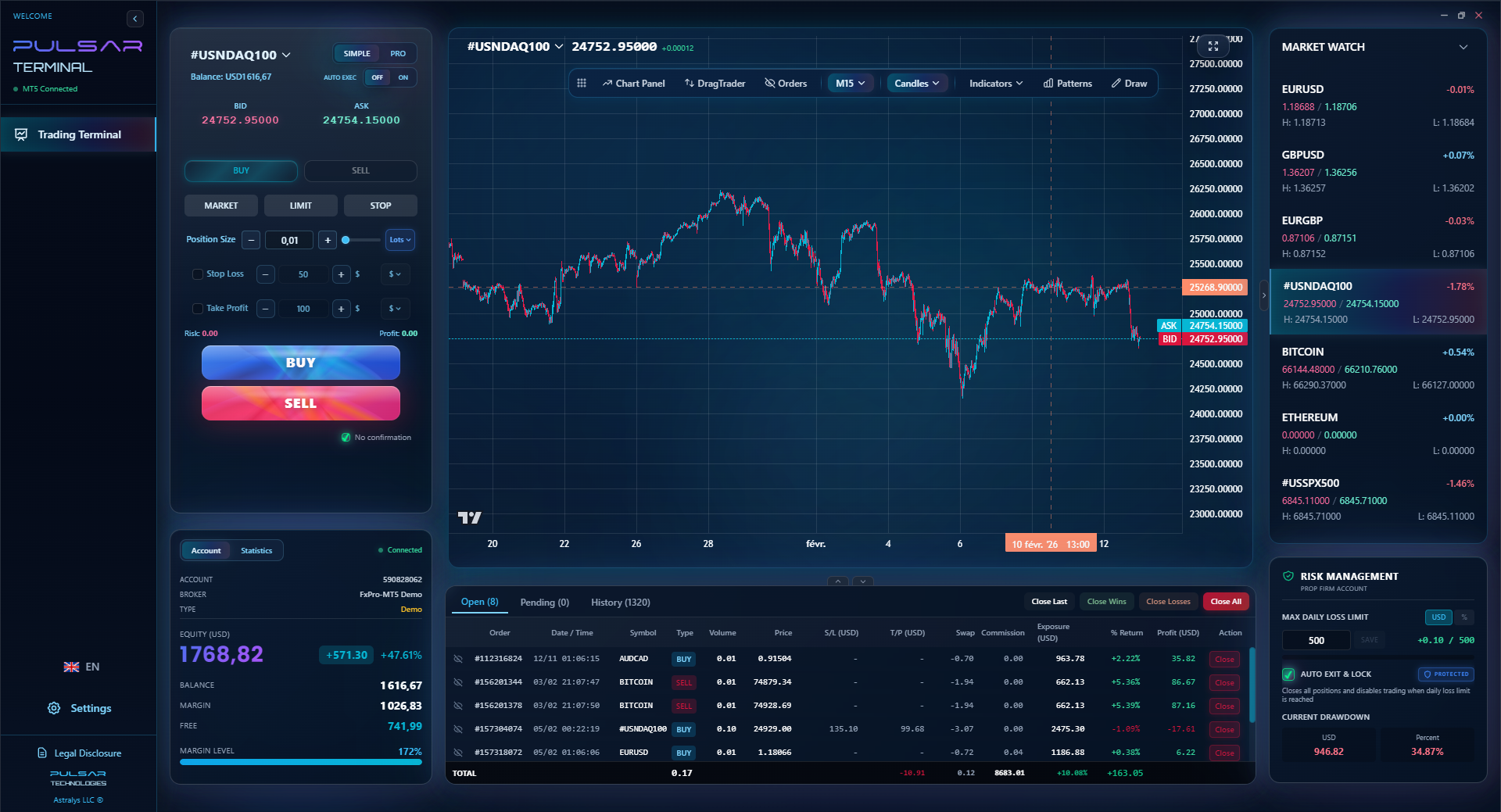
Managing multiple ORB trades with precise stop losses and profit targets is easier with tools that let you drag-and-drop orders directly on your chart.
Pulsar Terminal
The all-in-one MT5 companion: drag-and-drop orders, multi-TP/SL, trailing stop, grid trading, Volume Profile, and prop firm protection. Used by 1,000+ traders daily.
The ORB isn't for everyone. Let's see how it stacks up.
Compared to a pure scalping strategy, the ORB is less frenetic. Scalpers might take 10-20 trades a day, hunting for 5-10 pips. The ORB trader might take just 1-2 high-conviction trades, aiming for 30-50 pips. It requires more patience but less screen time after the opening period. If you have a day job, the ORB is far more practical.
Compared to swing trading, the ORB is much faster. Swing trades can last days or weeks. An ORB trade is usually done within the same session, often within a few hours. It doesn't carry overnight risk or require analyzing fundamental news in depth. It's purely technical and intraday.
The ORB's sweet spot is for the disciplined intraday trader who can't watch screens all day but can commit focused attention to the first hour of a major session. It provides a clear structure in a chaotic market open. Think of it as your opening gambit. You might use it to establish a position that you then manage as a swing trade, but that's an advanced adaptation.
“Master this, and you'll have a foundational skill that makes sense of the market's chaotic open every single day.”
This strategy will fail with a bad broker. The opening minutes of a session are when spreads are widest and slippage is most likely. You need a broker that handles this well.
Low and Stable Spreads: A broker that spikes its spreads to 3 or 4 pips on EUR/USD at the London open will destroy your risk management. Your stop is calculated in pips. If the spread eats a third of your planned risk, your strategy's math falls apart. Look for true ECN/RAW spread accounts.
Fast Execution: You need orders filled at the price you see, especially on the breakout. Requotes or slow execution mean you enter late, with a worse price and a worse risk-to-reward.
Good for Indian Traders: Based on my experience and that of peers, brokers like IC Markets and Pepperstone offer the raw spreads and reliable execution needed for this. Exness can be good for smaller accounts due to low minimum deposits, but always check their specific conditions during session opens. XM is another option with a strong local presence. The key is to test their demo accounts specifically during the volatile opening period you plan to trade.
Remember, the spread definition isn't just a cost; it's a direct tax on your strategy's edge. Minimize it.
💡 Winston's Tip
If you find yourself constantly tweaking the ORB rules, the problem isn't the strategy. It's your inability to follow a plan.
Don't just read this and jump in. Here's a step-by-step plan to avoid blowing up your account.
- Go to Demo: Open a demo account with a good broker. Don't use your live money yet. I don't care how confident you are.
- Pick One Pair: Choose EUR/USD. It's the most liquid and reliable for this.
- Define Your Session: Mark the London open (1:30 PM IST). Set an alarm for 1:25 PM.
- Chart the Range: From 1:30 to 2:00 PM IST, mark the high and low. Draw your box.
- Wait for the Close: Watch the 5-minute chart. Do nothing until a candle closes outside the range.
- Execute Mechanically: Enter, set your stop on the other side, set your 1:1.5 or 1:2 target. Walk away for an hour.
- Journal Everything: Did you follow the rules? What was the spread? Was there slippage? Why did the trade win or lose?
Do this for 50 trades. Not 10, not 20. Fifty. Only after you have a demonstrable, journaled track of profitability on demo should you consider going live with a tiny position size.
The ORB trading strategy is a gem because it's simple, but it's not easy. It requires the discipline of a sniper. It forces you to be patient, to act decisively only when your edge is present, and to accept small, defined losses when you're wrong. Master this, and you'll have a foundational skill that makes sense of the market's chaotic open every single day.
FAQ
Q1What is the best time frame for the ORB strategy?
Use a 30-minute or 15-minute chart to define your opening range (the first 30 or 15 mins of a session). Then use a 5-minute chart to wait for the confirming breakout candle close. This gives precision without getting lost in lower-timeframe noise.
Q2Can I use the ORB strategy on the Nifty 50?
Yes, but with adjustments. The Indian market open (9:15 AM IST) can have gaps. Use the first 15 minutes to define the range after the initial volatility settles. Be aware that news-driven gaps can invalidate the standard ORB logic, so always check for a large gap up or down first.
Q3How do I handle a false breakout?
You follow your rules. Your stop loss is placed on the opposite side of the range. If price breaks out, you enter, and then it reverses and hits your stop, you take the loss. That's the cost of doing business. Do not move your stop. A false breakout is a losing trade in the system; accept it and wait for the next setup.
Q4What's a good risk-to-reward ratio for ORB trades?
Aim for a minimum of 1:1.5. Ideally, 1:2 is the sweet spot. If your stop loss is 20 pips, your take profit should be 40 pips. This means you can be wrong more than half the time and still be profitable, which is crucial for dealing with the strategy's inevitable false breakouts.
Q5Is the ORB strategy suitable for beginners?
It's suitable in its simplicity, but challenging in its required discipline. The rules are easy to understand, which is good for beginners. However, the mental fortitude needed to wait for the close, not chase spikes, and take repeated small losses is where most beginners fail. Start on a demo account for at least two months.
Q6Can I combine the ORB with news trading?
Generally, no. High-impact news releases (like US Non-Farm Payrolls) during or right after your opening range period create massive, unpredictable volatility that can trigger and then violently reverse breakouts. It's best to avoid trading the ORB on days with major scheduled news during your chosen session open.
Q7How much capital do I need to start trading the ORB?
Focus on risk, not capital. You should never risk more than 1-2% of your account on a single trade. If your typical ORB stop loss is 25 pips, and you're trading a micro lot (1,000 units where 1 pip = $0.10), that's a $2.50 risk. To risk 1% ($10), you'd need a $1,000 account. Use a position size calculator to work backwards from your stop loss distance.
Prof. Winston's Lesson
Key Takeaways:
- ✓Wait for the candle close, not the spike.
- ✓Place your stop on the opposite side of the range. Never move it.
- ✓Aim for a minimum 1:1.5 risk-to-reward ratio.
- ✓Test for 50 demo trades before going live.
- ✓Choose brokers with low, stable spreads during session opens.
How useful was this article?
Click a star to rate
Weekly Trading Insights
Free weekly analysis & strategies. No spam.
About the Author
Rajesh Sharma
Senior Forex Analyst
Trading Indian and South Asian markets for over 10 years. Started with NSE currency derivatives before moving to international forex. Specializes in USD/INR and emerging market pairs.
Comments
Risk Disclaimer
Trading financial instruments carries significant risk and may not be suitable for all investors. Past performance does not guarantee future results. This content is for educational purposes only and should not be considered investment advice. Always conduct your own research before trading.
You Might Also Like

Cara Trading Forex Sukses: 7 Prinsip dari Trader Profesional
Cara trading forex sukses dengan 7 prinsip trader pro: manajemen modal, disiplin, journal trading, backtest. Data nyata, bukan janji profit palsu.
Jam Trading Forex Terbaik untuk Trader Indonesia: Panduan Lengkap dengan Tabel Waktu
Panduan jam trading forex untuk trader Indonesia. Tabel 4 sesi dunia, jam emas 20:00-00:00, sesi mana yang harus dihindari. Data akurat + tips dari trader berpengalaman.
Top 5 Sàn Forex Uy Tín Nhất 2026: Review Jujur dari Trader Indonesia
Top 5 sàn forex uy tín 2026 untuk trader Indonesia. Review jujur: spread, deposit, withdraw, dukungan lokal. Exness, XM, IC Markets & lebih.
Get Pulsar Terminal
All these calculators are built into Pulsar Terminal with real-time data from your MT5 account. One-click position sizing, automatic risk management, and instant calculations.
Get Pulsar Terminal