


Let's be blunt: most South African traders use oscillators completely wrong.

David van der Merwe
Emerging Markets Trader ·  South Africa
☕ 10 min read
What you'll learn:
- 1What the Hell is an Oscillator, Really?
- 2Why Oscillators Behave Differently with the ZAR
- 3The Big Three: RSI, Stochastic, and MACD Demystified
- 4How to Actually Trade with Oscillators (Without Blowing Up)
- 5Mistakes I Made So You Don't Have To
- 6Brokers and Platforms: Getting the Tools You Need
- 7A Simple, Actionable Oscillator Routine
- 8The Bottom Line for South African Traders
Let's be blunt: most South African traders use oscillators completely wrong. They slap a Stochastic on their chart, see it hit 'overbought,' and immediately short the Rand, only to watch the USD/ZAR rally another 200 pips against them. I've been there, I've lost money that way, and it's a fast track to blowing up your account. This isn't about memorizing textbook definitions. This is a street-level guide on how to actually use an oscillator in forex to make better decisions with your hard-earned Rands, not get tricked by every false signal the market throws at you.
Forget the complex math. An oscillator is just a momentum meter. Think of it like the rev counter in your car. It doesn't tell you where you're going (that's the trend), but it tells you how hard the engine is working to get there. Is the price movement running out of steam (momentum fading) or is it accelerating?
The core job of any oscillator in forex is to identify potential turning points by measuring the speed and magnitude of price moves. They're built to fluctuate between defined bands or around a centerline. The most common mistake? Treating an oscillator as a standalone buy/sell signal generator. It's not. It's a context tool. A screaming overbought reading in a powerful uptrend isn't a sell signal, it's a warning that the trend might need a breather before continuing.

Warning: No oscillator predicts the future. They are lagging indicators, calculated from past price data. Using them to blindly trade reversals is a great way to fund someone else's new car.
Trading USD/ZAR or EUR/ZAR isn't like trading EUR/USD. Our market has unique quirks that will chew up a standard oscillator strategy if you're not careful.
Liquidity and Gaps
Major pairs like EUR/USD trade trillions daily. USD/ZAR? The daily volume is a fraction of that. Lower liquidity means prices can move more erratically. You'll see sharper, faster moves that can send an oscillator like the RSI from oversold to overbought in a few candles, especially during local market hours or around SARB announcements. These aren't always meaningful signals, just noise amplified by a thinner market.
The Volatility Factor
The Rand is famously volatile. Political news, load-shedding fears, commodity prices – it all hits us fast. High volatility stretches oscillator readings. An RSI of 75 on EUR/USD might be noteworthy; on USD/ZAR during a risk-off session, it might just be getting started. You need to adjust your overbought/oversold thresholds mentally. I often treat 80 and 20 as my extreme levels for ZAR pairs, not the textbook 70 and 30.
The Cost of Being Wrong
With the FSCA capping use at 30:1, your margin for error is smaller than traders in unregulated spaces have. A bad oscillator-based trade that goes 50 pips against you hurts more. This makes position sizing non-negotiable. Never risk more than 1-2% of your capital on a single trade, no matter how perfect your Stochastic divergence looks. Use a position size calculator religiously. I learned this the hard way early on, putting R5,000 on a "sure thing" EUR/ZAR short from an overbought signal and watching it reverse to take R800 from me in minutes.

💡 Winston's Tip
An oscillator reading is just a number. The price chart is the truth. If they disagree, believe the price every single time.
“Your edge doesn't come from the oscillator itself, but from how you integrate its message with price action, trend analysis, and brutal risk management.”
Relative Strength Index (RSI)
The RSI measures the magnitude of recent price changes. It's my personal workhorse. The classic levels are 70 (overbought) and 30 (oversold). But here's the real use: RSI Divergence. This is where price makes a new high, but the RSI makes a lower high. It signals weakening momentum and is one of the stronger reversal clues you can get from an oscillator.
Real Trade Example: In early 2023, USD/ZAR was grinding up. Price made a high at 18.45, RSI peaked near 75. It pulled back, then price rallied again to a new high at 18.52. I looked at the RSI – it only reached 68. That was a bearish divergence. I entered a short at 18.50, placed a stop at 18.65, and took profit at 18.20. The divergence warned me the rally was tired.
Stochastic Oscillator
The Stochastic shows the closing price relative to its recent high-low range. It's hyper-sensitive. It has two lines: %K (fast) and %D (slow). Traders watch for crosses and look for it to exit overbought/oversold territory. It's great for ranging markets but will give constant false signals in strong trends. For a deeper look at momentum tools, understanding the MACD indicator as a complement is useful.
Moving Average Convergence Divergence (MACD)
While often grouped with oscillators, the MACD is a trend-following momentum indicator. It consists of the MACD line, signal line, and a histogram. I use it less for overbought/oversold and more to confirm trend direction and momentum shifts. A MACD crossover above the zero line can be a decent confirmation for a long trade in an emerging uptrend.
| Oscillator | Best For | Biggest Pitfall for ZAR Traders |
|---|---|---|
| RSI | Spotting divergences, general momentum | Being whipsawed in high volatility. |
| Stochastic | Ranging markets, fast entries/exits | Giving endless false signals in a trend. |
| MACD | Trend confirmation, momentum shifts | Lagging behind on fast Rand moves. |
The Trend-Filter Rule
This is the single most important rule. Never use an oscillator signal that goes against the dominant trend on the higher timeframe. If the daily chart for USD/ZAR is in a clear uptrend, I will only take buy signals from oscillators on the 1-hour or 4-hour chart. I will ignore all sell signals, no matter how overbought it looks. This one rule saved me more money than any perfect entry ever made.
Convergence of Signals
Don't rely on one oscillator. Wait for two to agree. Is the RSI showing bullish divergence AND has the Stochastic crossed up from oversold territory? That's a much higher-probability setup than just one indicator flashing. I often use RSI for divergence and the MACD histogram for momentum confirmation.
Timeframe Stacking
I use a three-tier system:
- Daily Chart: Determines the primary trend (my filter).
- 4-Hour Chart: Finds the trading opportunity within the trend.
- 1-Hour Chart: Uses the oscillator for precise entry.
For example, daily trend up. 4-hour chart shows a pullback to a support level. I then drop to the 1-hour and wait for the RSI to climb back above 30 from oversold, then enter long. This is a form of swing trading that uses oscillators for timing.

Pro Tip: Adjust your oscillator settings. The default 14-period RSI can be noisy. Try a 9-period for more sensitivity on lower timeframes, or a 21-period for smoother signals on higher timeframes. There's no holy grail setting – backtest on ZAR pairs to see what works for your style.
“Never use an oscillator signal that goes against the dominant trend on the higher timeframe. This one rule saved me more money than any perfect entry ever made.”
- Trading Every Overbought/Oversold Reading: This is the rookie killer. In a strong trend, an asset can stay overbought or oversold for weeks. Selling USD/ZAR every time the RSI hit 70 during its 2022 bull run was a financial bloodbath.
- Ignoring Divergence Failures: Divergence doesn't guarantee an immediate reversal. Sometimes price will make one more powerful push. I once shorted GBP/ZAR on a beautiful divergence, only to have it squeeze another 150 pips, hitting my stop loss before finally collapsing. You must use a sensible stop loss and accept that not all signals work.
- Using Oscillators on Low Timeframes for Scalping: Trying to scalping strategy the 1-minute chart with a Stochastic is a recipe for disaster. The spread costs alone will eat you alive. On Exness or IC Markets, you might get a tight spread, but the noise is overwhelming. Oscillators need some room to breathe; use them on 15-minute charts or higher.
- Forgetting About the Spread: If you're trading a ZAR pair with a 3-pip spread (common on some accounts), your trade is already 3 pips in the red. An oscillator signal needs to be strong enough to overcome that immediate hurdle. Always check the live spread definition before entering.
My most expensive lesson was on EUR/USD (not even a ZAR pair). RSI was oversold at 28 on the 4-hour chart. I went all in long. The trend was strongly down, but I ignored it. The RSI stayed oversold, dipping to 25, then 22 as price kept falling. I was margin called. That trade cost me R12,000. The trend always trumps the oscillator.
💡 Winston's Tip
The most profitable oscillator signal is the one you ignore because it's against the higher timeframe trend. Patience is a strategy.
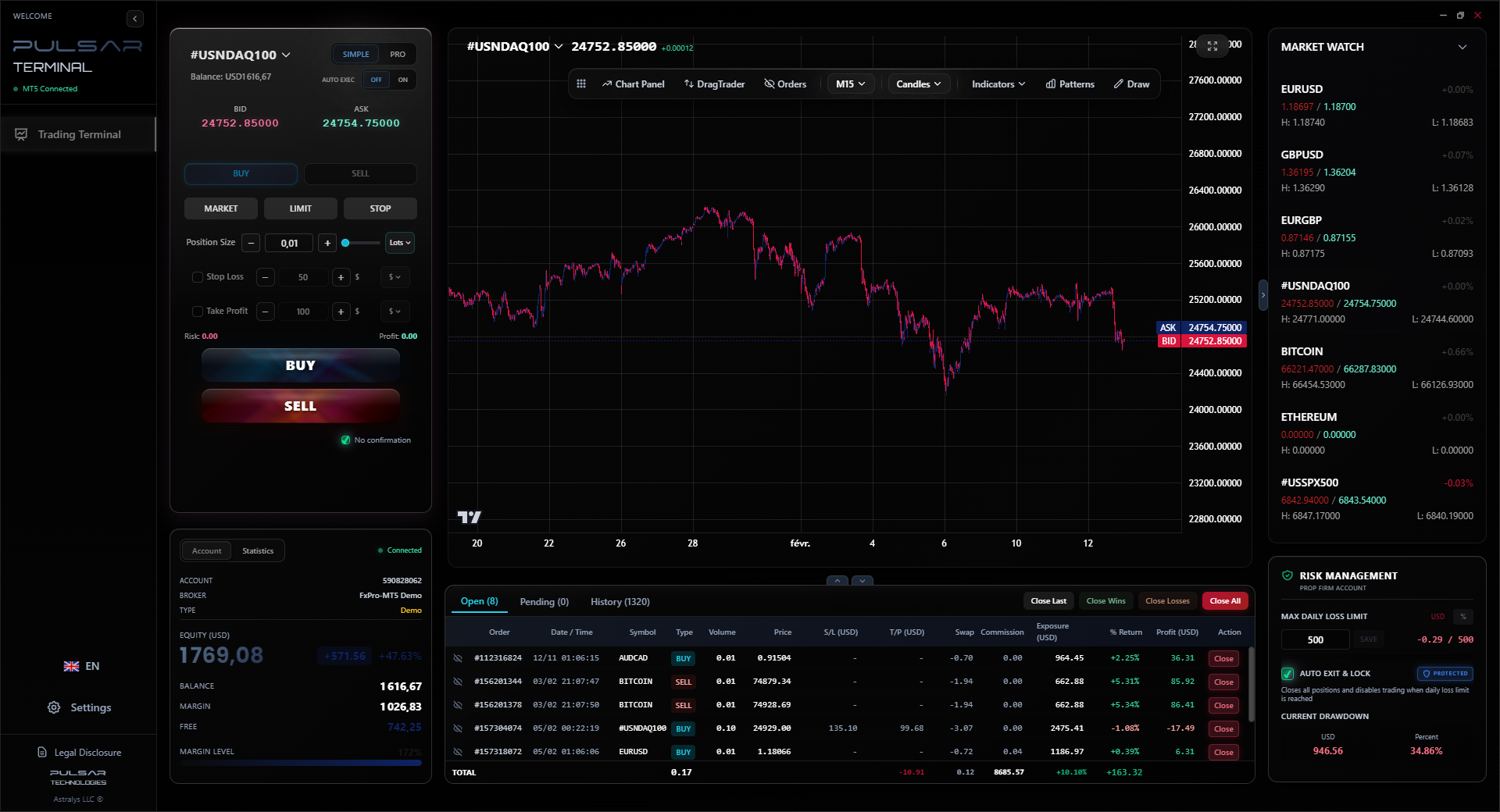
Managing multiple trades based on oscillator signals is complex, but tools like Pulsar Terminal let you set multi-level take-profits and trailing stops directly on your MT5 charts, automating your exit strategy so you don't have to watch every wiggle.
Pulsar Terminal
The all-in-one MT5 companion: drag-and-drop orders, multi-TP/SL, trailing stop, grid trading, Volume Profile, and prop firm protection. Used by 1,000+ traders daily.
You need a platform that lets you use these tools effectively. Most South Africans use MT4 or MT5, which come with all standard oscillators built-in.
Choosing a Broker: Regulation is key. Stick to FSCA-regulated brokers like Pepperstone, IC Markets, or XM. They offer ZAR accounts, which saves you conversion fees. Check their trading conditions:
- Spreads on ZAR Pairs: Expect wider spreads than on majors. A good USD/ZAR spread might be 8-15 pips during active hours. Compare this across brokers.
- Minimum Deposit: You can start with as little as $5 or $10 with some. But be realistic. Starting with R500 (like Khwezi Trade's minimum) is possible, but your position size will be tiny. I recommend at least R5,000 to have room to breathe and manage risk properly.
- Platform Choice: Ensure they offer MT4/MT5. These platforms allow you to customize oscillator settings, save templates, and create alerts.

Example: Let's say you deposit R10,000 with a broker offering 30:1 use. You decide to trade USD/ZAR. With proper risk management (1% risk per trade), your maximum loss on this trade should be R100. Using a position calculator, this dictates your lot size. Don't let use tempt you into a size that makes a normal market move trigger a margin call.
“Trading every overbought/oversold reading is the rookie killer. In a strong trend, an asset can stay overbought or oversold for weeks.”
Here’s my daily checklist when I sit down to trade:
- Determine the Trend: Look at the Daily chart of my chosen pair (e.g., USD/ZAR). Is price above or below key moving averages? Simple trend line? I note: Trend = UP/DOWN/RANGE.
- Find Confluence on the 4H: I zoom to the 4-hour chart. I'm looking for a support level (in an uptrend) or resistance (in a downtrend). Is there a Fibonacci level, a previous swing high/low, or a psychological number nearby?
- Apply the Oscillator on the 1H: Now I go to the 1-hour chart. If the trend is up and price is at 4H support, I wait for the RSI to dip into oversold (below 30-35) and start curling back up. I might also check for bullish divergence.
- Execute with Discipline: If my setup aligns, I calculate my entry, stop loss (placed beyond the recent swing low), and take profit target (at least a 1:1.5 risk-to-reward ratio). I place the trade and walk away. I don't sit and watch the oscillator jiggle.
This process forces me to use the oscillator as a timing tool within a larger, logical framework. It stops me from reactive, emotional trading based on a single flashing light. For pairs like XAU/USD (Gold), this routine is equally valid, though the volatility demands wider stops.
Oscillators are not magic. They are useful servants but terrible masters. In the volatile, sometimes chaotic world of ZAR forex trading, they provide a moment of objective data in a sea of emotion. Your edge doesn't come from the oscillator itself, but from how you integrate its message with price action, trend analysis, and brutal risk management.
Start simple. Master the RSI and its divergences. Practice on a demo account with a South African broker's platform. Lose virtual money until you stop making the classic mistakes. Then, and only then, fund a live account with money you can afford to lose. The path from seeing an oscillator to consistently profiting from it is long, but for the disciplined trader, it's a path worth taking. Now go look at a chart. But this time, look at the trend first.
FAQ
Q1What is the best oscillator for beginner forex traders in South Africa?
Start with the Relative Strength Index (RSI). It's widely available, easy to understand, and its divergence signals are powerful. Avoid the hyper-sensitive Stochastic until you have more screen time. Master one tool before adding complexity.
Q2Can I make a living trading forex with oscillators in South Africa?
Possible, but statistically unlikely and incredibly difficult. With 51-89% of retail traders losing money, the odds are against you. It requires significant capital (ideally R50,000+), years of disciplined practice, and treating it like a business, not a gamble. Most successful traders combine oscillators with other forms of analysis.
Q3Why do my oscillator signals fail more often on USD/ZAR than on EUR/USD?
Lower liquidity and higher inherent volatility. The ZAR market is thinner, so price moves can be sharper and more erratic, causing oscillators to give extreme readings that don't lead to immediate reversals. You often need to adjust your overbought/oversold thresholds and use wider stop losses.
Q4What timeframe should I use oscillators on?
Avoid very low timeframes (under 15 minutes) as they are too noisy. For day trading, the 1-hour and 4-hour charts are most common. For swing trading, the 4-hour and daily charts work well. Always use a higher timeframe to establish the trend first.
Q5Is it legal to use trading signals from oscillator-based apps or gurus?
Using the signals is legal, but the provider must be licensed by the FSCA if they are giving advice as a business. In 2024, the FSCA fined and debarred an unlicensed signals provider. Always check their FSP number. Remember, you are responsible for your trades.
Q6How does FSCA's 30:1 use limit affect using oscillators?
It reduces your margin for error. A bad trade based on a false oscillator signal will lose you a smaller percentage of your margin, but it also means you can't over-use a "sure thing" signal. It forces better risk management, which is a good thing. Always use a position size calculator.
Prof. Winston's Lesson
Key Takeaways:
- ✓Trend first, oscillator second. Always.
- ✓Adjust RSI levels to 80/20 for volatile ZAR pairs.
- ✓Use divergence, not just overbought/oversold levels.
- ✓Risk a maximum of 1-2% per oscillator-based trade.
How useful was this article?
Click a star to rate
Weekly Trading Insights
Free weekly analysis & strategies. No spam.
About the Author
David van der Merwe
Emerging Markets Trader
Johannesburg-based trader with 11 years in emerging market currencies. Specializes in ZAR pairs, FSCA-regulated trading, and South African market analysis.
Comments
Risk Disclaimer
Trading financial instruments carries significant risk and may not be suitable for all investors. Past performance does not guarantee future results. This content is for educational purposes only and should not be considered investment advice. Always conduct your own research before trading.
You Might Also Like

Cara Trading Forex Sukses: 7 Prinsip dari Trader Profesional
Cara trading forex sukses dengan 7 prinsip trader pro: manajemen modal, disiplin, journal trading, backtest. Data nyata, bukan janji profit palsu.
Jam Trading Forex Terbaik untuk Trader Indonesia: Panduan Lengkap dengan Tabel Waktu
Panduan jam trading forex untuk trader Indonesia. Tabel 4 sesi dunia, jam emas 20:00-00:00, sesi mana yang harus dihindari. Data akurat + tips dari trader berpengalaman.
Top 5 Sàn Forex Uy Tín Nhất 2026: Review Jujur dari Trader Indonesia
Top 5 sàn forex uy tín 2026 untuk trader Indonesia. Review jujur: spread, deposit, withdraw, dukungan lokal. Exness, XM, IC Markets & lebih.
Get Pulsar Terminal
All these calculators are built into Pulsar Terminal with real-time data from your MT5 account. One-click position sizing, automatic risk management, and instant calculations.
Get Pulsar Terminal