


I lost R4,200 in about 45 minutes.

David van der Merwe
Emerging Markets Trader ·  South Africa
☕ 11 min read
What you'll learn:
I lost R4,200 in about 45 minutes. That's what happened the first time I tried a prop firm challenge that felt a lot like what people now call Penguin Forex. I got cocky after a few good weeks on my personal account with a broker like IC Markets, figured I could handle the pressure, and blew through the daily loss limit on a single, stubborn EUR/USD trade. The platform just shut me out. No warning, no 'are you sure?' Just a closed position and a locked account. That sting, that sudden cold stop, is the essence of the penguin forex experience. It's not for the faint-hearted, and if you're in South Africa looking at this model, you need to know exactly what you're getting into.
Let's clear this up first. 'Penguin Forex' isn't one specific company with a website you can visit. It's more of a nickname, a label the trading community uses for a certain type of proprietary trading firm (prop firm) model. The 'penguin' part? Think of the environment: cold, strict, and survival-of-the-fittest. These firms operate with a set of rules so tight they feel icy.
In practice, a penguin forex firm gives you a simulated account with a large balance (say, $100,000) to trade with. Your goal is to pass their evaluation challenge by hitting a profit target without breaking their strict rules. If you pass, you get a funded account and keep a large share of the profits you make. The catch? Their rules are notoriously unforgiving. We're talking ultra-low daily loss limits (like 5% of your initial balance), maximum drawdown rules that include both equity and balance, and sometimes even limits on how many lots you can trade per day.

Warning: The community nickname exists for a reason. If a firm's rules feel designed to make you fail rather than succeed, you're probably looking at a penguin-style model. Always read the fine print twice.
It's a world away from the relative freedom of your own retail account. The psychology is completely different. You're not just trading the market; you're trading against a very rigid rulebook.
As a South African, you interact with these firms almost entirely online. You'll sign up, pay a challenge fee (which can range from $100 to $500+), and get access to their trading platform, usually a version of MetaTrader. Your challenge is to hit a profit target - often around 10% - within a set time, while staying within their loss limits.
The Financial Logistics
You'll be paying your challenge fee in US Dollars. That means you're immediately exposed to the ZAR/USD exchange rate. A $250 fee might be R4,500 one month and R4,800 the next. You need to factor that volatility into your risk calculation before you even place a trade. Profits, when you make them, are typically paid out in USD via international wire transfer or sometimes cryptocurrencies like USDT. You'll then have to get those funds into your South African bank account, which involves its own fees and delays.
The Rulebook is Your Bible
This is the core of the penguin forex experience. Let's break down a typical, harsh rule set:
| Rule Type | Typical Penguin Forex Limit | What It Means For You |
|---|---|---|
| Daily Loss Limit | 5% of Initial Balance | Lose $5,000 on a $100k account in a day, and you're out. Immediately. |
| Maximum Drawdown | 10% (Total Equity) | Your account equity (balance + floating P/L) can never drop 10% from the starting point. A string of losing trades can trigger this even if you haven't hit your daily loss. |
| Profit Target | 10% in 30 days | You need to make $10,000 profit on that $100k account to pass. |
| Trading Period | Minimum 5-10 trading days | You can't just make one huge, lucky trade and pass. You have to show consistency. |
The pressure these rules create is immense. It forces a style of trading that is hyper-focused on preservation. You can't use the aggressive scalping strategy you might use on your personal account if it risks a big, quick loss. Every trade's potential loss must be measured against that daily limit.

Example: On a $100,000 challenge account with a 5% ($5,000) daily loss limit, your maximum risk per trade should be a fraction of that. If you risk just 1% of your daily limit per trade, that's only $50. That means your stop-loss placement has to be incredibly precise, or your position size tiny.

💡 Winston's Tip
If a rulebook takes more than 10 minutes to understand, the house always wins. Clarity is the first sign of legitimacy.
“The 'penguin' doesn't care if you need that fee for rent. It only follows the rules of its environment.”
I learned the hard way that the biggest risk isn't the markets. It's the rulebook. My R4,200 lesson happened because I misjudged how quickly a trending move could hit my stop-loss and then, due to slippage, blow right past it. What I thought was a R1,500 risk turned into a R4,200 loss in seconds, tripping the daily limit.
The Psychological Grind: This is the silent killer. Trading under the constant threat of a sudden, automated account closure is stressful. It can make you exit winning trades too early ('I've made my 2% for the day, I can't risk giving it back') and hesitate on valid setups. It's the opposite of the disciplined, process-oriented mindset you need for long-term success in swing trading or other styles.
The 'Gotcha' Factors: Some firms have rules that aren't immediately obvious. For example, a maximum drawdown based on your balance (your starting capital plus any withdrawn profits) instead of just your equity. This means if you pass, get funded, make R20,000 profit and withdraw it, your drawdown limit is still calculated from the original, higher balance. One bad week could wipe out your entire account even if you're technically 'up' overall. You must understand every detail of what a margin call or drawdown means to them.
The Cost of Trying: Challenge fees are non-refundable. If you're a newer trader who needs five or six attempts to get your psychology right, you could be out R20,000 or more before you ever see a cent of profit. That money could have been used to build your own capital in a retail account.
Managing the strict daily loss limits of a penguin forex challenge is nearly impossible manually, which is where automated tools like Pulsar Terminal's daily loss protection feature become essential.
Pulsar Terminal
The all-in-one MT5 companion: drag-and-drop orders, multi-TP/SL, trailing stop, grid trading, Volume Profile, and prop firm protection. Used by 1,000+ traders daily.
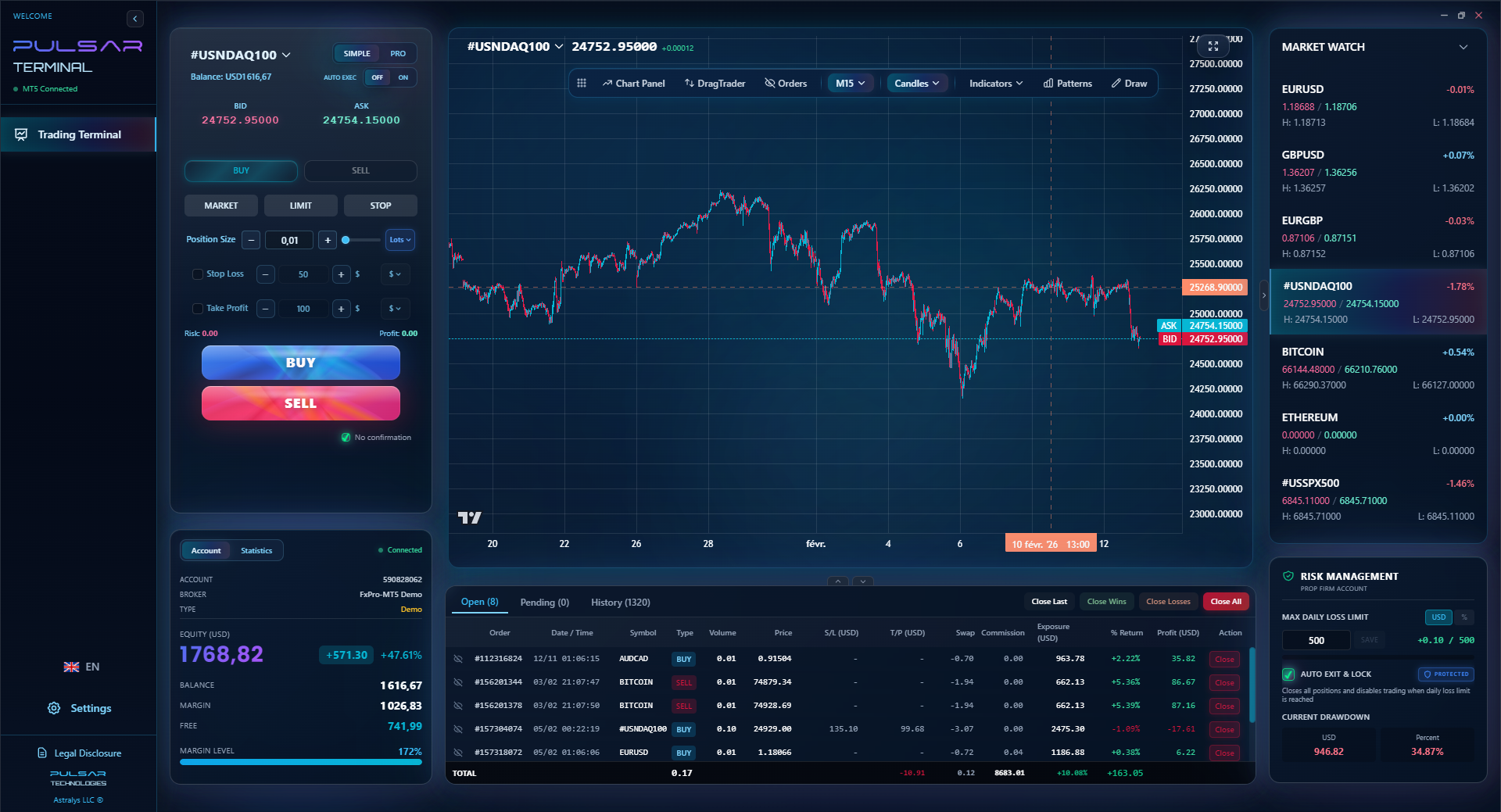
To have any shot in a penguin forex environment, you need a trader's equivalent of blubber and a streamlined body. Your strategy must be insulated against sudden shocks and efficient in its movements.
1. Micro-Position Sizing is Non-Negotiable. This is the most important adjustment. Your position size must be so small that even a worst-case scenario loss won't come close to your daily limit. I now use a position size calculator religiously, but for a prop challenge, I input numbers that are 50% more conservative than my normal risk. If my analysis says I can risk 1% of the account, I'll risk 0.5%. It feels painfully slow, but it keeps you in the game.
2. Favor High-Probability, Technical Setups. Fundamental trades that might take days to play out are dangerous because they tie up capital and create floating losses that count against your drawdown. You need clean, technical setups with clear invalidation points. Tools like the RSI indicator for divergence or the MACD indicator for momentum crosses can help identify these. The goal is a high win rate with small, consistent gains, not home runs.
3. The Daily Loss Limit is Your Sacred Number. Know it, write it down, and track it live. If your daily loss limit is $5,000, consider your first $2,500 loss as a 'warning zone.' If you hit it, seriously consider stopping for the day. The mental recovery is more valuable than trying to claw back and potentially triggering the limit.

Pro Tip: Before you pay for a challenge, practice the exact rules on a demo account for a full month. Give yourself the same profit target and strict loss limits. If you can't pass your own demo challenge consistently, you're not ready to pay real money.
4. Avoid High-Volatility Instruments Early On. Trading XAU/USD (gold) might be tempting, but its spreads can widen and it can move R1,000 per ounce in a blink. Stick to major forex pairs like EUR/USD during the overlapping London and New York sessions where liquidity is highest and spreads are tightest. Every saved pip on the spread helps your tiny profit margins.
💡 Winston's Tip
Practice on demo with the exact rules for twice as long as you think you need. Your future self will thank you for the cheap tuition.
“Your biggest risk in a prop challenge isn't the markets. It's the rulebook.”
Is this the only path to trading larger capital? Absolutely not. Let's compare.
The Penguin Forex (Prop Firm) Route:
- Capital Access: High. You can trade $100k+ with a few hundred dollars.
- Risk: Your risk is limited to the challenge fee. No debt if you blow the account.
- Control: Very low. You are bound by a strict, often stressful, rulebook.
- Profit Potential: High percentage share (80-90%), but of the firm's capital.
- Best For: Disciplined, rule-based traders with small starting capital who can handle high psychological pressure.
The Retail Broker Route (e.g., Exness, XM, Pepperstone):
- Capital Access: You trade only what you deposit.
- Risk: You can lose your entire deposited capital.
- Control: Total. You set your own rules, trading times, and strategies.
- Profit Potential: 100% of your profits, but on a much smaller base.
- Best For: Traders building their own capital, those who value flexibility, and anyone developing their own unique style without external pressure.
The 'Save-Up' Route:
- Capital Access: Grows slowly with your savings and profits.
- Risk: You risk your own, hard-saved money.
- Control: Total.
- Profit Potential: 100% of your profits on your growing capital.
- Best For: Patient traders with a steady income outside of trading. This is the slowest but often most psychologically sustainable path.
For many South Africans, starting with a reputable international broker that accepts ZAR deposits and offers decent use might be a smarter first step. You can build skills and confidence without the sword of Damocles hanging over every trade.
If you decide the prop firm model is for you, due diligence is critical. The penguin forex label warns of harsh rules, but you must also avoid outright scams.
1. Transparency is Key: Legitimate firms have clear, easily accessible terms and conditions. They explain their drawdown calculations with examples. If you have to dig through forums or ask support five times to understand a basic rule, walk away.
2. Community Reputation: Don't just look at the firm's website. Search for the firm's name + 'review' + 'South Africa' or 'withdrawal problem.' Look on independent forums and social media. A pattern of delayed payments or hidden fees is a major red flag.
3. Start Small: If a firm offers multiple challenge sizes (e.g., $10k, $50k, $100k), start with the smallest, cheapest one. Use it as a paid learning experience to understand their platform and rule enforcement before committing more money.
4. Support Responsiveness: Test their customer support before you pay. Send a question about their rules. How fast and how clearly do they respond? If they're unhelpful before they have your money, they'll be ghosts afterwards.
Remember, you are paying them for the opportunity. You are the customer. Act like one.
💡 Winston's Tip
The fastest way to blow a prop account is to trade like it's your money. It's not. It's a rented car with a strict mileage limit.
“Trade micro lots (0.01) or smaller to have any breathing room against those icy daily limits.”
Here's my straight take, after 12 years and that expensive early lesson.
The penguin forex model is a specific tool for a specific job. It's not a magic shortcut. It's a high-pressure, high-stakes audition. It can be a viable path for a trader who has proven consistency on a personal account but lacks the capital to scale up meaningfully. The strict rules, as painful as they are, can teach brutal lessons in risk management that stick with you forever.
However, for most South African traders, especially those still in their first few years, I believe it's a sub-optimal path. The psychological toll and the cost of repeated challenges can set you back further than just patiently growing a R10,000 account at a broker like IC Markets or Pepperstone. The pressure to perform can distort your trading process, ingraining bad habits like premature exits or an inability to let winners run.
If you do choose to enter the icy waters, go in with your eyes wide open. Practice the rules first. Size your positions as if your daily loss limit is half of what it actually is. And never, ever risk money on a challenge that you can't afford to lose completely. The penguin doesn't care if you need that fee for rent. It only follows the rules of its environment. Make sure you can survive in it.
FAQ
Q1Is Penguin Forex a scam?
Not necessarily. 'Penguin Forex' is a community term for prop firms with very strict, unforgiving rules. While some firms using this model are legitimate, the harsh rules make it extremely difficult to pass and withdraw profits. The risk is less about outright theft and more about rules designed so tight that failure is highly likely, allowing the firm to keep your challenge fee.
Q2Can I use my normal trading strategy for a Penguin Forex challenge?
Probably not without major adjustments. Your normal strategy likely risks too much per trade or holds trades through drawdowns that would violate a prop firm's maximum drawdown rule. You'll need to drastically reduce position sizes and may need to favor shorter-term trades to avoid overnight risk counting against your daily limit.
Q3How do I get paid from a prop firm in South Africa?
Most firms pay profits via international bank wire transfer (in USD) or cryptocurrency like USDT. For bank transfers, you'll receive USD into your local bank account, where it will be converted to ZAR by your bank, often with less favorable rates and fees. Crypto withdrawals to a local exchange like Luno or VALR are becoming more common and can be faster and cheaper.
Q4What's the biggest mistake traders make with these challenges?
Oversizing. They see a $100,000 account and trade lots sizes as if it's their own $100,000. A single 1-lot trade on EUR/USD has a pip value of $10. A 50-pip loss is $500, which could be 10% of your daily limit on one trade. You must trade micro lots (0.01) or smaller to have any breathing room.
Q5Are there any prop firms that are better for beginners?
Look for firms with more reasonable rules, sometimes called 'beginner-friendly' prop firms. These might have a higher daily loss limit (e.g., 10% instead of 5%), a drawdown based only on equity (not balance), and no minimum trading day rule. However, 'easier' rules often come with higher challenge fees or lower profit splits. Always do your research.
Q6Is it better to just trade my own money in South Africa?
For most people, especially in the first 2-3 years, yes. Trading your own R10,000-R50,000 with a broker like Exness or XM teaches you real risk management with your own capital. There's no artificial pressure to hit a target by a certain date. You can focus on the process, which is the foundation of long-term success. The growth is slower, but the lessons are more sustainable.
Prof. Winston's Lesson
Key Takeaways:
- ✓Position size must be 50% of your normal risk in a prop challenge.
- ✓A 5% daily loss limit can be breached by a single bad trade.
- ✓Always practice the exact rules on demo for 30 days first.
- ✓The challenge fee is tuition, not an investment.
How useful was this article?
Click a star to rate
Weekly Trading Insights
Free weekly analysis & strategies. No spam.
About the Author
David van der Merwe
Emerging Markets Trader
Johannesburg-based trader with 11 years in emerging market currencies. Specializes in ZAR pairs, FSCA-regulated trading, and South African market analysis.
Comments
Risk Disclaimer
Trading financial instruments carries significant risk and may not be suitable for all investors. Past performance does not guarantee future results. This content is for educational purposes only and should not be considered investment advice. Always conduct your own research before trading.
You Might Also Like

Cara Trading Forex Sukses: 7 Prinsip dari Trader Profesional
Cara trading forex sukses dengan 7 prinsip trader pro: manajemen modal, disiplin, journal trading, backtest. Data nyata, bukan janji profit palsu.
Jam Trading Forex Terbaik untuk Trader Indonesia: Panduan Lengkap dengan Tabel Waktu
Panduan jam trading forex untuk trader Indonesia. Tabel 4 sesi dunia, jam emas 20:00-00:00, sesi mana yang harus dihindari. Data akurat + tips dari trader berpengalaman.
Top 5 Sàn Forex Uy Tín Nhất 2026: Review Jujur dari Trader Indonesia
Top 5 sàn forex uy tín 2026 untuk trader Indonesia. Review jujur: spread, deposit, withdraw, dukungan lokal. Exness, XM, IC Markets & lebih.
Get Pulsar Terminal
All these calculators are built into Pulsar Terminal with real-time data from your MT5 account. One-click position sizing, automatic risk management, and instant calculations.
Get Pulsar Terminal