


If you've spent any time in a Nigerian trading group, you've seen it: 'What's the pivot for EUR/USD today?' It's treated like a magic number, a secret key to the market.

Olumide Adeyemi
West African Trading Pioneer ·  Nigeria
☕ 11 min read
What you'll learn:
- 1What Are Pivot Points, Really?
- 2Calculating Your Levels: The Formulas You Should Know
- 3Practical Trading Strategies for the Nigerian Trader
- 4Setting Up Pivots on Your Platform: A Local Guide
- 5Risk & Money Management: Protecting Your Naira
- 6Common Mistakes & How to Avoid Them
- 7Taking It Further: Confluence with Other Tools
If you've spent any time in a Nigerian trading group, you've seen it: 'What's the pivot for EUR/USD today?' It's treated like a magic number, a secret key to the market. But here's the truth most won't tell you: blindly trading off a single pivot point is a fast way to lose money. The real power isn't in the number itself, but in the structure of support and resistance it reveals. I learned this the hard way, losing two decent positions on GBP/JPY because I ignored the other levels. Let's set the record straight on how to actually use pivot points forex trading to your advantage, right here in our market.
Forget the complex definitions. A pivot point is simply a calculated average of the previous day's high, low, and closing price. It acts as a central reference point for the current trading day. The magic happens with the levels derived from it: support levels (S1, S2, S3) below and resistance levels (R1, R2, R3) above.
Think of it like a football pitch. The pivot point (PP) is the center circle. The support levels are your defensive lines, areas where buying pressure might step in. The resistance levels are your attacking lines, areas where selling pressure might emerge. The market tends to react around these lines. It's not a crystal ball, but a map of probable battlegrounds.
I used to think these levels were rigid walls. They're not. They're more like zones of interest. Price will often respect them, test them, or fake a break before reversing. The key is watching how price behaves at these zones. Does it bounce cleanly? Does it stall and chop around? That reaction gives you the information, not just the level itself.

Example: Let's say yesterday, EUR/USD had a High of 1.0850, a Low of 1.0750, and a Close of 1.0800. The Standard Pivot Point (PP) is (1.0850 + 1.0750 + 1.0800) / 3 = 1.0800. Resistance 1 (R1) = (2 x 1.0800) - 1.0750 = 1.0850. Support 1 (S1) = (2 x 1.0800) - 1.0850 = 1.0750. Your platform does this math instantly, but knowing the formula helps you understand what you're looking at.
“Pivot points are not a trade signal. They are a map of where the fight is likely to happen.”
Most platforms auto-calculate, but you need to know what's under the hood. There are different methods, but the Standard (Floor) method is the most common starting point. Here’s the breakdown:
Standard Pivot Points
- Pivot Point (PP) = (Previous High + Previous Low + Previous Close) / 3
- First Resistance (R1) = (2 x PP) - Previous Low
- First Support (S1) = (2 x PP) - Previous High
- Second Resistance (R2) = PP + (Previous High - Previous Low)
- Second Support (S2) = PP - (Previous High - Previous Low)
- Third Resistance (R3) = Previous High + 2*(PP - Previous Low)
- Third Support (S3) = Previous Low - 2*(Previous High - PP)
Other Methods You Might See
Fibonacci Pivot Points: These use Fibonacci ratios (38.2%, 61.8%) to calculate the support and resistance levels instead of the standard formulas. They tend to be tighter and can be useful in trending markets. Camarilla Pivot Points: These generate 4 support and 4 resistance levels very close to the current price, popular for scalping strategy.
My advice? Start with Standard. Get comfortable reading price action there before complicating things. I wasted months jumping between Fibonacci and Camarilla systems, confused when they gave conflicting signals. Consistency with one method beats randomness with five.

Warning: The 'Previous Close' is critical. For the 24-hour forex market, most traders use the New York close (5 PM EST). If your platform uses a different session close (like GMT), your levels will be different. Check your settings! A mismatch here was the reason my early trades were constantly getting stopped out just before a reversal.

💡 Winston's Tip
The central Pivot Point is a magnet. In a quiet market, price will often get drawn back to it after testing S1 or R1. Use this to take partial profits.
“One level is a suggestion. Two or three aligning is a plan.”
Theory is fine, but how do you make money with this? Here are two core approaches I've used successfully, adapted for our volatile market conditions and the brokers we use, like Exness or IC Markets.
The Range-Bound Bounce Trade
This works beautifully on days without major news. The idea is simple: buy near support, sell near resistance.
- Identify a clear range between S1 and R1.
- Wait for price to approach S1. Don't jump in early.
- Look for a confirmation candle - a bullish pin bar, a bullish engulfing, or just a clear rejection off the level.
- Enter long, with a stop loss just below S1 (or below S2 for more room).
- Take profit at the PP or R1.
I took a trade like this on USD/NGN futures (yes, you can speculate on this) last month. Price dipped to S1 at ₦1,492.50, formed a hammer candle. I went long, placed my stop at ₦1,488 (below S2). Took half profit at the PP (₦1,502) and let the rest run to R1 at ₦1,510. Net gain: about 1.1% on the margin used.
The Breakout and Retest Trade
When news hits or a strong trend is in play, the market will break levels. The trick is not chasing the break.
- Price breaks above R1 with strong momentum.
- Wait for it to pull back and retest R1, which should now act as support.
- Look for a bullish confirmation on the retest.
- Enter long, stop loss below the retested level.
- Target the next resistance (R2).
This requires more patience. The false break is the killer. I got caught in 2023 on Gold (XAU/USD guide) when it broke R1, I bought immediately, and it slammed back down. Lost $280 in minutes. Now, I always wait for the retest.
Remember, these levels work on all timeframes. For day trading, use the daily pivots on the 15-min or 1-hour chart. For swing trading, the weekly pivots on the 4-hour chart can be golden.
“One level is a suggestion. Two or three aligning is a plan.”
Here’s the good news: every major platform used in Nigeria has pivot points built in. You don't need to calculate manually. Let's get you set up.
On MetaTrader 4/5 (MT4/MT5): This is what most of us use with brokers like XM, Pepperstone, or XM review.
- Open your chart.
- In the top menu, click 'Insert' -> 'Indicators' -> 'Custom' -> 'Pivot Points'.
- A settings box appears. The key setting is 'Timeframe'. Set it to 'Daily' for daily pivots. You can also choose the calculation method (Standard, Fibonacci, etc.) here.
- Click OK. Your levels will now appear as horizontal lines across the chart.
A Crucial Nigerian Consideration: Session Times Your broker's server time dictates the 'day'. If your broker server is on GMT (like many), the 'daily' pivot resets at midnight GMT. This might not align perfectly with the traditional New York close (5 PM EST, which is 10 PM GMT). This can cause a 5-hour shift in your levels! Some brokers offer 'Session Pivot Points' where you can manually set the start/end time. If yours doesn't, just be aware of the shift and maybe use weekly pivots for a more stable picture.
Visual Settings Tip: Change the color of the central Pivot Point line to something bold (like thick red). Make S1/R1 a solid blue, and S2/R2 a dashed blue. This visual hierarchy helps you instantly see the most important levels. Cluttered charts lead to confused decisions.
💡 Winston's Tip
Weekly Pivot Points, especially the Weekly R1 and S1, are often the most important for swing traders. Mark them on your Sunday chart and watch them all week.
“The false break is the killer. I now always wait for the retest.”
This is where the rubber meets the road. Pivot points give you entry and exit zones, but money management keeps you in the game. With Nigerian brokers offering use up to 1:1000 (like Exness review shows), the temptation to over-use at a 'sure thing' pivot bounce is huge. Resist it.
First, Position Size. Never risk more than 1-2% of your account on a single trade. Use a position size calculator. Let's say your account is $500 (about ₦715,000 at ~₦1,430/$). 1% is $5. If your stop loss on a EUR/USD trade is 20 pips, and each pip is worth $1 for a standard lot, you can only trade 0.025 lots. That's a micro lot. It feels small, but it's sustainable.
Second, Stop Loss Placement. Your stop should always be based on the market structure, not an arbitrary dollar amount. If you go long at S1, your stop should go below S2 or below the recent swing low. This gives the trade room to breathe. Placing it 5 pips below S1 is asking to get stopped out by market noise. I've paid the 'noise tax' more times than I care to admit.
Third, The 10% Tax Reality. Remember, profits are subject to a 10% Capital Gains Tax in Nigeria. Factor this into your profit targets. If you aim for a 5% return, know that 0.5% of that is going to tax. It's a cost of doing business. Keep simple records - a spreadsheet with entry, exit, profit in USD and Naira. When you withdraw, be prepared.

Pro Tip: Use pivot levels to trail your stop loss. If you're long and price moves from S1 to PP, move your stop loss to breakeven. When it hits R1, trail your stop to just below PP. This locks in profit and lets winners run. Manual trailing is tough; this gives you a logical, level-based method.
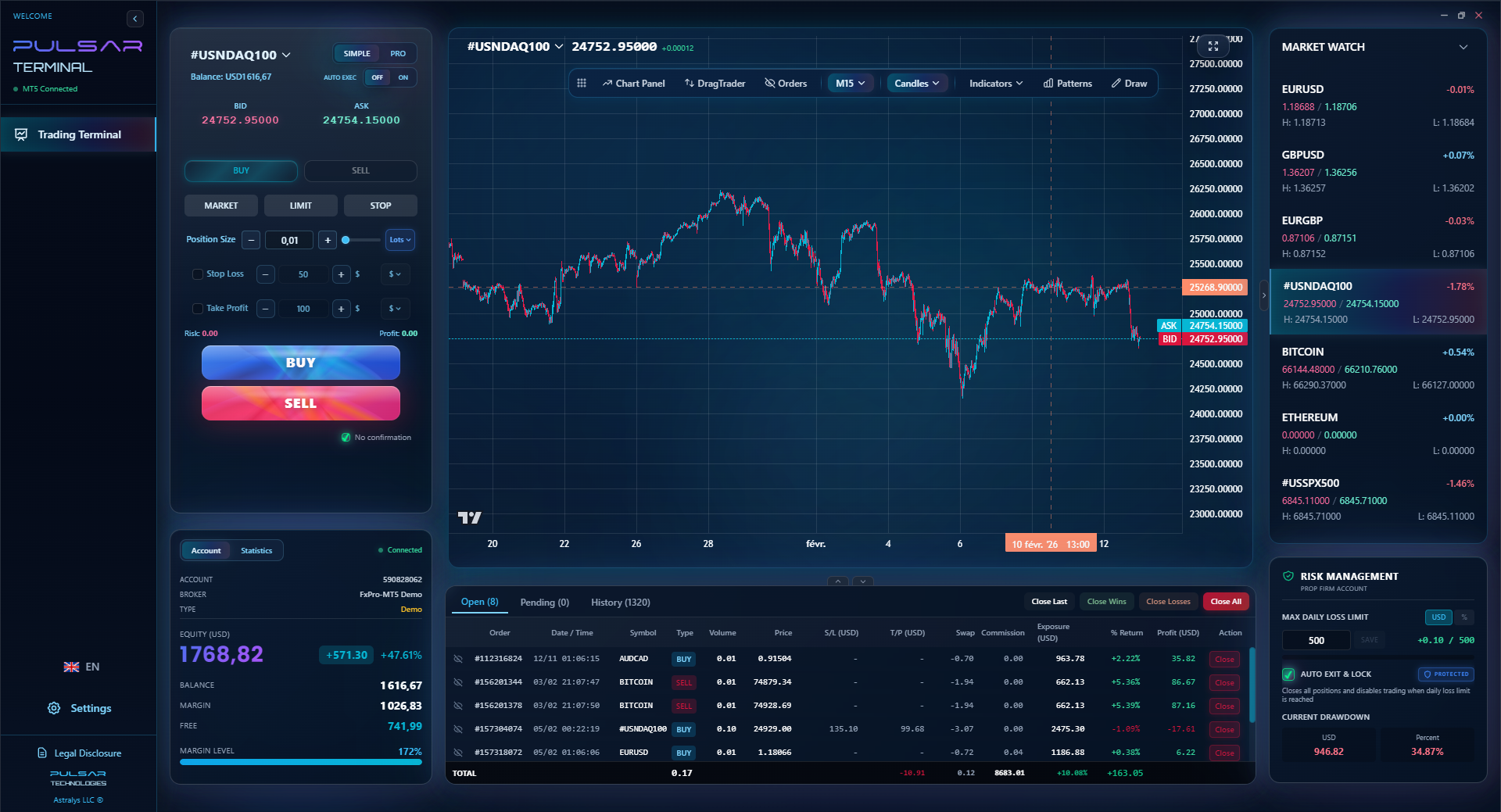
Managing multiple trades and trailing stops around pivot levels is complex, but tools like Pulsar Terminal automate partial closures and trailing stops directly on your MT5, turning level-based strategies into precise, hands-off executions.
Pulsar Terminal
The all-in-one MT5 companion: drag-and-drop orders, multi-TP/SL, trailing stop, grid trading, Volume Profile, and prop firm protection. Used by 1,000+ traders daily.
“The false break is the killer. I now always wait for the retest.”
I've made most of these. Learn from my losses.
1. Trading the Pivot Point in Isolation. The PP is important, but it's not a trade signal by itself. You need confluence. Is the PP also near a 50% Fibonacci retracement? Is there a key horizontal level there? Is the MACD indicator showing a divergence? One level is a suggestion. Two or three aligning is a plan.
2. Ignoring Higher Timeframe Context. The daily pivot might say 'buy' at S1, but what if on the weekly chart, price is crashing through a massive support zone? The higher timeframe usually wins. Always zoom out. A quick check of the 4-hour and weekly chart can save you from a terrible trade.
3. Forgetting About Spreads. If S1 is at 1.0800 on EUR/USD and you want to buy, your broker's buy price might be 1.0803 due to the spread definition. If the spread is wide (common on exotic pairs or with certain account types), your effective entry is already past the level. This is especially crucial with brokers offering 'zero spread' accounts that charge a commission - know your total cost per pip definition.
4. Chasing Breakouts Without Confirmation. This was my biggest leak. Price ticks above R1 and I FOMO in. Then it fails. Now, I use a simple close rule: I need to see a 1-hour or 30-minute candle close above R1 before I even consider a breakout trade. It filters out 80% of the fakeouts.
5. Not Adjusting for Volatility. Pivot levels are static for the day. If a huge news event hits (like a CBN announcement), all technical levels can go out the window. On high-volatility days, either widen your stops significantly or stay out. Protecting your capital is job number one.
💡 Winston's Tip
If price gaps open above R1 or below S1, the first move of the day is often a fill of that gap back towards the level. Don't chase the gap.
“Protecting your capital is job number one, especially with the taxman waiting for his 10%.”
To graduate from basic pivot use, you need to combine them with other trusted tools. This is where your edge is built.
Pivot Points + Moving Averages: Use a simple 50 or 200-period Exponential Moving Average (EMA). If price is at a pivot support (S1) and bouncing off the rising 50 EMA, that's a much stronger buy signal than just the pivot alone. The moving average shows the trend direction, adding context.
Pivot Points + RSI indicator: Look for divergence. If price makes a new low at S2, but the RSI makes a higher low (bullish divergence), it signals weakening selling pressure right at a key support. That's a high-probability reversal setup. I caught a beautiful 120-pip move on GBP/USD using this exact setup at a weekly S1 level.
Pivot Points + Volume/Market Profile: This is next-level stuff. Tools like Volume Profile show where most trading activity happened (the Point of Control). If the daily Pivot Point aligns with the previous day's Point of Control, that zone becomes a massive magnet for price. It's a powerful confluence few retail traders check.
The Final Word: Pivot points are not a standalone system. They are a fantastic framework - a map of the day's potential turning points. Your job is to use other tools (price action, momentum indicators, volume) to decide if and when to trade at those points. Start simple. Mark your daily levels, watch how price behaves there for a week without trading. Then, add one confirmation filter. Slow, deliberate practice beats frantic, complex trading every single time.
FAQ
Q1What is the best time frame to use with pivot points in forex?
It depends on your style. For day trading, plot the Daily pivots on the 15-minute, 30-minute, or 1-hour chart. The levels are fixed for the day, and you use the lower timeframe for precise entries. For swing trading, use the Weekly pivots on the 4-hour or daily chart. I personally have the daily pivots on my 1-hour chart for most of my trading.
Q2Do pivot points work on all currency pairs?
They work best on major and minor pairs with high liquidity and lower spreads, like EUR/USD, GBP/USD, or USD/JPY. These pairs respect technical levels more cleanly. On exotic pairs (which can involve the Naira), volatility and wider spreads can cause price to spike through levels without much respect. Stick to the majors when learning.
Q3How do I know which pivot point calculation method to use?
Start with the Standard (Floor) method. It's the most common, most referenced, and provides a solid baseline. Once you're completely comfortable, you can experiment. Some traders use Fibonacci pivots in strong trending markets. But 90% of the time, Standard pivots are perfectly sufficient. Don't get lost in the options.
Q4Are pivot points lagging indicators?
Yes, and that's okay. They are calculated from past price data (yesterday's high, low, close). They don't predict the future. What they do is identify probable areas of future support and resistance based on where the market has already decided value was. They are a reactive framework, not a predictive one.
Q5Can I use pivot points for crypto trading in Nigeria?
Absolutely. The principle is the same. However, crypto markets (like Bitcoin/USD) are far more volatile and trade 24/7. You need to be consistent with your session times - most crypto traders use UTC midnight for their 'daily' reset. Also, use wider stop losses because the noise around levels is much greater.
Q6What should I do if price is stuck between two pivot levels (e.g., PP and R1)?
Stay out. That's a sign of consolidation or indecision. Your edge with pivots comes at the reactions near the levels. If price is chopping in the middle, there's no clear signal. Wait for it to approach a level with purpose. Patience is a position. Forcing a trade in no-man's-land is a common mistake.
Q7How do Nigerian forex regulations affect using pivot points?
The regulations (like the new SEC rules) don't affect the technical tool itself. They affect your choice of broker and the safety of your funds. Always prioritize trading with a reputable, well-regulated international broker that accepts Nigerian clients. The pivot points will work the same on any legitimate MT4/MT5 platform.
Prof. Winston's Lesson
Key Takeaways:
- ✓Always use the Standard Pivot formula as your baseline.
- ✓Never risk more than 1-2% of your account on any single pivot trade.
- ✓Place stop losses based on market structure (below S2, not just below S1).
- ✓Wait for a candle close beyond a level before trading a breakout.
- ✓Combine pivots with one other indicator (like RSI or an EMA) for confirmation.
How useful was this article?
Click a star to rate
Weekly Trading Insights
Free weekly analysis & strategies. No spam.
About the Author
Olumide Adeyemi
West African Trading Pioneer
One of Nigeria's most active forex trading educators. 8 years of experience trading from Lagos. Specializes in low-capital strategies and prop firm challenges for African traders.
Comments
Risk Disclaimer
Trading financial instruments carries significant risk and may not be suitable for all investors. Past performance does not guarantee future results. This content is for educational purposes only and should not be considered investment advice. Always conduct your own research before trading.
You Might Also Like

Cara Trading Forex Sukses: 7 Prinsip dari Trader Profesional
Cara trading forex sukses dengan 7 prinsip trader pro: manajemen modal, disiplin, journal trading, backtest. Data nyata, bukan janji profit palsu.
Jam Trading Forex Terbaik untuk Trader Indonesia: Panduan Lengkap dengan Tabel Waktu
Panduan jam trading forex untuk trader Indonesia. Tabel 4 sesi dunia, jam emas 20:00-00:00, sesi mana yang harus dihindari. Data akurat + tips dari trader berpengalaman.
Top 5 Sàn Forex Uy Tín Nhất 2026: Review Jujur dari Trader Indonesia
Top 5 sàn forex uy tín 2026 untuk trader Indonesia. Review jujur: spread, deposit, withdraw, dukungan lokal. Exness, XM, IC Markets & lebih.
Get Pulsar Terminal
All these calculators are built into Pulsar Terminal with real-time data from your MT5 account. One-click position sizing, automatic risk management, and instant calculations.
Get Pulsar Terminal