


I lost $4,200 in 37 minutes.
James Mitchell
Senior Trading Analyst
☕ 13 min read
What you'll learn:

I lost $4,200 in 37 minutes. It was a Tuesday morning, and the EUR/USD was choppy. I saw a false breakout, piled in with 3 standard lots using 50:1 use, and watched it reverse. My stop-loss was too tight, got taken out, and the price immediately rocketed back in my original direction. I was furious, re-entered without a plan, and got chopped up again. That single session wiped out 21% of my account. It wasn't bad luck. It was a complete failure to follow any professional forex trading framework guidelines. In the US, where rules are strict and the odds are stacked against you, a rigid system isn't optional. It's the only thing separating you from that 75% loss statistic.
Trading forex in America is different. It's not the wild west. The Commodity Futures Trading Commission (CFTC) and the National Futures Association (NFA) built a cage, and you're trading inside it. This isn't necessarily bad - it forces discipline you'd otherwise ignore.
The rules define the playing field. use is capped at 50:1 for majors like the EUR/USD and 20:1 for minors. You can't hedge (no simultaneous buy and sell on the same pair). The FIFO rule (First-In, First-Out) means you close your oldest position first, which kills certain types of scalping strategies. Your broker, if they're legit, must be a Registered Retail Foreign Exchange Dealer (RFED) holding at least $20 million in capital and keeping your money segregated.
Why does this matter for your framework? Your strategy must be built within these walls. That fancy grid strategy you saw on a forum? Illegal here. That massive 200:1 use play? Not happening. This regulatory environment actually saves most new traders from themselves. It's the first, and most non-negotiable, part of any professional forex trading framework guidelines for the US market.

Warning: If a "broker" offers you higher use, bonuses, or allows hedging while claiming to serve US clients, run. They are almost certainly unregulated offshore entities, and your funds are not protected. Always verify on the NFA BASIC database.
Your first step is picking a broker that operates within this framework. You have a short list. FOREX.com and OANDA are the big, established players. I've used both. FOREX.com's raw spreads on their commission account can get tight, but you pay $5 per lot per side. OANDA's spreads are commission-free but can widen more noticeably during news. tastyfx (formerly IG US) is another solid, regulated option. Your choice here sets your baseline costs - the spread and commission - which your entire profitability model must overcome.

“A professional doesn't care about the individual trade. They care about the process over the sample size.”
Forget complicated systems with 15 indicators. A professional framework rests on three simple, brutal pillars: a defined edge, ruthless risk management, and flawless execution. Miss one, and you fail.
Pillar 1: Your Defined Edge
An edge is a statistical advantage. It's not a feeling. It's a repeatable setup where, over 100 trades, you make more than you lose. In the US market, with its constraints, common edges include price action at key support/resistance, momentum breaks in the London-New York overlap, or trading the reaction to scheduled news (though that's risky).
My edge for years was a simple swing trading approach on the daily chart. I'd wait for a strong trend, then enter on a pullback to a 50-period EMA, with the trend. My win rate was only about 42%, but my average winner was 2.8 times larger than my average loser. That's an edge. You need to define yours with concrete rules: What chart? What setup? What confirms it? No ambiguity.
Pillar 2: Ruthless Risk Management
This is where you survive. The brokers' data doesn't lie: 59% to 77% of accounts lose money. They all had an "edge" they believed in. They all blew up on risk.
The golden rule: Risk a fixed percentage of your total account per trade. Not a fixed dollar amount that changes as your account grows or shrinks. A percentage. For most, 1-2% is the ceiling. If you have a $10,000 account, 1% is $100 risk per trade.
You use this to determine your position size. Here's the math: Position Size = (Account Risk in $) / (Stop-Loss Distance in Pips * Pip Value). If your stop on EUR/USD is 20 pips away and you're risking $100, your position size is $100 / (20 * $1 per pip per mini lot) = 5 mini lots (or 0.5 standard lots). Don't guess. Use a position size calculator every single time.
Pillar 3: Flawless Execution
This is the boring part. It's your pre-trade checklist and your trade journal. Before you click buy:
- Does this match my defined edge setup? (If no, walk away.)
- Have I calculated my position size based on my 1% risk? (If no, don't trade.)
- Where is my stop-loss and take-profit? (They must be set before entry.)
After the trade, you journal. Entry/exit prices, reason for trade, emotional state, screenshots. This is how you refine Pillar 1. I journaled a losing streak of 7 trades in my XAU/USD guide strategy and realized my setup was failing in a specific volatility regime. Without the journal, I'd have just blamed the market.

💡 Winston's Tip
Your first 100 trades are not about profit. They are about collecting unbiased data on your own behavior and your system's performance. Pay for the data with small, fixed-risk trades.

“Profitable trading is profoundly boring. The excitement, the adrenaline, the 'gut feel' trades? That's how you get included in your broker's 75% loss statistic.”
Your framework needs to live on paper (or a digital doc). A trading plan is your constitution. It's not inspirational. It's operational. Here's what mine includes, and you should copy this structure.
Section A: The Logistics
- Broker & Account: e.g., "FOREX.com, Standard Account, $15,000 starting capital."
- Instruments: e.g., "EUR/USD, USD/JPY, GBP/USD only. No exotics, no CFDs on other assets."
- Session: e.g., "Primary focus: New York Open (8 AM - 12 PM EST). Secondary: London-New York overlap."
Section B: The Strategy (Your Edge)
- Timeframe: e.g., "4-Hour chart for trend direction, 1-Hour chart for entry signals."
- Entry Signal: Be painfully specific. e.g., "Price must be above 200-period SMA on 4H. On 1H, wait for a pullback to the 50-period EMA and a bullish engulfing candle closing above the EMA. Enter on a break of the high of that engulfing candle."
- Confirmation: e.g., "RSI indicator (14-period) must be above 40 and turning up."
Section C: The Risk Rules (Non-Negotiable)
- Maximum Daily Risk: 5% of account. If I lose 5%, I shut down for the day.
- Maximum Per-Trade Risk: 1.5% of account.
- Stop-Loss Placement: e.g., "Place stop-loss 1 pip below the low of the triggering candle's range."
- Take-Profit: e.g., "Initial take-profit at a 1:2 risk/reward ratio. Move stop to breakeven once price moves 1.5x my risk in my favor."
Section D: The Psychology & Journal
- "I will review my plan every Sunday night."
- "I will not trade within 30 minutes of major US news releases (NFP, CPI, FOMC)."
- "I will fill out my trade journal within 10 minutes of closing a position."

Example: Let's say your account is $20,000. Your 1.5% risk is $300. You see a EUR/USD setup where your stop-loss is 25 pips away. Pip value for a standard lot is $10. Position Size = $300 / (25 * $10) = 1.2 standard lots. You'd enter 1.2 lots, not 1.5 because it "feels" right.

“Profitable trading is profoundly boring. The excitement, the adrenaline, the 'gut feel' trades? That's how you get included in your broker's 75% loss statistic.”
Your edge has to be big enough to pay the toll booth. In the US, the toll is spreads, commissions, and sometimes slippage.
Let's look at real numbers from early 2026. If you're trading the EUR/USD guide, your cost per round trip (open and close) on a standard lot (100k units) might be:
| Broker & Account Type | Avg. EUR/USD Spread | Commission | Total Cost per Round Lot |
|---|---|---|---|
| FOREX.com Standard | 1.2 pips | $0 | $12 |
| FOREX.com Commission | 0.2 pips | $10 ($5 per side) | $12 |
| OANDA Standard | 1.4 pips | $0 | $14 |
| tastyfx Standard | 1.15 pips | $0 | $11.50 |
See the story? The total cost is remarkably similar, around $12. That's your tax. If you're scalping for 5-10 pips, this tax eats a huge chunk of your profit. If you're swinging for 50 pips, it's less significant.
This is why your framework must account for holding time. A scalping strategy needs a much higher win rate or a much tighter effective spread to work. Most retail traders fail because they scalp without realizing they need to win just to cover $12 in fees on every $100,000 traded.
Execution matters too. During volatile news, your market order might get filled 2-3 pips away from your intended price. That's slippage, and it comes straight out of your pocket (or adds to your loss). A professional guideline: Use limit orders to enter where possible, especially if you're trading around known support/resistance. It gives you control over the entry price.
💡 Winston's Tip
If you can't explain your entire framework, including your exact entry trigger and risk calculation, in 60 seconds to another trader, it's too complicated. Complexity fails under pressure.

“Your edge has to be big enough to pay the toll booth. In the US, the toll is spreads, commissions, and sometimes slippage.”
You are lazy and emotional. I am too. We need tools to enforce the discipline our framework demands.
Your trading platform is your cockpit. Most US brokers offer MT4/MT5 or their own platform. Learn the order entry tools cold. You should be able to set a stop-loss and take-profit with your entry order in one click (a "limit order with attached stop/limit"). This prevents you from entering a trade and then "watching it a bit" before placing your stop - a fatal mistake.
Charting tools are for analysis, not clutter. I use maybe three: horizontal lines for S/R, the EMA for dynamic levels, and volume. That's it. I wasted years with a chart so cluttered with indicators it looked like a UFO dashboard. They all said the same thing and just delayed my decision.
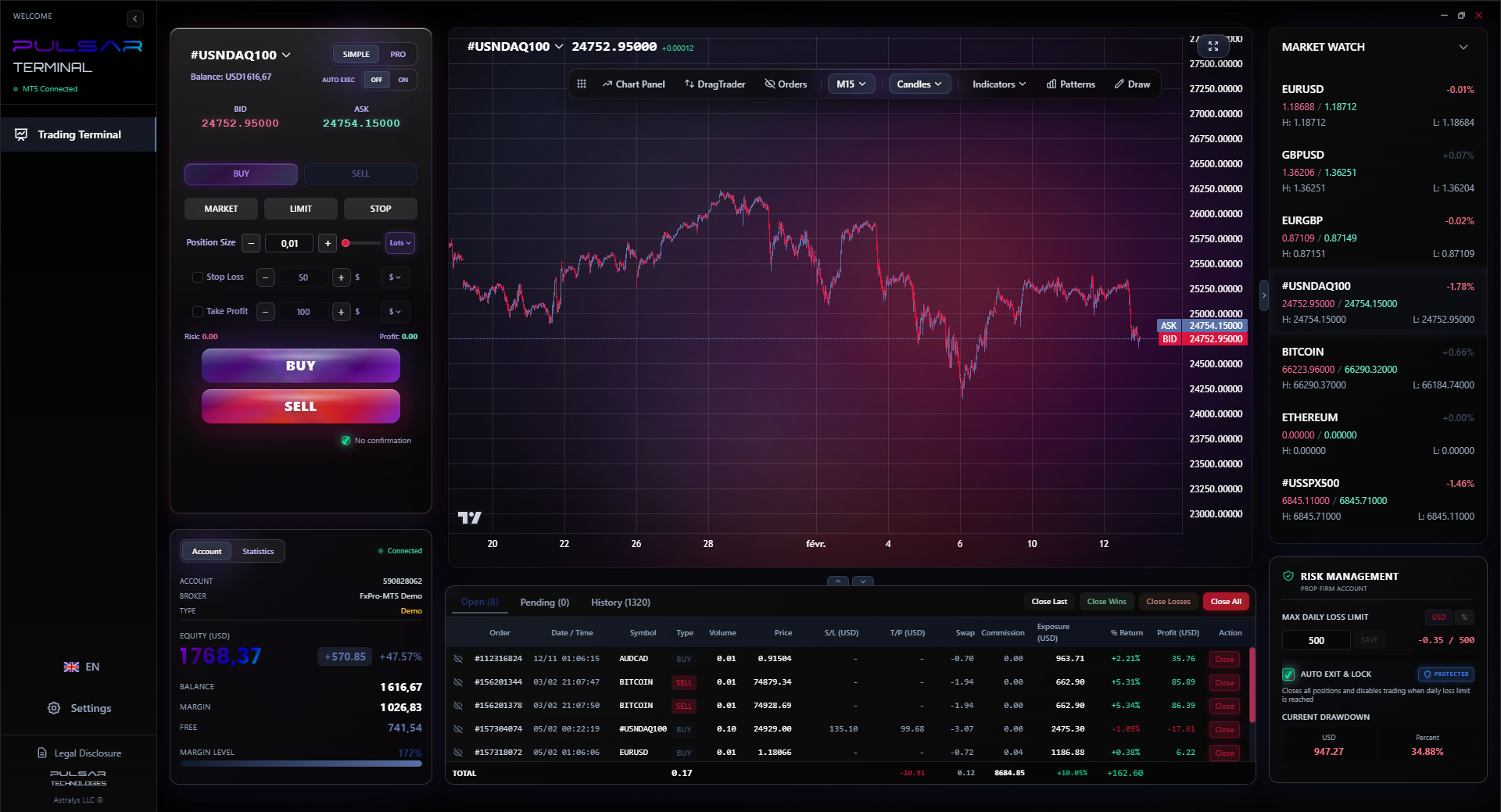
Where technology truly shines is in automating your risk rules. This is where a tool like Pulsar Terminal for MT5 becomes a game-saver. You can set rules like "automatically move stop to breakeven when trade is up 15 pips" or "set a trailing stop of 20 pips once profit hits 25 pips." It takes the emotion out of the most emotional parts of trading: moving stops and taking profits. You pre-program your framework's rules, and the tool executes them. This is a massive force multiplier for adhering to your professional guidelines.
Your other critical tool is the spreadsheet. Track every trade. I have a Google Sheet with columns for Date, Pair, Long/Short, Entry, Stop, Target, Exit, P&L, % Risked, Reason for Entry, and Lesson. The "Lesson" column is the most valuable. After 100 trades, you can sort by loser and see if a pattern emerges. Maybe 80% of your losses happen on Tuesday. Maybe your win rate on GBP/USD is 30% but on USD/JPY it's 55. The data tells you what to fix.
Automating your trade management rules, like moving stops to breakeven or taking partial profits, is critical for discipline, and Pulsar Terminal for MT5 handles this programming for you directly on your charts.
Pulsar Terminal
The all-in-one MT5 companion: drag-and-drop orders, multi-TP/SL, trailing stop, grid trading, Volume Profile, and prop firm protection. Used by 1,000+ traders daily.
“Your edge has to be big enough to pay the toll booth. In the US, the toll is spreads, commissions, and sometimes slippage.”
The final, and hardest, part of the framework is between your ears. A professional doesn't care about the individual trade. They care about the process over the sample size.
I had a month where I took 22 trades. Won 9, lost 13. A 41% win rate. A retail thinker is depressed, doubting their system. A professional looks at the numbers: The average winner was $287. The average loser was $98 (thanks to the 1.5% risk rule). Total net profit: +$769. The process worked. The statistics played out.
You have to detach. Your job is not to "be right" on EUR/USD today. Your job is to execute your plan's rules. If your plan says take the signal, you take it - even if you just had three losers in a row. If your plan says stop trading for the day, you close the platform - even if you see the "perfect" setup an hour later.
This mindset is built on preparation and routine. My routine:
- Pre-Market (30 min): Review economic calendar. Check daily charts of my 3 pairs. Draw key levels. No trading.
- Trading Session: Wait for my setup. If it comes, execute checklist, enter, walk away. I set alerts for my targets/stops.
- Post-Market (15 min): Update journal. Review any mistakes (e.g., did I move my stop? Did I hesitate?).
It's boring. Profitable trading is profoundly boring. The excitement, the adrenaline, the "gut feel" trades? That's how you get included in your broker's 75% loss statistic. The boring, systematic execution of a framework is how you end up in the other 25%.

Pro Tip: Record your screen. Use OBS or a simple recorder. Watch back your losing trades. You'll see the moment you leaned into the screen, your breathing changed, and you broke your own rules. It's the most cringeworthy, effective coaching you can give yourself.
💡 Winston's Tip
The market's job is to find the point where your framework breaks and your emotion takes over. Your job is to make that point beyond your maximum acceptable loss for the day.

“The rules define the playing field. Your strategy must be built within these walls.”
Even with a plan, you'll crack. Here are the classic failures I've seen (and done).
Breakdown 1: "Revenge Trading" You take a max daily loss. You're angry. You see another move, jump in with double your normal size to "make it back fast." This is how accounts get halved in an afternoon.
- Fix: The rule must be mechanical. Your trading platform should be locked after the daily loss. Use a tool that cuts you off, or physically shut your laptop and put it in another room.
Breakdown 2: "Moving the Stop-Loss" The trade goes against you. "It's just 5 more pips to that other level, it'll reverse." You slide your stop further away. You've now broken your risk calculation. A 1% risk trade just became a 3% risk trade.
- Fix: Enter with a stop-limit order. Once entered, delete the stop price from your platform view. If you can't easily see it, you can't easily move it. Better yet, use a tool that doesn't allow you to modify the stop once the trade is in a certain drawdown.
Breakdown 3: "Taking Profit Too Early" You're in profit, fear sets in, you close for a small gain. Then the trade runs another 50 pips without you. This destroys your risk/reward ratio.
- Fix: Use partial closes. Take 50% off at your first target (1:1 R:R), move stop to breakeven on the remainder, and let the rest run. This books profit and removes the anxiety of giving it all back. Tools that automate multi-level take-profits make this effortless.
Breakdown 4: "Over-Trading in Chop" The market is flat. You're bored. You start taking low-probability, "maybe" setups just to be in the game. This drains capital with commissions and small losses.
- Fix: Have a market filter. My rule: I only trade if the Average True Range (ATR) on the 1-hour chart is above its 20-period average. If it's below, the market is sleeping, and so am I. Go read a book instead.
FAQ
Q1Is 50:1 use in the US enough to make money?
It's more than enough to blow up an account, which is the point of the limit. Seriously, professional frameworks use use to efficiently allocate capital, not to amplify bets. With a 1-2% risk rule, 50:1 is sufficient for any sensible strategy. The problem isn't the use cap; it's traders wanting to use 100% of their margin on one trade.
Q2What's the single most important part of a trading framework?
The risk management pillar. You can have a mediocre edge and strict risk management and survive. You can have a brilliant edge and poor risk management and go bankrupt. The math is unforgiving. Calculating your position size before every trade is non-negotiable.
Q3How much money do I need to start trading forex professionally in the US?
"Professionally" implies it's your primary income. That requires significant capital. You shouldn't risk more than 1-2% per trade, and you need enough buffer to withstand a drawdown. Realistically, you'd need at least $50,000 to generate meaningful, sustainable income while still adhering to safe risk guidelines. Starting with $500 is for learning the process, not making a living.
Q4Can I use TradingView with US forex brokers?
Yes, many now offer integration. OANDA and tastyfx have direct TradingView integration for charting and execution. FOREX.com uses its own platform or MT4/MT5. TradingView is excellent for analysis, but always confirm your broker's execution rules and spreads on their own platform before trading.
Q5Does the FIFO rule really make that much difference?
It changes your strategy design. It prevents you from layering into a position with multiple entries and closing the most recent one for a quick scalp. You must manage your entire position as one block. It forces a cleaner, more disciplined approach to position sizing from the start.
Q6How do I know if my trading edge actually works?
Back-test it objectively on historical data (not just remembering your winners), then forward-test it in a demo account for at least 50-100 trades. Record every trade. The stats will tell you: win rate, average win/loss, largest drawdown, profit factor (Gross Profit / Gross Loss). A profit factor above 1.2 with a manageable drawdown suggests a potential edge. If you haven't done this, you don't have an edge; you have a hope.
Q7Are prop firms a way around the US use rules?
No. Proprietary trading firms operating for US clients are also subject to CFTC/NFA rules. They may offer simulated challenges, but the capital you trade is not real client money in the same way. The use limits and other regulations (FIFO, no hedging) still fundamentally apply to the trading activity. Passing a prop firm challenge requires extreme discipline, often using tools with built-in daily loss protection features to avoid instant failure.
Prof. Winston's Lesson
Key Takeaways:
- ✓Risk a fixed 1-2% of capital per trade, always.
- ✓Your edge must be defined with zero ambiguity.
- ✓US rules (50:1 max use, FIFO) are constraints to design within.
- ✓The spread is a tax your strategy must overcome.
- ✓Journal every trade to find your personal failure patterns.
How useful was this article?
Click a star to rate
Weekly Trading Insights
Free weekly analysis & strategies. No spam.
About the Author
James Mitchell
Senior Trading Analyst
Based in New York with over 9 years of trading experience. Focuses on major USD pairs, prop firm challenges, and the US regulatory landscape.
Comments
Risk Disclaimer
Trading financial instruments carries significant risk and may not be suitable for all investors. Past performance does not guarantee future results. This content is for educational purposes only and should not be considered investment advice. Always conduct your own research before trading.
You Might Also Like

Cara Trading Forex Sukses: 7 Prinsip dari Trader Profesional
Cara trading forex sukses dengan 7 prinsip trader pro: manajemen modal, disiplin, journal trading, backtest. Data nyata, bukan janji profit palsu.
Jam Trading Forex Terbaik untuk Trader Indonesia: Panduan Lengkap dengan Tabel Waktu
Panduan jam trading forex untuk trader Indonesia. Tabel 4 sesi dunia, jam emas 20:00-00:00, sesi mana yang harus dihindari. Data akurat + tips dari trader berpengalaman.
Top 5 Sàn Forex Uy Tín Nhất 2026: Review Jujur dari Trader Indonesia
Top 5 sàn forex uy tín 2026 untuk trader Indonesia. Review jujur: spread, deposit, withdraw, dukungan lokal. Exness, XM, IC Markets & lebih.
Get Pulsar Terminal
All these calculators are built into Pulsar Terminal with real-time data from your MT5 account. One-click position sizing, automatic risk management, and instant calculations.
Get Pulsar Terminal