


Everyone's telling you prop firms are the golden ticket.

James Mitchell
Senior Trading Analyst
☕ 13 min read
What you'll learn:
- 1The Regulatory Reckoning (It's Already Here)
- 2The Real Costs (It's Never Just the Challenge Fee)
- 3Profit Splits & Payouts: The Real Math
- 4The Only Metric That Matters: Pass & Payout Rates
- 5Rules Compared: Drawdowns, Consistency & Time Traps
- 6use, Platforms & Instruments
- 7Who to Consider & Who to Steer Clear Of (2026)
- 8Final Verdict: Making Your Choice
Everyone's telling you prop firms are the golden ticket. Pay a fee, pass a challenge, and trade millions. What they're not telling you is that 93% of you will fail and never see a payout. I've traded with six different firms, blown two accounts, and made consistent withdrawals from three. This isn't another fluffy listicle. This is a veteran's breakdown of the actual numbers, the hidden traps, and which firms might still be standing after the regulators finish their lunch.
Let's cut through the marketing. Most prop firms operate in a gray area, and that party's ending. The SEC and CFTC have these guys in their crosshairs, and the rules are changing fast.
Remember My Forex Funds? The CFTC called it a $310 million fraud. The case got messy and was dismissed on a technicality in 2025, but the message was sent: the 'Wild West' days are over. The CFTC is now pushing hard to classify these evaluation firms as Commodity Trading Advisors (CTAs). If that happens by 2026 - and I think it will - everything changes. We're talking mandatory registration, formal risk disclosures, and capital requirements. Firms that can't or won't comply will vanish.
The SEC tried a power grab in 2024 with new 'dealer' rules, but got slapped down in court. Don't let that fool you. They're just regrouping. The scrutiny is permanent now.
What this means for you: Your number one criterion in any prop firm comparison should be long-term stability. A firm with shaky compliance is a firm that might freeze your payout when the next lawsuit drops. I learned this the hard way in 2023 with a now-defunct firm that offered '95% splits.' Got my first $8,500 payout, then radio silence. Their website went dark a month later.

Warning: If a firm's terms seem too good to be true, they're probably operating on borrowed time. Regulatory compliance isn't sexy, but it's the only thing protecting your future profits.
Your trading profits are typically reported on a 1099 as self-employment income. Get a good accountant. The tax man always gets his cut, even from your prop firm winnings.
They hook you with a $99 challenge. Sounds cheap, right? That's just the cover charge. The real bill comes later.
The Fee Breakdown You Need to See
Let's put real numbers on the table. I tracked my costs across three different firm evaluations last year.
| Fee Type | Typical Range | My Experience (Apex Trader Funding) | The Catch |
|---|---|---|---|
| Challenge Fee | $39 - $1,500+ | Paid $297 for a $25k eval | One-time, but you'll likely pay it more than once. |
| Monthly Platform/Data | $30 - $80 | $80/month for Rithmic data | This charges even if you're not trading. It's a subscription. |
| Activation Fee | $50 - $150 | $149 one-time after passing | A surprise 'gotcha' before you touch real capital. |
| Reset Fee | ~80% of challenge fee | $237 for a reset | You will breach a rule. This is their recurring revenue. |
| Withdrawal Fee | $0 - $25 | $0 at Apex | Some firms nickel-and-dime you on the way out. |
My total cost to get a $25k funded account at Apex? $297 (challenge) + $149 (activation) + two months of data ($160) while I proved consistency = $606 out of pocket before I made a single profitable trade with their capital.

Example: Let's say you go for a $100k account. Challenge fee: $675. You fail once, reset ($540). Pass, activate ($150). Two months of data ($160). Total: $1,525. You need to make that back in profits just to break even before you see a dime.
Some firms like FTMO have a clearer all-in cost, but it's higher upfront. Others, like FundedNext, have more complex models with 'stretches' and scaling plans. The 'Pay After You Pass' models sound great, but read the fine print - the final fee is often much higher.
This is why your position size calculator is your best friend. Trading too big to recoup costs fast is the quickest path to a blown account and another reset fee.

💡 Winston's Tip
A firm's reset fee price tells you everything. If it's 90% of the challenge fee, they're betting on you failing. If it's 50% or offers free retries, they might actually want you to pass.
“A smaller, manageable account you can trade calmly is always better than a huge one that terrifies you.”
They all advertise 'up to 90% profit split!' It's the siren song. Here's what that actually looks like in practice.
Most firms operate on a net profit model. That means their split comes off the top after all commissions and fees are deducted from your gross profit. If you're trading futures with a prop firm, those exchange and data fees add up fast.
The Scaling Illusion: Firms like FTMO promote scaling plans - hit a target, and your account size increases. Sounds fantastic. But with a larger account comes larger daily loss limits and drawdown rules. A 5% drawdown on a $200k account is $10,000. That's a much bigger psychological mountain to climb than a 5% drawdown on a $50k account ($2,500). I scaled a FTMO account to $400k in 2022. The pressure to not lose $20,000 in a day (their max daily loss) completely warped my trading. I overtraded, forced setups, and blew it in three weeks. My biggest lesson: a smaller, manageable account you can trade calmly is always better than a huge one that terrifies you.
Payout Frequency: This matters more than you think. Bi-weekly payouts (like many firms offer) mean you have a two-week cycle of pressure. Weekly (like FundedNext offers on some accounts) is better for cash flow and mental health. 'On-demand' payouts sound great but often have minimums or fees.
The 100% Myth: A few firms, like FundedNext Futures, offer 100% profit shares. The catch? Usually, it's on a specific, often restrictive, account type or after hitting a very high profit target. Don't choose a firm solely for this. A realistic 80% split you can actually achieve is better than a mythical 100% you'll never see.
My most consistent payout stream has been from a firm with an 80/20 split, but weekly, reliable withdrawals with no hassle. Over 18 months, that consistency has beaten any firm that promised more but delivered headaches. Which brings us to the single most important metric...
Forget use. Forget spreads. This is the number that tells you everything about a firm's business model.
Industry data from 2025 is brutal: Only 5-10% of traders pass the initial challenge. Only about 7% of all traders who sign up ever receive a payout.
Let that sink in. For every 100 people dreaming of funded accounts, 93 are just paying fees. They are the customers. You are not the product; your failure is.
Now, some firms are better than others. Apex Trader Funding publishes a first-attempt pass rate of 15-20%. That's still low, but it's double the industry average. Why? Their rules are slightly more trader-friendly (no consistency rule, for example). This suggests they might actually want some people to pass and become profit partners, not just fee payers.
Other firms design challenges that are statistically almost impossible. Extreme profit targets combined with tiny daily drawdowns. I tried one in 2024 where the daily loss was 1.5% and the profit target was 10% in 30 days. It forced hyper-aggressive trading. I passed, but my trading psychology was so damaged I blew the funded account in days. The firm made money on my challenge fee, my reset fee, and my activation fee. I made zero.

Pro Tip: In your prop firm comparison, hunt for the published pass/payout rates. If a firm doesn't publish them, ask yourself why. Then, read the rules not as goals, but as traps. Where will you most likely fail? That's where they make their money.
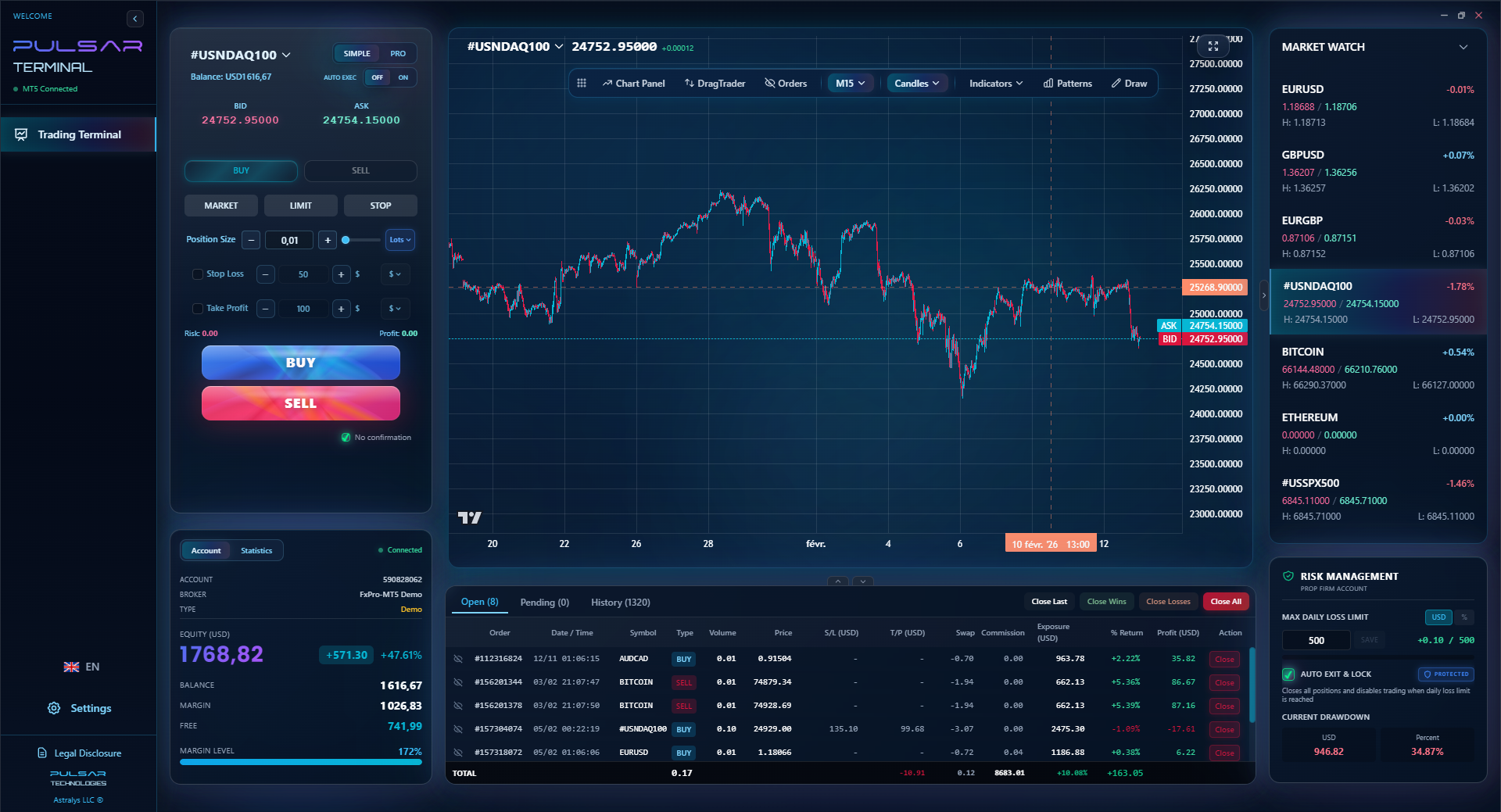
This is where a tool like Pulsar Terminal's prop firm daily loss protection is a game-saver. It can automatically hard-stop your trading for the day if you hit that limit, saving you from an emotional overtrade that breaches your account. I wish I'd had that years ago.
“The profit target is the shiny object. The rules are the bear trap.”
This is where you do your real homework. The profit target is the shiny object. The rules are the bear trap.
Drawdown Types: This is the killer. You must understand the difference.
- Overall Drawdown (Max Drawdown): Measured from your starting balance or your highest equity point. This is your absolute stop-loss for the entire challenge. Hit this, account failed.
- Daily Drawdown: Measured from the previous day's closing balance. This is your daily loss limit. Breach it, and you're done for the day (or fail the account, depending on the firm).
A common trap is a firm with a 10% max drawdown but a 3% daily drawdown. You can have a great run up 8%, then one bad day down 4% and you've failed, even though you're still up 4% overall. It's designed to catch emotional, revenge-trading days.
The 'Consistency Rule' Ghost: Some firms require you to make a certain percentage of your profit on a minimum number of trading days. This is meant to prevent one lucky trade from passing you. In reality, it forces you to trade on low-probability days just to hit a day count. I hate this rule. It creates bad habits.
Profit Target Realism: A 10% profit target in 30 days is aggressive but doable with a solid swing trading plan. A 10% target with a 5% max drawdown is a statistical nightmare - you need a 2:1 win rate just to survive variance. It's a sucker's bet.
Time Limits: Most challenges are 30 days. Some are unlimited. Unlimited sounds better, but often comes with a monthly fee that drains your motivation. A firm with a fair 60-day window, like some FTMO alternatives, is often the sweet spot.
My advice? Paper trade the rules first. Seriously. Take two weeks and trade a demo account as if the prop firm rules are law. You'll quickly see if your strategy fits inside their cage.
💡 Winston's Tip
The first payout is the hardest. Withdraw a small amount immediately after you're eligible, even if it's just $100. It tests their systems and makes the profits real in your mind.
Managing prop firm daily loss limits is a psychological nightmare, which is why automating it with a tool like Pulsar Terminal is non-negotiable for serious traders.
Pulsar Terminal
The all-in-one MT5 companion: drag-and-drop orders, multi-TP/SL, trailing stop, grid trading, Volume Profile, and prop firm protection. Used by 1,000+ traders daily.
The use Mirage
Prop firms often boast higher use than retail - 1:100 on forex, 40:1 on oil. This is a double-edged sword that most new traders impale themselves on. Regulators are pushing for lower limits, and that's a good thing. I've never met a trader who blew up from using too little use. Using the maximum on a scalping strategy is a great way to turn a 5-pip stop loss into a catastrophic margin call.
Platforms Matter More Than You Think
You might love MT5, but does the firm support it? The big three are usually MT4/MT5, cTrader, and dedicated futures platforms like Rithmic or Tradovate.
- MT4/MT5: Universal, but MetaQuotes' licensing changes have caused headaches. Some firms are moving away.
- cTrader: Cleaner execution, better for ECN-style trading. Favored by firms like FTMO.
- Futures Platforms (Rithmic): Non-negotiable if you trade futures. The data fees are part of the cost.
A growing trend is in-house platforms. They're more stable (no third-party outages) and can be tailored with firm-specific risk controls. The downside? You can't use your favorite custom indicators unless they allow it.
What Can You Actually Trade?
Most firms offer forex, indices, commodities, and crypto. But check the specifics.
- Are there restricted pairs? (Often exotics are off-limits).
- Are there news trading restrictions? (Many firms don't allow trading 5 minutes before/after major news).
- What are the spreads like on the instruments you actually trade? A 0.0 pip spread on EUR/USD is useless if you trade XAU/USD and they have a 50-pip spread on gold. Check this before you pay a dime.
I made a $2,700 profit on a crude oil trade once, only to find the firm's commission structure on futures ate nearly $400 of it. Know the cost of doing business on your chosen instruments.
“I've never met a trader who blew up from using too little use.”
This isn't a ranking. It's a categorization based on sustainability and trader-friendliness in the current climate.
The Established & Regulator-Ready (Lower Risk): These firms have been around, have clear terms, and are likely preparing for the CTA classification.
- Apex Trader Funding: My personal workhorse for futures. Simple rules (no consistency rule), straightforward pricing. Their payout rate data is more transparent than most. They use well-known brokers like Pepperstone for their forex offerings.
- FTMO: The OG. Very structured, slightly stricter rules, but unparalleled in terms of process and reputation. They've been through regulatory scrutiny and adapted. You pay for that stability.
The Aggressive Competitors (Check the Fine Print): These firms offer attractive terms to grab market share. The value is real, but be extra diligent.
- FundedNext: new models (Stellar Challenges), good profit splits, and weekly payouts. Their rules can be complex - understand the 'balance vs. equity' drawdown difference perfectly.
- BrightFunded / Atlas Funded: Often compete on price and low spreads. Newer, so their long-term compliance is less proven. Their terms can change quickly.
Firms I'm Skeptical Of In 2026:
- Any firm that doesn't clearly state its legal entity and location.
- Any firm with rules that seem mathematically designed for failure (e.g., profit target > 3x max drawdown).
- Any firm that had major "technical issues" delaying payouts in the last 12 months. That's a red flag for financial health.
- Firms that promise "instant funding" with no evaluation. This model is under extreme regulatory attack and may not survive.
Your broker relationship is often hidden, but matters. Some firms partner with solid brokers like IC Markets or Exness, which adds a layer of infrastructure credibility. Others use obscure offshore entities. It's worth digging into.
💡 Winston's Tip
Your strategy must fit the firm's time horizon. A 30-day challenge hates swing traders. A firm with no time limit hates scalpers paying monthly data fees. Mismatch here is fatal.
So, after all this prop firm comparison, how do you choose? Don't start with the biggest account. That's ego, not strategy.
- Match the Firm to Your Strategy: Are you a forex scalper? You need tight spreads and a platform that supports it. A futures swing trader? You need a firm with a good Rithmic package and sensible daily drawdowns. I once wasted $500 trying to pass a firm's challenge with a trend-following strategy that needed 2-month trades, but their challenge had a 30-day limit. Idiotic.
- Start Small & Prove It: Go for the smallest, cheapest evaluation the firm offers. Your goal isn't to get rich on the first account. Your goal is to prove to yourself that you can pass their rules and manage their capital. The profit from a $10k account pays for the challenge fee of a $50k account.
- Read the Forum Complaints: Don't just read the reviews on the firm's site. Go to independent trading forums. Search for the firm's name + "payout problem." One or two complaints might be disgruntled failed traders. A pattern of complaints about withdrawal delays is a screaming siren.
- Prepare for the Psychological Shift: Trading a prop firm account feels different than trading your own money. The rules create a prison of pressure. Use tools to automate your discipline. Set your stops religiously. Use a position size calculator for every single trade. The goal is survival first, profits second.
The prop firm landscape in 2026 is consolidating. The cowboys are being run out of town. Your job is to align yourself with a sheriff, not an outlaw. Find a firm whose business model relies on you succeeding in the long run, not on you failing the test. Do that, and you might just find yourself in that elusive 7%.
FAQ
Q1What's the single biggest mistake traders make when choosing a prop firm?
Chasing the biggest account size or highest profit split. They ignore the rules (drawdowns, time limits) which are designed to make them fail. Start small, learn the firm's system, and scale up with profits.
Q2Are prop firms a scam?
Not inherently. Reputable firms are legitimate. However, the business model profits from the 90%+ who fail evaluations. The 'scam' feeling comes from traders not understanding they're statistically likely to be a fee-paying customer, not a funded trader. Do your due diligence.
Q3How much of my own money do I need to start?
Plan for at least $500-$1,000. This covers a challenge fee ($100-$300), a likely reset fee ($80-$240), activation ($50-$150), and 1-2 months of data fees ($60-$160). Never use money you can't afford to lose entirely.
Q4Can I trade with multiple prop firms at once?
Yes, and I recommend it once you're experienced. It diversifies your 'funding' source and smooths out payout cycles. But don't do it initially. Master one firm's rules and systems first.
Q5What happens if the prop firm goes bankrupt?
You lose any unpaid profits and the funded account. This is the biggest risk. This is why choosing a firm with a solid track record and transparent financials is crucial. Your capital is not segregated or insured like in a bank.
Q6Is the 'Pass After You Pay' model better?
It's lower risk upfront, but often more expensive long-term. The final fee is usually higher than a standard challenge. It's a good option if you're very confident but cash-poor. Read the contract: what happens if you don't pay the final fee?
Q7How do taxes work with prop firm profits in the US?
You're typically an independent contractor. The firm will send you a 1099 form for your profit share. You report this as self-employment income, subject to income tax and self-employment tax (Social Security & Medicare). Keep detailed records of all your fees, as they may be deductible.
Prof. Winston's Lesson
Key Takeaways:
- ✓Pass rates are ~7%. You are the customer, not the product.
- ✓Budget $500+ for fees, not just the challenge cost.
- ✓Daily drawdown rules are the #1 account killer.
- ✓Start with the smallest account to learn the rules.
- ✓Choose firms preparing for CTA regulation by 2026.
How useful was this article?
Click a star to rate
Weekly Trading Insights
Free weekly analysis & strategies. No spam.
About the Author
James Mitchell
Senior Trading Analyst
Based in New York with over 9 years of trading experience. Focuses on major USD pairs, prop firm challenges, and the US regulatory landscape.
Comments
Risk Disclaimer
Trading financial instruments carries significant risk and may not be suitable for all investors. Past performance does not guarantee future results. This content is for educational purposes only and should not be considered investment advice. Always conduct your own research before trading.
You Might Also Like

Cara Trading Forex Sukses: 7 Prinsip dari Trader Profesional
Cara trading forex sukses dengan 7 prinsip trader pro: manajemen modal, disiplin, journal trading, backtest. Data nyata, bukan janji profit palsu.
Jam Trading Forex Terbaik untuk Trader Indonesia: Panduan Lengkap dengan Tabel Waktu
Panduan jam trading forex untuk trader Indonesia. Tabel 4 sesi dunia, jam emas 20:00-00:00, sesi mana yang harus dihindari. Data akurat + tips dari trader berpengalaman.
Top 5 Sàn Forex Uy Tín Nhất 2026: Review Jujur dari Trader Indonesia
Top 5 sàn forex uy tín 2026 untuk trader Indonesia. Review jujur: spread, deposit, withdraw, dukungan lokal. Exness, XM, IC Markets & lebih.
Get Pulsar Terminal
All these calculators are built into Pulsar Terminal with real-time data from your MT5 account. One-click position sizing, automatic risk management, and instant calculations.
Get Pulsar Terminal