


Let's cut through the hype.

James Mitchell
Senior Trading Analyst
☕ 10 min read
What you'll learn:
- 1What Exactly Is a "No Evaluation" Prop Firm?
- 2The Real Cost: Upfront Fees vs. Challenge Fees
- 3Who Are These Accounts Really For? (A Reality Check)
- 4The US Regulatory Gray Area (What's Changing)
- 5The Hidden Pitfalls in the Trading Rules
- 6Better Paths to Funded Capital
- 7Final Verdict: Should You Use a No-Evaluation Prop Firm?
Let's cut through the hype. Prop firms offering 'no evaluation accounts' are selling you a fantasy, and it's one that could cost you more than just a failed challenge. They promise instant access to real capital, skipping the dreaded challenge phase. Sounds perfect, right? I thought so too, until I saw the fine print and paid the price. In this guide, I'll show you exactly how these models work, who they're really for, and why the traditional evaluation might still be your smarter, cheaper path to getting funded.
Forget everything you know about the standard two-step challenge. A prop firm with no evaluation accounts flips the script. Instead of proving yourself in a demo environment first, you pay a fee and get immediate access to a live, or live-simulated, trading account with the firm's capital.
The pitch is simple: no profit targets to hit, no time limits, no daily drawdown rules to sweat over during an evaluation. You start trading what feels like a funded account from day one. Firms like FundYourFX and some programs from Alpha Capital Group popularized this model. They call it 'instant funding' or a 'direct funding' program.
Here's the critical part: while there's no formal evaluation, there are always rules. Always. These are the live account rules you'd get after passing a normal challenge. That means maximum drawdown limits, profit split structures, and often stricter position sizing from the get-go. You're not avoiding rules; you're just starting on the final, most restrictive level.

Warning: 'No evaluation' does not mean 'no rules.' It means you are immediately subject to the funded trader rules, which are often tougher to manage without a phased learning period. A single bad week can blow your entire account and fee.
This is where the rubber meets the road. The main appeal is speed, but you pay a massive premium for it.
Let's talk numbers. For a standard $100,000 evaluation account at a reputable firm, you might pay a $500 challenge fee. If you pass, you might pay a $50-$200 'activation' fee to get your funded account. Total outlay: around $550-$700, but only if you succeed.
A no-evaluation prop firm offering a $100,000 account? The upfront fee can easily be $1,200 to $2,000. You pay that whether you make a single trade or not. It's double or triple the cost, and it's non-refundable.
I learned this the hard way. In 2022, I paid $1,850 for a 'direct funded' $200k account, lured by the idea of skipping the grind. The pressure was immense. That fee was staring at me every time I opened a position. I overtraded, violated the max daily loss rule on a volatile GBP/USD move, and lost the account in 9 days. I'd have been better off taking three separate $500 challenges and learning from the process.
Profit Split Realities
The profit splits often look attractive - sometimes up to 90% or even 100% for the first chunk of profits. But remember, you've already fronted a huge sum. That high split is partly paying you back for your own massive risk. A traditional model might start at 80/20, but your total capital at risk is far lower.
| Model | Account Size | Typical Upfront Cost | Capital at Risk | Profit Split (Starting) |
|---|---|---|---|---|
| Traditional Evaluation | $100,000 | $500 (challenge fee) | Your $500 fee | 80/20 in your favor |
| No-Evaluation/Instant | $100,000 | $1,500+ | Your $1,500+ fee | 80/20 or 90/10 |
The math is clear. The no-evaluation model asks you to risk significantly more of your own money for the privilege of faster access. You need a very high level of confidence in your immediate, consistent profitability to justify it. Before you consider this, you must master your position size calculator to avoid an instant margin call.

💡 Winston's Tip
If you wouldn't risk the fee on a single hand of blackjack, don't risk it on an instant funding account. The odds might be similar.
“You're not avoiding rules with a no-evaluation account; you're just starting on the final, most restrictive level.”
After my expensive lesson, I sat down with a few traders who actually made these models work. The profile is specific. These accounts are not for beginners, and I'd argue they're not even for most intermediate traders.
They are designed for the proven, consistently profitable trader who is bottlenecked by personal capital. Think of a trader who has a solid 2-year track record, a verified swing trading or scalping strategy with positive expectancy, and needs a larger pool of capital to scale their returns meaningfully. For them, paying a $2,000 fee to immediately deploy a $200,000 account is a business investment, not a gamble.
If you're still perfecting your strategy, dealing with psychology, or haven't consistently traded a live personal account for at least a year, this model is a minefield. The traditional evaluation, for all its frustrations, acts as a cheaper, structured training ground. The rules force discipline. Blowing a $500 challenge teaches you a lesson. Blowing a $1,500 'instant funding' fee can set you back months.

Pro Tip: If you're considering a no-evaluation firm, do this first. Take the cost of their fee and divide it by the cost of a standard challenge. If the no-eval fee is $1,500 and a challenge is $300, that's five separate evaluation attempts. Be brutally honest: would you pass a standard challenge within five tries? If the answer isn't 'yes, probably in one or two,' you're not ready for the instant model.
Here's something most prop firm websites won't highlight: the entire industry is on shaky regulatory ground, especially in the US. As of now, most prop firms operate in a gray area. They argue they're not brokers managing client funds but simply companies offering a service (evaluation) and then sharing profits from their own capital.
That's changing fast. The SEC and CFTC are paying attention. New rules are coming down the pipe that could fundamentally alter how these firms operate. We're talking about mandatory registration, stricter capital requirements for the firms, and clearer rules on how trader profits are held.
Why does this matter for the no-evaluation model? Because it often involves a larger, non-refundable fee upfront. If a firm gets shut down or restructured by regulators a week after you pay your $2,000, what's your recourse? Probably very little. With a traditional two-phase model, you at least risk less capital upfront.
The regulatory scrutiny is intensifying because of the very promise these 'instant' firms make. The line between a 'service fee' and 'managing client capital' gets blurrier when you're immediately placed on a live account. When choosing any prop firm, but especially these, you must do your due diligence. Check reviews, see how long they've been around, and look for transparency. Our Exness review, IC Markets review, and XM review cover regulated brokers, which is a different world, but it shows you what real financial oversight looks like.
💡 Winston's Tip
The best prop firm for you is the one whose rules best fit your natural trading style. Forcing a square peg into a round hole is the fastest way to lose.
“The instant funding model asks you to risk significantly more of your own money for the privilege of faster access.”
You skip the evaluation rules, but you jump straight into the funded account rules. These are designed to protect the firm's capital, and they can be brutal if you're not prepared.
The Daily Loss Trap: This is the most common killer. Say you have a $100k account with a 5% max daily loss ($5,000). In a normal challenge, you might have a separate, smaller daily loss limit during the evaluation. On the instant account, that $5k is your only buffer. A single bad trade that gaps against you can hit that limit and terminate your account before you can blink. I've seen it happen trading news on EUR/USD.
Consistency Rules: Some firms have hidden 'consistency' clauses even in their live accounts. They might require you to not have a single day that accounts for more than 30% of your total profits, or they can flag you. It's not just about making money; it's about making money in their approved manner.
Scaling is Not Guaranteed: The promise is often 'scale up to $1M!' But the thresholds to scale can be incredibly high. You might need to generate $20,000 in net profits just to qualify for a $25,000 increase. The path is longer and steeper than it appears.
Managing these rules manually is a full-time job. This is where technology becomes non-negotiable. You need tools that can automate your risk management.

Example: Your $100k account has a 5% max daily loss ($5,000). You open a gold (XAU/USD) trade with a 2-lot position. Gold moves $10 against you. That's a $2,000 loss per lot, or $4,000 total. You're now 80% to your daily limit on one trade. Without automated stop-loss and position sizing, you're playing with fire.
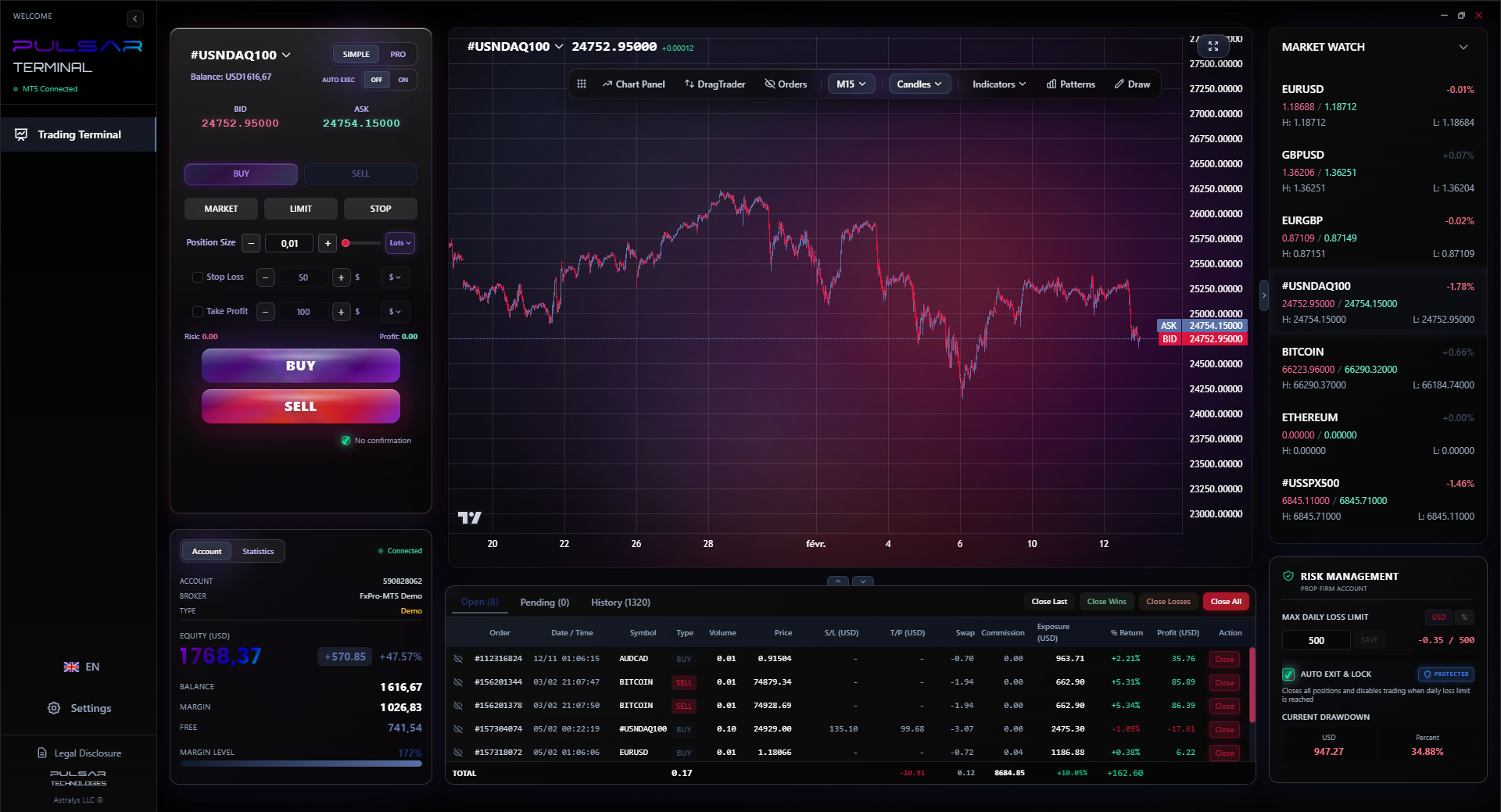
Managing a prop firm's strict daily loss limit is a constant pressure, but Pulsar Terminal's prop firm daily loss protection feature can automate this for you directly on MT5, shutting off trades before you breach your rule.
Pulsar Terminal
The all-in-one MT5 companion: drag-and-drop orders, multi-TP/SL, trailing stop, grid trading, Volume Profile, and prop firm protection. Used by 1,000+ traders daily.
Unless you're in that elite category of proven pros, I believe there are smarter ways to get funded.
- Master the Two-Step Challenge: It's a rite of passage for a reason. The discipline it forces is useful. Treat the first phase as a pure strategy test. Use the second phase to practice the live account rules. The total cost of failure is lower, and the learning is structured. Firms like Pepperstone aren't prop firms, but they offer similar tools and education for developing traders.
- Look for Hybrid Models: Some newer firms offer interesting twists. For example, a 'one-step' challenge that's slightly more expensive than a standard first phase but cheaper than an instant account. Or models where you get a small instant account that can scale rapidly based on performance.
- Build Your Own Track Record: This is the slowest but most powerful path. Trade a small personal account ($1k-$5k) for 12-18 months. Build a verifiable, audited track record on a platform like Myfxbook. Then, approach smaller prop firms or trading groups directly. Your proven history becomes your negotiation tool, and you might bypass standard fees altogether.
- Focus on Percentage Growth, Not Account Size: A 10% return on a $10,000 personal account is $1,000. A 5% return on a $100,000 prop account (before split) is $5,000. Which is easier to achieve consistently? Grow your personal capital first. Master your use of indicators like the RSI indicator and MACD indicator on your own terms before adding the pressure of someone else's capital.
The allure of the big number is strong. I get it. But controlling a $100k account poorly will lose you money faster than growing a $10k account well.
💡 Winston's Tip
View any upfront fee not as a cost, but as the purchase price for a specific set of rules. Read that rulebook like your life depends on it.
“If you can't pass a standard two-phase challenge, you have no business fronting thousands for an instant account.”
So, is a prop firm with no evaluation accounts right for you? Here's my blunt take.
Probably not.
For 95% of traders, the traditional evaluation model is a cheaper, more educational, and lower-risk path. It turns the process into a paid apprenticeship rather than a high-stakes audition. The instant funding model is a premium product for a niche audience: the already-professional trader who needs operational scale immediately.
If you're still reading charts and figuring out what a pip definition or spread definition really means in your P&L, start there. If you can't pass a standard two-phase challenge within a couple of attempts, you have no business fronting thousands of dollars for an instant account. The challenge isn't the barrier; it's the filter.
My advice? Save your money. Hone your craft on a personal account. Conquer a standard prop firm challenge. Learn the discipline. Then, if you're consistently profitable and hungry for more capital, you can reconsider the instant route from a position of strength, not desperation. The capital will still be there when you're truly ready for it.
FAQ
Q1What's the main advantage of a no-evaluation prop firm?
Speed. You bypass the 1-2 month evaluation process and get immediate access to a larger trading account. This is only an advantage if you are already a highly disciplined, consistently profitable trader who can handle the strict live rules from day one.
Q2Are no-evaluation prop firms safer than traditional ones?
No, they are often riskier for the trader. You risk a much larger upfront, non-refundable fee. The regulatory uncertainty applies to all prop firms, but losing a $1,500+ fee hurts more than losing a $500 challenge fee.
Q3Can I withdraw profits immediately with an instant funding account?
Usually, yes, after your first profit cycle (e.g., after 14-30 days). However, you must first reach any minimum profit threshold and adhere to all withdrawal rules, which can include not having any open trades during the request.
Q4What's the biggest mistake traders make with these accounts?
Overtrading due to the psychological pressure of the large upfront fee. Traders feel they need to make back their fee quickly and take oversized risks, which often triggers the strict daily loss limit and blows the account.
Q5Do these firms offer use?
Yes, but often lower than in evaluation challenges. You might see 1:30 or 1:50 on a funded account versus 1:100 in a challenge. This is to protect the firm's capital, as you're trading it from the start.
Q6How do I know if I'm ready for an instant funding account?
Ask yourself: Can I easily pass a standard two-phase prop firm challenge on my first or second try? Do I have 12+ months of verified, profitable live account history? If the answer to both is 'yes,' you might be a candidate. If not, stick with the traditional path.
Q7Will regulation kill the no-evaluation model?
Not necessarily kill it, but it will likely force more transparency. Rules may require firms to hold trader profits in segregated accounts and treat upfront fees differently. This could make the model more secure for traders but might also increase costs or change the structure.
Prof. Winston's Lesson
Key Takeaways:
- ✓No-evaluation fees are often 2-3x a standard challenge cost.
- ✓You immediately face the strictest funded account rules.
- ✓Daily loss limits are the most common account killer.
- ✓This model is only suitable for pre-verified profitable traders.
- ✓Regulatory changes in 2025-2026 add another layer of risk.
How useful was this article?
Click a star to rate
Weekly Trading Insights
Free weekly analysis & strategies. No spam.
About the Author
James Mitchell
Senior Trading Analyst
Based in New York with over 9 years of trading experience. Focuses on major USD pairs, prop firm challenges, and the US regulatory landscape.
Comments
Risk Disclaimer
Trading financial instruments carries significant risk and may not be suitable for all investors. Past performance does not guarantee future results. This content is for educational purposes only and should not be considered investment advice. Always conduct your own research before trading.
You Might Also Like

Cara Trading Forex Sukses: 7 Prinsip dari Trader Profesional
Cara trading forex sukses dengan 7 prinsip trader pro: manajemen modal, disiplin, journal trading, backtest. Data nyata, bukan janji profit palsu.
Jam Trading Forex Terbaik untuk Trader Indonesia: Panduan Lengkap dengan Tabel Waktu
Panduan jam trading forex untuk trader Indonesia. Tabel 4 sesi dunia, jam emas 20:00-00:00, sesi mana yang harus dihindari. Data akurat + tips dari trader berpengalaman.
Top 5 Sàn Forex Uy Tín Nhất 2026: Review Jujur dari Trader Indonesia
Top 5 sàn forex uy tín 2026 untuk trader Indonesia. Review jujur: spread, deposit, withdraw, dukungan lokal. Exness, XM, IC Markets & lebih.
Get Pulsar Terminal
All these calculators are built into Pulsar Terminal with real-time data from your MT5 account. One-click position sizing, automatic risk management, and instant calculations.
Get Pulsar Terminal