


Here's a statistic that should sober you up: only about 7% of funded prop firm accounts ever see a payout.
James Mitchell
Senior Trading Analyst
☕ 11 min read
What you'll learn:
- 1The Legal Minefield (It's Not What You Think)
- 2The 2024 MetaQuotes Apocalypse (What Really Happened)
- 3Real Costs (And How They *Really* Make Money)
- 4The Rules That Will Trip You Up (Daily Loss is a Killer)
- 5Who's Actually Paying Out in 2025? (The Survivors)
- 6Futures vs. Forex: The US Trader's Dilemma
- 7A Realistic Path to Getting Funded
- 8Final Verdict: Is It Worth It for You?

Here's a statistic that should sober you up: only about 7% of funded prop firm accounts ever see a payout. That's the reality after the hype. For US traders, the landscape got even more complicated in 2024 when the entire industry nearly imploded. I've traded with prop capital for years, and I've seen the good, the bad, and the downright scammy. This isn't a fluffy overview. It's a straight-talking guide on what prop firms for US traders actually look like now, who's surviving, and whether it's even worth your time and money.
Let's clear up the biggest misconception first. Legitimate prop firms in the US aren't regulated like your standard broker. They don't need SEC or CFTC registration because they're not managing your money. You're paying a fee to be evaluated on their capital. It's a service contract, not an investment fund.
This legal gray area is why the industry exploded, and also why it's so fragile. The firms aren't breaking laws by operating, but they exist in a regulatory shadow. This became painfully clear in early 2024.
The key thing to understand is they must trade with their own proprietary funds. If a firm is asking for a 'deposit' to trade, run. That's not a prop firm; that's something else entirely. Your only financial risk should be the one-time evaluation fee.

Warning: The lack of direct regulation means your primary protection is the firm's own terms of service. If they go bankrupt or decide not to pay, your legal recourse is limited and expensive. Always prioritize firms with a long, verifiable track record of payouts.

💡 Winston's Tip
When sizing your eval trade, cut your normal position in half. Your goal isn't maximum profit; it's maximum survival. Passing is a binary outcome.
This was the event that separated the men from the boys. In early 2024, MetaQuotes - the company behind MT4 and MT5 - started yanking licenses from prop firms left and right, especially those serving US clients with 'virtual' trading environments.
Overnight, traders couldn't log in. Firms like SurgeTrader (based in Florida) completely folded by May 2024. It was chaos. The reason? MetaQuotes decided these simulated environments, which are the backbone of most prop firm evaluations, violated their licensing terms. They didn't want their software associated with what they viewed as 'gaming' platforms.
The Aftermath
The result was a brutal industry shakeout. Over 100 firms didn't survive 2024. Another 30 or so are basically zombies now. This was a good thing in the long run. It weeded out the fly-by-night operations. The survivors had to scramble to find new platforms like cTrader, DXtrade, or TradeLocker.
If you're looking at a prop firm today, your first question should be: "What platform do you use, and is it a direct, legitimate license?" If they're still on MT4/MT5, you need to understand how they navigated that crisis. Many of the best prop firms for US traders now use a multi-platform approach to avoid single-point failure. This event taught everyone that the firm's tech stack is just as important as its payout rules.
“The 2024 MetaQuotes crackdown wasn't a setback; it was a purification.”
Let's talk numbers. The pricing model is the industry's open secret. You think you're paying for a chance at capital. Really, you're paying for a product - the challenge itself.
Evaluation Fees: This is your ticket. Ranges from $50 for a tiny account to over $500 for a $100k+ challenge. Some firms, like OneFunded or FTMO, refund this 100% with your first payout. Others don't. I always go for the refundable option; it aligns the firm's incentives with your success.
The Hidden Economics: The dirty little secret is that most traders fail. The stats don't lie: only 5-10% pass the initial evaluation. That failure rate is a revenue stream for the firm. It's not necessarily malicious - it's just math. They collect fees from the 90% who blow up. Your job is to be in the 10%.
Ongoing Costs:
- Profit Split: Usually starts at 80/20 in your favor, scaling to 90/10 or even 100% as you prove yourself. Apex Trader Funding and The5ers have good scaling models.
- Platform Fees: $0-$30/month. Annoying, but standard.
- Data Fees: For futures, add $10-$15/month for CME data.
- Commissions: Typically $0.50 to $2.00 per futures contract, or $3.50-$5 per forex lot. This is taken before your profit split, so it directly impacts your bottom line.

Example: Let's say you pass a $50,000 challenge. You make a $5,000 profit in a month. With an 80/20 split and $4/lot commissions that totaled $200, your math is: $5,000 - $200 = $4,800 net. Your 80% cut is $3,840. The firm keeps $960 + the $200 in commissions. Always calculate your net after commissions.
I learned this the hard way early on. I was scalping the EUR/USD, thrilled with my raw profit, only to see a huge chunk vanish to commissions. It changed my entire approach to position sizing.

This is where dreams go to die. Prop firm rules are designed for one thing: capital preservation. They are brutally efficient at stopping losers.
The Daily Loss Limit is the most common assassin. It's usually a percentage of your initial balance or your starting equity for the day. Hit it, and your account is frozen or failed. It forces you to have an ironclad stop-loss discipline. You can't just 'average down' and hope for a reversal.
The Maximum Overall Loss is your final barrier. Hit this, and the challenge is over. Period.
Time Limits used to be standard - like making 10% profit in 30 days. Thankfully, many top firms (OneFunded, FTMO, FXIFY) have dropped these, which is a huge positive. It allows for a more realistic swing trading approach.
Consistency Rules are sneaky. Some firms require you to not have a single day account for more than, say, 40% of your total profit. They're looking for steady Eddie, not a lottery winner.
The psychological pressure these rules create is immense. I once blew a funded account on a single trade in 2018. I was long GBP/USD, it dipped, I ignored my stop because 'I knew it would come back,' and I vaporized my daily loss limit in minutes. It was a $2,500 mistake that taught me more than any winning trade. Managing a prop account is a different beast than trading your own money. The fear of a margin call is replaced by the fear of rule violation.
💡 Winston's Tip
Pick a firm with a refundable fee. It's the simplest test of their confidence. If they keep your fee win or lose, their incentive is for you to fail.
“Your only financial risk should be the one-time evaluation fee. If they ask for a 'deposit,' run.”
After the 2024 purge, here's who's left standing with reputations intact. This isn't sponsorship; this is based on track records and trader communities I trust.
For Futures Traders:
- Apex Trader Funding: A giant. They've paid out over $598 million since 2022. They use Tradovate/NinjaTrader, offer flexible rules, and have a 15-20% first-time pass rate (high for the industry). Their scaling plan is solid.
- Topstep: The old guard. They're regulated as a Futures Commission Merchant (FCM), which is a huge plus for security. More rigid rules, but you know they're not going anywhere.
For Forex/Multi-Asset Traders:
- FTMO: The original pioneer. Over $500 million paid out globally. Extremely reputable, refundable fee, no time limits. A safe bet if their model fits your style.
- The5ers: Good scaling plan up to $4 million, with a clear path to 100% profit splits. They've been around a while and survived the storm.
- Take Note: Many forex-focused firms are now avoiding US clients due to the regulatory complexity. Always check if they accept US residents before you get excited.
The New Trend: On-Demand Payouts. Firms like Apex now let you request a payout whenever you want, not just on a monthly schedule. This is a game-changer for cash flow.
A personal experience: I've been with Apex for two years. My first funded account was a $25k eval. I passed, traded it to $32k, and requested a payout of $2,500. It hit my bank account in 3 business days. That reliability, post-2024, is priceless. When choosing, look for firms partnered with solid brokers. For example, checking a trusted IC Markets review or Pepperstone review can give you clues about the underlying liquidity and execution your prop firm might be using, even if indirectly.
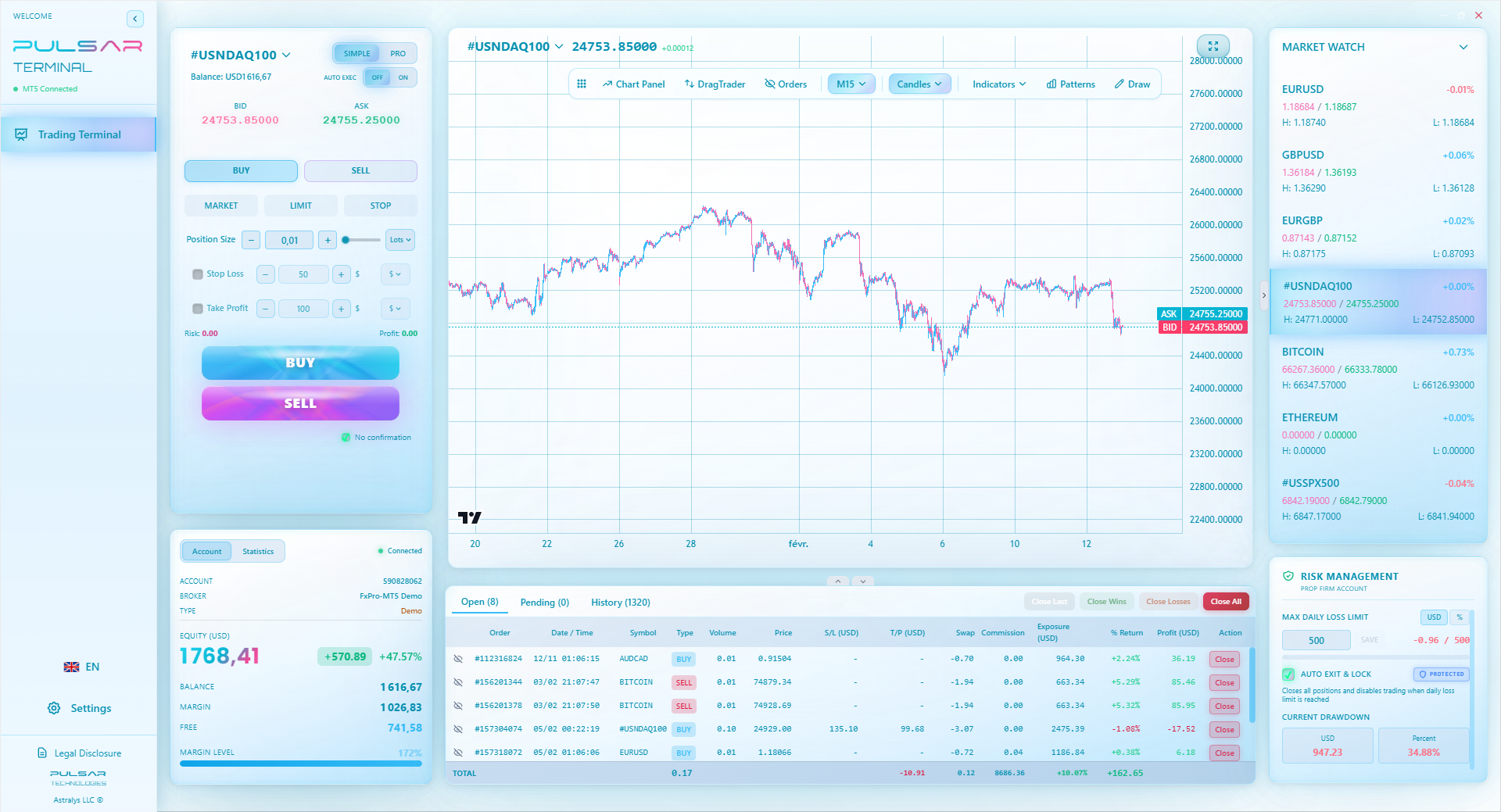
Managing the strict daily loss limits of a prop firm challenge is stressful, but tools like Pulsar Terminal can automate stop-loss and breakeven orders directly on your MT5 chart, turning a rigid rule into a seamless part of your execution.
Pulsar Terminal
The all-in-one MT5 companion: drag-and-drop orders, multi-TP/SL, trailing stop, grid trading, Volume Profile, and prop firm protection. Used by 1,000+ traders daily.
In the US, futures are king. They trade on regulated exchanges (CME, CBOT), the tax treatment (60/40 rule) is fantastic, and they align perfectly with American trading hours. Searches for futures trading now outpace forex here for a reason.
Forex prop trading for US residents is trickier. The underlying OTC market is global, and many international prop firms don't want the legal headache of dealing with US clients. If you do forex, you're likely trading a CFD or simulated version of the market with the prop firm.
My advice? If you're new to prop firms and based in the US, start with futures. The instruments - like the E-mini S&P 500 (ES) or Micro Crude Oil (MCL) - are clear, the data is cheap, and the environment is built for us. The learning curve on something like NinjaTrader is worth it.
I made the switch from forex to futures in 2020. The clarity was liberating. No more worrying about spread widening during news events on a simulated prop firm feed. With futures, I'm getting direct exchange data. Trading the NQ (Nasdaq futures) during the US session with a prop account feels like 'real' trading in a way some forex sim environments don't.
“Prop firms are a capital solution for already-profitable traders, not a training ground for beginners.”
Forget the YouTube hype. Here's the actual process, stripped bare.
- Treat the Fee as a Business Expense. That $200 challenge fee is gone. Write it off mentally. If you get it back, great. This mindset removes desperation.
- Trade a Strategy You've Already Proven. Don't use the eval to test new ideas. Use a strategy you've backtested and traded successfully in a personal account for at least 3 months. Your goal is to pass, not to get creative.
- Size for Survival, Not Glory. Your lot size or number of contracts should be so small that hitting the daily loss limit feels almost impossible. Your primary goal in the evaluation is to not lose. Profit is secondary. I used a position size 50% smaller than my normal strategy called for.
- Pass the First Stage, Then Relax. The first profit target is usually the hardest. Once you're in the 'verification' or second stage, the pressure often eases. The rules might even be slightly more lenient.
- Get Funded and THEN Revert to Your Real Strategy. Once you have the funded account, you can gradually scale your position size back to your proven, optimal level. The firm has given you a bullet; don't fire it all at once.
This process is a grind. It tests discipline more than skill. I failed my first two evaluations because I tried to hit the profit target too fast. On my third, I treated it like a boring job. I took 4 weeks to hit an 8% target, trading mostly XAU/USD with a simple MACD and support/resistance strategy. Boring wins.
💡 Winston's Tip
The first payout is the only one that matters. Don't fantasize about scaling to $2M. Get that first real withdrawal into your bank account. Everything else is noise until then.

Prop firms for US traders in 2025 are a legitimate, but narrowed, path. The get-rich-quick charlatans have been largely cleared out. What's left are serious businesses.
It's worth it if:
- You have a proven, rule-based strategy with a positive expectancy.
- You possess monastic discipline for risk management.
- You lack the personal capital to scale your trading to meaningful income levels.
- You understand it's a business partnership, not free money.
It's a waste of money if:
- You're still searching for a 'winning strategy.'
- You can't control drawdowns or stick to a daily loss limit.
- You have a decent-sized personal account you could just grow yourself.
- You need the income quickly and can't withstand a few months of evaluation cycles.
The bottom line? Prop firms are a fantastic capital solution for a very small subset of already-profitable traders. For everyone else, they're an expensive lesson. Focus on becoming a consistently profitable trader with your own money first. The prop firm opportunity will still be there when you're ready. And when you are, you'll understand that the real value isn't just the capital - it's the enforced discipline that can make you a better trader across all your accounts.
FAQ
Q1Are prop firms legal in the United States?
Yes, but with a big caveat. Legitimate firms operate legally by offering evaluation services for a fee and trading with their own capital, not client funds. This structure typically avoids SEC/CFTC registration. However, they exist in a regulatory gray area and are not protected like funds in a regulated broker. The 2024 MetaQuotes crackdown showed how vulnerable they can be to third-party decisions.
Q2What is the best prop firm for US traders in 2025?
There's no single 'best.' For futures traders, Apex Trader Funding and Topstep are top contenders due to their track record, payout history, and US-focused operations. For forex/multi-asset, FTMO and The5ers have strong global reputations, but always confirm they accept US clients. The 'best' firm is the one whose rules best fit your proven trading strategy.
Q3How much do prop firms charge?
You pay an upfront evaluation fee (from $50 to $500+), which may be refundable. If funded, you'll face costs like profit splits (you keep 80-90%), commissions per trade ($0.50-$5.00), and possible platform/data fees ($10-$30/month). The real 'cost' for the industry is the 90%+ of traders who fail their challenges and forfeit their fees.
Q4Can you really make money with prop firms?
Yes, but the statistics are brutal. Only about 5-10% of traders pass the initial evaluation. Of those who get funded, only about 7% eventually receive a payout. To be in that winning group, you need a statistically proven strategy and the discipline to trade under strict, unforgiving risk rules. It's a high barrier for a reason.
Q5What happened to prop firms in 2024?
MetaQuotes (maker of MT4/MT5) revoked licenses from many firms using its platforms for simulated 'evaluation' trading, causing a massive industry shakeout. Over 100 firms collapsed, including SurgeTrader. Surviving firms had to migrate to platforms like cTrader, Tradovate, or DXtrade. This event proved the industry's reliance on third-party tech and separated stable businesses from unstable ones.
Q6Should I trade forex or futures with a US prop firm?
For US traders, futures are generally the cleaner, more straightforward choice. They trade on regulated US exchanges, have favorable tax treatment, and many top US prop firms (Apex, Topstep) are built for them. Forex prop trading for US residents is more complex, with fewer firm options and often simulated environments.
Q7What's the most common reason traders fail prop firm challenges?
Violating the Daily Loss Limit. This rule is the number one account killer. It forces instant stop-loss discipline. The second biggest reason is a lack of a consistent, proven strategy before starting. Traders use the expensive evaluation as a testing ground, which is a guaranteed way to burn money.
Prof. Winston's Lesson
Key Takeaways:
- ✓Daily Loss Limits kill 80% of funded accounts.
- ✓Expect to pay $10-$30/month in platform/data fees.
- ✓Only 5-10% of traders pass the initial evaluation.
- ✓Seek firms with 100% refundable evaluation fees.
How useful was this article?
Click a star to rate
Weekly Trading Insights
Free weekly analysis & strategies. No spam.
About the Author
James Mitchell
Senior Trading Analyst
Based in New York with over 9 years of trading experience. Focuses on major USD pairs, prop firm challenges, and the US regulatory landscape.
Comments
Risk Disclaimer
Trading financial instruments carries significant risk and may not be suitable for all investors. Past performance does not guarantee future results. This content is for educational purposes only and should not be considered investment advice. Always conduct your own research before trading.
You Might Also Like

Cara Trading Forex Sukses: 7 Prinsip dari Trader Profesional
Cara trading forex sukses dengan 7 prinsip trader pro: manajemen modal, disiplin, journal trading, backtest. Data nyata, bukan janji profit palsu.
Jam Trading Forex Terbaik untuk Trader Indonesia: Panduan Lengkap dengan Tabel Waktu
Panduan jam trading forex untuk trader Indonesia. Tabel 4 sesi dunia, jam emas 20:00-00:00, sesi mana yang harus dihindari. Data akurat + tips dari trader berpengalaman.
Top 5 Sàn Forex Uy Tín Nhất 2026: Review Jujur dari Trader Indonesia
Top 5 sàn forex uy tín 2026 untuk trader Indonesia. Review jujur: spread, deposit, withdraw, dukungan lokal. Exness, XM, IC Markets & lebih.
Get Pulsar Terminal
All these calculators are built into Pulsar Terminal with real-time data from your MT5 account. One-click position sizing, automatic risk management, and instant calculations.
Get Pulsar Terminal