


I stared at the screen, my heart pounding.

James Mitchell
Senior Trading Analyst ·  Canada
☕ 13 min read
What you'll learn:
- 1What Are Prop Firms and How Do They Work in Canada?
- 2How to Choose the Right Prop Firm as a Canadian
- 3My Blueprint for Actually Passing the Challenge
- 4Risk Management: The Only Thing That Matters
- 5Taxes and Legal Stuff for Canadians
- 6Pitfalls I Fell Into (So You Don't Have To)
- 7What Happens After You Get Funded?

I stared at the screen, my heart pounding. It was March 15, 2023, and my FTMO challenge account was sitting at a 9.8% drawdown. The daily loss limit was 10%. One more bad trade on the CAD/JPY and I'd be out, losing the $500 evaluation fee. I'd been here before, blowing challenges by being too aggressive. This time, I did nothing. I closed the platform, made a coffee, and waited for the London session to pass. That single decision - to not trade - was the turning point. It saved the challenge and eventually led to a $200,000 funded account. Here’s what a dozen years and a lot of broken rules taught me about navigating prop trading firms in Canada.
Let's clear something up first. A prop (proprietary) trading firm isn't a broker. They don't execute your trades with external liquidity providers in the same way. Instead, they provide you with their capital to trade. You pass an evaluation challenge to prove you can be profitable and manage risk, and then you get a share of the profits you generate. No more risking your own savings on every trade.
In Canada, we operate in a unique space. We don't have the same regulatory hurdles as the US (where the PDT rule cripples small accounts), but we're also not a completely wild west. Reputable global prop firms like FTMO, The5%ers, and FundedNext all accept Canadian traders. Your biggest concern isn't legality, it's finding a firm with fair rules that match your trading style.
The core model is almost always the same: you pay for a challenge. You trade a simulated account under specific profit target and risk rules. Pass, and you get a funded account. Fail, and you lose the challenge fee. It's a high-stakes test, but when you pass, the use is incredible. I went from trading a $10,000 personal account to managing a $200,000 simulated pool. The psychology changes completely.

Warning: The 'simulated' part is key. You are trading the firm's capital in a risk-controlled environment. You don't legally own the account. Your profit split is a performance fee. Always read the legal terms.
The Two-Phase Standard
Most firms use a two-phase evaluation. Phase 1: hit a profit target (e.g., 10%) without violating daily or max drawdown rules. Phase 2: do it again, often with a lower profit target but the same strict risk limits. Only then do you get funded. It's designed to filter out gamblers and find consistent, disciplined traders. I failed three of these before I finally understood that consistency beats home runs every single time.
“Prop firms are not testing your ability to pick winners. They are testing your ability to not blow up.”
This is where most Canadians, including my past self, mess up. We see a cheap challenge fee and jump in. Big mistake. The rules are everything. You need to dissect them like a contract, because that's exactly what they are.
First, look at the drawdown rules. Is it based on starting balance or equity? Starting balance is far more forgiving. If you start with $100,000 and your max drawdown is 10% ($10,000), a starting balance rule means your stop is at $90,000, period. An equity-based drawdown means your stop moves up with your profits. If you profit to $105,000, your new stop might be $95,000 (105k - 10k). This is much tougher. My first failed challenge was on an equity-based drawdown system I didn't fully understand.
Second, check the daily loss limit. This is your circuit breaker. It might be 5% of the starting balance. Hit it, and the challenge is over immediately. This rule alone taught me more about position size calculator discipline than any book.
Third, and this is huge for us: what are the trading instrument restrictions? Some firms don't allow trading of certain commodities or indices during news events. If you're a XAU/USD guide gold trader, you need to know if you can hold positions over the weekend or during major US data releases.
Here’s a quick comparison from my experience:
| Firm Aspect | Good Sign | Red Flag |
|---|---|---|
| Profit Split | 80% or more to you | Starts below 70% |
| Payout Frequency | Monthly or bi-weekly | Quarterly or 'upon request' |
| Challenge Fee | Clear, one-time fee | Hidden 'reactivation' fees after a loss |
| Platform | Common (MT4/5, cTrader) | Proprietary, clunky platform |
| Canadian Support | 24/5 live chat, clear responses | Email-only, slow replies |
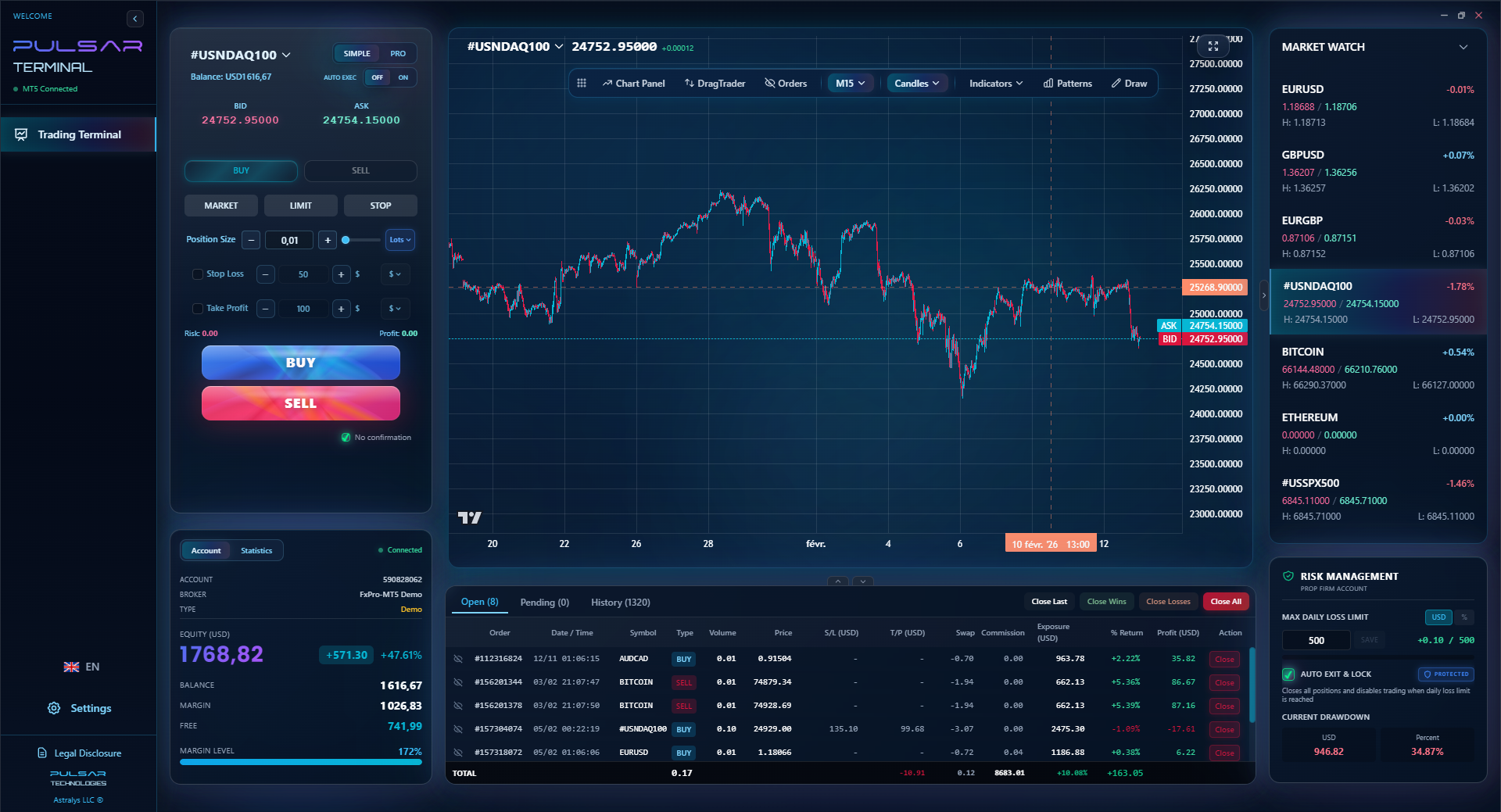
I've had good experiences with firms that offer MT5, as it allows for more advanced scripting and tools. If you use a platform like MT5, a companion tool like Pulsar Terminal can be a game-saver for managing the complex order types needed in prop firm challenges.
Finally, lurk in Canadian trading forums and Discord servers. Ask for real user experiences. Did people get paid? How long did it take? I once chose a firm because a buddy in Toronto got three payouts to his RBC account without a hitch. That social proof is worth more than any slick website.

💡 Winston's Tip
The challenge fee is tuition, not a ticket. If you fail, you paid for a masterclass in your own psychological weaknesses. The lesson is more valuable than the money.
“I went from trading a $10,000 personal account to managing a $200,000 simulated pool. The psychology changes completely.”
Alright, let's get tactical. You've chosen a firm. You've paid your fee. Now, don't place a single trade for 48 hours. Seriously. Use that time to plan. This is the single biggest difference between my failures and my success.
Your strategy must be built for the challenge rules, not the other way around. You might be a brilliant swing trading strategist, but if the challenge has a 30-day time limit, you need to adapt. I had to shift from my comfortable multi-day holds to a more active, daily-bias style.
Here was my winning blueprint for a typical 10% profit target, 10% max drawdown challenge:
- The Daily 1% Rule: My only goal was to make 1% of the account per day. Not 2%, not 5%. Just 1%. A 1% gain compounds. Ten trading days of 1% gets you to your 10% target (it's actually about 10.4% with compounding). This mindset eliminates greed.
- The Hard Stop: Before every trade, I knew my maximum loss. I used a position size calculator to ensure that even if I hit my stop loss, I would never lose more than 0.5% of the account. This meant my daily loss limit of 5% would require ten consecutive losing trades to hit. That never happened.
- The Session Focus: I traded only the London open (3 AM EST) for 2-3 hours. The volatility was reliable, and it prevented me from overtrading. Once I hit my 1% or the session lost its momentum, I was done. Computer off.

Pro Tip: Use a trading journal religiously during the challenge. Note your mental state for every entry. When I passed my FTMO, I reviewed my journal. My winning trades all had notes like 'planned entry, waited for pullback.' My losing trades from earlier failures said things like 'felt bored,' or 'trying to make up for earlier loss.'
Let me give you a real example from my successful challenge. I was trading the EUR/USD guide during the London open. I had a bias for a small continuation upward. Instead of jumping in, I set a buy limit order 8 pips definition below the current price with a 15-pip stop loss and a 30-pip target. I walked away. It filled an hour later, and I didn't even watch it hit the target. That trade made 0.8%. Boring. Perfect. That's the mindset.
Remember, the goal isn't to impress anyone with huge gains. The goal is to survive. The firm is testing your risk management, not your genius.
“I went from trading a $10,000 personal account to managing a $200,000 simulated pool. The psychology changes completely.”
If you take one thing from this entire guide, let it be this: Prop firms are not testing your ability to pick winners. They are testing your ability to not blow up. Your number one job is capital preservation.
Every rule they have - daily loss, max drawdown, no over-weekend holdings on some instruments - is a risk cap. Your trading plan must be built inside these fences. I learned this the hardest way possible.
In 2021, I was in a challenge with a 5% daily loss limit. I was down 2.5% on a messy USD/CAD trade. My ego kicked in. I thought, 'I'm a pro, I can get this back.' I doubled my position size on the next trade, a classic revenge trade. It went against me another 1.5%. Panic set in. I took a third trade, smaller, but it was sloppy. Another 1% loss. I hit the 5% daily limit and the challenge was terminated in under three hours. I lost the fee and a chunk of my confidence.
That failure cost me $400. The lesson was priceless: you must have a personal daily loss limit that's half of the firm's limit. Mine is now 2.5%. If I hit that, I'm done for the day. No arguments, no 'one more try.' This self-imposed rule is what saved my 9.8% drawdown story from the introduction.
Tools are your best friend here. Learn to use a trailing stop to lock in profits on runners. Understand how to move your stop to breakeven once a trade is in profit by a certain amount. These aren't just techniques, they are your armor against yourself. Managing multiple trades and their stops manually is stressful and error-prone. Using a trading terminal that can automate trailing stops and breakeven moves takes the emotion out of it, which is critical under evaluation pressure.
Also, understand the margin call and spread definition policies of your chosen firm. During high volatility, spreads can widen dramatically. If your stop loss is too tight, you could get stopped out at a much worse price than you set, potentially violating a drawdown rule. Always account for the worst-case spread definition in your risk calculations.
💡 Winston's Tip
Your first goal in any challenge is not to reach the profit target. It's to get your stop loss to breakeven. Survival first, profits second.


“That failure cost me $400. The lesson was priceless.”
This isn't fun, but ignoring it can be very expensive. I am not an accountant, but here's what my accountant explained to me after I got my first prop firm payout.
Your profit split is considered self-employment income in Canada. It's not capital gains. You receive a payment from a foreign entity (most prop firms are based in Europe or the UK) for services rendered (your trading). You must report this as business income on your T2125 Statement of Business or Professional Activities when you file your personal tax return.
You will not receive a Canadian T4 or T5 from the prop firm. They will likely provide you with a statement detailing your profit splits for the year. Keep these records carefully.
Key implications:
- You must pay both the employee and employer portions of CPP contributions on this net business income.
- You can deduct legitimate business expenses. This can include a portion of your home office, trading software subscriptions, internet costs, computer equipment depreciation, and even the fees you paid for challenges (though only for the challenges that led to a funded account, in my accountant's view).
- You may need to register for an HST/GST number if your net self-employment income exceeds $30,000 in a calendar year. Most solo prop traders won't hit this, but it's something to monitor.

Example: In 2023, I received $28,500 in profit splits from my prop firm. After deducting $2,000 in software, data, and home office expenses, my net business income was $26,500. This was added to my other income and taxed at my marginal rate. I also had to calculate and pay CPP on the $26,500.
The best advice? After your first payout, spend $300-$500 to consult with a Canadian accountant who understands trading and foreign income. It will save you stress and potentially a lot of money.
Managing the complex stop-loss and breakeven rules under pressure is easier with a tool like Pulsar Terminal, which automates these functions directly on your MT5 chart.
Pulsar Terminal
The all-in-one MT5 companion: drag-and-drop orders, multi-TP/SL, trailing stop, grid trading, Volume Profile, and prop firm protection. Used by 1,000+ traders daily.
“That failure cost me $400. The lesson was priceless.”
Let me be a cautionary tale. Here are the concrete mistakes that blew up my early attempts and how to avoid them.
Pitfall 1: Trading the Challenge Like It's Real Money. It's not. It's a simulation with strict, game-like rules. You must play the game. I used to treat the drawdown as a suggestion. It's a law. The moment you're close to any limit, your only job is to get away from it, even if it means taking a small, ugly loss to free up margin.
Pitfall 2: Ignoring the Time Limit. Many challenges have a 30-day minimum trading period but also a maximum day limit (like 60 days). I once got to 9% profit on day 55 of a 60-day challenge. I got nervous and started forcing trades to hit the 10% target. I blew the drawdown. If you're ahead of schedule, you can afford to trade smaller or even take days off. Don't force it.
Pitfall 3: Overcomplicating the Strategy. During evaluations, I'd switch from my simple MACD indicator and support/resistance strategy to some complex multi-indicator system I saw on YouTube. Disaster. Use the one strategy you know best. The challenge is about discipline, not strategy innovation.
Pitfall 4: Not Accounting for Withdrawal Rules. You pass. Congrats! But wait, your first payout might be after 30 days, and only on profits made after you were funded. Don't quit your day job. Also, some firms have a 'first payout is 50%' rule. Know this cash flow timeline before you start celebrating.
Pitfall 5: Going All-In on One Challenge. This was my biggest financial mistake. I once put $1,000 into a single, large challenge account. The psychological pressure was immense. Now, I never risk more than 10% of my 'prop firm bankroll' on a single challenge fee. If I have $2,000 set aside for challenges, my max fee is $200. This lets me fail and retry without it being catastrophic. It turns the process into a statistical game, not a life-or-death gamble.

“Use the one strategy you know best. The challenge is about discipline, not strategy innovation.”
You get the email. 'Congratulations, you have passed!' It's an incredible feeling. But the work is just beginning.
The funded account usually comes with the same, or sometimes slightly relaxed, risk rules. The profit target is gone, replaced by a profit split schedule. But the daily and max drawdowns remain. The pressure should decrease, but the discipline must not.
Your first month funded is a new psychological test. You're now trading 'real' capital (even though it's simulated). The urge to go for bigger profits can creep in. Fight it. Stick to the exact same strategy and risk parameters that got you funded. My first month on a $100k account, I aimed for a modest 3% return. I hit 4.2% trading my same boring 0.5%-risk-per-trade system. That first payout was over $1,500 (after the split). It was validation.
The relationship with the firm changes. You now have a account manager or point of contact. Payouts are typically monthly. You submit a withdrawal request, and they process it via bank transfer (often to a Wise or PayPal account, which you then transfer to your Canadian bank). It works, but it can take 3-7 business days.
The biggest shift is in your own identity. You're no longer just a retail trader. You're a funded trader. It builds a different kind of confidence, one rooted in proven process rather than hope. It also opens doors. Some firms offer scaling plans - if you're consistently profitable, they'll increase your capital. That's the real goal: turning a $50k account into a $500k account over time through performance, not more deposits.
Just remember, they can and will withdraw funding if you break the risk rules. The account is always theirs. Your edge is your consistency. Keep it, and it can become a very real income stream from your desk in Vancouver, Toronto, or anywhere in Canada.
💡 Winston's Tip
When funded, withdraw your profit share consistently, even if it's small. Reinforce the behavior that this is real income, not just numbers on a screen.


FAQ
Q1Are prop trading firms legal for Canadians?
Yes, it is legal for Canadians to trade with international proprietary trading firms. These firms are typically based overseas (e.g., Europe, Asia). You are not trading on a regulated Canadian exchange; you are trading the firm's capital in a simulated environment under a performance contract. The income you earn is considered self-employment income for tax purposes.
Q2How much does it cost to try a prop firm challenge in Canada?
Challenge fees vary widely based on the account size you want to qualify for. They can range from about $50 for a small $10,000 evaluation to over $500 for a $200,000 challenge. Always view this fee as the cost of education if you fail. Never risk money you can't afford to lose on a challenge fee.
Q3Which prop firm is best for beginners in Canada?
For beginners, I'd recommend a firm with straightforward rules: a starting balance drawdown (not equity-based), a clear one-step evaluation (not two phases if you can find it), and a lower profit target. Firms like The5%ers often have simpler structures. Start with the smallest, cheapest challenge to learn the process without major financial pressure.
Q4How are payouts from prop firms taxed in Canada?
Payouts are treated as self-employment business income. You report the net amount (after deducting eligible business expenses) on Form T2125 with your personal tax return. You will pay income tax at your marginal rate and must contribute to the Canada Pension Plan (CPP) on this income. Consult an accountant for your specific situation.
Q5Can I use robots or EAs in a prop firm challenge?
It depends entirely on the firm's rules. Most allow Expert Advisors (EAs) on platforms like MT4/5, but many prohibit fully automated trading or arbitrage strategies. Some also ban 'grid' or 'martingale' EAs. You must read the specific rules of your chosen firm. Even if allowed, ensure your EA is calibrated to respect the firm's strict daily and max drawdown limits.
Q6What happens if I lose money on the funded account?
You can lose up to the maximum drawdown limit. If you hit the max drawdown (e.g., 10% of the starting balance), your funded account will be closed. You will not owe the firm money for the losses, but you will lose the opportunity to trade that capital. Some firms offer a 'second chance' or a discounted re-challenge if you fail a funded account.
Q7Do prop firms affect my Canadian credit score?
No. Prop firm challenges and payouts have no direct connection to Canadian credit bureaus (Equifax, TransUnion). You are not taking a loan. The relationship is contractual for performance-based compensation. Your banking activity related to receiving international transfers is unrelated to credit reporting.
Prof. Winston's Lesson
Key Takeaways:
- ✓Treat drawdown limits as absolute laws, not suggestions.
- ✓Risk a maximum of 0.5% of account balance per trade.
- ✓Aim for consistent 1% days, not heroic 5% gains.
- ✓Choose firms with starting balance drawdown, not equity-based.
- ✓Your first funded month, trade exactly as you did in the challenge.
How useful was this article?
Click a star to rate
Weekly Trading Insights
Free weekly analysis & strategies. No spam.
About the Author
James Mitchell
Senior Trading Analyst
Based in New York with over 9 years of trading experience. Focuses on major USD pairs, prop firm challenges, and the US regulatory landscape.
Comments
Risk Disclaimer
Trading financial instruments carries significant risk and may not be suitable for all investors. Past performance does not guarantee future results. This content is for educational purposes only and should not be considered investment advice. Always conduct your own research before trading.
You Might Also Like

Cara Trading Forex Sukses: 7 Prinsip dari Trader Profesional
Cara trading forex sukses dengan 7 prinsip trader pro: manajemen modal, disiplin, journal trading, backtest. Data nyata, bukan janji profit palsu.
Jam Trading Forex Terbaik untuk Trader Indonesia: Panduan Lengkap dengan Tabel Waktu
Panduan jam trading forex untuk trader Indonesia. Tabel 4 sesi dunia, jam emas 20:00-00:00, sesi mana yang harus dihindari. Data akurat + tips dari trader berpengalaman.
Top 5 Sàn Forex Uy Tín Nhất 2026: Review Jujur dari Trader Indonesia
Top 5 sàn forex uy tín 2026 untuk trader Indonesia. Review jujur: spread, deposit, withdraw, dukungan lokal. Exness, XM, IC Markets & lebih.
Get Pulsar Terminal
All these calculators are built into Pulsar Terminal with real-time data from your MT5 account. One-click position sizing, automatic risk management, and instant calculations.
Get Pulsar Terminal