


Let's get one thing straight: 89% of individual F&O traders lost money in FY 2023-24.

Rajesh Sharma
Senior Forex Analyst ·  India
India
☕ 11 min read
What you'll learn:
- 1The Myth vs. The Trader: His Real "Double Life"
- 2The Core Principles (It's Not Magic)
- 3The Risk Management Nobody Talks About
- 4Applying It Today: The Indian Market Reality Check
- 5The Psychology Gap: Where You Will Fail
- 6Brokers & Platforms for His Style
- 7One Trade I Wish I Made (And One I'm Glad I Didn't)
- 8Your Action Plan: Start This Week
Let's get one thing straight: 89% of individual F&O traders lost money in FY 2023-24. That's SEBI's own data. Yet, one man turned a few thousand rupees into a fortune worth over 40,000 crores. Rakesh Jhunjhunwala's success wasn't magic or insider luck. It was a brutally disciplined, often misunderstood strategy that most retail traders get completely wrong. This isn't a hagiography. It's a trader's autopsy of what actually worked, what he kept quiet about, and how you can steal his best ideas without blowing up your account.
The media painted Jhunjhunwala as the ultimate long-term investor, the patron saint of 'buy and hold.' That's only half the story, and the less important half for most of us. The man lived a double life in the markets.
His public persona was the investor, holding stocks like Titan for decades. His private engine was the trader. He used trading - especially in the early days - to generate cash flow. This cash was the fuel for his big, long-term investment bets. He wasn't just sitting on his hands. He was actively managing risk and capital on two different timeframes simultaneously.
I made this mistake early in my career. I tried to copy the 'investor' Jhunjhunwala by buying a stock and ignoring it. What I missed was the active management behind the scenes. He wasn't passive; he was patient but fiercely attentive. A long-term hold for him didn't mean a 'set and forget.' It meant constant reassessment of the business thesis. If the thesis broke, he would exit. That's trading discipline applied to an investment timeframe.

Warning: Don't confuse his legendary patience with passivity. His portfolio was a living thing, not a museum. He trimmed, added, and exited positions based on valuation and business changes, not just blind faith.
Strip away the legend, and you find a framework built on a few non-negotiable rules. This is the real Rakesh Jhunjhunwala trading strategy.
Follow the Earnings, Not the Noise
Jhunjhunwala was obsessed with earnings growth, not chart patterns or tips. His question was simple: "Is this company making more money year after year, and why?" He looked for a 20-25% CAGR in earnings as a baseline. The stock price, in his view, was a slave to earnings over the long run. I learned this the hard way chasing a 'hot' tech stock in 2018 based on momentum. It had terrible cash flow. I lost 35% in six months while the Nifty rallied. The chart lied; the earnings report told the truth.
High Conviction, Concentrated Bets
This is where most people chicken out. He believed in putting meaningful capital behind his best ideas. His top 5 holdings often made up a huge chunk of his portfolio. This isn't diversification; it's conviction. But - and this is critical - this only works after insane amounts of research. Your average retail trader picking 3 stocks from a Telegram channel is not practicing "high conviction." They're gambling.
The Market is a Voting Machine in the Short Term, a Weighing Machine in the Long Term
He borrowed this from Ben Graham, but lived it. He used short-term market pessimism (the voting machine) to buy great businesses at cheap prices. He then waited for the long-term weighing machine (earnings) to be recognized. This requires a stomach for volatility. In the 2008 crash, he bought when there was blood in the streets. Most of us are wired to do the opposite.

Pro Tip: To manage the risk of concentrated bets, use a strict position size calculator. Even Jhunjhunwala had a maximum percentage of his capital he would allocate to a single idea. Define yours before you enter a trade.

💡 Winston's Tip
The market's job is to make you feel stupid for being right too early. Jhunjhunwala's edge was he didn't care. If your thesis is solid, price is just noise.
“Your average retail trader picking 3 stocks from a Telegram channel is not practicing 'high conviction.' They're gambling.”
Here's the biggest misconception: that Jhunjhunwala was a reckless risk-taker. The opposite is true. His public bravado masked a careful risk manager.
First, he used trading profits to fund investments. This is a brilliant capital allocation strategy. Risk capital (from trading) is used for long-term bets. If a trade goes bad, it doesn't impair his core investment portfolio.
Second, he knew his exit before his entry. He famously said he had a "stop-loss in his mind" for every investment. For a long-term hold, this wasn't a 5% price stop. It was a fundamental stop: "I will sell if the company's competitive edge erodes or management integrity is questioned." This is a higher-level form of risk management than just setting a margin call alert.
Third, he was a master of position sizing. His first buy in a stock was often small. If the thesis played out and the price went against him (offering a better entry), he'd average down. If it went up, he had a foot in the door. This is the antithesis of the retail trader who goes 'all in' at the top.
Let me give you a real example from my book. In early 2020, I liked a pharma stock. I bought a 2% portfolio position at ₹850. It crashed to ₹650 on pandemic fears. Because I had sized it small, I could double my position at ₹670 without panic. It eventually ran to ₹1,400. A large, reckless initial position would have triggered a stop-loss and a story of 'the one that got away.'
You can't copy his 1980s playbook in 2026. The market structure has changed. Here’s how to adapt his principles to today's India.
The Cost Structure is Your Enemy: Jhunjhunwala's early compounding happened in a lower-cost environment. Today, you fight taxes and fees on every turn. Let's break down a ₹1,00,000 delivery trade:
| Charge | Approx. Cost | Who Pays? |
|---|---|---|
| Brokerage (Discount) | ₹0 | You |
| STT | ₹100 | Buyer & Seller |
| SEBI Turnover Fee | ₹1.18 (₹10/cr + GST) | You |
| DP Charges (on sell) | ₹15.34 | You (on sell) |
| Total to Break Even | ~₹116.52 | You |
Your trade needs to gain 0.12% just to cover statutory costs. For scalping, it's a massacre. This is why his long-term horizon made sense - it amortized these costs over years.
The F&O Trap: SEBI's new rules (higher margins, fewer weekly expiries) are a direct response to the 89% loss rate. Jhunjhunwala traded derivatives, but as a tool for hedging and strategic use, not as a casino. The recent STT hike on options (0.15% on premium from April 2026) makes punting even more expensive. If you're buying weekly Bank Nifty options for a thrill, you're not following his strategy. You're funding his dividend.
Finding "His" Kind of Stocks: Look for sectors with a long runway - consumer brands, financials, specialty manufacturing. Avoid fads. Use his lens: Can this company grow earnings at 20%+ for the next decade? Is the management trustworthy? Is the balance sheet clean? Platforms like Screener.in are your best friend for this deep dive.
“For truly great businesses, valuation is important, but timing is secondary. A slightly expensive entry on a 10-year compounder is better than no entry.”
You can know his principles and still fail. The gap is in your psychology.
He had a pre-commitment to his process. When the market crashed 35% in March 2020, were you researching buying opportunities or staring at your P&L in terror? He was buying. This isn't intelligence; it's emotional discipline wired in over decades.
He also embraced being wrong. He exited Sesa Goa (now Vedanta) early, missing a later mega rally. He admitted it. Most traders hold losers hoping to be proven right. Jhunjhunwala cut his losers based on his thesis, not his ego.
Your biggest test won't be picking a stock. It will be holding it through a 30% correction when the business is still sound. Or selling it when it's up 100% but is now wildly overvalued. This requires a system, not just feelings. Tools that help you visualize risk, like the Volume Profile in Pulsar Terminal, can ground you in objective data when your emotions are screaming.

Example: In 2015, I bought a logistics stock at ₹300. It ran to ₹450 in 6 months (a 50% gain). Greed said 'hold.' My pre-set valuation model said 'sell half.' I sold half. It then crashed back to ₹280 over the next year. Taking partial profits locked in gains and let the rest ride risk-free. That's Jhunjhunwala-style patience with trader-style exit management.
💡 Winston's Tip
Your portfolio should bore you. Excitement in investing usually means you're taking undue risk or speculating. The big money is made in the quiet, compounding years.
Jhunjhunwala used traditional full-service brokers. You shouldn't. For his style of long-term investing combined with tactical trading, here’s what you need:
For the Investing Arm (The "Sit Tight" Portfolio): A reliable discount broker with zero brokerage on delivery trades is perfect. Your goal is to minimize friction for buy-and-hold. Zerodha or Groww are excellent here. The interface is simple, and the costs are near zero for equity delivery. You don't need fancy research; you're doing your own.
For the Trading Arm (The "Cash Engine"): This is where platform quality matters. You need fast execution, reliable charts, and advanced order types for managing risk. For active trading in equities or indices, I prefer IC Markets or Pepperstone for their raw spreads and MT4/MT5 access, though they cater more to forex and global CFDs. For pure Indian F&O, Zerodha's Kite or Angel One are industry standards.
The Research Toolkit: Forget broker reports. Build your own:
- Screener.in: For fundamental data and ratio analysis.
- Trendlyne: For ownership patterns (see what the big bulls are doing) and forensic accounting flags.
- TradingView: For charting. Apply simple indicators like the RSI indicator or MACD indicator to check if your fundamental buy is at a technically reasonable level.
The key is segregation. Use one account/core portfolio for your high-conviction, long-term picks. Use a separate capital pool and maybe even a different broker for your active trading. It prevents you from cannibalizing your investments for a bad trade.
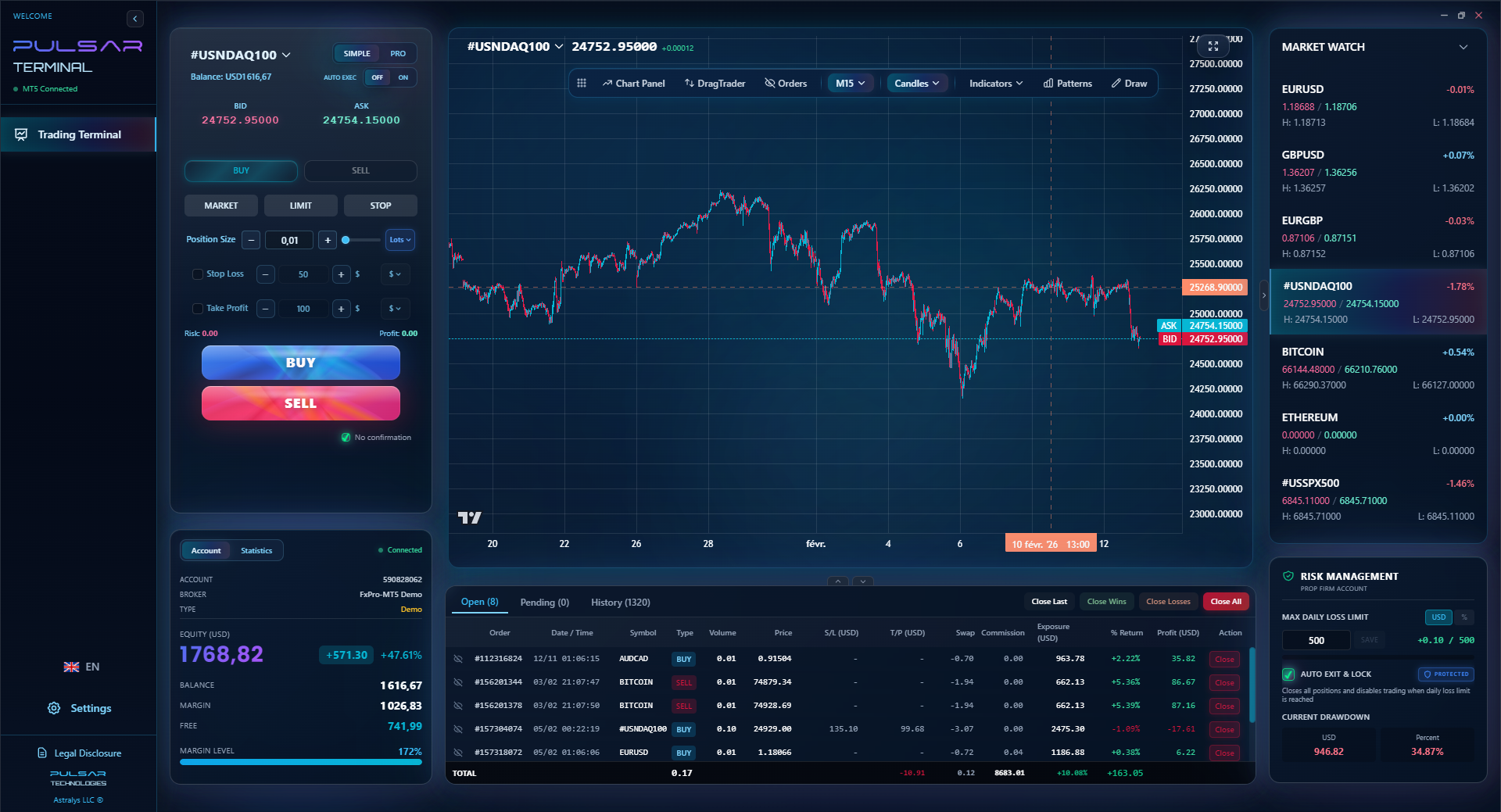
Maintaining a separate trading book requires precise order management, which Pulsar Terminal's drag-and-drop orders and multi-TP/SL features handle directly on your MT5 chart.
Pulsar Terminal
The all-in-one MT5 companion: drag-and-drop orders, multi-TP/SL, trailing stop, grid trading, Volume Profile, and prop firm protection. Used by 1,000+ traders daily.
“He saw market crashes as sales. This was possible because he always kept a portion of his wealth in cash.”
To make this real, let's talk about two specific scenarios.
The One I Missed: Tata Elxsi. I saw this stock in 2017 at around ₹800. The earnings were growing steadily, it had a niche in design services, and the management was solid. It ticked all the Jhunjhunwala boxes. But I thought, "It's already had a big run. I'll wait for a dip." The dip never came. It's a ₹9,000+ stock now. The lesson? For truly great businesses, valuation is important, but timing is secondary. A slightly expensive entry on a 10-year compounder is better than no entry. He would have bought a small position and added on any weakness.
The One I Dodged: Yes Bank. During its heyday, everyone was in love with Yes Bank. The growth was spectacular. But a closer look showed deteriorating asset quality and a reliance on wholesale funding. The Jhunjhunwala principle of "management integrity" was flashing red. I stayed away. It collapsed from ₹400+ to under ₹20. The lesson here is that explosive earnings growth without quality is a trap. He would have avoided it, or if he'd gotten in early, he would have exited long before the collapse on that fundamental stop-loss.
These examples show his strategy in action: ruthless focus on sustainable business quality over everything else. It's not about catching every bull run; it's about avoiding the permanent loss of capital.
Forget trying to be the next Big Bull. Aim to be a disciplined version of yourself using his rules.
- Audit Your Portfolio: Right now, label each holding. Is it an "Investment" (5+ year horizon, based on business quality) or a "Trade" (short-term, based on technicals or momentum)? If you can't answer, sell it. This clarity is the first step.
- Start a Watchlist: Pick 3 sectors you understand. Use Screener.in to find the top 2 companies in each by ROCE and 5-year earnings growth. Study them. Read their annual reports. This is your potential investment universe.
- Practice Patience with a Small Ticket: Take 10% of your capital. Buy one high-conviction stock from your list. Do not look at the price for a month. Check the business news, not the chart. This trains the right muscle.
- Define Your Exits: For that one stock, write down: "I will sell if [Specific Fundamental Condition] happens." For example, "If the debt-to-equity ratio crosses 1," or "If market share drops for 3 consecutive quarters." This is your 'stop-loss in the mind.'
This strategy isn't sexy. It won't give you 100% returns in a month. But it might, just might, help you be in the 11% who don't lose money in the long run. And that's the only statistic that matters.
Pro Tip: The hardest part is the waiting. To stay engaged without meddling, use your time to study market structure. Learn about the Volume Profile to understand where big institutions are buying and selling. It turns waiting from a passive act into an active learning process.
FAQ
Q1Did Rakesh Jhunjhunwala use technical analysis?
He publicly downplayed it, focusing on fundamentals. However, traders close to him suggest he was acutely aware of market levels, liquidity, and sentiment - which are the essence of price action. He likely used charts for timing his entries and exits, especially in his trading book, but never as the primary reason for an investment.
Q2What was Jhunjhunwala's view on stop-losses?
For his long-term investments, he didn't use hard price-based stop-losses. His stop was fundamental: a break in the business thesis. For his trading positions, he was absolutely disciplined with stops. He understood that a short-term trade gone wrong must be cut quickly to preserve capital for investment opportunities.
Q3How much diversification did he believe in?
He believed in concentrated diversification. His portfolio had stocks across sectors (diversification), but within that, he held large, concentrated positions in his highest-conviction ideas (like Titan, Crisil). He mocked over-diversification, calling it a "protection against ignorance."
Q4Can I follow his strategy with a small capital of ₹50,000?
Yes, but with a crucial adjustment. You cannot diversify meaningfully. Therefore, your research burden is higher. You might only be able to hold 1-2 stocks. This makes position sizing and entry price even more critical. Consider using a low-cost SIP in direct mutual funds to build capital first, while using a small portion to practice the stock-picking discipline.
Q5What is the biggest mistake retail traders make when trying to copy him?
They copy the concentration without the conviction, and the patience without the process. They pile into a stock because it's going up (herd mentality) and then call it a 'long-term investment' when it starts falling, refusing to sell even when the fundamentals deteriorate. That's not investing; it's hope masquerading as strategy.
Q6How did he handle market crashes?
He saw them as sales. His most famous line is, "I see opportunity in every crash." This was possible because he always kept a portion of his wealth in cash or cash equivalents. He didn't stay fully invested at all times. He built cash reserves to deploy when prices became attractive.
Prof. Winston's Lesson
Key Takeaways:
- ✓Earnings growth of 20%+ CAGR is the non-negotiable starting point.
- ✓Use trading profits as risk capital to fund long-term investments.
- ✓Your stop-loss is a broken business thesis, not just a price level.
- ✓Concentrate only after research so deep it borders on obsession.
How useful was this article?
Click a star to rate
Weekly Trading Insights
Free weekly analysis & strategies. No spam.
About the Author
Rajesh Sharma
Senior Forex Analyst
Trading Indian and South Asian markets for over 10 years. Started with NSE currency derivatives before moving to international forex. Specializes in USD/INR and emerging market pairs.
Comments
Risk Disclaimer
Trading financial instruments carries significant risk and may not be suitable for all investors. Past performance does not guarantee future results. This content is for educational purposes only and should not be considered investment advice. Always conduct your own research before trading.
You Might Also Like

Cara Trading Forex Sukses: 7 Prinsip dari Trader Profesional
Cara trading forex sukses dengan 7 prinsip trader pro: manajemen modal, disiplin, journal trading, backtest. Data nyata, bukan janji profit palsu.
Jam Trading Forex Terbaik untuk Trader Indonesia: Panduan Lengkap dengan Tabel Waktu
Panduan jam trading forex untuk trader Indonesia. Tabel 4 sesi dunia, jam emas 20:00-00:00, sesi mana yang harus dihindari. Data akurat + tips dari trader berpengalaman.
Top 5 Sàn Forex Uy Tín Nhất 2026: Review Jujur dari Trader Indonesia
Top 5 sàn forex uy tín 2026 untuk trader Indonesia. Review jujur: spread, deposit, withdraw, dukungan lokal. Exness, XM, IC Markets & lebih.
Get Pulsar Terminal
All these calculators are built into Pulsar Terminal with real-time data from your MT5 account. One-click position sizing, automatic risk management, and instant calculations.
Get Pulsar Terminal