


Most lists of recommended books for forex trading are useless for someone sitting in Johannesburg or Cape Town.

David van der Merwe
Emerging Markets Trader ·  South Africa
☕ 12 min read
What you'll learn:
- 1Why Most Trading Books Fail South Africans
- 2The Non-Negotiable Foundation (Read These First)
- 3Strategy-Specific Must-Reads (Pick Your Poison)
- 4The South African Contextualizer (The Local Edge)
- 5Books to Avoid (At Least Until You're Profitable)
- 6Your Action Plan: From Reading to Trading
- 7Beyond Books: The Essential South African Resources
Most lists of recommended books for forex trading are useless for someone sitting in Johannesburg or Cape Town. They're written for a generic global audience and ignore the realities of trading the Rand, dealing with FSCA regulations, and navigating our unique market hours. I've spent over R40,000 on trading books and courses in the last decade. About 90% of it was a complete waste. Today, I'm going to save you that money and headache by breaking down the handful of books that actually changed my trading, and explaining exactly how to apply them to the South African market.
Let's get this out of the way first. The biggest problem with generic trading books is that they assume you're trading USD/JPY or EUR/USD with perfect liquidity at all hours. They don't account for the fact that when London opens at 10:00 SAST, you might still be in a morning meeting. They ignore the wild volatility in USD/ZAR when local political news hits. They certainly don't tell you how to handle the 1.5% spread on exotic pairs that some local brokers sneak in.
I learned this the hard way. Early on, I followed a classic 'breakout' strategy from a popular book. I tried it on GBP/ZAR. The book said to place a stop-loss 20 pips away. What it didn't say was that during our afternoon, GBP/ZAR's average daily range can be 300 pips on a slow day. My stop was gone in minutes, not because the strategy was wrong, but because the book's risk parameters were designed for majors, not our volatile crosses.
Another issue? Psychology. A book written for a New York desk jockey doesn't address the pressure of trading with money that feels more real when it's in Rand. Losing R5,000 hits differently than losing $300 when you're calculating it against school fees or a bond payment.

Warning: Be extremely skeptical of any trading book that doesn't explicitly discuss adjusting strategies for different currency pairs, volatility regimes, and session overlaps. If it treats all pairs the same, it's teaching theory, not practical trading.
The good news is that a few authors get it right. Their principles are universal enough to apply anywhere, but strong enough to survive the specific chaos of the ZAR market.
“Losing R5,000 hits differently than losing $300 when you're calculating it against school fees or a bond payment.”
Before you even think about a specific strategy, you need to build a trader's mindset and understand the battlefield. These two books are mandatory reading. I don't care if you're a scalper in Durban or a swing trader in Pretoria.
Trading for a Living by Dr. Alexander Elder
This is the single most important book on this list. Forget the charts for a moment. Elder drills into the psychology of trading - the part that causes 95% of your failures. He introduces the 'Three M's': Mind, Method, Money. Your mindset comes first, then your trading method, then your money management. Most South Africans get this backwards. They jump straight to a 'Method' (some fancy indicator setup they saw online) with no mental discipline and terrible position sizing.
His concept of the 'Impulse System' versus the 'Expert System' saved my account. The Impulse is your greedy, fearful gut reaction. The Expert is your cold, pre-written trading plan. In 2022, during a huge ZAR sell-off on load-shedding headlines, my Impulse wanted to short USD/ZAR massively. My Expert plan, inspired by Elder's rules, said my maximum risk was 1% per trade. I took a small, planned short. It was wrong, I hit my stop, and lost 1%. The guy next to me at the coffee shop (who hadn't read the book) went all-in, lost 15% of his account in an hour, and quit trading. That's the difference.
Currency Trading for Dummies by Brian Dolan & Kathleen Brooks
Don't let the title fool you. This is the best plain-English explanation of how the forex market actually works. It explains everything from how an ECN executes your order to why the Reserve Bank's decisions move USD/ZAR. For a South African, the most valuable sections are on fundamental analysis and macroeconomics. You'll finally understand why the US Non-Farm Payroll report can cause chaos in EUR/ZAR, or how China's GDP affects our commodity-driven Rand.
It won't give you a 'get-rich-quick' system. It gives you the literacy to understand every other book and strategy you'll encounter. Think of it as learning the rules of rugby before you try to run onto the field at Ellis Park.

💡 Winston's Tip
A library of a thousand trading books is worthless if you haven't mastered the one on your desk. Read one chapter, then trade the concept on demo for a week. That's how knowledge becomes skill.
“Your mindset comes first, then your trading method, then your money management. Most South Africans get this backwards.”
Once your foundation is solid, you need a method. These books are masters of their specific craft. Choose based on how you want to trade.
For Price Action Purists: Naked Forex by Alex Nekritin & Walter Peters
If you're sick of lagging indicators cluttering your MT4 screen, this is your bible. It teaches you to read raw price movement - support, resistance, and candlestick patterns - without the noise. This approach is brilliant for South Africans because it works on any timeframe and any pair, including our quirky ZAR crosses.
I applied their '123' reversal pattern to USD/ZAR on the 4-hour chart. In September 2023, after a long rally, price made a high (1), pulled back (2), failed to make a new high (3). The book's rules said to short on a break below the '2' point. Entry was around R18.90. I rode it down to R18.40. No RSI, no MACD indicator, just pure price. It teaches self-reliance, which is crucial when your internet drops during load-shedding and you can't see your fancy indicators.
For Short-Term Traders: Day Trading and Swing Trading the Currency Market by Kathy Lien
Kathy Lien is a pro. This book is dense with actionable strategies for different market conditions (trending vs. ranging). Her breakdown of trading during specific market sessions is gold for us. She explains why the London-New York overlap (15:00-19:00 SAST) offers the best volatility for scalping strategy majors, and why you might want to avoid trading AUD pairs during our early morning.
Her fundamental analysis frameworks are especially useful. She shows you how to trade news events - not just the headline number, but the market's expectation versus the reality. I used this to trade GBP/ZAR during a Bank of England meeting. The market expected a hike. The hike happened, but the statement was dovish. Using Lien's framework, I knew to sell the 'buy the rumor, sell the news' event. Booked a quick 50-pip profit while everyone else was confused.
For Technical Analysis Geeks: Japanese Candlestick Charting Techniques by Steve Nison
This is the original text. It's not a light read, but it's the definitive source. You'll learn to spot a 'Doji' or 'Shooting Star' and, more importantly, understand the psychology behind each pattern. This skill helps you see when a move is exhausting. On the USD/ZAR daily chart, a series of long bullish candles followed by a small 'Spinning Top' candle often signals the big players are losing conviction, even if the news is still bullish.

Pro Tip: Don't try to memorize all 40+ patterns. Master the 10 major reversal and continuation patterns first. A solid understanding of 'Engulfing' and 'Hammer' patterns will serve you better than a shallow knowledge of dozens.
“Your mindset comes first, then your trading method, then your money management. Most South Africans get this backwards.”
This is where we move from global principles to local application. No single book covers this, so I'm giving you the synthesis you need.
Applying the Books to ZAR Pairs:
- Volatility Adjustments: Any stop-loss or profit target from a book must be adjusted for Average True Range (ATR). If a book suggests a 20-pip stop on EUR/USD (ATR 70), and USD/ZAR has an ATR of 300, your proportional stop should be around 85 pips. Use a position size calculator to keep your risk constant.
- Liquidity & Sessions: The strategies in Naked Forex or Lien's book work best on USD/ZAR and EUR/ZAR during London/NY hours. Trying the same precision on GBP/ZAR at 22:00 SAST is asking for slippage. Know your pair's active hours.
- Fundamental Overlay: South Africa is a risk-sensitive, commodity-driven economy. Use Currency Trading for Dummies to understand the concepts, then apply them locally. A rising gold price supports the ZAR. Eskom news is a direct fundamental input. Corrupt the global principles with local knowledge.
Broker & Platform Reality: The books assume you have a good broker. In SA, you must choose an FSCA-regulated one for protection. A broker like Exness or XM offers ZAR accounts and local deposits, which simplifies everything. When a book talks about 'quick execution,' test it with your broker on a demo during volatile news. I found my old broker added 3-5 pips of slippage on USD/ZAR news; my current one, IC Markets, adds less than 1.
Tax Implications (SARS): No trading book mentions this, but you must. Profits from trading are considered income tax in South Africa, not capital gains. Keep careful records of every trade. It's boring, but an audit is more boring.
💡 Winston's Tip
The market doesn't care what your favourite book says. If your carefully studied setup isn't appearing, the correct trade is to do nothing. Patience is a strategy you won't find in an index.
“Reading without application is just a hobby.”
Some books are popular but dangerous for a developing trader. They're not necessarily bad, but they teach concepts that are easy to misuse.
- Any Book Promising a 'Simple, Guaranteed' System: Forex isn't simple. If a 200-page book had a guaranteed system, the author would be using it, not selling it. These books build magical thinking.
- Advanced Algorithmic & EA Coding Books: If you're still asking what a pip definition is, building a trading robot is a fantastic way to lose money very efficiently. Master discretionary trading first.
- Extreme use & 'Get Rich Quick' Memoirs: These are entertainment, not education. They glorify risk-taking that will obliterate a retail account. Remember, between 51% and 89% of retail accounts lose money trading CFDs. Your goal is to be in the minority, not to emulate a billionaire's gamble.
I bought one of these 'secret system' books early on. It cost me R800 and two months of my time backtesting a strategy that was just a convoluted version of a moving average crossover. The only secret was how effectively it separated me from my money.
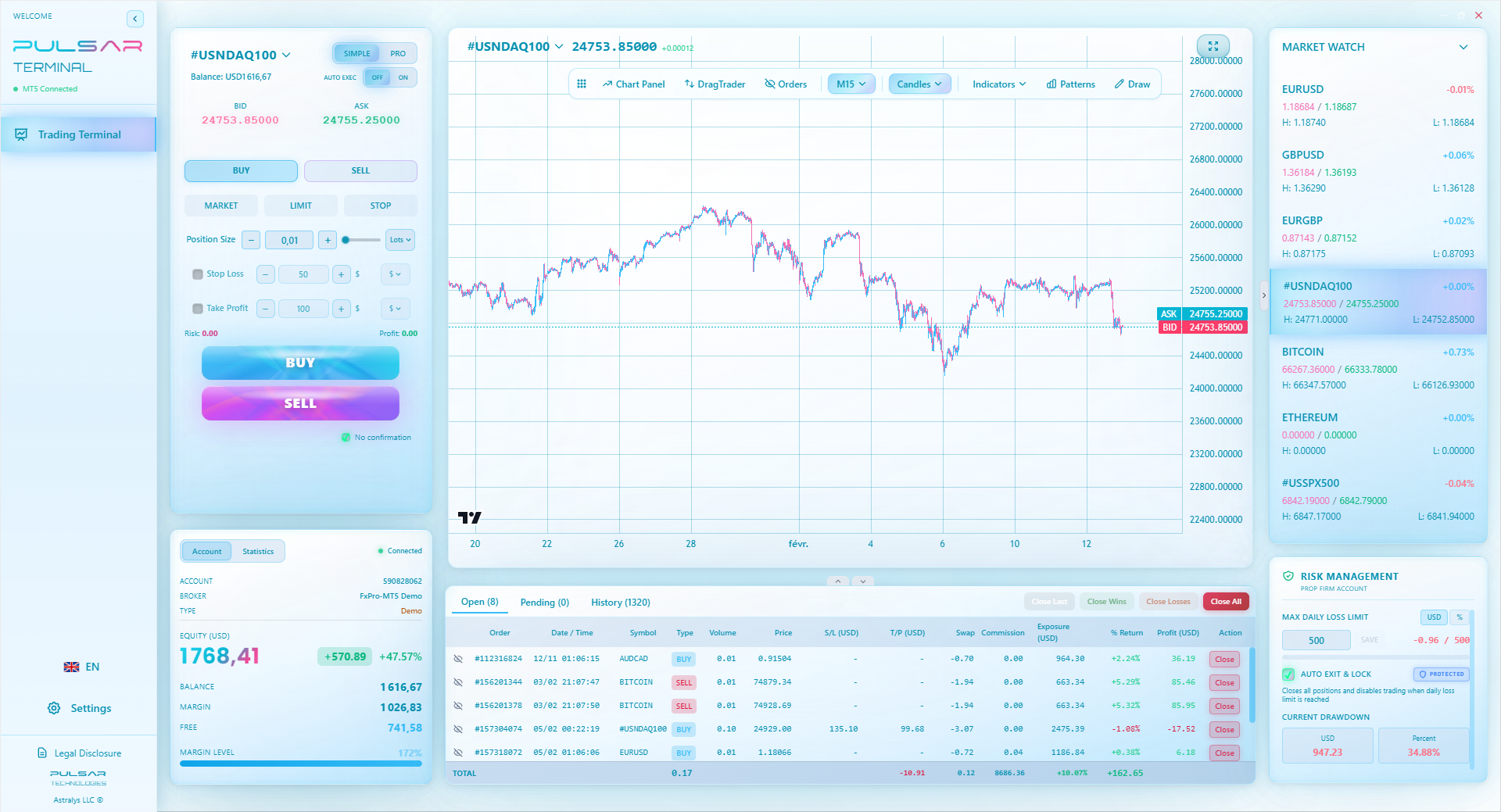
Executing the precise stop-loss and take-profit levels from your trading book is critical, and Pulsar Terminal lets you drag-and-drop those orders directly onto your MT5 chart with multi-level exits.
Pulsar Terminal
The all-in-one MT5 companion: drag-and-drop orders, multi-TP/SL, trailing stop, grid trading, Volume Profile, and prop firm protection. Used by 1,000+ traders daily.
“Reading without application is just a hobby.”
Reading without application is just a hobby. Here’s how to turn these recommended books for forex trading into real Rand in your account.
The Order of Operations:
- Month 1: Read Currency Trading for Dummies. Open a demo account with an FSCA broker like Pepperstone. Don't trade yet. Just watch USD/ZAR and EUR/USD for a week, identifying the concepts from the book.
- Month 2: Read Trading for a Living. Write your first trading plan. It must include: your risk-per-trade (start at 0.5%), your daily loss limit, and the conditions under which you'll stop trading for the day. This is non-negotiable.
- Month 3: Choose ONE strategy book (Naked Forex OR Kathy Lien's book). Study one single setup from it. On your demo, practice only that setup on EUR/USD for two weeks. Record every trade in a journal - why you took it, your emotion, the outcome.
- Month 4: Now, and only now, apply that same single setup to USD/ZAR. Note the differences in volatility and behavior. Adjust your position size using a position size calculator to keep your risk identical to your EUR/USD trades.
The Journal is Your Best Tool: Your trade journal is more important than any indicator. For every trade, note:
- Book/Strategy used
- Entry/Exit Price
- Risk (in Rands)
- Emotional State (Confident? Frightened? Bored?)
- Screenshot of the setup
After 20 trades, you'll see patterns. You'll find you lose money when you're bored and overtrade, or when you ignore the session timing from Lien's book. That data is priceless.

Example: My journal showed 80% of my losses came from trades taken after 19:00 SAST, trying to 'catch up' after a slow day. I made a rule: no new trades after the NY close. My consistency improved immediately.
💡 Winston's Tip
Your trade journal will tell you more about your future performance than any forecast. The patterns are all there: the over-trading after a loss, the fear of pulling the trigger on a perfect setup. The data doesn't lie.
“Your trade journal is more important than any indicator.”
Books give you knowledge, but these resources give you the real-time data and community to apply it.
Regulatory & Safety:
- FSCA Website: Always verify your broker here first. Search their warnings list; it's a gallery of scams to avoid.
- SARS Guide on Trading Income: Know your tax obligations before you make a profit. It's less painful that way.
Market Data & News:
- Reserve Bank Statements: The primary driver of ZAR. Don't just read the headline rate decision; read the Monetary Policy Committee's commentary.
- TradingView: For charts and ideas. But beware - the comment sections are often financial carnivals. Use it for the charts, not the chatter.
- Reliable News Feeds: Bloomberg, Reuters. Avoid getting your 'analysis' from social media hype-men.
Community & Continuous Learning:
- Find a Mentor or Small Group: Not a paid 'signal group.' Find 2-3 other serious South African traders to review trades and hold each other accountable. This provided more insight than any book after the basics.
- The Trading Mentor Guides: Use our specific guides to deepen areas you struggle with. Stuck on swing trading the Rand? Read our XAU/USD guide to understand gold's correlation. Need broker specifics? Our EUR/USD guide breaks down execution on the world's most liquid pair, a great benchmark.
The journey from reading to consistent profitability is a long one. I've had losing streaks that made me want to quit. But having a library of core principles from these books, and a rigid plan, allowed me to survive those streaks and come out the other side. Start with the foundation, build slowly, and always, always protect your capital. That's the real secret no single book will ever teach you.
FAQ
Q1I'm a complete beginner in South Africa. What's the absolute first book I should buy?
Without a doubt, 'Currency Trading for Dummies' by Brian Dolan & Kathleen Brooks. It will explain the market, the jargon, and the mechanics in a way that doesn't make you feel stupid. It's the essential primer before you touch anything about strategy or psychology.
Q2Are books about trading US stocks or crypto useful for forex trading in South Africa?
Marginally useful at best, dangerously misleading at worst. The psychology and risk management principles can transfer, but the market mechanics, drivers, and volatility profiles are completely different. A strategy built for the 24/7 crypto market or the equity open auction will fail spectacularly in forex if applied directly. Focus on forex-specific texts first.
Q3How do I adjust the risk management rules from these books for volatile pairs like USD/ZAR?
You scale everything by volatility. Don't use a fixed pip stop-loss. Use a stop-loss based on the Average True Range (ATR). If a book suggests a 20-pip stop for a strategy, and USD/ZAR's current 14-period ATR is 250 pips, while EUR/USD's is 70 pips, your stop on USD/ZAR should be roughly (250/70)*20 = ~71 pips. Always use a position size calculator so that 71-pip stop risks the same percentage of your account as the 20-pip stop on EUR/USD.
Q4Do I need to read all of these books to be successful?
No. You need to master the concepts in the foundation books ('Currency Trading for Dummies' and 'Trading for a Living') and then achieve deep competence in one strategy from one of the strategy books. A trader who is an expert at one price-action setup from 'Naked Forex' will outperform a trader who has a shallow understanding of ten different methods from ten different books.
Q5What's the biggest mistake South Africans make after reading trading books?
They treat the rules as gospel and don't contextualize them for our market. They'll take a scalping strategy designed for the EUR/USD London open and try to run it on USD/ZAR at midnight SAST, wondering why they get horrible slippage and false breaks. They also ignore the psychological pressure of trading their home currency and often risk far more per trade than the books advise.
Q6Are older trading books still relevant with all the new technology and algorithms?
The best ones are more relevant than ever. Technology changes how orders are filled, but it doesn't change human greed and fear, which is what the classics like Elder's book teach. Price action principles from Steve Nison's 1991 book still work because they describe auction market behavior, which is fundamental. The core hasn't changed; just the speed.
Q7Should I use the demo accounts offered by the brokers mentioned in the research?
Absolutely. Demo accounts are your free training ground. Test the strategies from your books on demos from brokers like Exness, IC Markets, or XM. Pay attention to execution speed, spreads during SAST news times, and platform reliability. It's the closest you get to real trading without risk.
Prof. Winston's Lesson
Key Takeaways:
- ✓Master psychology & basics before any strategy.
- ✓Adjust all book rules for ZAR pair volatility.
- ✓Demo trade one setup for a month minimum.
- ✓Your journal is your true mentor.
How useful was this article?
Click a star to rate
Weekly Trading Insights
Free weekly analysis & strategies. No spam.
About the Author
David van der Merwe
Emerging Markets Trader
Johannesburg-based trader with 11 years in emerging market currencies. Specializes in ZAR pairs, FSCA-regulated trading, and South African market analysis.
Comments
Risk Disclaimer
Trading financial instruments carries significant risk and may not be suitable for all investors. Past performance does not guarantee future results. This content is for educational purposes only and should not be considered investment advice. Always conduct your own research before trading.
You Might Also Like

Cara Trading Forex Sukses: 7 Prinsip dari Trader Profesional
Cara trading forex sukses dengan 7 prinsip trader pro: manajemen modal, disiplin, journal trading, backtest. Data nyata, bukan janji profit palsu.
Jam Trading Forex Terbaik untuk Trader Indonesia: Panduan Lengkap dengan Tabel Waktu
Panduan jam trading forex untuk trader Indonesia. Tabel 4 sesi dunia, jam emas 20:00-00:00, sesi mana yang harus dihindari. Data akurat + tips dari trader berpengalaman.
Top 5 Sàn Forex Uy Tín Nhất 2026: Review Jujur dari Trader Indonesia
Top 5 sàn forex uy tín 2026 untuk trader Indonesia. Review jujur: spread, deposit, withdraw, dukungan lokal. Exness, XM, IC Markets & lebih.
Get Pulsar Terminal
All these calculators are built into Pulsar Terminal with real-time data from your MT5 account. One-click position sizing, automatic risk management, and instant calculations.
Get Pulsar Terminal