


I remember staring at my screen in 2019, watching the EUR/USD spike on a Fed announcement.

David van der Merwe
Emerging Markets Trader ·  South Africa
☕ 8 min read
What you'll learn:
- 1The Regulatory Showdown: US Iron Fist vs. SA Pragmatism
- 2The 1:50 use Cap: Why It Changes Everything
- 3SARB's R1 Million Wall: Getting Your Money In and Out
- 4The Very Short List: Which US Brokers Actually Exist?
- 5The Smart South African Compromise: FSCA-Regulated International Brokers
- 6Final Call: Should You Even Bother?
I remember staring at my screen in 2019, watching the EUR/USD spike on a Fed announcement. My trade with a European broker was in profit, but the spread had widened to 15 pips on the news. I thought, 'If only I was with one of those tight-spread US brokers.' That's when I learned the hard way that as a South African, trading with a US-regulated broker isn't just a sign-up form. It's a maze of use caps, exchange controls, and regulatory walls. Let's cut through the marketing and look at what dealing with regulated forex brokers in the USA really means for someone sitting in Johannesburg or Cape Town.
You need to understand this first: the US and South Africa approach retail forex trading with completely different philosophies. The US treats you like a child who can't be trusted with matches. South Africa treats you like an adult who should know better, but will still step in if you're about to burn the house down.
The US system, run by the CFTC and NFA, is built on extreme caution. Their primary goal is to prevent another 2008-style blow-up where retail traders get wiped out and complain to Congress. That's why they enforce the 1:50 use cap on majors and 1:20 on minors. They also require brokers to hold a staggering $20 million in capital. It's safe, but it's restrictive.
South Africa's FSCA, by contrast, sets a 1:30 use limit but allows you to access a global market of brokers. Their job is to ensure the brokers operating here are legitimate, not to hand-hold your every trade. The critical difference? If your FSCA-regulated broker like XM or IC Markets messes up, you have a local authority to shout at. If your US-regulated broker decides to freeze your account, you're arguing with the NFA from 8,000 miles away.

Warning: Don't confuse safety with convenience. A US broker is 'safe' in terms of capital security, but 'inconvenient' when you need to move Rands in and dollars out. Your FSCA-regulated broker might offer higher use, but you're relying on their international entity's compliance, not just the local license.

💡 Winston's Tip
A regulator's job is to protect the system from you, not to protect you from yourself. Trade accordingly.
This is the single biggest practical difference, and most South African traders completely underestimate it. You're probably used to seeing offers of 1:100, 1:200, or even 1:500 from international brokers. Switching to a max of 1:50 isn't just a minor adjustment, it rewires your entire approach to position sizing and margin.
Let me give you a real example from my own journal. In 2021, I tested a US broker account with a $10,000 deposit. My standard scalping strategy on the EUR/USD involved a 0.5 lot (50,000 units) position. At 1:100 use, that required about $500 in margin. Easy. At 1:50 use, the same trade required $1,000 in margin. Suddenly, half my account was tied up in one scalp. I couldn't run multiple positions or leave room for error. My whole strategy, built over years, was useless.
The Capital Multiplication Myth
New traders think low use is 'safer.' It's not safer, it's just different. It forces you to use more of your own capital per trade. If you're undercapitalized, you'll hit a margin call faster during normal volatility, not slower. You need a much larger account to trade the same effective size. For a South African trader converting Rands, this is a massive barrier. That R100,000 you saved up ($5,300-ish) doesn't go nearly as far.

Example: Trade: Buy 1 standard lot (100,000) EUR/USD at 1.0850.
- At 1:100 use: Required Margin ≈ $1,085
- At 1:50 use: Required Margin ≈ $2,170 That's double the cash locked up. For a swing trading account holding for days, this dramatically reduces your portfolio flexibility.
“Your dream of funding a US broker account hits the wall of SARB's R1 million allowance.”
This is the part that makes most South Africans give up. The South African Reserve Bank (SARB) doesn't care about your forex P&L. They care about controlling the flow of Rands out of the country. Your dream of funding a US broker account is subject to the single discretionary allowance: R1 million per person, per calendar year.
That sounds like a lot, but it's for everything – travel, gifts, online shopping, and investing. If you fund a $10,000 trading account (about R185,000), that's a significant chunk of your annual allowance gone. Now imagine you have a good year and want to withdraw $50,000 in profits. You can't just wire it back. You'll need to apply to SARS for an Approval of International Transfer (AIT), proving the source of funds. I've spoken to two traders who went through this; it took 3 months and a pile of brokerage statements and tax records.
Compare that to using an FSCA-regulated broker like Exness or Pepperstone that offers a ZAR-denominated account. Deposits and withdrawals are in Rands, via local bank transfer or instant EFT. It's done in hours, not months. The convenience is night and day.

Pro Tip: If you're determined to use a US broker, open a USD account with a South African bank (like FNB or Standard Bank) first. Fund that account using your allowance, then transfer to the broker. It creates a clearer paper trail for SARS when you need to bring profits back. Keep every single statement.
💡 Winston's Tip
If your strategy can't survive a use cut from 1:100 to 1:50, it wasn't a strategy. It was a gamble with a bigger safety net.
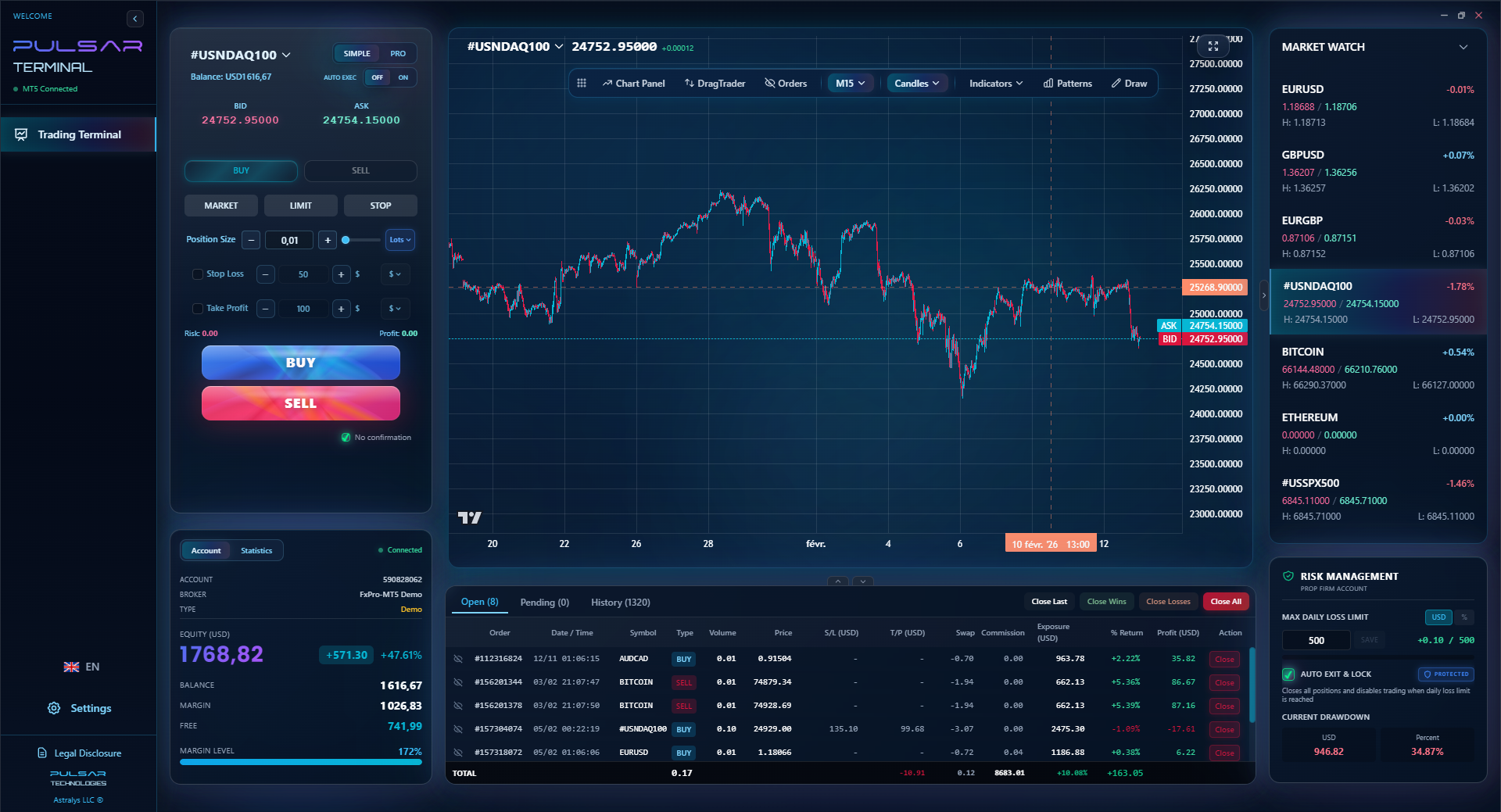
Managing complex trades with strict US leverage limits requires precision; Pulsar Terminal's drag-and-drop order and multi-TP/SL tools on MT5 help you execute your plan without margin errors.
Pulsar Terminal
The all-in-one MT5 companion: drag-and-drop orders, multi-TP/SL, trailing stop, grid trading, Volume Profile, and prop firm protection. Used by 1,000+ traders daily.
Because the regulations are so tough, only a handful of brokers bother with the US retail market. The big names are FOREX.com and OANDA. Sometimes IG's US arm (tastyfx) and Interactive Brokers are in the mix, but IB is more geared toward stocks.
Let's be blunt: their offerings are boring and expensive compared to what you can get elsewhere. Spreads are competitive but not the best. Platforms are solid (they offer MT4/MT5), but you won't find the raw, ultra-low latency environments of a Pepperstone Raw account or the tight spreads of IC Markets. They cater to the conservative, long-term American retail trader, not the aggressive scalper or algorithmic trader.
I deposited $2,000 with OANDA US for a month in 2023 to test it. Execution was fine. The platform was fine. Everything was... fine. But the spread on the XAU/USD (gold) averaged about 35 cents, where my main account with an international broker was seeing 20 cents. Over 100 trades a month, that adds up. You're paying a premium for the CFTC's protection.
“For 99% of South African traders, there's no good reason to choose a US broker.”
Given the use and exchange control headaches, why would a South African trader choose a US broker? For 99% of you, there's no good reason. The smarter path is using a top-tier international broker that is ALSO regulated by the FSCA.
This gives you the best of both worlds: you operate under South African exchange controls (using ZAR accounts), you have a local regulator for complaints, but you get access to global liquidity and better trading conditions. Brokers like XM, IC Markets, Exness, and AvaTrade all hold FSCA licenses.
Your money is still segregated. You still get professional execution. But you can use use up to 1:30 (the FSCA limit) or sometimes more if the broker classifies you as a professional client (difficult, but possible). More importantly, you can fund your account with Rands today and be trading EUR/USD in an hour.
Warning: Just because a broker's group is regulated elsewhere doesn't mean your specific account is under that jurisdiction. When you sign up with the South African entity of an international broker, your contract and regulator is the FSCA. Don't assume you get the protection of ASIC (Australia) or CySEC (Cyprus) by default.
💡 Winston's Tip
The most important 'regulation' is the one you impose on your own position size. A calculator is cheaper than any license.
Here’s my straight take after 12 years and trying most setups:
Only consider a US-regulated forex broker if:
- You are permanently moving to the USA and need to transfer your trading there.
- You have a massive account (think $500,000+) where the absolute capital security of the $20 million requirement outweighs every other factor.
- You are a fundamentally-focused, low-frequency swing trader who doesn't need use above 1:50 and hates change.
For every other South African trader, the friction is too high. The use cap cripples most active strategies. The exchange control process is a bureaucratic nightmare for withdrawals. The broker choice is limited and often more expensive.
Your focus should be on finding the best FSCA-regulated broker that offers tight spreads on your preferred instruments, a platform you like (MT4/MT5, cTrader), and reliable ZAR funding/deposits. Regulate your own risk using a strict position size calculator. That's where you'll find the real edge, not in chasing a US license that wasn't designed with you in mind.
The grass isn't greener with US brokers. It's just mowed to a very specific, very short height that doesn't suit our climate.
FAQ
Q1Can I legally open an account with a US forex broker as a South African resident?
Technically, yes, if the broker accepts non-resident clients. However, most major US-regulated brokers (like FOREX.com US) restrict their services to US residents only to simplify compliance. Even if you find one that accepts you, you'll still face the SARB exchange control process to get your money there.
Q2Is my money safer with a US broker compared to an FSCA-regulated one?
It's a different type of safety. US brokers have extreme capital requirements ($20 million), which makes broker insolvency very unlikely. However, 'safety' also means access. If you have a dispute, dealing with the NFA from South Africa is hard. With an FSCA-regulated broker, you have a local authority for recourse, and your funds are still segregated. The practical safety for a South African is often higher with a locally licensed broker.
Q3How do I fund a US broker account with Rands?
You don't. You must first convert your Rands to US Dollars using your annual R1 million discretionary allowance through an authorized dealer (a bank). You then wire the USD to the broker's US bank account. This process incurs bank fees and uses up your allowance. It is the opposite of the instant EFT you're used to.
Q4What happens if I make a big profit with a US broker? How do I get the money back to South Africa?
This is the major hurdle. To repatriate profits over your remaining annual allowance, you must apply to SARS for an Approval of International Transfer (AIT). You'll need to provide extensive documentation from the broker proving the source of the funds is trading profits. This process can take months and is not guaranteed.
Q5Why is the use so low with US brokers?
It's a regulatory decision by the CFTC/NFA following the 2008 financial crisis. The view is that high use is too risky for the average retail trader and leads to excessive losses. The cap is 1:50 on major pairs and 1:20 on minors, regardless of your experience or wealth.
Q6Are the trading platforms and tools better with US brokers?
Not necessarily. They offer standard platforms like MetaTrader. You won't find advanced tools like sophisticated Market Profile or automated trade management suites as commonly as with some international brokers catering to professional clients. The US retail offering is streamlined and conservative.
Q7Should I just use Interactive Brokers for forex?
Interactive Brokers is a CFTC-regulated FCM, but its primary focus is stocks and futures for sophisticated/institutional clients. Their forex offering is spotty for retail, often with poor liquidity on minor pairs. It's not a dedicated forex broker, and the platform is complex. It's not a good substitute for a dedicated forex provider.
Prof. Winston's Lesson
Key Takeaways:
- ✓US use caps (1:50) demand 2x the capital for the same trade size.
- ✓SARB exchange controls add months of delay to large profit withdrawals.
- ✓FSCA-regulated international brokers offer better practical access.
- ✓US broker 'safety' is capital security, not dispute resolution access.
How useful was this article?
Click a star to rate
Weekly Trading Insights
Free weekly analysis & strategies. No spam.
About the Author
David van der Merwe
Emerging Markets Trader
Johannesburg-based trader with 11 years in emerging market currencies. Specializes in ZAR pairs, FSCA-regulated trading, and South African market analysis.
Comments
Risk Disclaimer
Trading financial instruments carries significant risk and may not be suitable for all investors. Past performance does not guarantee future results. This content is for educational purposes only and should not be considered investment advice. Always conduct your own research before trading.
You Might Also Like

Cara Trading Forex Sukses: 7 Prinsip dari Trader Profesional
Cara trading forex sukses dengan 7 prinsip trader pro: manajemen modal, disiplin, journal trading, backtest. Data nyata, bukan janji profit palsu.
Jam Trading Forex Terbaik untuk Trader Indonesia: Panduan Lengkap dengan Tabel Waktu
Panduan jam trading forex untuk trader Indonesia. Tabel 4 sesi dunia, jam emas 20:00-00:00, sesi mana yang harus dihindari. Data akurat + tips dari trader berpengalaman.
Top 5 Sàn Forex Uy Tín Nhất 2026: Review Jujur dari Trader Indonesia
Top 5 sàn forex uy tín 2026 untuk trader Indonesia. Review jujur: spread, deposit, withdraw, dukungan lokal. Exness, XM, IC Markets & lebih.
Get Pulsar Terminal
All these calculators are built into Pulsar Terminal with real-time data from your MT5 account. One-click position sizing, automatic risk management, and instant calculations.
Get Pulsar Terminal