


You've probably seen that little line at the bottom of your chart, bouncing between 0 and 100.

Olumide Adeyemi
West African Trading Pioneer ·  Nigeria
☕ 10 min read
What you'll learn:
- 1What the RSI Actually Measures (It's Not What You Think)
- 2Why the Classic 70/30 Setup Fails in Real Trading
- 3Using RSI for Nigerian Forex Pairs: USD/NGN, GBP/NGN
- 4The Only RSI Strategies That Consistently Make Money
- 5Position Sizing and Stops: The RSI Trader's Survival Kit
- 6Practical Setup: Installing and Configuring RSI on MT4/MT5
- 7Beyond the Basics: RSI Swing Rejections and Range Trading

You've probably seen that little line at the bottom of your chart, bouncing between 0 and 100. The Relative Strength Index (RSI) is on almost every trader's screen in Nigeria. But here's the uncomfortable truth: most people treat it like a magic buy/sell signal generator, and that's exactly why they lose money. I've blown up accounts following bad RSI advice. Let's strip away the nonsense and talk about what this indicator actually does, how it fails, and the few ways you can use it without getting wrecked.
The Relative Strength Index doesn't measure who's winning between buyers and sellers. That's a common myth. It measures the speed and magnitude of recent price changes. Think of it as a momentum oscillator.
Created by J. Welles Wilder in 1978, the standard setting is 14 periods. The formula compares the average gains and average losses over that time. When the RSI is at 70, it means the average size of up moves has been significantly larger than the average size of down moves over the last 14 candles. That's it. It's not telling you the market is 'overbought' and must reverse. A strong trend can see the RSI stay above 70 or below 30 for weeks.
I learned this the hard way in 2018, shorting GBP/JPY every time the RSI touched 75 during a massive bullish run. I kept thinking, 'It's overbought, it has to drop.' It didn't. It went from 145.00 to 148.50 with the RSI pegged above 70, and I lost nearly $1,200 fighting it. The indicator was just confirming powerful bullish momentum, not calling a top.

Warning: Treating RSI levels as automatic reversal signals is the single biggest mistake new traders make. In a strong trend, these levels just define the trend's momentum boundary.

💡 Winston's Tip
The 50 level on the RSI is more important than 70 or 30. It's the line between bullish and bearish momentum bias on your chosen timeframe.
Every beginner's tutorial tells you: buy when RSI crosses above 30 (oversold), sell when it crosses below 70 (overbought). If trading were that easy, we'd all be rich. This setup fails consistently because it ignores context.
The Context Problem
A market can be 'oversold' (RSI < 30) in a crushing bear trend and just keep going. In early 2020, when oil crashed, the RSI on USOIL was below 20 for days. Buying the 'oversold' crossover would have been financial suicide as price kept plummeting. The same happens in raging bull markets. The indicator needs a market context to be useful. Using it alone is like trying to drive with only a speedometer, no windshield.
Divergence: The Slightly Better Signal
This is where traders get more sophisticated. Regular bearish divergence happens when price makes a higher high, but RSI makes a lower high. It suggests weakening momentum and can sometimes precede a pullback or reversal. The key word is sometimes.
In my experience, divergence works best on higher timeframes (like the 4-hour or daily chart) and when it aligns with a key support or resistance level. On the 15-minute chart? It's mostly noise. I once counted 12 divergence signals on EUR/NGN in a single day on the 5-minute chart. Most led nowhere.

Example: Let's say you're looking at USD/NGN on the daily chart. Price hits a two-year high at 1600, but the RSI's peak is at 65, lower than its previous peak of 75 at the 1550 high. That's a potential warning sign the uptrend is exhausting. But you still need a price-based trigger to act, like a break below a recent swing low.
“Treating RSI levels as automatic reversal signals is the single biggest mistake new traders make.”
Trading pairs like USD/NGN or GBP/NGN adds another layer. The Naira market can have unique volatility, especially around Central Bank of Nigeria (CBN) announcements or liquidity crunches. The standard 14-period RSI can get extremely jumpy.
For these pairs, I often use a slower RSI, like a 21 or even 25-period setting. It smooths out the noise and gives fewer, but more reliable, readings. During periods of extreme CBN-driven volatility, I ignore oscillators altogether. No indicator can reliably model political or policy shock.
Also, remember spreads. If you're scalping with RSI on these pairs with a broker that has a wide spread, the 'signal' is often eaten up by costs before you're in profit. Always check the live spread on your platform before entering based on a short-term RSI move. A good broker review will detail typical spreads for local pairs.
Here’s a quick comparison of RSI behavior:
| Market Condition | Standard 14-RSI Behavior | Better Approach for Nigeria |
|---|---|---|
| Normal Liquidity | Works moderately well | Use 21-period RSI for smoother signals |
| High Volatility (Post-CBN News) | Whipsaws violently between extremes | Avoid RSI. Use pure price action & volume. |
| Slow, Grinding Trend | Can stay overbought/oversold | Use trend-following methods, not RSI reversals. |
The main lesson? Adapt the tool to the market's rhythm, not the other way around.
So, if the classic ways are flawed, how do professionals use the relative strength index forex? They use it as a confirming filter, not a primary trigger.
RSI as a Trend Filter
This is my go-to method. On a daily chart, I use the 50 level as a basic trend filter. If the RSI is above 50, I only look for buy setups on lower timeframes. If it's below 50, I only look for sell setups. It keeps me on the right side of the larger momentum. For instance, if I'm planning a swing trade on XAU/USD (Gold), I won't consider a long position if the daily RSI is languishing below 45. It's a simple, effective bias check.
RSI with Price Action Confluence
Never act on an RSI signal alone. Wait for it to align with a clear price action event. For example:
- RSI shows bullish divergence (higher low) AND price bounces off a major support level with a bullish engulfing candle.
- RSI moves back above 30 after being oversold AND price breaks above a minor downtrend line.
The price action is the decision-maker. The RSI just adds a layer of confidence. It tells you the momentum agrees with the price story.
The Failure Swing (Hidden Divergence)
This is an advanced but powerful concept. A bullish failure swing occurs when RSI makes a low below 30, rallies, pulls back, holds above 30, and then breaks its previous rally high. It often signals the start of a strong move. I used this on EUR/USD in late 2023. The RSI made the pattern on the 4-hour chart while price was testing a consolidation zone. It was the extra confirmation I needed to enter a long, which ran for over 150 pips.

Pro Tip: Combine RSI with a trend-identifying tool like a moving average. If price is above the 200-period EMA and the RSI is holding above 40 on pullbacks, the bullish trend is strongly confirmed. Look for buy opportunities, not tops.
💡 Winston's Tip
If you see a perfect RSI signal but can't place a logical, price-based stop-loss within your risk limit, the trade doesn't exist. Walk away.
“The RSI should be a confirming filter, not your sole entry trigger.”
An RSI-based trade is still a probabilistic bet. Your survival depends on managing the risk of being wrong. Because RSI signals can fail often, your risk per trade must be small.
I never risk more than 0.5% of my account on any single RSI-confluence trade. Why? Because even good setups fail. If your position size calculator tells you to risk 2% on a 'sure thing' RSI divergence, ignore it. Dial it down.
Where do you place your stop-loss? Never place it based on an RSI level. Your stop must be based on price. If you buy based on an oversold bounce, place your stop-loss below the recent swing low that coincided with the oversold reading. If that swing low is 50 pips away, and your risk tolerance is 20 pips, the trade is invalid. Don't squeeze the stop to fit. Just pass on the trade.
This discipline saved me from a nasty loss on GBP/NGN last month. I had a perfect-looking bullish divergence on the hourly chart. My entry would have been at 2050. The logical swing low stop was at 2035 (15 pips). My risk rules only allowed a 10-pip stop for that position size. Instead of cheating and placing a tighter stop (which would have been hit), I skipped the trade. Price dipped to 2037 and then rocketed up. I missed the profit, but I also avoided the high probability of being stopped out due to a poorly placed stop.
Managing trades is just as crucial. This is where automation helps.
Warning: A common pitfall is moving your stop-loss further away because the RSI 'still looks good.' If price hits your stop, you're wrong. The RSI is lagging. Accept the loss and move on.
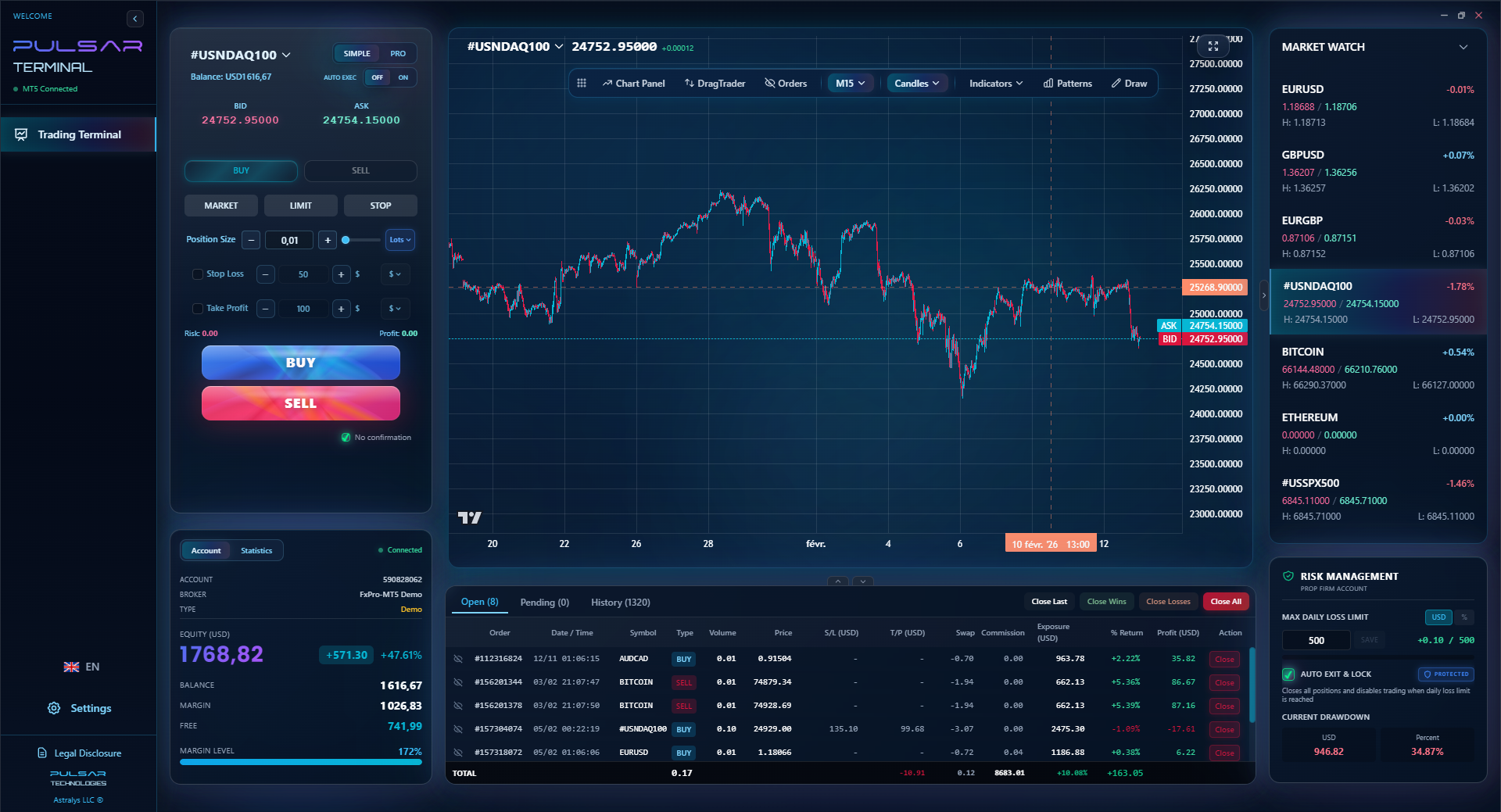
Managing multiple RSI-based trades with precise stops and targets is complex, but tools like Pulsar Terminal automate this directly on your MT5 platform.
Pulsar Terminal
The all-in-one MT5 companion: drag-and-drop orders, multi-TP/SL, trailing stop, grid trading, Volume Profile, and prop firm protection. Used by 1,000+ traders daily.
Let's get your charts set up properly. The default settings are often not the best.
- Adding the Indicator: In MT4/MT5, go to Insert > Indicators > Oscillators > Relative Strength Index.
- The Settings Window:
- Period: The default is 14. Experiment with 21 for smoother signals on major pairs, or 9 for more sensitive scalping (use with extreme caution).
- Apply to: Use 'Close' (default). Some traders use 'Median Price (HL/2)' for a slightly smoother calculation.
- Levels: Add 70, 30, and 50. The 50 level is critical as a trend filter.
- Visuals: I change the overbought/oversold level lines to a light grey dashed line so they don't dominate the chart. The RSI line itself I set to a solid blue or orange.
A crucial step most skip: adjusting the RSI's vertical scale. Right-click on the RSI window > Properties > Scale. Check 'Fix Maximum' and 'Fix Minimum' and set them to 0 and 100. This prevents the scale from auto-adjusting, which can make a move to 65 look like an overbought extreme if the recent range was small.
Remember, the tool is only as good as the strategy behind it. A perfectly configured RSI won't help a flawed plan. For deeper analysis, some traders use the MACD indicator alongside RSI to gauge both momentum and trend cycles.
💡 Winston's Tip
Backtest any RSI strategy through at least 100 trades in a trading journal before risking real money. You'll quickly see its win rate and flaws.
“Your stop must be based on price. Never place it based on an RSI level.”
Once you've mastered using RSI as a filter, two advanced techniques can be useful in specific markets.
RSI Swing Rejection
This is a specific 4-candle pattern on the RSI itself that can signal a strong reversal. For a bullish swing rejection:
- RSI falls below 30 (oversold).
- RSI bounces back above 30.
- RSI pulls back again but holds above 30.
- RSI then breaks above its previous bounce high. This sequence shows sellers failing to maintain momentum below 30 twice. It's a high-probability buy signal, especially on the 1-hour or 4-hour chart. I look for this more than regular divergence now.
Using RSI in a Range-Bound Market
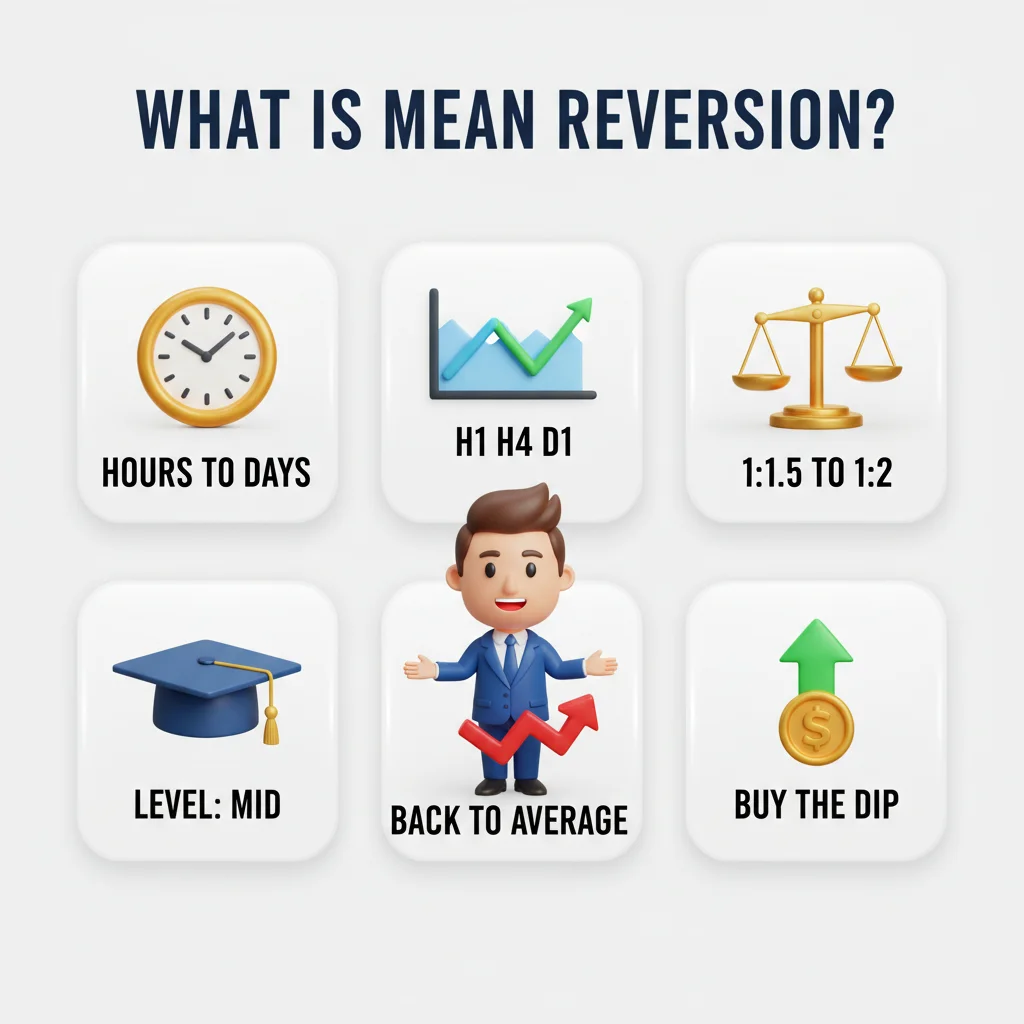
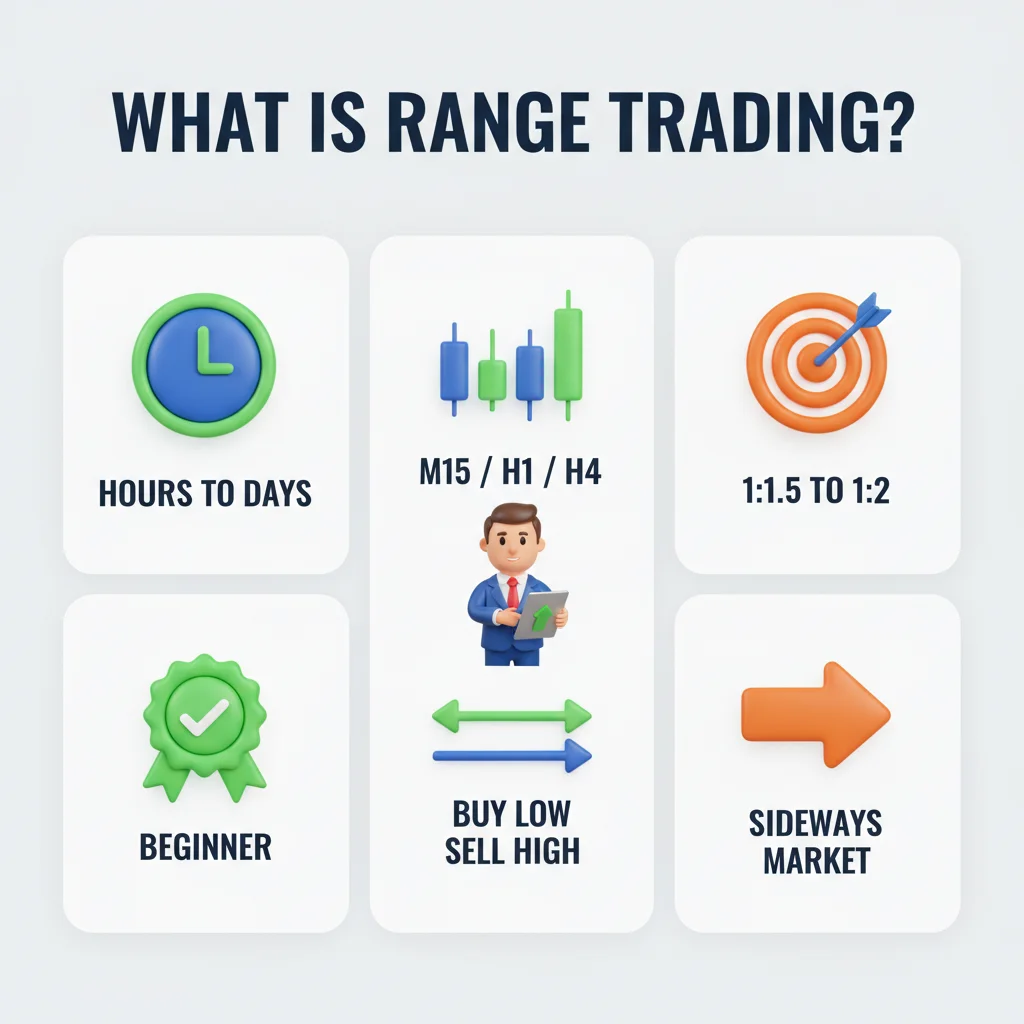
This is the one scenario where the classic 70/30 approach has some merit. When a currency pair is clearly chopping sideways between a support and resistance level (like EUR/USD often does), you can use RSI extremes as mean-reversion triggers. Sell when RSI hits 70 near the range top, buy when it hits 30 near the range bottom. Your stop-loss goes just outside the range.
The catch? You must be absolutely certain it's a range. The moment price breaks out, this strategy will cause massive losses. It requires constant monitoring. For most traders, especially in trending markets like USD/NGN, it's a dangerous game.
, the relative strength index forex is a component of a system, not a system itself. It's the seasoning, not the meal. Pair it with sound money management, clear price action rules, and a lot of patience. That's how you move from the 90% who use it wrong to the minority who use it to consistently protect and grow their capital.
FAQ
Q1What is the best RSI setting for forex trading?
There's no single 'best' setting. The default 14-period works for general use. For smoother, more reliable signals (especially on higher timeframes or volatile pairs like USD/NGN), try 21 or 25. For faster, more sensitive signals for scalping, try 9 or 7, but be prepared for more false signals and whipsaws.
Q2Can I use RSI alone to trade forex?
No, and you shouldn't try. Using the RSI alone is a recipe for consistent losses. It's a lagging momentum indicator. You must combine it with other forms of analysis, primarily price action (support/resistance, trend lines, candlestick patterns) to find high-probability confluence. The RSI should be a confirming filter, not your sole entry trigger.
Q3What does RSI divergence mean, and is it reliable?
Divergence occurs when price makes a new high/low but the RSI does not. It suggests weakening momentum and can signal a potential reversal or pullback. It's more reliable on higher timeframes (4-hour, daily) and when it occurs at a major price level. On lower timeframes, it's common and often leads to false signals. Never trade divergence alone.
Q4Why does RSI stay overbought or oversold during strong trends?
Because the RSI measures momentum, not overbought/oversold conditions in the sense of a guaranteed reversal. In a powerful trend, sustained buying (or selling) pressure keeps the RSI at extreme levels. This is a sign of trend strength, not weakness. Trying to fade (trade against) an RSI reading above 70 in a strong uptrend is a common and costly mistake.
Q5How do I avoid false RSI signals in the Nigerian forex market?
First, use a slower period setting (like 21) to reduce noise. Second, avoid trading around major CBN announcements or liquidity events - price action is king during those times. Third, always wait for RSI signals to align with a clear price structure break or bounce from a key level. Finally, manage your risk tightly, assuming any signal could be false.
Q6Should I use RSI for scalping or swing trading?
It can be used for both, but with different approaches. For scalping, a faster RSI (like period 9) on a 1-5 minute chart can identify short-term momentum shifts, but you must have ultra-tight risk management. For swing trading, a standard or slower RSI on the 1-hour or 4-hour chart is better for identifying trend pullbacks and divergences that align with daily chart direction.
Q7What's the difference between RSI and the MACD indicator?
Both are momentum oscillators, but they work differently. The RSI measures the velocity of price moves on a fixed 0-100 scale, focusing on overbought/oversold conditions. The MACD shows the relationship between two moving averages and can indicate trend direction, momentum, and potential reversals via its signal line crossovers and histogram. Many traders use them together for confirmation. You can learn more about the MACD indicator here.
Prof. Winston's Lesson
Key Takeaways:
- ✓RSI measures momentum speed, not overbought/oversold reversals.
- ✓Never use RSI alone. Always seek price action confluence.
- ✓Use the 50 level as a primary trend filter on higher timeframes.
- ✓Risk no more than 0.5% per trade on RSI-based setups.
How useful was this article?
Click a star to rate
Weekly Trading Insights
Free weekly analysis & strategies. No spam.
About the Author
Olumide Adeyemi
West African Trading Pioneer
One of Nigeria's most active forex trading educators. 8 years of experience trading from Lagos. Specializes in low-capital strategies and prop firm challenges for African traders.
Comments
Risk Disclaimer
Trading financial instruments carries significant risk and may not be suitable for all investors. Past performance does not guarantee future results. This content is for educational purposes only and should not be considered investment advice. Always conduct your own research before trading.
You Might Also Like

Cara Trading Forex Sukses: 7 Prinsip dari Trader Profesional
Cara trading forex sukses dengan 7 prinsip trader pro: manajemen modal, disiplin, journal trading, backtest. Data nyata, bukan janji profit palsu.
Jam Trading Forex Terbaik untuk Trader Indonesia: Panduan Lengkap dengan Tabel Waktu
Panduan jam trading forex untuk trader Indonesia. Tabel 4 sesi dunia, jam emas 20:00-00:00, sesi mana yang harus dihindari. Data akurat + tips dari trader berpengalaman.
Top 5 Sàn Forex Uy Tín Nhất 2026: Review Jujur dari Trader Indonesia
Top 5 sàn forex uy tín 2026 untuk trader Indonesia. Review jujur: spread, deposit, withdraw, dukungan lokal. Exness, XM, IC Markets & lebih.
Get Pulsar Terminal
All these calculators are built into Pulsar Terminal with real-time data from your MT5 account. One-click position sizing, automatic risk management, and instant calculations.
Get Pulsar Terminal