


On March 28, 2025, SEBI slapped a ₹40 lakh penalty on a group of traders.

Rajesh Sharma
Senior Forex Analyst ·  India
India
☕ 11 min read
What you'll learn:
- 1What SEBI Thinks When You Say 'Reversal Trade'
- 2The Real Cost of Trading Reversals in India
- 3Spotting a Real Reversal (Not a Fakeout)
- 4How the New Algo Rules Change Everything (April 2026)
- 5A Practical Setup and Risk Management
- 6Choosing a Broker & Platform in 2026
- 7Final Word: Staying Safe and Profitable
On March 28, 2025, SEBI slapped a ₹40 lakh penalty on a group of traders. Their crime? Executing non-genuine 'reversal trades' in illiquid stock options to create artificial volume. I remember reading that order and thinking about the dozens of students who'd asked me that week about 'catching the turn' in Nifty. In India, the phrase 'reversal trading strategy' carries legal baggage most traders don't even know about. You're not just fighting the market; you're navigating a regulatory minefield where a simple concept can be misconstrued as manipulation. This guide is about finding real trend reversals the right way, staying profitable, and more importantly, staying on the right side of SEBI.
Let's get this straight first. In your mind, a reversal trade is about spotting a trend change - buying when a downtrend bottoms, selling when an uptrend peaks. In SEBI's rulebook, a 'reversal trade' has a specific, dangerous definition. It refers to a transaction where you buy a contract and later sell the same contract to the same counterparty on the same day, or vice-versa.
Why does this matter? Because if that trade lacks a 'basic trading rationale' and just creates artificial volume, SEBI calls it non-genuine. It's a violation of the Prohibition of Fraudulent and Unfair Trading Practices regulations. They've been hitting people with penalties from ₹1 lakh up to ₹1 crore for this stuff, especially in illiquid options. So, if your brilliant reversal strategy involves any circular, wash-trade-like activity, even accidentally through an algo, you're playing with fire.
Your actual, legitimate reversal trading strategy should be about identifying a genuine shift in market sentiment using price action and volume - trading with the market, not manufacturing it. The distinction isn't academic; it's the difference between a profit and a penalty notice.

Warning: Don't confuse strategy with manipulation. A strategy analyzes the market's natural movement. SEBI's definition of a problematic 'reversal trade' is about creating false movement. Know the difference.

💡 Winston's Tip
If you're feeling clever spotting a reversal, you're probably early. The smart money waits for the dumb money to get stopped out first.
“In India, the phrase 'reversal trading strategy' carries legal baggage most traders don't even know about.”
You think your trade just needs to move a few points in your favor? Think again. Let's break down where your money goes before you even see a profit, especially for the intraday trades common in reversal plays.
The Fee Death by a Thousand Cuts
For an intraday equity trade (say, you buy and sell 100 shares of Reliance Industries at ₹3,000 each, a ₹3,00,000 turnover):
| Charge | Rate | Approx. Cost on ₹3L Turnover | Who Pays? |
|---|---|---|---|
| Brokerage | 0.01% or ₹20/order | ₹40 (₹20 buy + ₹20 sell) | You to Broker |
| STT | 0.025% on sell | ₹75 | You to Govt. |
| Exchange Charge (NSE) | ~0.00297% | ~₹9 | You to Exchange |
| SEBI Turnover Fee | 0.0001% | ₹0.30 | You to SEBI |
| Stamp Duty | 0.003% on buy | ₹9 | You to State Govt. |
| GST (18% on brokerage + exchange charges) | 18% | ~₹9 | You to Govt. |
| Total Estimated Cost | ~₹143 |
That's ₹143 gone before you've made a single rupee. Your trade needs to gain about 0.05% just to break even on costs. In a volatile reversal play, that's your initial risk buffer, evaporated.
The Hidden Killer: The Bid-Ask Spread
The spread isn't a formal fee, but it's a real cost. In a fast-moving market trying to reverse, spreads can widen. If you're jumping in and out, paying that spread each time eats into thin reversal profits. This is why a tight spread definition is crucial for your edge. I got burned on this in 2022 trading Bank Nifty options during a supposed reversal; the theoretical profit was there, but the wide bid-ask on the illiquid strike I chose swallowed it whole.
The Minimum Deposit Myth
Brokers might let you start with ₹500. Don't. With the costs above, a couple of losing trades will wipe you out. A more practical starting point for any serious reversal trading strategy that allows for sensible position size calculator use and diversification is ₹10,000. It gives you room to breathe and absorb the inevitable learning-curve losses.
“Your trade needs to gain about 0.05% just to break even on costs. That's your initial risk buffer, evaporated.”
This is the art. Everyone sees a big red candle and thinks 'bottom!' Most of the time, it's just a pause before more pain. Here’s what I look for, learned from years of getting it wrong.
1. Volume is the Truth-Teller. A potential reversal on low volume is suspect. I want to see a climactic volume spike on the final thrust of the old trend (panic selling or frenzied buying), followed by a clear rejection candle (like a long wick) on similarly high volume. The market needs to show exhaustion and then a forceful rejection. The Volume Profile tool in platforms like Pulsar Terminal can help visualize where high-volume nodes are - reversals often happen at these key areas.
2. Price Action at Key Levels. Reversals don't happen in a vacuum. They love major support/resistance, previous swing highs/lows, or key Fibonacci retracement levels (like the 61.8%). The price needs to respect these levels decisively.
3. Divergence is Your Early Warning. This saved me more than any other concept. When the price makes a new low but your momentum oscillator (like the RSI indicator or MACD indicator) makes a higher low, that's bullish divergence. It shows selling momentum is waning even as price drops. The opposite is true for tops. It's not a signal to buy/sell immediately, but a flag to get ready.
A Personal Trade Example (The Good): On October 26, 2023, Nifty was in a nasty downtrend. It made a new intraday low around 18,850, but the 1-hour RSI made a clear higher low. The next candle was a bullish engulfing pattern with above-average volume. I took a long at 18,890. My stop was at 18,820, and I scaled out at 19,050 and 19,150. It worked because multiple factors aligned: divergence, price action, volume.
A Personal Trade Example (The Bad): A week earlier, I saw a two-candle drop in HDFC Bank and jumped in long, thinking it was a quick reversal. No divergence, no major support level, just hope. I lost 1.2% of my account before hitting my stop. That's the difference between a setup and a guess.
💡 Winston's Tip
That ₹143 in fees on a ₹3 lakh trade? That's your first opponent. Your strategy must beat the government and the broker before it beats the other traders.
“Your trade needs to gain about 0.05% just to break even on costs. That's your initial risk buffer, evaporated.”
If you're even thinking about automating your reversal strategy, listen up. As of April 1, 2026, SEBI's full algorithmic trading framework is live. This isn't a suggestion; it's the law. And it turns the old world upside down.
Your Broker is Now Your Babysitter (And They're Liable). You can't just code a Python script on your laptop and fire orders via an API anymore. Every algorithm must be hosted on your broker's infrastructure. The broker must get it approved by the exchange (NSE/BSE), and every single order it places carries a unique Algo-ID for tracking. The broker is fully responsible for your algo's actions. This means they'll be incredibly cautious about what they approve.
What This Means for Your Reversal Strategy:
- Speed? Forget ultra-low latency personal setups. Your orders go through broker systems.
- Strategy Secrecy? You have to disclose the logic to your broker for approval. So much for your secret sauce.
- Testing? You'll need strong backtesting within the broker's framework. A strategy that does a high number of quick, small reversal trades might be flagged as potentially disruptive.
- Prop Firm Challenges? If you're using an algo to pass a prop firm challenge with strict daily loss limits, you need a tool that can automate that protection flawlessly. This is where external trade management tools that integrate with your broker platform become critical.
The game has shifted from who has the fastest code to who has the most strong, compliant, and broker-friendly strategy. The era of the retail algo cowboy is over.
“The best reversal entries often feel the worst. Buying when there's blood in the streets takes guts.”
Let's build a simple, compliant framework for trading reversals on a platform like Zerodha Kite or Upstox.
A Basic Swing Reversal Setup
- Find the Trend: Use a higher timeframe (Daily) to establish the prevailing trend. We're looking for a counter-trend reversal within a larger trend or a major trend reversal.
- Wait for the Pullback: On the 1-hour or 4-hour chart, wait for the price to pull back to a key level (support/resistance, moving average, trendline).
- Look for the Signal: At that level, watch for a reversal candlestick pattern (Pin Bar, Engulfing, Morning/Evening Star) accompanied by a volume spike and/or momentum divergence on the RSI indicator.
- Enter: Place a buy order above the high of the signal candle (for a bullish reversal) or a sell order below its low (for bearish).
- Stop Loss: Place your stop loss just beyond the extreme of the recent swing (the low for a long trade, the high for a short).
Non-Negotiable Risk Rules
- Position Size: Never risk more than 1% of your capital on a single trade. Use a position size calculator every time. If your account is ₹1,00,000 and your stop is 50 points away, your position size should only expose ₹1,000 (1%) to that risk.
- use: Respect the SEBI-mandated 5x intraday use limit. For a reversal trading strategy, I'd argue you should use far less - 2x or 3x max. Reversals can be messy, and high use will blow you up on a fakeout.
- The Squaring-Off Deadline: Remember, all intraday positions MUST be closed by 3:20-3:30 PM. Your broker will auto-square-off, often at terrible prices. If you're playing a reversal late in the day, you're at the mercy of this closing auction. It's often better to use a swing trading approach for reversals to avoid this time pressure.
- Protect Your Capital: A trailing stop or a breakeven stop is essential once the trade moves in your favor. Letting a winning reversal turn into a loser is a special kind of pain. Managing multiple take-profit levels and moving stops is where a tool like Pulsar Terminal shines, automating what is often a stressful manual process on MT5.

Pro Tip: The best reversal entries often feel the worst. Buying when there's blood in the streets takes guts. Have a clear plan, stick to your risk limits, and don't let emotion override your rules. A failed trade with a good stop is a lesson. A failed trade that blows past your stop is a disaster.
💡 Winston's Tip
The new algo rules didn't kill retail algorithmic trading. They just made the entry fee a lot higher: it's now paid in compliance, patience, and paperwork, not just coding skill.
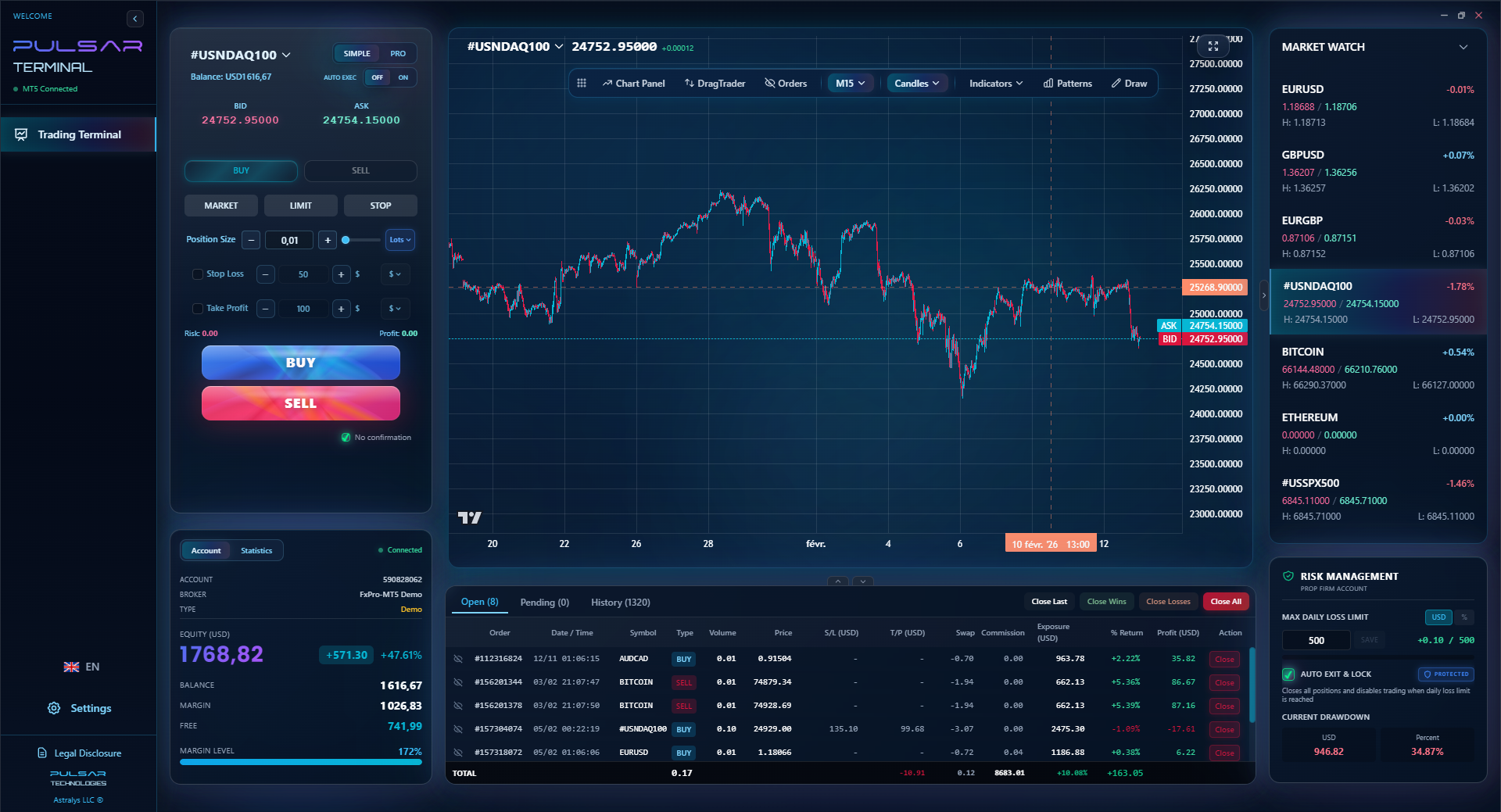
Managing multiple take-profit levels and moving stops for a reversal trade is stressful, which is why Pulsar Terminal automates partial closures, breakeven, and trailing stops directly on your MT5 platform.
Pulsar Terminal
The all-in-one MT5 companion: drag-and-drop orders, multi-TP/SL, trailing stop, grid trading, Volume Profile, and prop firm protection. Used by 1,000+ traders daily.
“The best reversal entries often feel the worst. Buying when there's blood in the streets takes guts.”
Your platform is your battlefield. In India's regulated environment, not all are equal, especially now.
For the Manual Trader:
- Zerodha Kite: Still the king for a reason. Clean interface, good charting (TradingView), low costs. Their
coinplatform for mutual funds is a bonus. Their recent focus on compliance means they're ahead of the algo rule curve. - Upstox: Strong competitor, also very cost-effective. Their Pro web platform is solid. Good for active intraday traders.
- Angel One: Has invested heavily in its platform (Angel One Speed Pro) and offers advanced tools. Their scalping strategy support is decent.
For the Aspiring Algo Trader (Post-April 2026): This is trickier. You need a broker with a strong, approved algo infrastructure. IC Markets and Pepperstone, while excellent globally, primarily serve the forex/CFD market and aren't direct substitutes for Indian equity trading. For Indian equities, you'll need to work closely with your domestic broker's API and algo team. Zerodha, Upstox, and Angel One all offer API access, but expect the onboarding and approval process to be lengthy and stringent under the new rules.
Key Questions to Ask Your Broker:
- What is your process for algo strategy approval under the new SEBI framework?
- What risk controls (kill switches, order throttling) do you have in place on your algo platform?
- What are the costs associated with hosting and running an algorithm on your system?
Funding is easy - UPI is instant and mostly free. The hard part is finding a broker whose tech and compliance align with your trading style in this new, stricter world.
“The era of the retail algo cowboy is over.”
Let's recap the harsh reality. SEBI's data shows most intraday traders lose money. A big part of that is chasing reversals without a plan, racking up costs, and getting steamrolled by fakeouts.
A successful reversal trading strategy in India now requires a dual focus: market skill and regulatory awareness.
- Trade the Reality, Not the Hope. Use confirmed price action, volume, and divergence. Don't predict bottoms; wait for the market to show its hand.
- Respect the Costs. That ₹143 on a ₹3 lakh trade is your enemy. Your edge must be large enough to overcome it consistently.
- Understand the Rules. Know what a 'reversal trade' means to SEBI. If you're automating, accept that the 2026 algo rules have fundamentally changed the game. Compliance is not optional.
- Manage Risk Religiously. The 1% rule isn't a suggestion. A margin call or a blown account doesn't care how clever your strategy was. Use stops, and use them properly.
Reversals offer some of the best risk-reward ratios in trading - if you catch them right. But in the Indian market, the stakes are higher than just profit and loss. They're about sustainable practice. Trade smart, trade safe, and for god's sake, keep good records. Your future self (and maybe your auditor) will thank you.
FAQ
Q1Is reversal trading illegal in India?
No, trading a genuine change in market trend is perfectly legal. What SEBI penalizes is a specific, manipulative practice also called a 'reversal trade' - which is entering and exiting a position with the same counterparty on the same day to create artificial volume. Your strategy based on chart analysis is fine.
Q2What is the best timeframe for trading reversals?
There's no single 'best.' Higher timeframes (like 4-hour or Daily) give more reliable signals but fewer opportunities. Lower timeframes (like 15-min or 5-min) used in scalping strategy setups offer more chances but have more noise and fakeouts. Many successful traders use a multi-timeframe approach: find the trend on the daily, wait for the pullback on the 1-hour, and fine-tune entry on the 15-min.
Q3Can I use algorithmic trading for reversal strategies after April 2026?
Yes, but under strict new rules. Your algorithm must be approved by the exchange and hosted on your broker's infrastructure. Every order will be tagged. The broker is fully liable, so they will be very selective. Simple reversal logic based on indicators may get approved, but complex, high-frequency strategies face more scrutiny.
Q4How much money do I need to start trading reversals?
While you can technically start with a few hundred rupees, the transaction costs will eat you alive. A more practical minimum to apply proper risk management and have a realistic shot is ₹10,000. This allows for sensible position sizing and can withstand a few losing trades without a total wipeout.
Q5What's the biggest mistake traders make with reversal strategies?
Jumping in too early. They see one bullish candle in a downtrend and buy, only to watch the trend continue down. Patience is key. Wait for multiple confirmation signals - price action at a key level, volume confirmation, and/or momentum divergence. Let the market prove the reversal is happening.
Q6Do I need to square off reversal trades intraday?
Only if you took them as intraday positions using margin. SEBI mandates all intraday positions be closed before market close. If you want to hold a reversal trade for several days (a swing trade), you must take it as a 'delivery' trade, which requires full payment for shares and involves higher brokerage and 0.1% STT on both buy and sell.
Q7Which indicator is best for spotting reversals?
No indicator is perfect, but the RSI indicator is particularly useful for spotting momentum divergences, which often precede reversals. The MACD indicator can also show divergence and momentum shifts. Remember, indicators should confirm price action, not lead it. The chart itself is the primary source of truth.
Prof. Winston's Lesson
Key Takeaways:
- ✓SEBI's 'reversal trade' is a manipulative act, not a chart strategy.
- ✓Fees consume 0.05% of your trade before you even start.
- ✓Wait for volume & divergence; one candle is a trap.
- ✓Post-2026, algo trading means broker approval & hosting.
How useful was this article?
Click a star to rate
Weekly Trading Insights
Free weekly analysis & strategies. No spam.
About the Author
Rajesh Sharma
Senior Forex Analyst
Trading Indian and South Asian markets for over 10 years. Started with NSE currency derivatives before moving to international forex. Specializes in USD/INR and emerging market pairs.
Comments
Risk Disclaimer
Trading financial instruments carries significant risk and may not be suitable for all investors. Past performance does not guarantee future results. This content is for educational purposes only and should not be considered investment advice. Always conduct your own research before trading.
You Might Also Like

Cara Trading Forex Sukses: 7 Prinsip dari Trader Profesional
Cara trading forex sukses dengan 7 prinsip trader pro: manajemen modal, disiplin, journal trading, backtest. Data nyata, bukan janji profit palsu.
Jam Trading Forex Terbaik untuk Trader Indonesia: Panduan Lengkap dengan Tabel Waktu
Panduan jam trading forex untuk trader Indonesia. Tabel 4 sesi dunia, jam emas 20:00-00:00, sesi mana yang harus dihindari. Data akurat + tips dari trader berpengalaman.
Top 5 Sàn Forex Uy Tín Nhất 2026: Review Jujur dari Trader Indonesia
Top 5 sàn forex uy tín 2026 untuk trader Indonesia. Review jujur: spread, deposit, withdraw, dukungan lokal. Exness, XM, IC Markets & lebih.
Get Pulsar Terminal
All these calculators are built into Pulsar Terminal with real-time data from your MT5 account. One-click position sizing, automatic risk management, and instant calculations.
Get Pulsar Terminal