


Let's be brutally honest: if you're looking at Sasfin Forex for trading, you're already making your first major mistake.

David van der Merwe
Emerging Markets Trader ·  South Africa
☕ 10 min read
What you'll learn:
- 1The Sasfin Forex Reality Check: It's Not What You Think
- 2How South Africa's Forex Rules Actually Work (And How to Use Them)
- 3The Real Costs for SA Traders: It's More Than the Spread
- 4Where Should You Actually Trade? FSCA & International Options
- 5The Sasfin Lesson: 3 Pitfalls Every SA Trader Must Avoid
- 6Setting Up for Success: A ZAR-Based Trader's Checklist
- 7Final Verdict: Is There Any Role for Sasfin?
Let's be brutally honest: if you're looking at Sasfin Forex for trading, you're already making your first major mistake. I'm not saying that to be harsh, but because the story of Sasfin's forex business is a masterclass in how things go wrong in South African markets. It ended with a R160.6 million fine and a R4.9 billion SARS claim. That's not a minor regulatory slap. It's a catastrophic failure that shows you exactly where the hidden traps are for local traders. In this guide, I'll break down what really happened, why their 'forex solutions' aren't for you as a trader, and show you the actual, regulated path to trading forex with your ZAR without getting blown up.
First, a critical fact you must understand: Sasfin has discontinued its foreign exchange trading business. When you hear "Sasfin Forex" today, you're not looking at a MetaTrader broker where you can speculate on EUR/USD. You're looking at a corporate and private banking service for things like international payments and Foreign Currency Accounts (FCAs).
This distinction is everything. I've seen too many traders confuse banking services with trading platforms. A Foreign Currency Account lets you hold US Dollars or Euros. It's a savings tool, subject to South African Reserve Bank (SARB) allowances. It is not a leveraged trading account where you can go long or short on currency pairs. The moment you mix these up, you're in the wrong lane entirely.
The real story, and the one every South African trader needs to know, is why that business was shut down. In August 2024, the Prudential Authority hit Sasfin Bank with an effective fine of R160.6 million. The reason? Alleged non-compliance where employees in the forex unit colluded with clients to dodge exchange controls and anti-money laundering rules. There's also a R4.9 billion civil claim from SARS hanging over them. This isn't background noise. This is the core lesson: operational and compliance risk can destroy a business (and client funds) faster than a bad trade.

Warning: If a provider's own internal controls failed so spectacularly, ask yourself a hard question: would you trust them with the precise, rapid-fire risk management required for active trading? I wouldn't.

💡 Winston's Tip
A R160m fine isn't a 'cost of doing business.' It's a sign the engine was built wrong. Never trade with a firm where compliance is an afterthought.
Trading from South Africa means playing by two rulebooks: the Financial Sector Conduct Authority (FSCA) for broker conduct, and the South African Reserve Bank (SARB) for getting your money in and out. Most blow-ups start with misunderstanding one of these.
The FSCA: Your First Line of Defence
The FSCA regulates the brokers. A broker offering services to South Africans should be licensed by them. This is non-negotiable. Before you even look at spreads, check the FSCA's website for the broker's license status. The FSCA's 2025–2028 strategy explicitly aims to tighten oversight on forex services. This is good for you. It means more protection.
The SARB Allowances: Your Funding Pipeline
This is where Sasfin's clients allegedly got into trouble. You must work within the legal channels. As a resident taxpayer over 18, you have annual allowances:
- Single Discretionary Allowance: R1 million. No tax clearance needed. This is your easiest route for funding an international broker.
- Foreign Investment Allowance: R10 million. Requires a Tax Compliance Status (TCS) pin from SARS.
- Total: R11 million per year.
You use these allowances to send ZAR to a properly licensed international broker via a legitimate foreign exchange process. Trying to circumvent this, as the Sasfin case alleges happened, invites disaster. I use my Single Discretionary Allowance each year to fund my main account. It's a straightforward bank transfer once your broker is approved. The key is documentation - keep records of every transfer.

Pro Tip: Always get a formal invoice from your broker for the exact amount in USD or EUR you wish to deposit. Present this to your bank when initiating the transfer. It smooths the process and creates a clear audit trail for SARS, showing a legitimate investment transaction.
“The Sasfin saga shows operational risk can destroy a business faster than a bad trade.”
Let's talk numbers, because this is where your profit gets eaten. Sasfin's old fee structure gives us a glimpse into banking costs, but trading costs are a different beast.
Banking & Funding Costs (The Silent Killer): When you fund an international account, you face two costs: the bank's forex conversion margin and a wire fee. Local banks might add a 1-3% margin on the exchange rate on top of the SWIFT fee (Sasfin charged R350 for this). If you're depositing $1,000 (roughly R18,000), a 2% margin is R360 gone before you even place a trade. I learned this the hard way early on, seeing a R500 discrepancy between the interbank rate and what landed in my broker account.
Trading Costs: This is where you focus. With a proper broker, costs are primarily the spread and commission.
| Cost Type | Typical Example (EUR/USD) | Impact on a R10,000 Trade (~$550) |
|---|---|---|
| Spread (Variable) | 1.0 pip | ~R18.50 (R18.50 per pip) |
| Commission (Raw Spread Account) | $3.50 per 100k lot | ~R1.30 on a 0.05 lot trade |
| Bank Funding Fee | 2% margin + R350 SWIFT | R710 (This is the killer) |
See the problem? The funding cost dwarfs the actual trading cost. This is why choosing a broker with low-cost deposit options is critical. Some global brokers offer fee-free deposits via credit/debit cards or local e-wallets, which use better exchange rates. This one switch saved me thousands in Rands over the years.
Your mission is to minimize the funding cost and then manage the trading cost with smart execution. Using a position size calculator is essential to know your exact risk in Rands per pip definition.
💡 Winston's Tip
Your bank's 2% forex margin on a deposit is a 40-pip headwind on a typical trade. Choose your funding path as carefully as your entry signal.
Since Sasfin Forex isn't a trading option, where do you go? You have two clear paths, both better.
Path 1: FSCA-Regulated International Brokers Several top-tier global brokers hold FSCA licenses, giving you direct recourse under South African law. This is a strong option. For example, Pepperstone and IC Markets are regulated by the FSCA. They offer the MetaTrader/ cTrader platforms you need, with competitive spreads. Your funds are held in segregated accounts, and you have the FSCA as an ombudsman.
Path 2: Reputable Global Brokers (Using SARB Allowances) This is the path I use. You employ your SARB allowance to fund a globally recognized broker with a stellar reputation. Think of firms like those reviewed in our Exness review or XM review. The advantage here is often tighter regulation from bodies like CySEC (Cyprus) or ASIC (Australia), and sometimes better pricing models.
The Platform is Key: Whatever you choose, ensure they support MetaTrader 5 (MT5) or a similar professional platform. MT4 is legacy tech. MT5 offers more timeframes, better hedging options, and an economic calendar. Your platform is your cockpit; don't settle for a broken dashboard. Most scalping strategy pros demand MT5 for its speed.

Example: I fund my primary trading account with a global broker using my R1m discretionary allowance. I make one large transfer per year (minimizing bank fees), and the broker offers fee-free credit card deposits for top-ups. My trading cost is a raw spread of 0.1 pips on EUR/USD plus a $3.50 commission. My all-in cost for a 1-lot trade is about $4, or roughly R72. Vastly cheaper than any bank-based solution.
“A 2% bank funding fee can wipe out 40 pips of profit before you even place a trade.”
The Sasfin saga isn't just news. It's a case study. Here’s what it teaches us to avoid.
1. Confusing Banking with Trading: This is the root error. A bank's forex service is for conversion and transfers. A broker's platform is for price speculation. Different tools, different risks, different regulators. Wanting to "trade with your bank" because it feels safer is a cognitive error. Banks aren't built for speculative trading execution.
2. Ignoring the True Cost of Funding: As we calculated, the bank's spread and wire fees can be 10 times the cost of your actual trade. If your strategy has a 2-pip average profit target, a 2% funding fee wipes out 40 pips of profit instantly. You must factor this into your edge. I didn't, and it made my first six months of "profitable" trading actually net-negative.
3. Underestimating Compliance Risk: The alleged collusion at Sasfin shows what happens when a firm's internal culture is weak. For you, the trader, compliance risk means choosing a broker with a transparent, by-the-book operation. It means declaring your trading income to SARS (it's taxable). It means never, ever trying to use unofficial channels to get money offshore. The short-term "convenience" leads to long-term ruin, as those Sasfin clients facing SARS now know.
Your strategy needs to account for more than charts. It needs a funding plan, a tax plan, and a regulatory safety check. This is the boring stuff that keeps you in the game. A tool like our position size calculator helps with one piece, but you need the whole framework.
💡 Winston's Tip
The SARB's R11m allowance isn't a limit for most. It's a roadmap. Follow it precisely. The guys who tried to shortcut it are now facing R4.9bn in claims.
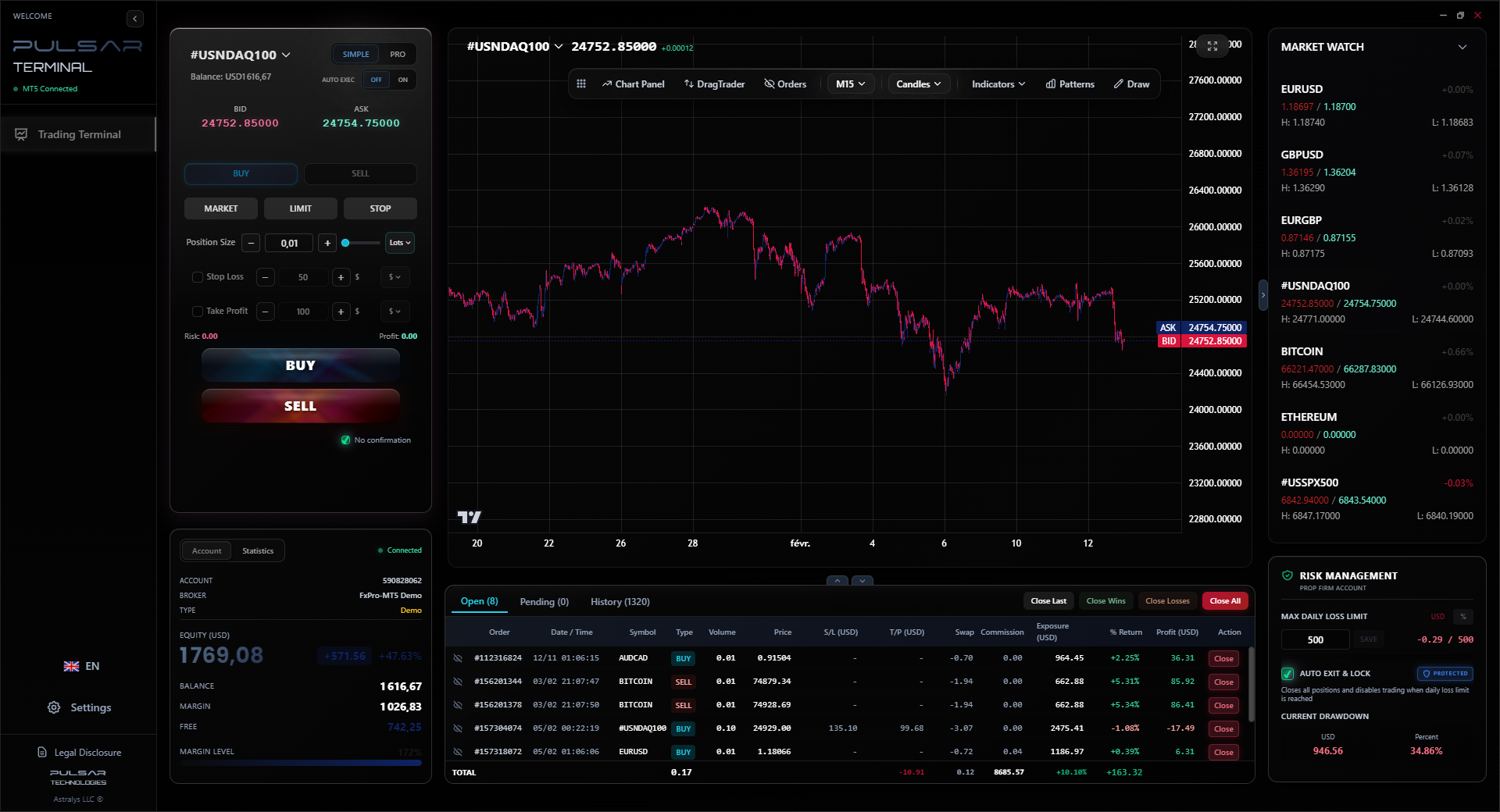
Managing trades and risk manually under pressure is where mistakes happen; Pulsar Terminal automates this with one-click trailing stops, breakeven, and multi-TP orders directly on your MT5 charts.
Pulsar Terminal
The all-in-one MT5 companion: drag-and-drop orders, multi-TP/SL, trailing stop, grid trading, Volume Profile, and prop firm protection. Used by 1,000+ traders daily.
Let's get practical. Here’s your action list to start correctly, learning from the past.
Step 1: Choose a Regulated Broker. Decide on an FSCA-licensed broker or a major global one. Check their license, read independent reviews like our IC Markets review, and test their demo. Ensure they offer MT5 and low-cost deposit methods for South Africans.
Step 2: Open Your Account & Get Funding Docs. Use your SA ID and proof of residence. Once approved, contact their support and ask for: "A formal proforma invoice for a deposit of [X] USD/EUR for the purpose of funding my trading account." This document is gold for your bank.
Step 3: Execute Your SARB Allowance Transfer. Go to your local bank (Absa, FNB, Standard Bank, etc.) with the invoice. Initiate a SWIFT transfer for the exact foreign amount. You'll pay the ZAR equivalent at the bank's rate, plus their fee. This is your legal, documented pipeline.
Step 4: Start Trading with Correct Risk Management. This is where most fail. Your first trade shouldn't be about profit. It should be about testing execution. Use a demo to finalize your strategy, whether it's swing trading or something else. Then, on live, risk no more than 1% of your capital per trade. A margin call should feel like a theoretical concept, not something you've ever experienced.
Step 5: Keep Impeccable Records. Download your monthly statements. Track every deposit. Your annual tax return will need this. A simple spreadsheet with dates, amounts, and purposes saves endless hassle.
This process is bureaucratic by design. It filters out the impatient, who are also the ones most likely to blow up their accounts chasing shortcuts.
“Your edge comes from doing the correct, disciplined thing while others cut corners.”
After all this, does Sasfin have any role for a forex trader? In a very limited, specific way, maybe.
If you need a Foreign Currency Account (FCA) to park profits you've withdrawn from your international broker (converted back to USD/EUR), then a Sasfin FCA could be a tool. It's a savings account in foreign currency, not an investment. You can hold dollars there, perhaps if you believe the Rand will weaken further.
But that is an end-of-process wealth preservation tool, not a trading tool. For the entire active trading lifecycle - deposit, execution, risk management, withdrawal - your relationship is with a dedicated, globally competitive broker.
The story of Sasfin Forex is a cautionary tale about what happens at the intersection of poor controls, complex regulation, and client desire for easy solutions. Your takeaway shouldn't be fear. It should be clarity. The rules (FSCA, SARB) are there. The legitimate brokers are there. The path is clear, if you're willing to walk it properly. Don't look for back doors. Master the front gate.
Your edge doesn't come from finding a loophole. It comes from doing the correct, disciplined thing consistently, while others cut corners and eventually get caught out. In trading, and in navigating the South African financial system, that's the only sustainable advantage.
FAQ
Q1Can I still trade forex with Sasfin Bank?
No. Sasfin has discontinued its foreign exchange trading business. They no longer offer a platform for speculative trading on currency pairs. Their current forex services are for banking needs like international payments and Foreign Currency Accounts (savings accounts in foreign cash).
Q2What was the R160 million Sasfin forex fine for?
In August 2024, the Prudential Authority fined Sasfin Bank R160.6 million for alleged non-compliance with financial laws. The investigation found that employees in their former forex unit colluded with clients to circumvent South Africa's exchange control and anti-money laundering (FICA) regulations. This is a core reason they exited that business.
Q3How do I legally get money offshore to trade forex from South Africa?
Use your annual South African Reserve Bank (SARB) allowances. As a taxpayer, you have a R1 million Single Discretionary Allowance (no tax clearance) and a R10 million Foreign Investment Allowance (with SARS tax clearance). You use these to make a formal SWIFT transfer from your SA bank to your regulated international broker, providing the broker's invoice as documentation.
Q4Is it cheaper to use a South African broker or an international one?
Often, international brokers have lower trading costs (spreads/commissions). The key is minimizing the funding cost. Some international brokers offer fee-free card deposits, which avoid high bank forex margins. While FSCA-licensed brokers offer direct local recourse, you must compare the all-in cost: funding cost + trading cost.
Q5Are my forex trading profits taxable in South Africa?
Yes. Profits from trading are generally considered taxable income by SARS. You must declare them on your annual tax return. Keep detailed records of all statements, deposits, and withdrawals from your broker. The Sasfin case involved SARS allegedly being unable to tax client funds moved offshore, highlighting the importance of transparency.
Q6What's the difference between a Sasfin FCA and a forex trading account?
A Sasfin Foreign Currency Account (FCA) is a savings account. You deposit US Dollars or Euros to hold them. A forex trading account with a broker is for speculation. You use use to profit from price movements without owning the underlying currency. They are completely different financial products.
Prof. Winston's Lesson
Key Takeaways:
- ✓Bank forex services are not for speculative trading.
- ✓Always factor in the real cost of funding (bank fees + spread).
- ✓Use your SARB allowances (R1m/R10m) for legal transfers.
- ✓Choose an FSCA or top-tier globally regulated broker.
- ✓Taxable profits must be declared to SARS.
How useful was this article?
Click a star to rate
Weekly Trading Insights
Free weekly analysis & strategies. No spam.
About the Author
David van der Merwe
Emerging Markets Trader
Johannesburg-based trader with 11 years in emerging market currencies. Specializes in ZAR pairs, FSCA-regulated trading, and South African market analysis.
Comments
Risk Disclaimer
Trading financial instruments carries significant risk and may not be suitable for all investors. Past performance does not guarantee future results. This content is for educational purposes only and should not be considered investment advice. Always conduct your own research before trading.
You Might Also Like

Cara Trading Forex Sukses: 7 Prinsip dari Trader Profesional
Cara trading forex sukses dengan 7 prinsip trader pro: manajemen modal, disiplin, journal trading, backtest. Data nyata, bukan janji profit palsu.
Jam Trading Forex Terbaik untuk Trader Indonesia: Panduan Lengkap dengan Tabel Waktu
Panduan jam trading forex untuk trader Indonesia. Tabel 4 sesi dunia, jam emas 20:00-00:00, sesi mana yang harus dihindari. Data akurat + tips dari trader berpengalaman.
Top 5 Sàn Forex Uy Tín Nhất 2026: Review Jujur dari Trader Indonesia
Top 5 sàn forex uy tín 2026 untuk trader Indonesia. Review jujur: spread, deposit, withdraw, dukungan lokal. Exness, XM, IC Markets & lebih.
Get Pulsar Terminal
All these calculators are built into Pulsar Terminal with real-time data from your MT5 account. One-click position sizing, automatic risk management, and instant calculations.
Get Pulsar Terminal