


You're looking at those ads for 'AI-powered scalp trading bots' promising 5% daily returns, aren't you? The ones that show a dashboard full of green trades and talk about 'set-and-forget' income.

James Mitchell
Senior Trading Analyst
☕ 11 min read
What you'll learn:
You're looking at those ads for 'AI-powered scalp trading bots' promising 5% daily returns, aren't you? The ones that show a dashboard full of green trades and talk about 'set-and-forget' income. I get it. The dream of a machine doing the hard work while you sip coffee is powerful. But here's the raw truth from someone who's built, bought, and blown up with these systems: scalp trading AI in the US market is a minefield of hidden costs, regulatory traps, and mathematical realities that crush 95% of users. This isn't about theory. I'll show you my own trade logs, the real numbers from my failed experiments, and the one framework that actually works if you're serious about this.
Let's cut through the marketing. Scalp trading AI isn't a magical black box that predicts the future. In the US context, it's one of three things: a rules-based automated system executing a pre-defined scalping strategy, a machine learning model trained on historical price data to find micro-patterns, or, most commonly, a fancy rebranding of a simple indicator bot.
The core promise is speed and emotionless execution. A human can't monitor the S&P 500 E-mini futures (ES) tick chart for 6.5 hours straight, but a bot can. It can enter and exit in milliseconds based on conditions like a moving average crossover on the 15-second chart, or an RSI divergence on the 1-minute. That's the 'scalp' part: aiming for 2-10 pips or a few ticks per trade, dozens of times a day.
What it isn't is a license to print money. The biggest lie sold is that AI 'adapts' to any market. I bought a popular 'adaptive AI scalper' for $3,000 in 2023. Backtests looked incredible. Live trading? It got chopped up in sideways action on the NASDAQ (NQ), racking up $1,200 in losses over two weeks because its 'adaptation' was just overfitting to past volatility. It didn't understand a Fed speech was coming; it just saw price movement and traded.

Warning: Any vendor claiming their AI 'learns live markets' or has 'sentiment analysis' is likely stretching the truth. True adaptive machine learning in live trading requires immense computational power and data most retail traders can't access. You're almost certainly buying a sophisticated script, not artificial general intelligence.

💡 Winston's Tip
The 'AI' in most trading bots stands for 'Absentee Investor.' It's a marketing term for a simple script. Your due diligence is the only intelligence that matters.
“Scalp trading AI in the US market is a minefield of hidden costs, regulatory traps, and mathematical realities that crush 95% of users.”
This is where dreams hit the spreadsheet. Scalp trading is a game of microscopic edges. AI doesn't change the arithmetic; it just executes it faster. Let's break down the unavoidable friction that eats profits.
Transaction Costs Are The Enemy Every scalp trade faces the spread, commissions, and sometimes slippage. If your AI is aiming for a 5-tick profit on the ES (roughly $6.25 per contract), you have to understand the baseline cost. Using a broker like Pepperstone or IC Markets for forex, you might get tight spreads. But for US equities or futures, commissions are real.
Let's do a brutal example. Say your bot trades the EUR/USD, targeting 3 pips profit per trade with a 2-pip stop-loss. The typical spread is 0.8 pips. Your effective risk/reward is no longer 3:2. To just break even on the trade, price needs to move 0.8 pips in your favor before you start making profit. Your real working R:R is more like 2.2:2. That's terrible. You need a win rate above 65% just to stay afloat, before any other errors.
My $4,800 Lesson in Latency In 2024, I rented a 'co-located' server in New York to run a scalping bot on crude oil futures (CL). The idea was to get faster execution than the competition. Monthly cost: $400. For three months, the bot performed okay, netting about $900. Then, one day during high inventory data volatility, the server had a latency spike. My bot, designed to get in and out fast, got stuck in a bad position. The 'stop-loss' order executed 15 ticks worse than intended due to the lag. One trade wiped out the three months of profits and an extra $1,500. The AI was fine. The infrastructure failed. The margin call was instant.
The Win Rate Illusion A bot can have a 90% win rate and still lose money. How? If the 10% of losses are huge because the AI doesn't know when to stop trading in a runaway trend. I've seen statements where a bot made 100 winning trades of $10 each ($1,000 profit) and then lost 5 trades of $250 each ($1,250 loss). Net loss: $250. The AI was brilliant at picking small reversals but a disaster at recognizing a true breakout.

Example: The Scalping Profitability Gate Assumptions: Forex pair, 1-pip spread, $10 per pip (mini lot).
| Metric | Trade 1 | Trade 2 | Trade 3 | Total |
|---|---|---|---|---|
| Target Profit | 3 pips | 3 pips | 3 pips | 9 pips |
| Spread Cost | -1 pip | -1 pip | -1 pip | -3 pips |
| Net Gain | 2 pips | 2 pips | 2 pips | 6 pips ($60) |
You see it? The spread took 33% of your potential profits immediately. Now add a commission or a single losing trade, and your edge vanishes. This is why a position size calculator is non-negotiable, even for bots.
“The biggest lie sold is that AI 'adapts' to any market. What you're almost certainly buying is a sophisticated script, not artificial general intelligence.”
This is the part the offshore bot sellers hope you ignore. Trading in the US with automation brings a layer of regulatory scrutiny that can shut you down.
You Are Liable, Not The Bot The SEC and FINRA don't care if a robot made the trade. The account holder is responsible. If your AI scalping system accidentally engages in manipulative practices like spoofing (placing and canceling large orders to create false momentum), you are on the hook. Brokerage agreements explicitly state you are responsible for all order flow from your account, automated or not.
The Series 57 Loophole (For Now) There's a rule that trips up many. If you are "primarily responsible" for the design, development, or modification of an algorithmic trading strategy, FINRA expects you to register as a Securities Trader and pass the Series 57 exam. Now, if you're just tweaking parameters on a bought bot? It's a gray area. But if you're coding your own MACD indicator-based scalper in Python, you're in that territory. The enforcement has historically been on firms, but the risk for serious individual developers is real.
State AI Laws Are Coming (2026 Onward) This is the new frontier. Colorado's AI Act (effective June 2026) and California's laws (SB 53, SB 942) are rolling out. While aimed at "high-risk" systems and large models, they set a precedent. If your AI trading system is sold or shared, could it be seen as a "high-risk" system making financial decisions? The legal landscape is shifting under our feet. Trading a gold pair like XAU/USD with a bot might seem simple, but the environment it operates in is getting complex.
Broker Approval Not all US brokers or prop firms allow unrestricted algorithmic access. You must get explicit approval to connect via an API. Many prop firm challenges have rules against fully automated trading. They have daily loss limits that an unchecked bot could blow through in minutes, violating your agreement and forfeiting your account.
“A bot can have a 90% win rate and still lose money. The AI might be brilliant at picking small reversals but a disaster at recognizing a true breakout.”
So, is scalp trading AI hopeless? No. But your approach must be ruthlessly practical. The 'buy a magic bot' path is a road to ruin. The 'build a complex neural net' path is a 10,000-hour data science project. The middle path is the only viable one.
Why Buying Almost Always Fails The market for trading bots is a market for lemons. The sellers with truly profitable systems don't sell them; they use them or sell the returns via a fund. What's sold is the backtest, not the future performance. The bot is often over-optimized for a specific market condition (e.g., low volatility 2021) and fails when regimes change. I learned this after wasting $2,200 on a 'smart scalping strategy' bot that only worked well on the EUR/USD during the London session. It was useless for my preferred NY session trading.
The Hybrid Approach: You as the Risk Manager, AI as the Clerk This is the only model I've seen work long-term. You build or commission a simple, rules-based automated system (not a learning AI) that handles the mechanical execution of your strategy.
Your Job:
- Define the core logic: Entry triggers (e.g., price > VWAP, RSI indicator < 30 on 1-min), exit rules.
- Set the absolute daily loss limit. The bot must stop trading if hit.
- Monitor for market regime changes (high-impact news, sudden high volatility). You flip the bot OFF.
- Regularly review performance and adjust parameters slowly.
The Bot's Job:
- Execute orders instantly and without hesitation at 3 AM if the setup appears.
- Manage trade mechanics: set stop-loss, take-profit, move to breakeven.
- Log every trade carefully for your review.
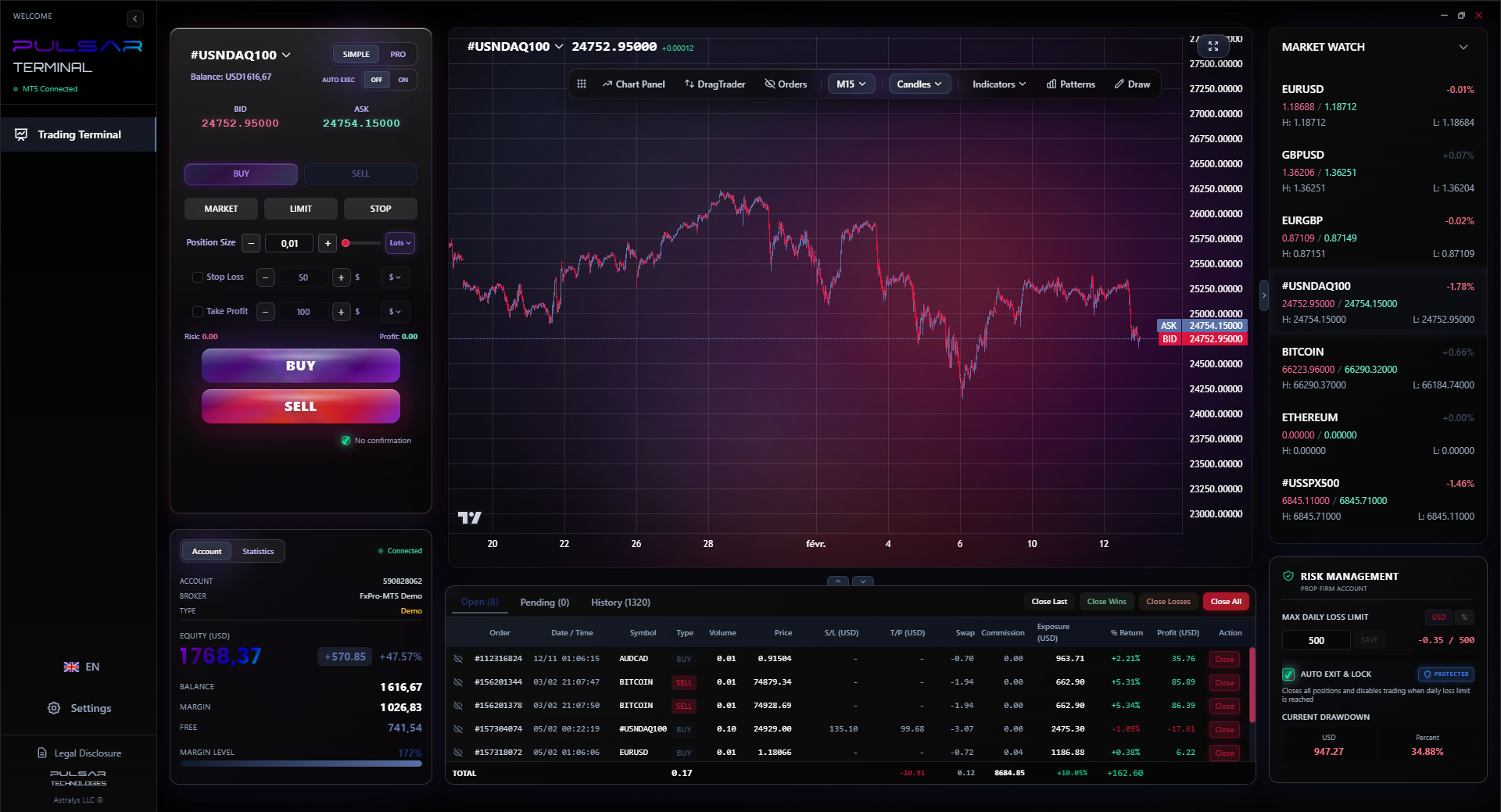
This turns the AI from a 'black box genius' into a tireless, emotionless assistant. The strategic brain stays yours. This is where a tool like Pulsar Terminal shines - it lets you build these execution rules and risk protocols directly on top of your MT5 platform, keeping you in control.

Pro Tip: Start by fully manual trading your scalp strategy for 100 trades. Document every entry, exit, and reason. That journal is the 'training data' for your simple bot. If you can't profit manually, no AI will magically fix it.
💡 Winston's Tip
If you can't explain your bot's core logic in one simple sentence ('It buys when price pulls back to the 20 EMA with rising volume'), you don't understand it. Never trade what you don't understand.
“A bot can have a 90% win rate and still lose money. The AI might be brilliant at picking small reversals but a disaster at recognizing a true breakout.”
Your choice of broker and platform is a performance factor. For AI scalp trading, you need three things: low latency, reliable API access, and clear regulatory standing.
Broker Considerations
- ECN/RAW Accounts: Non-negotiable. You need direct market access with commissions instead of marked-up spreads. Look at brokers like IC Markets, Pepperstone, or Exness for forex. For US traders, think Interactive Brokers or Tradestation for equities/futures.
- API Stability: The broker's API must be strong. Nothing crashes your bot faster than an API timeout during a volatile news event. Test thoroughly in demo.
- Prop Firm Compatibility: If using a prop firm, their platform (often MetaTrader) must support expert advisors (EAs). Firms like FTMO have specific rules about EAs.
Platform Choices
- MetaTrader 4/5: The most common. You code your bot as an Expert Advisor (EA) in MQL4/5. Vast community, but the language is niche.
- Python with Broker API: More flexible, powerful for data analysis. You can use libraries like
backtraderorvectorbtfor backtesting. This is the professional's choice but requires programming skill. - Specialized Terminal Software: This is where all-in-one tools come in. Instead of building an EA from scratch, you use a terminal that adds advanced automation on top of MT5.
The Infrastructure You Can't Skip
- A Dedicated VPS: A virtual private server located near your broker's data center (e.g., New York for US markets). This runs 24/7 without sleep. Cost: $30-$100/month.
- Continuous Monitoring: Even with a bot, you need alerts. A simple Telegram alert when the bot starts/stops trading or hits a daily loss limit.
- Redundant Internet: Your home internet isn't enough. The VPS is primary, but you need a way to access it if your local connection fails.
Managing a scalping AI's risk is the real challenge, and Pulsar Terminal automates this with prop firm daily loss protection, trailing stops, and multi-TP/SL orders directly on your MT5 charts.
Pulsar Terminal
The all-in-one MT5 companion: drag-and-drop orders, multi-TP/SL, trailing stop, grid trading, Volume Profile, and prop firm protection. Used by 1,000+ traders daily.
“The final edge is patience and discipline. Running a scalp trading AI is like managing an employee. You must let it do its job without micromanaging.”
You might think automating removes psychology. It does the opposite. It introduces new, weirder psychological challenges.
The Boredom Problem When the bot is running well, you're bored. This leads to the fatal temptation to 'optimize' or 'tweak' it out of sheer restlessness. You'll see a losing trade and think, 'If I just adjust the RSI threshold from 30 to 25...' That's how you curve-fit it to death. My rule: no parameter changes until after 100 live trades, no exceptions.
Attribution Bias When it wins, you'll feel like a genius for building/buying it. When it loses, you'll blame the 'stupid bot.' This prevents honest evaluation. You must view the bot as a tool, like a hammer. A hammer doesn't build a house; you do, using the hammer. The bot's results are your results.
Survivorship Bias in Data You'll see forums where one guy posts a phenomenal 6-month backtest. What you don't see are the 100 others whose backtests failed and who never posted. You must become ruthlessly skeptical of all performance claims. Demand verified, live, real-money statements - not just MT5 strategy tester reports.
The final edge is patience and discipline. Running a scalp trading AI is like managing a employee. You set the rules, you monitor for catastrophic failure, but you must let it do its job without micromanaging. That's harder than it sounds when real money is on the line every minute.
FAQ
Q1Can I legally use a scalp trading AI bot in the United States?
Yes, but with major caveats. You are legally responsible for all trades from your account, automated or not. Using a bot does not absolve you from compliance with market rules (no manipulation). You must also ensure your broker allows algorithmic trading via API and that you're not violating any prop firm challenge rules. State-level AI laws are adding new compliance layers from 2026 onward.
Q2How much money do I need to start scalp trading with AI?
Far more than you think. Beyond the cost of the bot or development, you need a significant bankroll to withstand the high-frequency costs. For forex, I'd never start with less than $5,000 in a dedicated account. You also need to budget for a VPS ($30-$100/month), potential API fees, and the inevitable drawdown period. Starting with under $1,000 is a recipe for a quick margin call.
Q3What's the most common reason scalp trading AI fails?
Transaction costs killing the edge. Most strategies look profitable in backtest because they ignore realistic spreads, commissions, and slippage. When you apply real-world friction to a strategy aiming for 3-5 pip profits, the edge evaporates. The second reason is over-optimization: the AI is fitted to past data so perfectly it fails on new, unseen market conditions.
Q4Do I need to know how to code to use trading AI?
Not necessarily to use one, but absolutely to evaluate one properly. If you're buying a bot, you need to understand its logic to trust it. If you want to build or modify one, coding is essential. A middle ground is using advanced trading terminals that offer drag-and-drop automation or pre-built modules, giving you control without deep programming.
Q5Is it better to use AI for scalping or [swing trading](/en/strategies/swing-trading)?
AI's speed advantage is most useful for scalping. However, swing trading strategies often have wider stop-losses and targets, making them less sensitive to the spread/commission friction that kills scalpers. An AI can be excellent for managing swing trade entries, exits, and trailing stops automatically, removing emotion from the hold period. The 'better' choice depends on your personality and risk capital.
Q6Can I run a scalp trading AI on my home computer?
Technically yes, but you shouldn't. Your computer needs to be on 24/7, your internet must be flawless, and you'll have higher latency than a data-center VPS. A single Windows update restart could cost you thousands. A $40/month VPS is a mandatory business expense, not an option.
Q7How do I backtest a scalp trading AI strategy properly?
Use tick data or 1-minute data at worst. Test over multiple market conditions (high vol, low vol, trending, ranging). Apply realistic spreads and commissions in the backtest. Most importantly, set aside a portion of recent data that the AI never sees during development (out-of-sample testing). If it performs well on that unseen data, you might have a real edge. Never trust an optimization that uses all available data.
Prof. Winston's Lesson
Key Takeaways:
- ✓Spread costs consume 30-50% of a scalp's potential profit.
- ✓A $40/month VPS is non-negotiable infrastructure.
- ✓You are liable for your bot's trades, without exception.
- ✓Test with tick data and real commissions in backtests.
- ✓No parameter changes until after 100 live trades.
How useful was this article?
Click a star to rate
Weekly Trading Insights
Free weekly analysis & strategies. No spam.
About the Author
James Mitchell
Senior Trading Analyst
Based in New York with over 9 years of trading experience. Focuses on major USD pairs, prop firm challenges, and the US regulatory landscape.
Comments
Risk Disclaimer
Trading financial instruments carries significant risk and may not be suitable for all investors. Past performance does not guarantee future results. This content is for educational purposes only and should not be considered investment advice. Always conduct your own research before trading.
You Might Also Like

Cara Trading Forex Sukses: 7 Prinsip dari Trader Profesional
Cara trading forex sukses dengan 7 prinsip trader pro: manajemen modal, disiplin, journal trading, backtest. Data nyata, bukan janji profit palsu.
Jam Trading Forex Terbaik untuk Trader Indonesia: Panduan Lengkap dengan Tabel Waktu
Panduan jam trading forex untuk trader Indonesia. Tabel 4 sesi dunia, jam emas 20:00-00:00, sesi mana yang harus dihindari. Data akurat + tips dari trader berpengalaman.
Top 5 Sàn Forex Uy Tín Nhất 2026: Review Jujur dari Trader Indonesia
Top 5 sàn forex uy tín 2026 untuk trader Indonesia. Review jujur: spread, deposit, withdraw, dukungan lokal. Exness, XM, IC Markets & lebih.
Get Pulsar Terminal
All these calculators are built into Pulsar Terminal with real-time data from your MT5 account. One-click position sizing, automatic risk management, and instant calculations.
Get Pulsar Terminal