


Let's get this out of the way: most people who try to scalp trade forex in the US lose their shirts.

James Mitchell
Senior Trading Analyst
☕ 10 min read
What you'll learn:
- 1What Scalp Trading Forex Actually Is (And Isn't)
- 2The US Regulations That Will Kill Your Strategy
- 3The Real Costs: What Eats Your Profits Alive
- 4Brokers, Platforms, and the Execution Arms Race
- 5A Simple Scalping Methodology That Works (Within US Rules)
- 6The Psychology of the Scalp: Your Real Enemy
- 7Common Mistakes (I Made Them All)
- 8So, Is Scalping Forex Right for You?
Let's get this out of the way: most people who try to scalp trade forex in the US lose their shirts. They get crushed by regulations they don't understand, eaten alive by costs they ignore, and outgunned by technology they can't afford. But if you're stubborn enough to keep reading, I'll show you the only way it's even remotely possible. This isn't about getting rich quick. It's about surviving long enough to maybe, just maybe, grind out a profit.
Forget the YouTube videos of guys clicking buttons and watching money pour in. Scalp trading forex is a high-frequency, high-stress job of capturing tiny price movements, usually 5 to 10 pips at a time. You're not betting on economic trends. You're trying to snipe the market's momentary indecision.
Think of it like this: you're trying to collect pennies from a moving treadmill. Do it a thousand times, and you might have something. Slip once, and the treadmill can throw you into a wall. The entire game is built on precision, repetition, and an obsessive focus on costs. A single wide spread or a slow execution turns a winning trade into a loser.
I learned this the hard way early on. I'd see a perfect setup on the EUR/USD, get filled, and watch my 5-pip target get hit. My platform showed a profit, but my account balance barely budged. Why? Because the 1.8-pip spread and the commission ate nearly half the gain. That's the reality of scalp trading forex. The market gives you crumbs, and your broker takes a bite out of every single one.

Warning: If you think scalping is 'easy money' or a side hustle, stop now. It's a full-time commitment that demands constant screen time and mental stamina. Treat it like anything less, and you'll be funding someone else's retirement.

💡 Winston's Tip
Your first profit target should always be your broker's spread plus commission. If you can't reliably capture that, you have no edge.
This is where most aspiring US scalpers blow up first. They try to copy a strategy from some trader in the UK or Australia and wonder why it fails miserably. The US regulatory environment, led by the CFTC and NFA, is designed to 'protect' you, which often means handicapping you.
The FIFO Rule
The First-In, First-Out (FIFO) rule is a strategy killer. You can't just close your most profitable position. You must close the oldest position in that pair first. This destroys many advanced scalping strategy techniques that rely on managing multiple lots at different prices. It forces a linear, simplistic trade management style that feels clunky and inefficient.
The No-Hedging Rule
Want to open a sell position on EUR/USD while you have a buy position running? Forget it. The no-hedging rule prohibits holding opposite positions on the same pair. This removes a key risk-management tool used by scalpers globally to lock in profits or defend a position temporarily. Your only choices are to close the trade or add to it (which increases risk).
The use Cap
US retail traders are capped at 1:50 use on major pairs. Compare that to 1:500 or even 1:1000 available elsewhere. While high use is dangerous, 1:50 means you need more capital tied up per trade to make the pip gains meaningful. It raises your capital requirements significantly and lowers your potential return on capital, making the scalping grind even harder.
These rules aren't suggestions. Your US-regulated broker, like FOREX.com or OANDA, has them hard-coded into their platforms. Trying to fight them is a waste of energy. Your entire approach must be built within this cage.
“Your real profit target isn't 7 pips. It's 7 pips minus the spread and commission.”
This is the math that separates the dreamers from the survivors. You must become a cost accountant. Your profit per trade is so small that fees become the main character in your trading story.
Let's break down a typical scalp on EUR/USD with a US broker:
- Target Profit: 7 pips.
- Spread Cost: 0.8 pips (on a good day with a broker like OANDA).
- Commission Cost: $7 per 100k traded (standard lot). That's another 0.7 pips in cost.
Your real profit target isn't 7 pips. It's 7 - 0.8 - 0.7 = 5.5 pips.
You haven't even placed the trade yet, and over 20% of your potential gain is already promised to the broker. Now add in slippage on entry or exit, which is common in fast markets. A bad fill of just 0.5 pips brings your effective target down to 5 pips.

Example: On a $10,000 account using 1:50 use, a standard lot is too big (that's $100,000 notional). You'd trade a mini lot (10k). A 5-pip win on a mini lot of EUR/USD is $5. You risked hundreds to make five bucks. Do that 100 times successfully, and you've made $500 before taxes. One bad trade can wipe out a week's work.
This is why your position size calculator is your most important tool. You must know the exact dollar cost of every pip and every fee before you click buy. If you don't, you're just gambling with extra steps.
Not all US brokers are built for scalping. You need two things above all else: raw spreads and lightning-fast execution.
Execution speed is non-negotiable. You're competing against algorithms that measure latency in microseconds. If your broker's average execution is over 100 milliseconds, you're already at a severe disadvantage. You'll get filled at worse prices, especially when volatility spikes. Brokers like FOREX.com and OANDA invest heavily in this infrastructure because they cater to active traders.
The Platform Choice: MetaTrader 4 (MT4) is the old reliable for many, but MetaTrader 5 (MT5) is becoming more common. The platform itself is less important than its stability and the tools you attach to it. You need one-click trading, reliable stop-loss placement, and the ability to move fast.
This is where external tools become force multipliers. Having a platform that lets you drag-and-drop orders, set multi-level take-profits, and automate a trailing stop can mean the difference between catching a full move and getting stopped out early. Managing these mechanics manually while trying to read price action is like trying to perform surgery with oven mitts on.
I made the switch to a broker with a true ECN model and raw spreads years ago, and it changed my results more than any indicator ever did. The consistency of fills and the transparency of costs (a clear commission instead of a hidden wide spread) allowed me to finally trust my edge. Before that, I was always wondering if I lost because of my analysis or because of my broker's pricing.
💡 Winston's Tip
Track your net pips (profit pips minus cost pips) separately. If this number isn't consistently positive, you're just a very active donor to your broker.
“The market isn't your problem. Your brain is. Scalping amplifies every psychological weakness you have.”
Given the FIFO and hedging constraints, you need a brutally simple plan. Here's a basic framework I've used:
- The Chart: 1-minute and 5-minute charts. Use the 5-minute to identify the broader micro-trend and the 1-minute for entry timing.
- The Trigger: I use a combination of a 9-period and 21-period Exponential Moving Average (EMA). When the 9 EMA crosses above the 21 EMA on the 5-minute chart, I only look for long setups on the 1-minute. Cross below, I only look for shorts. This keeps me on the right side of the minute-to-minute flow.
- The Entry: On the 1-minute chart, I wait for price to pull back to the 9 EMA in the direction of the 5-minute trend. I enter on the first candle that closes back in the trend direction. No fancy patterns, just a simple momentum continuation.
- The Exit: This is critical. You must have a strict exit plan.
- Profit Target: 7-10 pips. I set it immediately using a limit order.
- Stop Loss: 5-7 pips. It's tight. If you're wrong, get out fast. The goal is a positive risk-reward, even with costs factored in (aim for at least 1.5:1).
Why this works under US rules: It's a one-and-done trade. You open one position. You have one profit target and one stop loss. FIFO is irrelevant because there's only one trade. Hedging is irrelevant because you're not trying to get fancy. You're playing a pure, disciplined probability game.
You can add a confirmation indicator like the RSI indicator to avoid buying at overbought levels, but keep it simple. The more variables you add, the slower you become.
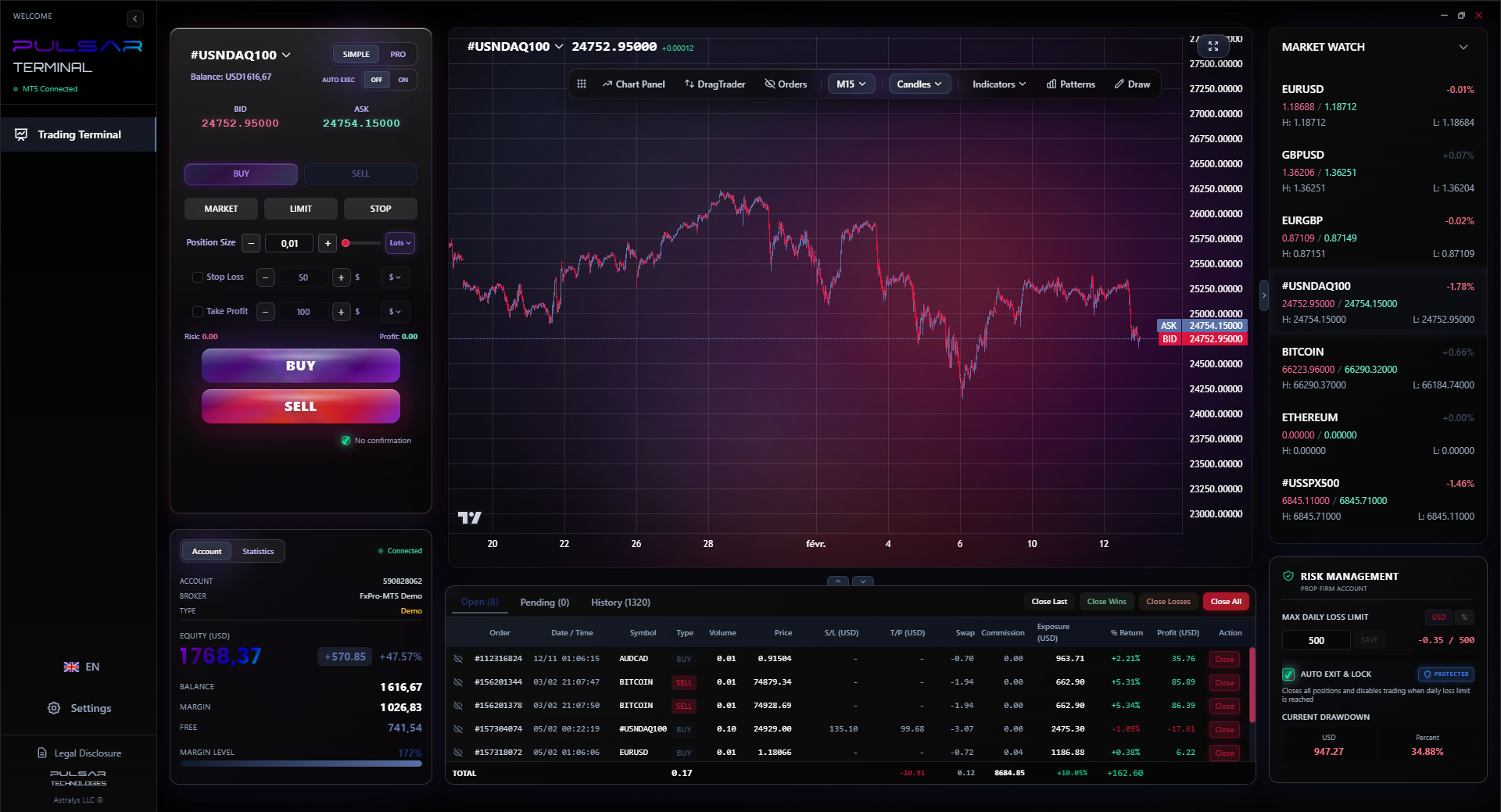
When your scalp trading strategy depends on split-second decisions, manually dragging stop-losses and setting multiple take-profit levels on MT5 is a distraction you can't afford.
Pulsar Terminal
The all-in-one MT5 companion: drag-and-drop orders, multi-TP/SL, trailing stop, grid trading, Volume Profile, and prop firm protection. Used by 1,000+ traders daily.
The market isn't your problem. Your brain is. Scalping amplifies every psychological weakness you have.
The Revenge Trade: You lose 5 pips. 'I'll get that back next trade.' You jump in without a signal, take another 5-pip loss. Now you're down 10. In 90 seconds, you've blown your daily loss limit. It happens faster than you can rationalize it.
The Over-Trade: You make 5 pips. Then 5 more. You feel invincible. The market gets choppy, but you keep trading because 'you're hot.' You give back all your profits and more. Scalping requires the discipline to stop when the conditions aren't perfect, even when you're winning.
The Hesitation: You see your setup. You know it's valid. But you pause for half a second, remembering your last loss. That half-second is the difference between a 2-pip profit and a 5-pip loss as the price moves away. You must act with robotic consistency.
My single biggest psychological hack was implementing a hard daily stop-loss of 2% of my account and a hard daily profit target of 3%. When I hit either, I shut down the platform. No exceptions. This prevented catastrophic days and locked in winning ones. It forced me to be consistent, not heroic. Protecting your capital is the only way to stay in the scalp trading forex game long enough to learn.
“If you can't be consistently profitable on demo with fake money, you have zero chance with real money.”
Let me save you some money and heartache.
- Trading During News: Just don't. Spreads widen to 10-20 pips, execution is terrible, and price moves are chaotic. Your tight stop-loss will get vaporized. If you must trade news, it's not scalping.
- Ignoring the Session: The best liquidity and tightest spreads for USD pairs are during the New York session overlap (8 AM - 12 PM ET). Trying to scalp the EUR/USD guide at 2 AM ET is a recipe for slippage and frustration.
- Not Accounting for Commissions: As discussed, this is suicide. Build commissions into your minimum target.
- Using Too Much use: Even at 1:50, it's easy to over-use. A 5-pip stop on a position that's too large can still cause a 2-3% account loss. Use a position size calculator for every single trade.
- Chasing the Trade: The setup is gone. The move has already happened. Let it go. There will be another in 5 minutes. Chasing is how you get filled at the worst possible price and watch it reverse immediately.
I have a notebook from my first year where I wrote 'Why did I do that?' after over 70% of my trades. The answers were always one of the points above. Fix the basics before you even think about a more complex scalping strategy.
💡 Winston's Tip
The best scalping setup you'll ever see will occur right after you hit your daily loss limit. That's not a sign to break your rule; it's proof the rule is working.
Probably not. And that's okay.
Scalp trading forex in the US is a niche within a niche. It's for the trader who thrives on intensity, has the discipline of a monk, and treats trading like a business of microscopic transactions. If you prefer analyzing longer-term trends, holding positions for days, and making fewer decisions, then swing trading is a far better path.
If you're still here, and you're nodding along, then your path is clear. Start with a demo account that simulates real costs (spreads and commissions). Trade the simple methodology I outlined for one month. Track every trade in a journal. If you can't be consistently profitable on demo with fake money, you have zero chance with real money.
Then, fund a small live account with money you can afford to lose. Trade one mini lot. Your goal for the first six months isn't to get rich. It's to not blow up. It's to prove you can follow your plan, manage your psychology, and grind out small gains in the most restrictive retail trading environment in the world. It's the hardest way to make easy money. But for a certain type of person, it's the only game in town.
FAQ
Q1Is scalping forex illegal in the United States?
No, scalping forex is perfectly legal. However, it is subject to strict US regulations like the FIFO rule, no-hedging rule, and a 1:50 use cap that make many common international scalping strategies impossible to execute. You have to adapt your approach to fit within the regulatory box.
Q2What is the best US forex broker for scalping?
Look for US-regulated brokers (CFTC/NFA) that offer raw spread accounts with low, transparent commissions and have a reputation for fast, reliable execution. FOREX.com's Raw Pricing account and OANDA are often cited by active traders. Avoid any broker whose main offering is wide, commission-free spreads, as those costs are hidden and will destroy your scalping profits.
Q3How many pips do scalpers aim for?
Most scalpers target 5 to 10 pips per trade. However, after you subtract the spread and commission, your net target might only be 3 to 7 pips. This is why position size and cost analysis are critical. A 5-pip net gain on a large position can be meaningful; on a tiny position, it's negligible.
Q4Can I use a scalping bot or EA in the US?
You can use Expert Advisors (EAs) on platforms like MT4/MT5. However, the EA's logic must comply with US rules. An EA designed to hedge or manage multiple lots in a way that violates FIFO will not work on a US broker's server. You must ensure any automated strategy is built specifically for the US regulatory environment.
Q5What time is best to scalp forex in the US?
The most liquid and ideal times are during the New York session (8 AM - 5 PM ET), especially the overlap with the London session (8 AM - 12 PM ET). This is when spreads are tightest and volume is highest for major pairs like EUR/USD and GBP/USD. Avoid the Asian session for scalping USD pairs.
Q6Why do most forex scalpers fail?
They fail because they underestimate transaction costs, over-use their accounts, lack a disciplined and simple strategy, and cannot control their emotions (revenge trading, over-trading). They treat it like gambling instead of a probabilistic business with razor-thin margins. The statistics from brokers show a majority of retail traders lose money, and scalpers have an even higher attrition rate.
Q7Is a 1-minute chart necessary for scalping?
It's common, but not an absolute requirement. Many successful scalpers use the 1-minute or 5-minute chart as their primary entry timeframe. The key is using a higher timeframe (like the 5-minute) for trend direction to avoid getting whipsawed by noise on the ultra-low charts.
Prof. Winston's Lesson
Key Takeaways:
- ✓US rules (FIFO, No Hedge, 1:50 use) define your strategy.
- ✓Costs must be your primary analysis; net pips are all that matter.
- ✓A simple, one-trade methodology works best under constraints.
- ✓A hard daily loss limit (e.g., 2%) is non-negotiable for survival.
How useful was this article?
Click a star to rate
Weekly Trading Insights
Free weekly analysis & strategies. No spam.
About the Author
James Mitchell
Senior Trading Analyst
Based in New York with over 9 years of trading experience. Focuses on major USD pairs, prop firm challenges, and the US regulatory landscape.
Comments
Risk Disclaimer
Trading financial instruments carries significant risk and may not be suitable for all investors. Past performance does not guarantee future results. This content is for educational purposes only and should not be considered investment advice. Always conduct your own research before trading.
You Might Also Like

Cara Trading Forex Sukses: 7 Prinsip dari Trader Profesional
Cara trading forex sukses dengan 7 prinsip trader pro: manajemen modal, disiplin, journal trading, backtest. Data nyata, bukan janji profit palsu.
Jam Trading Forex Terbaik untuk Trader Indonesia: Panduan Lengkap dengan Tabel Waktu
Panduan jam trading forex untuk trader Indonesia. Tabel 4 sesi dunia, jam emas 20:00-00:00, sesi mana yang harus dihindari. Data akurat + tips dari trader berpengalaman.
Top 5 Sàn Forex Uy Tín Nhất 2026: Review Jujur dari Trader Indonesia
Top 5 sàn forex uy tín 2026 untuk trader Indonesia. Review jujur: spread, deposit, withdraw, dukungan lokal. Exness, XM, IC Markets & lebih.
Get Pulsar Terminal
All these calculators are built into Pulsar Terminal with real-time data from your MT5 account. One-click position sizing, automatic risk management, and instant calculations.
Get Pulsar Terminal