


You've probably searched for a 'scalping trading strategy pdf' hoping for a secret formula.

Rajesh Sharma
Senior Forex Analyst ·  India
India
☕ 13 min read
What you'll learn:
- 1Is Scalping Legal in India? (Yes, But SEBI is Watching)
- 2The Real Costs That Kill Indian Scalpers (Forget the PDF)
- 3Brokers, Platforms & The Execution Edge
- 4A Real Strategy: It's Not About the RSI
- 5Risk Management & The Minimum Capital Lie
- 6Essential Tools (And What a PDF Can't Give You)
- 7Final Verdict: Should You Even Try Scalping in India?
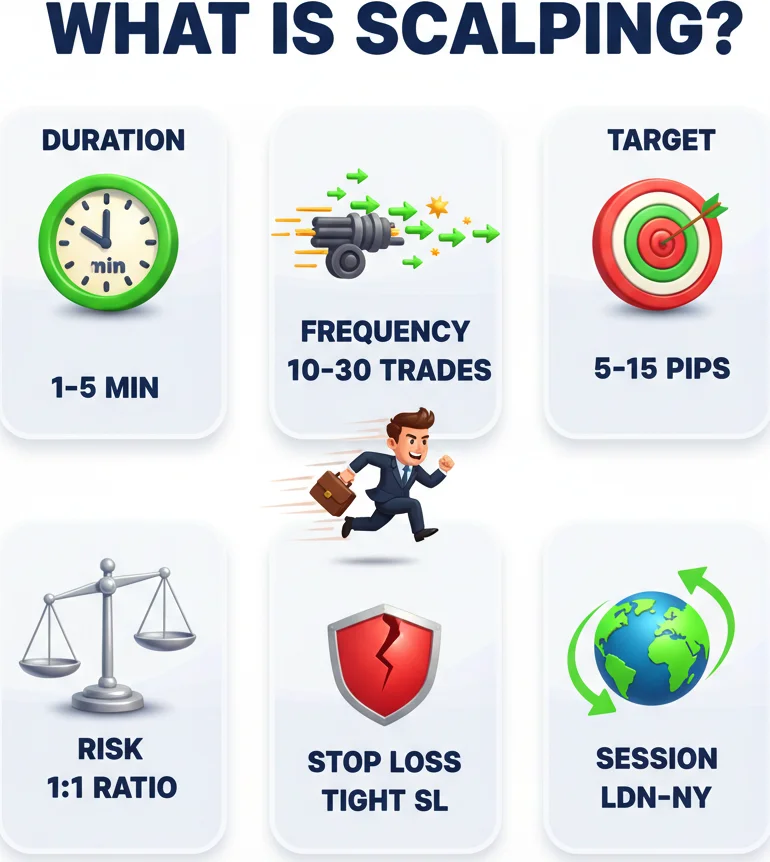
You've probably searched for a 'scalping trading strategy pdf' hoping for a secret formula. I get it. The promise of quick, small wins is intoxicating. But here's the brutal truth: the free PDFs and YouTube gurus are selling you a fantasy that ignores the single biggest factor in Indian markets - transaction costs. They don't show you the math where you win 60 trades but still end the day in the red after brokerage and taxes. Let's set the record straight. This isn't another strategy guide; it's a risk management manual for surviving scalping in India, where SEBI's rules and the taxman are your two biggest opponents.
First things first. Scalping - entering and exiting trades within seconds or minutes - is perfectly legal on Indian exchanges like the NSE and BSE. It's treated as a form of intraday trading. The illegal thing is 'ticket scalping' for concerts and matches, which is a completely different animal.
However, 'legal' doesn't mean 'unregulated.' The Securities and Exchange Board of India (SEBI) has been steadily tightening the screws, especially on the high-frequency, algorithmic side of scalping. They're not trying to stop you, but they are forcing everyone to play a cleaner, more transparent game.
The two biggest regulatory hurdles you need to know about are the Order-to-Trade Ratio (OTR) and the new algo rules.
The Order-to-Trade Ratio (OTR) Trap
This is a killer for undisciplined scalpers. SEBI brought this in to punish 'quote stuffing' - placing and cancelling a huge number of orders to create false liquidity. Here’s how it works: if your ratio of orders placed to trades executed exceeds a limit (which exchanges can set up to 2000), you get a penalty. Do it three times in 30 days, and you face a 15-minute trading suspension. For a scalper, that’s a death sentence for your session.

Warning: If you're the type to constantly modify orders or chase the price with limit orders you keep cancelling, you will hit the OTR limit. It forces you to be decisive. A recent relaxation in April 2026 for options helps, but the core rule remains: be intentional with every order you place.
The Algo Trading Crackdown (Feb 2025)
If you're using any automated tool, API, or even a fancy script on your charting platform to scalp, you're now under SEBI's microscope. As of February 2025, brokers must authorize and supervise all algorithmic strategies. If you're using a third-party tool, its provider must be registered with the exchange. Even retail traders using APIs need a static IP address. The era of wild west algo-scalping is over. This is a good thing for market integrity, but it adds a layer of compliance you can't ignore.
The bottom line? You can scalp. But you must do it within a framework designed to catch the bad actors. If your strategy relies on spamming the order book, it's not just unprofitable - it's now a fast track to getting your terminal shut off.
“Your strategy isn't competing against the market first; it's competing against the government and your broker.”
This is where the fantasy of that 'scalping trading strategy pdf' meets the concrete wall of Indian reality. Your strategy isn't competing against the market first; it's competing against the government and your broker. Let's break down the silent profit killers.
The Transaction Cost Bloodbath (As of March 2026)
Assume you're scalping Bank Nifty options. You make 100 trades in a day. Sounds like a lot? For a serious scalper, it's a slow Tuesday.
| Charge | Application | Cost per ₹1,00,000 Trade | Impact for 100 Trades |
|---|---|---|---|
| Brokerage | Per executed order | ₹20 (flat, discount broker) | ₹2,000 |
| STT (Options) | 0.15% on premium (sell side) | ~₹150 (on ₹1 lakh premium) | ~₹15,000 |
| Exchange Charge | Per side | ~₹5 | ₹1,000 |
| GST (18%) | On brokerage + exchange charge | ~₹4.5 | ₹450 |
| Stamp Duty | State-wise, on turnover | Varies | ~₹500 |
| **Estimated Daily Cost | ~₹18,950 |
Look at that number. ₹18,950. That's not your profit target. That's your break-even cost before you make a single rupee in actual profit. Your strategy needs to generate nearly ₹19,000 in gross gains just to reach zero. The recent STT hike in the 2026-27 budget (from 0.1% to 0.15% on options premium) was a direct policy shot across the bow of high-frequency trading.

Example: Let's say you're a genius scalper. You make an average gross profit of ₹250 per trade. Over 100 trades, that's ₹25,000. Minus your ₹18,950 in costs, your net profit is ₹6,050. A 24% net return on gross? That's the best-case scenario with near-perfect execution. Now factor in a few losing trades or slippage, and that profit evaporates.
Slippage: The Hidden Tax
Slippage is the difference between your expected entry price and your filled price. In fast markets, especially around news, it's brutal. On a ₹10 lakh capital account scalping Nifty futures, even 0.5 points of average slippage on 100 trades can add another ₹1,250 to ₹2,500 to your daily costs. It's death by a thousand cuts.
I learned this the hard way in 2019. I had a beautiful scalping strategy on crude oil mini. I was right on direction 70% of the time. My position size calculator was dialed in. After a month, I was up a gross of ₹87,000. My net after all charges and slippage? ₹11,200. The house always wins, unless you account for it first.

💡 Winston's Tip
Your first profit target should always be to cover your estimated daily costs. Only the money made after that is real trading profit.
“The free PDFs and YouTube gurus are selling you a fantasy that ignores the single biggest factor in Indian markets - transaction costs.”
Your broker and platform aren't just tools; they're part of your strategy. Choose wrong, and you start the race 10 meters behind everyone else.
For Indian markets (NSE, BSE), you need a SEBI-regulated broker. Full stop. Going offshore for 'better conditions' on Indian instruments is a regulatory nightmare. Here’s the local lay of the land:
Discount Brokers (The Scalper's Default): Dhan, Zerodha, Upstox, Angel One. Their model is simple: low, flat fees (like ₹20 per trade). Their platforms - Zerodha's Kite, Dhan's terminal - are built for speed. They have hotkeys, depth-of-market (DOM) views, and clean charts. This is where most retail scalpers should be.
Full-Service Brokers with a Twist: Some, like ICICI Direct with its 'Prime299' plan, offer zero brokerage for trades squared off within 5 minutes. This is a scalping-specific product! Kotak Securities has similar 'Trade Free' intraday plans. The catch? Their platforms can be clunkier than the discount brokers'. You're trading speed of execution for a lower cost per trade. You need to test which works for your style.
The Forex & Global Markets Grey Area
Many Indian traders look at forex pairs like EUR/USD or XAU/USD because of the 24-hour market and perceived lower costs. This is a legal grey area. International brokers like IC Markets, Pepperstone, and XM do accept Indian clients. They offer raw ECN accounts with spreads from 0.0 pips, which is tempting.
But remember: you're sending money overseas to an entity not regulated by SEBI or RBI. If there's a dispute, your legal recourse is complicated. The execution, however, is often superior for pure scalping, with platforms like MT4/MT5 being the global standard. If you go this route, treat it as a higher-risk venture. I use a global broker for forex, but I never keep more than 15% of my total capital there.

Pro Tip: Regardless of broker, test their execution during high volatility. Place a market order on a small lot during the opening bell or a news event. How much did you slip? Do it 10 times. That average slippage number needs to be baked into your profit target. A broker with a 'cheaper' fee but 2 points of slippage is more expensive than a broker with a ₹25 fee and 0.2 points of slippage.

“The free PDFs and YouTube gurus are selling you a fantasy that ignores the single biggest factor in Indian markets - transaction costs.”
Throw away that 'scalping trading strategy pdf' that tells you to buy when the 5-period RSI crosses above 30. In a vacuum, it's useless. The core of scalping isn't a magical indicator setup; it's understanding liquidity and market microstructure.
You're not trading 'the market.' You're trading the orders sitting at the current bid and ask. Your goal is to capture the spread or a tiny directional move before the liquidity shifts. This means your charts need to show you more than just candles.
What to Actually Focus On:
- Time & Sales (Tape Reading): See the orders flowing in real-time. Are large lots hitting the bid (selling pressure) or lifting the ask (buying pressure)? This is your primary signal.
- Depth of Market (DOM): See the buy and sell orders stacked at different prices. Is there a huge sell wall at 22,500? Trying to scalp long through that is suicide. The DOM tells you where the immediate battles are.
- Volume Profile: Identify the price levels where most trading happened (the Point of Control). Prices often get attracted back to these high-volume nodes, giving you clear scalping targets.
My Personal Setup (Nifty/Bank Nifty Options): I ignore the 1-minute chart. I use a 15-second or tick chart. I have the DOM open right next to it. I wait for consolidation - a tight range where the DOM shows balanced bids and asks. Then, I look for an imbalance: a sudden pulling of large bids or a surge of market sell orders. I don't use a standard RSI indicator or MACD. I might use a simple VWAP (Volume Weighted Average Price) as a mean-reversion guide. My stop loss is mental and tight - usually the other side of the consolidation range. My target is 5-10 points in Bank Nifty options. That's it. Boring, mechanical, and entirely based on reading the auction, not predicting the future.
I once tried a complex system with three confirmations. By the time my last indicator gave the signal, the 3-point move I was trying to capture was already over. I lost ₹8,000 in two days chasing my own rules. Simplicity wins.
💡 Winston's Tip
If you can't articulate your exact edge in one sentence - what market inefficiency you're capturing - you don't have a strategy. You have a hope.
“Trading with scared money is the surest way to a margin call.”
You'll see forums saying you can start scalping with ₹25,000. Technically, yes. Practically, you will blow up. Here’s the honest math.
For scalping Indian futures or options, you need enough capital to:
- Withstand the daily costs without panicking.
- Place trades with sensible position sizes that don't risk 5% of your account on a single scalping idea.
- Survive a string of 5-10 losses without your psychology crumbling.
My recommended absolute minimum: ₹2,00,000 for serious scalping.
Why? Let's say you risk 0.5% of your capital per trade. That's ₹1,000. In Nifty futures, that might be a 10-point stop loss, allowing you to trade 2 lots (20 points * 2 lots * 25 = ₹1,000). This is a sane position size. With a ₹25,000 account, a 0.5% risk is ₹125. You can't even trade a single mini lot with a reasonable stop. You're forced to use a 2-point stop, which is just market noise - you'll get stopped out constantly.
The Daily Loss Limit is Sacred
This is non-negotiable. You must have a hard daily loss limit. Mine is 2% of my core scalping capital. If my account is ₹5 lakh, my daily loss limit is ₹10,000. Once I hit that, I shut down the terminal. No excuses, no 'revenge trading.' This single rule has saved me from every major drawdown.
Prop firms are popular now, but their challenges are designed to exploit undisciplined scalpers. They have strict daily loss limits for a reason. Tools that can automate this cut-off are useful, because your brain will lie to you when you're down.
The SEBI statistic says it all: 93% of F&O traders lost money between FY22-FY24, with an average loss of ₹2 lakh. That's not a coincidence. It's the direct result of undercapitalization and no risk rules. Don't become a statistic. Fund your account properly, or don't start. Trading with scared money is the surest way to a margin call.
“Trading with scared money is the surest way to a margin call.”
A PDF gives you static rules. Scalping is a dynamic fight. You need dynamic tools.
Must-Have Platform Features:
- One-Click Trading & Hotkeys: Your mouse is too slow. You need to define keys for Buy Market, Sell Market, and Cancel All. Speed is an edge.
- Advanced Order Types: Not just limit and market. You need a trailing stop loss. This is critical. If you catch a 15-point move in Bank Nifty, a 3-point trailing stop locks in profit as it runs. Doing this manually is impossible. You also need bracket orders (OCO – One Cancels the Other) to set your take profit and stop loss the moment you enter.
- Reliable Data Feed: A delay of even 500 milliseconds means your chart is showing you history, not the present. Pay for a premium data feed if your broker's is slow.
This is where the right software moves from being a nice-to-have to a necessity. Managing multiple trades with manual trailing stops while watching the DOM is a superhuman task. Automation handles the mechanics, so you can focus on the decision.
The Psychological Tool: The Journal
This is your most important tool, and it's free. Log every trade: entry, exit, time, pips or points gained/lost, spread at entry, reason for entry (e.g., 'DOM buy imbalance at 22,450'), and emotional state. After 100 trades, you'll see the truth. You'll see that your 'winning strategy' only works between 10:30 AM and 11:30 AM. You'll see that you lose more on revenge trades after lunch. This data is more valuable than any indicator. I review my journal every Sunday. It's painful, but it's the only way to improve.
💡 Winston's Tip
The most powerful tool for a scalper isn't an indicator; it's the 'Disable Trading' button on your platform. Use it when you hit your daily loss limit.

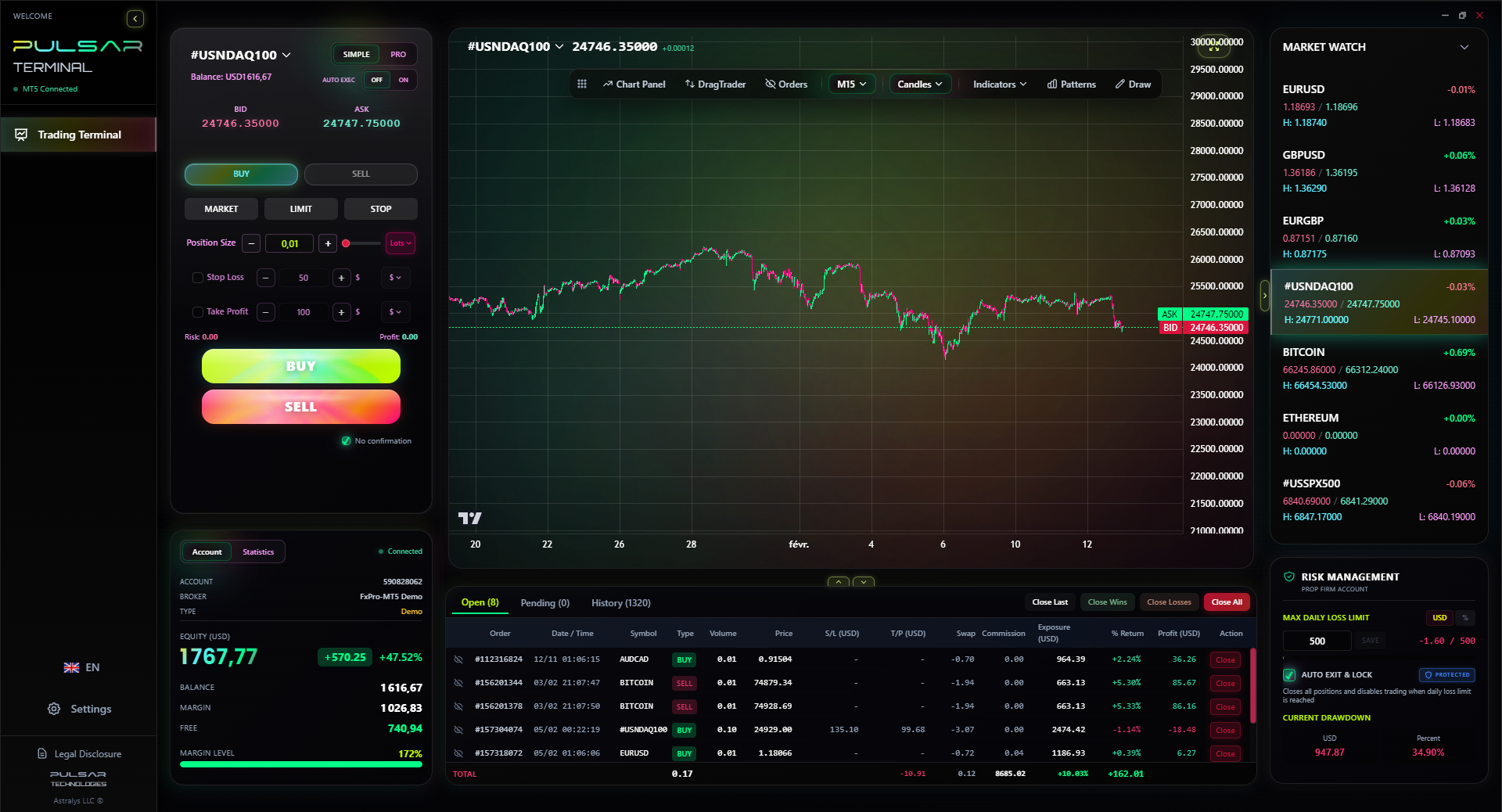
Manually managing multiple trades and trailing stops while scalping is nearly impossible, which is why tools like Pulsar Terminal that automate these mechanics directly on MT5 are a game-saver for serious traders.
Pulsar Terminal
The all-in-one MT5 companion: drag-and-drop orders, multi-TP/SL, trailing stop, grid trading, Volume Profile, and prop firm protection. Used by 1,000+ traders daily.
“Making 100 trades with a 55% win rate but high costs can lose money. Making 15 high-conviction trades can be far more profitable.”
Let's be blunt. For most people, the answer is no.
Scalping in India is a professional's game. It's about managing microscopic edges against enormous fixed costs. It requires a temperament of steel, significant starting capital, and a willingness to treat it like a business, not a casino.
Consider scalping if you:
- Have at least ₹2-5 lakh in dedicated risk capital.
- Are technologically adept and willing to invest in good hardware/software.
- Have the discipline to follow a daily loss limit without fail.
- Understand that you will have many losing days, and your net profit for a good month might be 3-5% of your capital.
Look at swing trading instead if you:
- Have a full-time job and can't watch screens all day.
- Have a smaller account (under ₹1 lakh).
- Find the transaction cost math in this article terrifying (it should be).
- Value your sanity and sleep.
The 'scalping trading strategy pdf' is a siren song. It promises simplicity and quick riches. The reality is a grinding, expensive battle of attrition where the only consistent winners are the brokers and the tax department. If you're still determined to step into this arena after reading this, you now have the map of the minefield. Tread carefully, count your costs first, and never risk money you can't afford to lose. The market will be here tomorrow. Make sure your capital is too.
FAQ
Q1What is the best time for scalping in Indian markets?
The first 90 minutes after market open (9:15 AM to 10:45 AM) and the last 60 minutes before close (2:30 PM to 3:30 PM) typically have the highest volume and volatility, creating the most scalping opportunities. The mid-day period is often slower and choppier, making it harder to capture clean moves.
Q2Can I scalp with just ₹50,000 in India?
You can, but it's extremely difficult and statistically likely to fail. With ₹50,000, transaction costs become a massive percentage of your capital. A single bad day of losses and costs can wipe out 10-15% of your account. For any chance of survival, you'd need to risk tiny amounts (like 0.2% per trade), which makes meaningful profits almost impossible after costs. It's strongly advised to have more capital.
Q3Is forex scalping legal for Indian residents?
Trading forex (like EUR/INR) on Indian exchanges like NSE is legal. However, trading international forex pairs (like EUR/USD) through offshore brokers exists in a regulatory grey area. The RBI does not permit Indian residents to remit money abroad for margin trading, but many global brokers accept Indian clients. You lack SEBI/RBI protection in this case, so it carries additional legal and financial risk.
Q4What's more important for a scalper: low brokerage or fast execution?
Fast execution is almost always more important. A broker with ₹10 cheaper fees but slower execution will cause more slippage. That slippage - the difference between your intended price and filled price - will cost you far more over 100 trades than the saved brokerage. Prioritize a stable, fast platform with a reliable data feed.
Q5How many trades does a scalper make per day?
It varies widely. A moderate scalper might make 20-50 trades. A high-frequency scalper using algorithms can make hundreds. The key isn't the number, but the quality. Making 100 trades with a 55% win rate but high costs can lose money. Making 15 high-conviction, well-managed trades can be far more profitable. Focus on net profit, not trade count.
Q6Did the 2026 STT hike kill scalping?
It didn't kill it, but it significantly wounded it. The hike in Securities Transaction Tax on futures and options directly eats into the already thin profit margins of scalpers. It forces strategies to be more efficient, require larger moves to be profitable, or push more activity into instruments with lower STT. It's a major headwind that any viable strategy must now overcome.
Prof. Winston's Lesson
Key Takeaways:
- ✓Calculate your break-even costs before your profit target.
- ✓Minimum realistic scalping capital: ₹2,00,000.
- ✓STT is now 0.15% on options premiums (2026 hike).
- ✓Daily loss limit is non-negotiable (suggest 2%).
- ✓Fast execution beats low brokerage every time.
How useful was this article?
Click a star to rate
Weekly Trading Insights
Free weekly analysis & strategies. No spam.
About the Author
Rajesh Sharma
Senior Forex Analyst
Trading Indian and South Asian markets for over 10 years. Started with NSE currency derivatives before moving to international forex. Specializes in USD/INR and emerging market pairs.
Comments
Risk Disclaimer
Trading financial instruments carries significant risk and may not be suitable for all investors. Past performance does not guarantee future results. This content is for educational purposes only and should not be considered investment advice. Always conduct your own research before trading.
You Might Also Like

Cara Trading Forex Sukses: 7 Prinsip dari Trader Profesional
Cara trading forex sukses dengan 7 prinsip trader pro: manajemen modal, disiplin, journal trading, backtest. Data nyata, bukan janji profit palsu.
Jam Trading Forex Terbaik untuk Trader Indonesia: Panduan Lengkap dengan Tabel Waktu
Panduan jam trading forex untuk trader Indonesia. Tabel 4 sesi dunia, jam emas 20:00-00:00, sesi mana yang harus dihindari. Data akurat + tips dari trader berpengalaman.
Top 5 Sàn Forex Uy Tín Nhất 2026: Review Jujur dari Trader Indonesia
Top 5 sàn forex uy tín 2026 untuk trader Indonesia. Review jujur: spread, deposit, withdraw, dukungan lokal. Exness, XM, IC Markets & lebih.
Get Pulsar Terminal
All these calculators are built into Pulsar Terminal with real-time data from your MT5 account. One-click position sizing, automatic risk management, and instant calculations.
Get Pulsar Terminal