


It was 8:05 AM on a Thursday, just after the SARB's rate announcement.

David van der Merwe
Emerging Markets Trader ·  South Africa
☕ 10 min read
What you'll learn:
- 1What Is Slippage, Really? It's Not Just a Bad Fill
- 2Why Slippage Hits South African Traders Especially Hard
- 3The Real Cost: How Slippage Erodes Your Edge
- 4Order Types: Your First Line of Defence Against Slippage
- 5Broker & Tech: The Hidden Factors in Slippage
- 6Building a Slippage-Resistant Trading Strategy
- 7The Final Word: Embrace Slippage to Find Your Edge
It was 8:05 AM on a Thursday, just after the SARB's rate announcement. I clicked to sell USD/ZAR at 18.4250. My platform flashed 'Order Filled' at 18.4225. A 25-pip difference before the trade even started. That wasn't a bad fill; that was slippage forex in its purest form, and it cost me R625 on a single standard lot before the market had moved a tick in my favour. Most traders fixate on spreads and commissions, but slippage is the ghost in the machine, the silent leak that drains accounts over time. In South Africa, with our volatile currency pairs and sometimes thinner liquidity, understanding this isn't optional - it's survival.
Let's cut through the broker jargon. Slippage is the difference between the price you expect to get and the price your order is actually executed at. It happens when there's a gap between supply and demand at your exact price point. You're not being cheated (usually); you're experiencing the mechanical reality of how orders are matched.
Think of it like trying to buy the last ticket to a Springbok match at the face value price as the stadium fills up. By the time your order reaches the front of the queue, that price is gone, and you either pay more or miss out. The forex market moves the same way, especially during our local market open (8-9 AM SAST) or around major data drops like CPI figures.
There are two types:
- Negative Slippage: This is the one that hurts. You buy for more than you wanted, or sell for less. Your entry is worse.
- Positive Slippage: A rare gift. Your order gets filled at a better price than you requested. A buy order fills lower, or a sell order fills higher. Don't rely on it.

Warning: Slippage isn't the same as your broker's quoted spread. The spread is the built-in cost between the bid and ask. Slippage is an additional cost (or benefit) that occurs when filling an order, particularly market orders or stop-loss/entry orders during fast markets. You can check a broker's typical execution quality in our Exness review and IC Markets review.
Our market context makes us uniquely vulnerable. It's not that our brokers are worse; it's about liquidity and timing.
The ZAR Liquidity Problem
Major pairs like EUR/USD have massive, deep liquidity pools. USD/ZAR, EUR/ZAR, and GBP/ZAR? Not so much. They're exotic or minor pairs. The pool of buyers and sellers is smaller, so a moderately sized order can literally move the price. If you're trading a few standard lots, you might be a big fish in a small pond, causing the very slippage you're trying to avoid. I learned this the hard way trying to quickly exit a 5-lot USD/ZAR position. My market order ate through three price levels before filling.
The SAST Time Zone Trap
Our trading day (8 AM - 5 PM SAST) overlaps with the London open for only a few hours. The most liquid period globally is the London-New York overlap, which happens in our late afternoon. If you're trading volatile news or opening trades early in the SA morning, you're dealing with the Asian session's thinner liquidity. Price gaps are more common, and slippage forex becomes almost guaranteed with market orders.
High-Impact Local Events
South African Reserve Bank (SARB) interest rate decisions, national budget speeches, or unexpected political news cause instant, violent jumps in ZAR pairs. Your stop-loss order becomes a market order the moment it's triggered. If the price gaps, you get filled at the next available price, which could be 50 pips away. This isn't a theory; it's how I once took a R2,300 loss on a trade that was only supposed to risk R800. The trigger was a comment from a finance minister, and my stop was obliterated. Proper position size calculation must account for this possibility, not just the calm-market risk.
“Slippage is the market charging you a stupidity tax for impatience.”
Traders obsess over finding a 55% win rate strategy but ignore a 2-pip average slippage cost. Let's do the math, because that's where the truth lives.
Let's say you're a scalping strategy trader on EUR/USD. You target 10 pips, risk 5 pips. Seems decent.
- Broker Spread: 1.0 pip
- Average Negative Slippage on Entry/Exit: 1.5 pips
- Total trade cost: Spread (1.0) + Slippage (1.5 x 2 for entry and exit) = 4.0 pips.
Your 10-pip target is now a 6-pip net gain. Your 5-pip stop is now a 9-pip net loss. Your risk-reward ratio just got destroyed. You need the market to move 4 pips just to break even on the trade cost alone.

Example: The ZAR Trade Reality Trade: Buy USD/ZAR, 1 Standard Lot (100,000 USD) Intended Entry: 18.5000 Actual Fill: 18.5035 (35 pips of slippage) Cost in ZAR: 35 pips * R1.00 per pip on USD/ZAR? Not quite. The pip value changes with the rate. At ~18.50, a pip is roughly R10.40 for a standard lot. Slippage Cost: 35 pips * R10.40 = R364.00 That's R364 lost before the trade even starts. Do that a few times a week, and you're funding your broker's coffee machine, not your kid's school fees.
The silent killer isn't the one big slip; it's the consistent, small erosion. It turns winning strategies into break-even ones, and break-even strategies into guaranteed losers. You must factor this into your backtesting. If your strategy doesn't account for at least 1-2 pips of slippage per trade, it's a fantasy.

💡 Winston's Tip
Track your slippage like a hawk. Log every entry and exit price versus your intended price. If your average negative slippage exceeds 2 pips per trade, your strategy is likely too dependent on perfect timing.
Your choice of order is the most direct control you have. Using a market order during the SARB announcement is like asking for a bill. Here’s the breakdown.
| Order Type | How It Works | Slippage Risk | Best For... |
|---|---|---|---|
| Market Order | "Fill me now at the best available price." | VERY HIGH. You accept whatever price the market gives you. | Getting in/out immediately at any cost. |
| Limit Order | "Fill me ONLY at this price or better." | LOW/NONE. No fill if price isn't met. Can miss the trade. | Entering at a specific level in calm or ranging markets. |
| Stop-Loss Order | Becomes a Market Order when price hits level. | HIGH on gaps. Guarantees exit but not price. | Risk management (you MUST use these). |
| Stop-Limit Order | Becomes a Limit Order when price hits level. | MODERATE. Limits slippage but risks no fill. | Exiting where price must trade past a point. |
My personal rule? I almost never use plain market orders. For entries, I use limit orders. For exits, I accept that my stop-loss is a market order and I massively widen my expected slippage around news. A trailing stop can help lock in profits in a trend, but its activation is still a market order subject to the same rules.

Pro Tip: If you must enter on news, use a limit order on a pullback after the initial spike. The initial liquidity vacuum causes the worst slippage. Wait 30-60 seconds for the market to find some footing. I've gotten fills 20 pips better by just being patient after the NFP number hits.
“Your goal isn't zero slippage. It's to have a strategy that survives after accounting for it.”
Not all brokers are created equal here. The 'how' of execution matters more than the 'what' of the spread.
Dealing Desk (DD) vs. No Dealing Desk (NDD): This is oversimplified, but generally, an NDD broker (like those in our Pepperstone review or XM review) routes your order directly to liquidity providers (big banks). A DD broker might internalise your order, acting as the counterparty. In fast markets, an NDD model can sometimes provide more consistent, if not always faster, execution. A DD broker may have more power to reject orders or give you massive slippage to protect their book.
Execution Speed & Liquidity Pool: This is the tech race. A broker with faster servers (often in London's LD4 data centre) and connections to 20+ top-tier banks will generally provide less slippage than one with slower tech and 3 liquidity providers. It's about having more places to shop for your price in milliseconds.
Guaranteed Stops: Some brokers offer these for a premium. They promise to fill your stop at the exact price, even in a gap. You pay extra for it, like an insurance premium. For a high-stakes trade on a ZAR pair around an event, it can be worth the fee to define your absolute maximum loss and avoid a margin call scenario.
The bottom line? Your broker's execution policy is a key part of your risk management. Read it. Understand if they're passing liquidity provider slippage on to you (most do) or absorbing it.
💡 Winston's Tip
The best defence against slippage on stop losses is to not be in the trade when high-impact news drops. If you can't watch the screen, close the position. It's cheaper than the alternative.
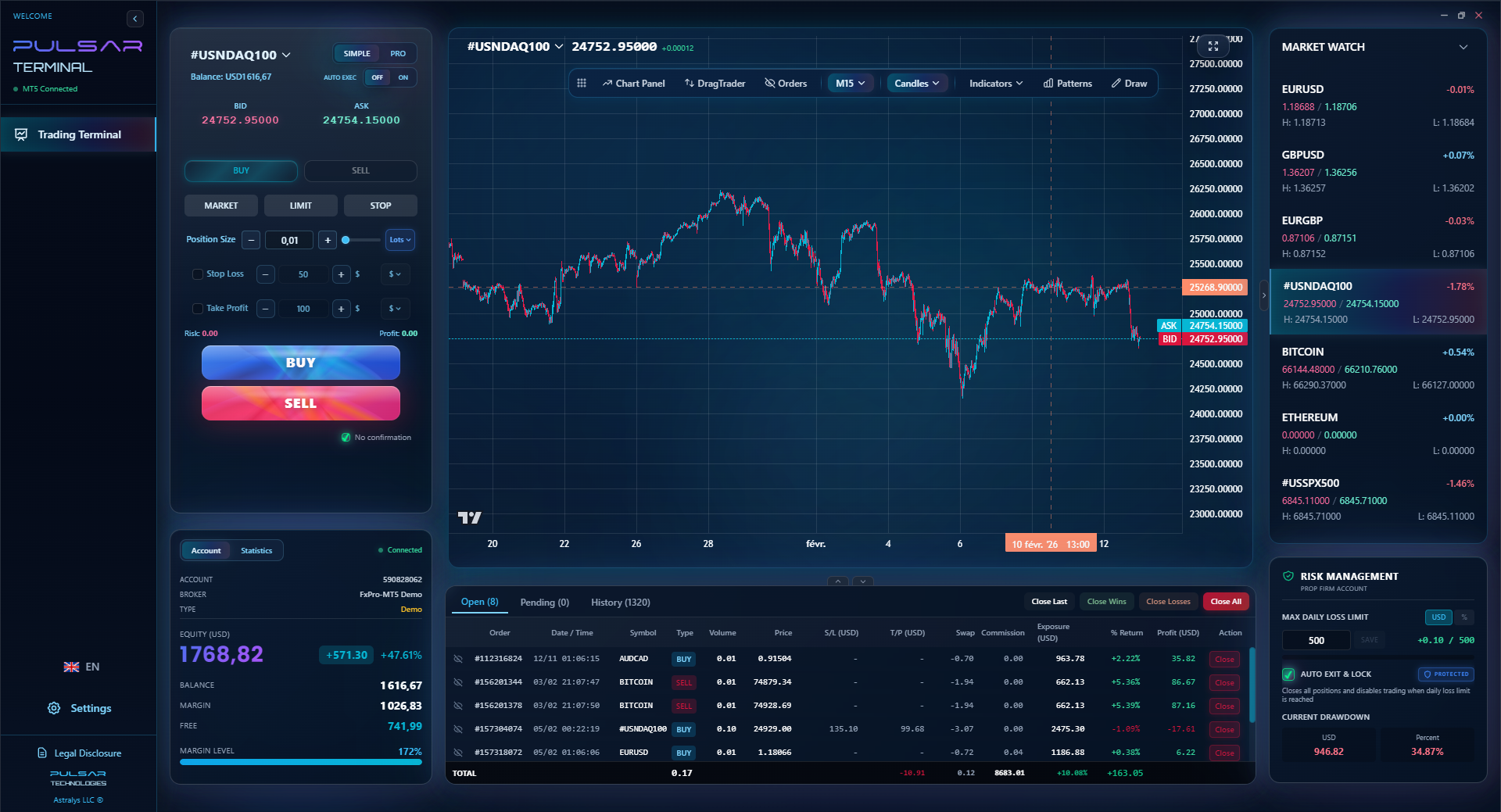
Managing multiple orders and stops in fast markets is where slippage hurts most, which is why tools like Pulsar Terminal that let you drag-and-drop orders and set multi-level take-profits directly on your MT5 chart are game-changers for controlling your risk.
Pulsar Terminal
The all-in-one MT5 companion: drag-and-drop orders, multi-TP/SL, trailing stop, grid trading, Volume Profile, and prop firm protection. Used by 1,000+ traders daily.
You can't eliminate slippage, but you can design your trading to minimise its impact and survive when it strikes.
1. Avoid Trading Around High-Impact News. This is the simplest, most effective rule. If you don't trade 5 minutes before and after major SA or global news (CPI, Interest Rates, Employment), you avoid 80% of catastrophic slippage events. Mark these events on your calendar in red. I treat them like market holidays.
2. Trade More Liquid Pairs. This sounds obvious, but are you trading EUR/ZAR because it's 'familiar'? The EUR/USD guide shows a pair with vastly tighter spreads and deeper liquidity. Your slippage on EUR/USD will almost always be less than on any ZAR cross. Save the exotic pairs for swing trading with very wide stops where a few pips of slippage don't matter as much.
3. Widen Your Stops & Targets. If your strategy has a 10-pip stop in backtesting, make it 15-20 pips in live trading. This builds in a 'slippage buffer.' Yes, it reduces your position size for the same monetary risk, but that's the point. It's realistic. The same goes for profit targets. If you need 10 pips, aim for 12.
4. Use Limit Orders for Entries. Be a patient hunter. Place your buy limit below the current price or your sell limit above it. You might not get filled every time, but when you do, you get your price. This one habit transformed my results more than any indicator. It forces discipline and gives you a known, fixed entry cost.
5. Size for the Worst-Case Scenario. When you calculate your position size using a position size calculator, add your estimated worst-case slippage to your stop distance. If your technical stop is 30 pips away, and you could see 10 pips of slippage on a news day, size your trade as if your stop is 40 pips away. This is conservative, boring, and keeps you in the game.
“A 2-pip average slippage cost can turn a winning strategy into a guaranteed loser.”
Here's the uncomfortable truth most gurus won't tell you: if you're consistently suffering large, negative slippage, the market might be telling you something. Your entries on breakouts are late. Your exits are panicked. Slippage is a feedback mechanism.
When I reviewed my worst slippage trades, a pattern emerged. I was chasing. I'd see USD/ZAR rocket up, FOMO would kick in, and I'd hit 'buy' with a market order right as the move was exhausting. The slippage was the market charging me a stupidity tax for my impatience.
Now, I see slippage as a cost of doing business, like a shop owner sees rent. I budget for it. I track it. I note the average slippage per trade type and broker. This data is as important as my win rate. By accepting it, planning for it, and adjusting my tactics, I've turned a silent killer into a manageable expense.
Your goal isn't to have zero slippage. That's impossible. Your goal is to ensure that after accounting for spreads, commissions, and slippage, your strategy still has a positive mathematical expectation. If it doesn't, you don't have a strategy. You have an expensive hobby. Do the hard math. It's the only thing between you and another blown-up account.
FAQ
Q1Is slippage always bad?
No, you can get positive slippage where your order fills at a better price. However, you should never rely on or expect it. Market mechanics and broker execution policies make negative slippage far more common, especially on stop-loss orders.
Q2Do all brokers have slippage?
Yes, all brokers have the potential for slippage because it's a function of market liquidity and price movement, not just the broker. However, the frequency and severity can vary dramatically based on a broker's execution model, technology, and liquidity providers. ECN/NDD brokers typically report it more transparently.
Q3How can I check my broker's historical slippage?
Many reputable brokers publish monthly execution quality reports on their websites. These show the percentage of orders filled at the requested price, within a slippage range, or with positive slippage. If your broker doesn't provide this data, it's a red flag. You can also track it manually by noting your requested vs. filled price on every trade.
Q4Is slippage worse on ZAR pairs like USD/ZAR?
Generally, yes. ZAR pairs are less liquid than majors like EUR/USD. This means larger bid-ask spreads and a higher likelihood that your market order will move the price slightly, causing slippage. It's especially pronounced during the South African market open and around local news events.
Q5Can I sue my broker for slippage?
Almost certainly not, provided the slippage was due to normal market conditions. Your client agreement will state that orders are filled 'at best available price' or similar, which permits slippage. You only have grounds for complaint if the broker's platform malfunctioned or they acted fraudulently. This is why understanding order types is crucial.
Q6What's the difference between slippage and a requote?
Slippage is an automatic fill at a different price. A requote is when the broker rejects your requested price and asks you to accept a new, worse price. Slippage is faster and more common in fast ECN environments. Requotes are more associated with dealing desk models and are often seen as less transparent.
Q7Does a VPS reduce slippage?
A Virtual Private Server (VPS) can reduce latency, meaning your order reaches the broker's server faster. This can help you get a better position in the execution queue, potentially reducing slippage in very fast, competitive markets. It won't help if the market has already gapped due to news.
Prof. Winston's Lesson
Key Takeaways:
- ✓Budget for 1-2 pips of slippage on every trade.
- ✓Never use market orders around scheduled news.
- ✓Trade liquid pairs; save ZAR crosses for wide-swing plays.
- ✓Widen your stops by 30% to build a slippage buffer.
How useful was this article?
Click a star to rate
Weekly Trading Insights
Free weekly analysis & strategies. No spam.
About the Author
David van der Merwe
Emerging Markets Trader
Johannesburg-based trader with 11 years in emerging market currencies. Specializes in ZAR pairs, FSCA-regulated trading, and South African market analysis.
Comments
Risk Disclaimer
Trading financial instruments carries significant risk and may not be suitable for all investors. Past performance does not guarantee future results. This content is for educational purposes only and should not be considered investment advice. Always conduct your own research before trading.
You Might Also Like

Cara Trading Forex Sukses: 7 Prinsip dari Trader Profesional
Cara trading forex sukses dengan 7 prinsip trader pro: manajemen modal, disiplin, journal trading, backtest. Data nyata, bukan janji profit palsu.
Jam Trading Forex Terbaik untuk Trader Indonesia: Panduan Lengkap dengan Tabel Waktu
Panduan jam trading forex untuk trader Indonesia. Tabel 4 sesi dunia, jam emas 20:00-00:00, sesi mana yang harus dihindari. Data akurat + tips dari trader berpengalaman.
Top 5 Sàn Forex Uy Tín Nhất 2026: Review Jujur dari Trader Indonesia
Top 5 sàn forex uy tín 2026 untuk trader Indonesia. Review jujur: spread, deposit, withdraw, dukungan lokal. Exness, XM, IC Markets & lebih.
Get Pulsar Terminal
All these calculators are built into Pulsar Terminal with real-time data from your MT5 account. One-click position sizing, automatic risk management, and instant calculations.
Get Pulsar Terminal