


Every trader in Lagos wants to be a sniper.

Olumide Adeyemi
West African Trading Pioneer ·  Nigeria
☕ 10 min read
What you'll learn:
Every trader in Lagos wants to be a sniper. They watch videos of perfect entries, dream of catching the exact pip before a 100-point move, and then blow up their account trying to replicate it. The problem? They're chasing a feeling, not a process. Sniper entries in forex aren't about magic or divine timing, they're about stacking probabilities in your favor with brutal discipline. I've seen more traders fail trying to be perfect than succeed by being patient. Let's set the record straight on what this actually takes, especially with the Naira's volatility and our unique market rules.
Forget the Instagram reels. A sniper entry isn't about hitting the absolute lowest tick on a chart. That's gambling. A real sniper entry is about identifying a high-probability zone where price is likely to react, and then having the patience to wait for price to come to you and confirm your bias. It's the difference between firing wildly and waiting for a clear shot.
The core idea is confluence. You need multiple reasons for price to move in your direction at a specific level. One indicator isn't enough. You're looking for a cluster of evidence - like a key support level aligning with a 61.8% Fibonacci retracement, while the RSI indicator shows oversold conditions on a higher timeframe. That's a zone. The entry is the specific candle close or price action signal within that zone.
Here’s where Nigerian traders get it wrong. With use often soaring to 1:1000 or more from brokers like Exness or HFM, the temptation is to use that power to enter early, 'just in case' the move happens without you. That's a surefire way to get stopped out by normal market noise. Sniper discipline means you might watch a trade setup form and then disappear without you. That's okay. Your job isn't to trade every setup, it's to execute the clean ones.

Warning: The biggest myth is that sniper entries eliminate risk. They don't. They manage it. Your stop loss is still sacred. A precise entry just means your stop can be tighter, improving your risk-to-reward ratio. Never compromise your stop loss to 'fit' your entry idea.

💡 Winston's Tip
A sniper's best tool is the 'Delete Pending Order' button. If the market structure changes before your order hits, cancel it. No entry is better than a compromised one.
“A sniper entry isn't about hitting the absolute lowest tick on a chart. That's gambling.”
You need strategies that hold up during Lagos trading hours (1 PM to 6 PM WAT is golden) and account for the spreads on pairs you can actually trade. Forget exotic crosses, focus on liquidity.
The London Session Rejection
This is my bread and butter. The London open (8 AM GMT, 9 AM WAT) often sets a high or low for the early day. I wait for the first 1-2 hours of the session to establish a range. Then, on the 15-minute or 1-hour chart, I look for a rejection (a pin bar or engulfing candle) at the very top or bottom of that range, especially if it aligns with a round number (like 1.0800 on EUR/USD). My entry is on a break of the high/low of that rejection candle. I used this on GBP/USD last month: price rejected 1.2650 three times in the first London hour. I entered short on the break of the third pin bar's low at 1.2638. Stop at 1.2665 (27 pips), target at 1.2580. It ran straight down. Clean.
The Daily Level Retest
This is pure patience. Identify a clear support or resistance level on the Daily chart. Write it down. Then, switch to the 4-hour chart and wait. Do not touch anything until price comes back to that level. Your entry trigger is a reversal candlestick pattern on the close. Not the wick, the close. This often means waiting days. In February, I watched EUR/NGN (yes, some brokers offer it) approach a major daily resistance. I waited three days for it to touch, stall, and then print a clear bearish engulfing candle on the 4H close. That was the sniper entry. The prior noise was irrelevant.
Confluence with Volume
This is more advanced but powerful. Use your platform's tools to see where high volume traded previously (a Volume Profile node). When price retraces into a high-volume node and you get a price action signal, the probability of a bounce is higher. This is where tools beyond basic MT4 help, but the principle is key: more buyers or sellers were active here before, they're likely to defend it.
These setups fail if you're impatient. I once lost $420 on a USD/JPY trade because I entered on a wick touch of a daily level, not a candle close. The wick spiked 5 pips past my entry, triggered my stop, and then reversed perfectly. I was technically right, but procedurally wrong. That stings more.
“Your job isn't to trade every setup, it's to execute the clean ones.”
You can't execute a sniper entry with a 3-pip spread and constant requotes. The Nigerian market is flooded with options, but for precision, your broker choice is a strategic decision, not an afterthought.
You need two things above all: raw spreads and instant execution. For majors like EUR/USD, look for brokers offering raw ECN/STP accounts with spreads at or near 0.0 pips. You pay a commission per lot, but it's worth it. Brokers like IC Markets and Pepperstone are famous for this. Why does it matter? If your entry zone is 5 pips wide, a 2-pip spread eats 40% of your working room before the market even moves.
Here’s a quick comparison of what matters for sniper trading:
| Feature | Why It Matters for Sniper Entries | What to Look For |
|---|---|---|
| Spread | Defines the immediate cost of your entry. | Raw spreads (0.0 - 0.2 pips) on majors. |
| Execution | Slippage can ruin a tight entry. | Instant execution (ECN) model, not dealing desk. |
| Platform | Needs advanced order types and charting. | MT4/MT5 is standard, but check for drag-and-drop orders & advanced tools. |
| use | Lets you use smaller stops, but is dangerous. | Up to 1:500 is more than enough. Avoid the 1:2000 traps. |
| Deposit | Funding in Naira without huge fees. | Local bank transfer, USDT, or cards with low fees. |
Minimum deposits are a marketing game. A $1 account is useless for real trading. Start with at least $500 to properly use a position size calculator and withstand a few losses without panic. I started with $200 and was constantly over-leveraged because my position sizing was forced to be too large just to make the trade worthwhile. It was a stressful, losing formula.

Pro Tip: Before you fund an account, open a demo with your shortlisted broker. Test your entry strategy during peak volatility (London/US overlap). Watch for spread widening and execution speed. If your stop orders are getting slipped on demo, imagine it with real money.
“Sniper trading is 90% waiting, 9% preparing, 1% executing.”
This is where dreams meet the FIRS (Federal Inland Revenue Service). You can't talk about profits without talking about risk and taxes. First, the golden rule: Never risk more than 1-2% of your account on a single trade. With a $1,000 account, that's $10-$20 max risk. Calculate this using your stop loss distance. If your sniper entry on XAU/USD has a 30-pip stop, your position size must be small enough that 30 pips equals $10. Our position size calculator does this math for you.
Now, the Naira problem. If you're trading USD-based accounts, your profit in Naira terms swings with the exchange rate. You might make a 10% return in USD, but if the Naira strengthens sharply, that gain shrinks when you convert to pay bills. It's a secondary risk factor most ignore.
Then there's the 10% Capital Gains Tax. Keep a detailed trade journal - not just screenshots, but a log with entries, exits, and profit/loss in USD and Naira equivalent. When you withdraw, you're generating a taxable event. The FIRS is getting smarter about tracking digital income. Set aside 10% of your net profits immediately in a separate account. Don't get caught at the end of the year with a tax bill you spent.
use is a double-edged sword. While brokers offer 1:2000, using it fully is suicide. For scalping, you might use higher use (1:100 to 1:200) because stops are tight. For swing trading based on daily levels, use should be much lower (1:10 to 1:30). The use should match your strategy's stop-loss distance, not your greed.
💡 Winston's Tip
Your first target should always be to move your stop loss to breakeven once price moves in your favor by 1.5x your initial risk. Protect your capital before you chase profits.
“Sniper trading is 90% waiting, 9% preparing, 1% executing.”
The technicals are easy to learn. The psychology is what bankrupts you. Sniper trading is 90% waiting, 9% preparing, 1% executing. Your brain is wired for action, not inaction. Sitting through a 4-hour candle formation without clicking 'Buy' or 'Sell' feels like you're failing. You're not. You're working.
FOMO (Fear Of Missing Out) is the sniper's nemesis. You see a pair like GBP/JPY rocketing, you have no setup, but you jump in anyway 'just to catch some pips.' That's not sniping, that's spray-and-pray. I have a rule: If I didn't identify the setup at least an hour in advance, I don't take it. It keeps me honest.
Another trap: moving your entry 'just a little' to get a better price. If your plan says entry is on a break of 1.0850, and price hits 1.0851 and reverses, you missed it. Tough. Don't chase it at 1.0845 hoping it'll continue. You've now entered in a zone of uncertainty, not confirmation. Your stop loss placement becomes arbitrary, and you'll likely close it early on a whim.
You need a pre-trade checklist. Mine is simple: 1) Is this a pre-defined setup? 2) Is my risk 1% or less? 3) Is my screen free of distractions? If yes to all, I can place the order. This ritual separates the desire to trade from the decision to trade.
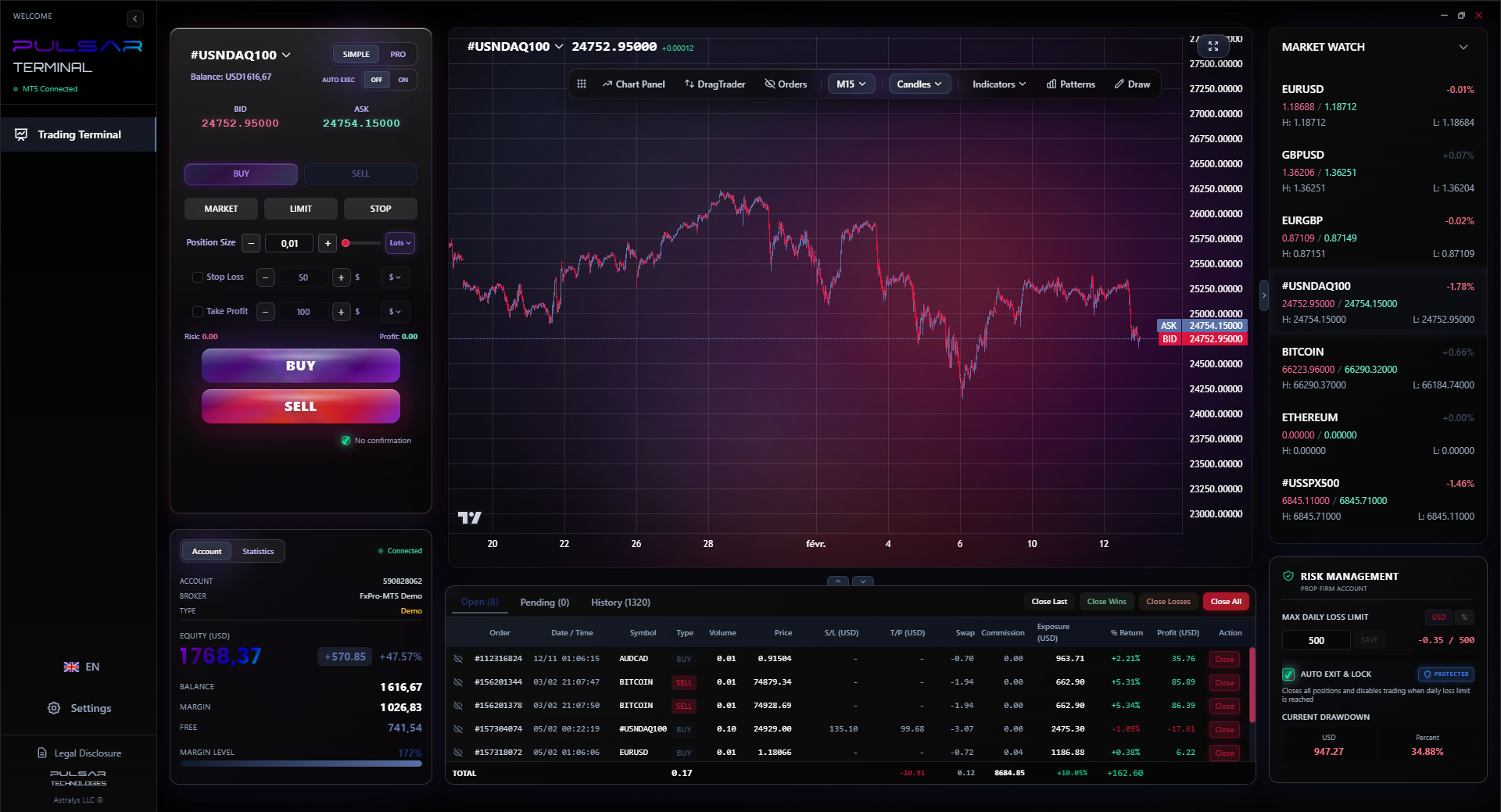
Managing the psychology of waiting is easier when your trade management is automated, letting you set precise entries and trailing stops without hovering over the chart.
Pulsar Terminal
The all-in-one MT5 companion: drag-and-drop orders, multi-TP/SL, trailing stop, grid trading, Volume Profile, and prop firm protection. Used by 1,000+ traders daily.
“The goal is not to be profitable every day, it's to be disciplined every day.”
This isn't a hobby, it's a craft. You need a routine.
Sunday Evening: Do your weekly analysis. Look at the Daily charts of 5-7 major pairs. Draw key support and resistance lines. Note where price closed relative to them. No trading, just planning.
Daily (Before Session Open): Review your plan. Which pairs are nearing your key levels? Set price alerts 20 pips away from those levels. Then walk away until the alert hits. Don't watch the charts tick.
When an Alert Hits: Now you engage. Zoom in to the 1-hour or 15-minute chart. Is price acting as expected? Look for your candlestick confirmation. If it forms, calculate your position size, set your entry, stop, and target. Then walk away again. Your job is done.
End of Day: Review. Look at your trades. Did you follow your rules? Journal the outcome. The goal is not to be profitable every day, it's to be disciplined every day. The profits come as a byproduct of that discipline.
Over time, you'll build a record of what confluence works best for you. Maybe you're great with Fibonacci retracements but terrible with moving average bounces. Focus on your strengths. The market offers more than enough opportunities; you don't need to master every pattern.

Example: Let's say you have a $2,000 account. Your 1% risk is $20. You spot a sniper entry on EUR/USD with a 15-pip stop loss. How many units can you trade? $20 risk / (15 pips * $0.10 per pip per micro lot) = 13.33 micro lots. Round down to 13 micro lots (or 0.13 standard lots). That's your sniper's bullet. Not more, not less.
FAQ
Q1Is forex trading with sniper entries legal in Nigeria?
Yes, individual forex trading is legal. The Central Bank of Nigeria (CBN) and SEC regulate the financial markets, but they primarily oversee brokers operating within Nigeria. Many Nigerian traders use internationally regulated brokers (like FCA or ASIC licensed ones) which is also legal. Just remember to declare your trading profits for the 10% Capital Gains Tax.
Q2What's the minimum amount I need to start practicing sniper entries?
To practice seriously, you need enough capital to use proper position sizing. On a demo, start with a virtual $5,000 to simulate real conditions. For a live account, I wouldn't recommend less than $500. This lets you risk 1% ($5) per trade with meaningful position sizes even with tight stops, covering the commission costs of a raw spread account without being wiped out by a few losses.
Q3Which currency pairs are best for this strategy in Nigeria?
Stick to major pairs with the tightest spreads and highest liquidity: EUR/USD, GBP/USD, USD/JPY, and USD/CHF. These are available on all brokers and have the most stable spreads, which is critical for precise entries. Avoid exotic pairs or crosses like EUR/NGN unless you fully understand the wider spreads and lower liquidity.
Q4How do I handle the time difference? I'm busy during London session.
You have two options. First, trade the New York session overlap (2 PM - 6 PM WAT), which is also highly liquid. Second, use a swing trading approach based on Daily chart levels. This allows you to place entry orders in advance and doesn't require you to watch the screen at a specific hour. The key is to match your strategy to your schedule.
Q5What's the single biggest mistake Nigerian traders make with this approach?
Impatience, followed by over-leveraging. They see a level, enter immediately without confirmation, and then use massive use to try and force a win from a bad entry. This leads to quick margin calls. The sniper waits for the confirmation candle to close, then acts. If the move happens without that confirmation, you let it go. There's always another setup.
Q6Do I need expensive software or indicators?
No. You can start with just MT4/MT5, horizontal lines for support/resistance, and the built-in Fibonacci tool. Fancy indicators often lag and clutter your chart. Price action and horizontal levels are free. Once you've mastered the basics, then consider tools that help with volume analysis or order flow, but they are not a prerequisite for success.
Q7How do I know if my broker's execution is good enough for sniper entries?
Test it. On a demo or small live account, place limit orders at very specific prices during volatile news events (like Non-Farm Payrolls). See if your order is filled at your exact price, or if it's slipped. Also, watch the spread. If it balloons from 0.2 pips to 5 pips regularly, that broker will eat your profits. Good execution feels instant and precise.
Prof. Winston's Lesson
Key Takeaways:
- ✓Confluence of 3 factors defines a true entry zone.
- ✓Never risk more than 1-2% of capital per trade.
- ✓Tight spreads (under 0.5 pips) are non-negotiable.
- ✓Wait for the confirming candle close, not the wick.
- ✓Set aside 10% of profits immediately for FIRS tax.
How useful was this article?
Click a star to rate
Weekly Trading Insights
Free weekly analysis & strategies. No spam.
About the Author
Olumide Adeyemi
West African Trading Pioneer
One of Nigeria's most active forex trading educators. 8 years of experience trading from Lagos. Specializes in low-capital strategies and prop firm challenges for African traders.
Comments
Risk Disclaimer
Trading financial instruments carries significant risk and may not be suitable for all investors. Past performance does not guarantee future results. This content is for educational purposes only and should not be considered investment advice. Always conduct your own research before trading.
You Might Also Like

Cara Trading Forex Sukses: 7 Prinsip dari Trader Profesional
Cara trading forex sukses dengan 7 prinsip trader pro: manajemen modal, disiplin, journal trading, backtest. Data nyata, bukan janji profit palsu.
Jam Trading Forex Terbaik untuk Trader Indonesia: Panduan Lengkap dengan Tabel Waktu
Panduan jam trading forex untuk trader Indonesia. Tabel 4 sesi dunia, jam emas 20:00-00:00, sesi mana yang harus dihindari. Data akurat + tips dari trader berpengalaman.
Top 5 Sàn Forex Uy Tín Nhất 2026: Review Jujur dari Trader Indonesia
Top 5 sàn forex uy tín 2026 untuk trader Indonesia. Review jujur: spread, deposit, withdraw, dukungan lokal. Exness, XM, IC Markets & lebih.
Get Pulsar Terminal
All these calculators are built into Pulsar Terminal with real-time data from your MT5 account. One-click position sizing, automatic risk management, and instant calculations.
Get Pulsar Terminal