


Most new traders think spot trading forex is a free-for-all.

James Mitchell
Senior Trading Analyst
☕ 11 min read
What you'll learn:
- 1What Spot Forex Actually Means in the US (It's Not What You Think)
- 2The American Rulebook: CFTC, NFA, and What You Can't Do
- 3The Real Costs & What US Brokers Actually Offer
- 4Adapting Your Strategy: What Works Under US Rules
- 5Platforms, Execution, and the Tech You'll Use
- 6The Classic US Trader Mistakes (I've Made Them All)
- 7Your Action Plan: Getting Started the Right Way
Most new traders think spot trading forex is a free-for-all. They're wrong, especially here. In the United States, it's one of the most heavily regulated retail trading environments on the planet. Forget what you've heard about 500:1 use and easy hedging. I'll show you how the game is actually played under CFTC and NFA rules, why those rules exist, and how you can still make money within this tight framework. Let's get real about the American forex market.
When you hear 'spot trading forex,' you probably picture buying euros with dollars and owning them instantly. Technically, you're right. A spot transaction is an agreement to exchange one currency for another at the current market rate, with settlement typically in two business days (T+2). That's the textbook definition.
But in the US regulatory context, 'spot' has a specific legal meaning that keeps it separate from other derivatives like swaps or futures. The CFTC clarified this in 2025, stating that package transactions settling within T+2 are considered spot and outside most swap regulations. This isn't just paperwork. This distinction is why you can trade spot forex through a retail broker instead of being forced onto a futures exchange.
The key takeaway? You're not actually taking delivery of 100,000 euros. You're trading a contract for the difference in price, but it's structured and regulated as a spot transaction. This is the foundation everything else is built on. Your broker acts as the counterparty, and the whole system operates under the watchful eyes of the CFTC and NFA. It's a controlled, off-exchange market.

Warning: Don't confuse US spot forex with CFDs. Contracts for Difference (CFDs) are outright banned for US retail traders. If a platform offers you CFDs on forex, it's either not accepting US clients or it's operating illegally. Your only legal avenue for direct forex speculation is through a registered Retail Foreign Exchange Dealer (RFED).
“Trading forex in America means playing by a very specific set of rules. These aren't suggestions; they're federal regulations.”
Trading forex in America means playing by a very specific set of rules. These aren't suggestions; they're federal regulations enforced by the Commodity Futures Trading Commission (CFTC) and the self-regulatory National Futures Association (NFA). Their primary goal is client protection, which often feels like hand-holding to experienced traders. I've had my frustrations with it, but I understand the why.
The Big Three Restrictions
First, use is capped. For major pairs like EUR/USD, the maximum is 50:1. For minors, it's 20:1. Compare that to the 500:1 or even 1000:1 available offshore, and you'll feel shackled. I remember trying to swing trade GBP/JPY with 20:1 use and feeling like I was moving in slow motion. It forces a different, often more patient, approach to position size calculator.
Second, the FIFO Rule (First-In, First-Out). You must close your oldest position first in a given currency pair. This kills a common discretionary tactic of closing the most profitable trade first. It simplifies the broker's bookkeeping and, regulators argue, reduces reckless risk-taking.
Third, no hedging. You cannot hold a buy and a sell position on the same pair simultaneously. This rule, combined with FIFO, fundamentally changes strategies. The classic 'hedging a losing trade' move is illegal. You have to decide: are you long or are you short? Pick one.
Broker Safeguards
On the broker side, rules are even tighter. They must segregate client funds from company funds. They need to maintain insane capital levels - at least $20 million in adjusted net capital for RFEDs. This is why there are fewer US brokers, but the ones that exist, like the ones we review such as FOREX.com, are financially strong. You won't see a US-regulated broker collapsing and taking client money with it. That security has a cost, usually in the form of wider spreads and fewer promotional offers.

💡 Winston's Tip
Stop fighting the 50:1 use. Treat it as a governor on a sports car. It's there to keep you from wrapping yourself around a tree. Your goal is to finish the race, not post the fastest lap for one corner.
“I remember trying to swing trade GBP/JPY with 20:1 use and feeling like I was moving in slow motion. It forces a different, often more patient, approach.”
Let's talk numbers, because this is where the rubber meets the road. Trading in a regulated environment isn't free. The protection comes with a price tag, and you need to know exactly what you're paying for.
First, the use limits directly affect your margin. At 50:1, you need 2% margin for a major pair. For a standard lot ($100,000), that's $2,000 in margin. At 20:1 for a minor pair, it's 5%, or $5,000 per lot. This dramatically reduces your buying power compared to global traders. Your capital needs to be larger, or your position sizes smaller.
Brokers make money through the spread and sometimes commissions. A typical spread for EUR/USD with a major US broker like FOREX.com might start around 0.8 pips on a variable account. That's not terrible, but it's often higher than the raw spreads you'd see from an offshore IC Markets or Pepperstone. During major news events, expect those spreads to widen more than you might be used to seeing on YouTube videos from non-US traders.
Here’s a snapshot of what you’re really looking at:
| Feature | Typical US Offering (e.g., FOREX.com) | Typical Offshore Offering |
|---|---|---|
| Max use (Majors) | 50:1 | 500:1+ |
| EUR/USD Spread | 0.8 - 1.2 pips variable | 0.0 - 0.5 pips + commission |
| Minimum Deposit | $100 | $5 - $100 |
| Hedging | Not Allowed | Allowed |
| Platforms | MT4, MT5, Proprietary | MT4, MT5, cTrader |
| Client Fund Safety | Segregated, High Capital Requirements | Varies Widely |
Funding is straightforward: ACH transfers, bank wires, maybe debit cards. Withdrawals can be slower than with some international brokers due to compliance checks. It's the trade-off. You're paying for safety and legal compliance with slightly higher costs and less flexibility. For a deep dive on executing within these conditions, our guide on scalping strategy adjusts for these wider spreads.
“I remember trying to swing trade GBP/JPY with 20:1 use and feeling like I was moving in slow motion. It forces a different, often more patient, approach.”
You can't just import a strategy from a UK or Australian trader and expect it to work. The FIFO and no-hedging rules will break it. You need to adapt. Here’s what I’ve found works in the American cage.
Swing trading becomes your best friend. With lower use, you're discouraged from the micro-scalping that thrives on 500:1. Swing trading, holding positions for days or weeks, aligns better with the 50:1 margin. You're forced to focus on higher-probability, higher-reward setups rather than churning the account for tiny gains. Our resource on swing trading principles is built with these constraints in mind.
Position sizing is non-negotiable. That 2% margin requirement means you can't just YOLO into a trade. You must calculate your risk on every entry. I once blew up an early account because I used a 50:1 use maximum as a default. I traded 10 lots on a $10,000 account. A 10-pip move against me (a common daily range) wiped out 50% of my capital. It was a brutal, stupid lesson. Now, I rarely use more than 10:1 effective use, even though 50:1 is available.
Indicator reliance shifts. Fast, tick-based strategies suffer from generally wider spreads. You need indicators that filter for quality over quantity. I lean more on daily and weekly levels, and use the MACD indicator on the 4H and daily charts for trend confirmation rather than the 1-minute for entries. The RSI indicator is great for spotting divergences on these higher timeframes when price approaches key support or resistance.

Pro Tip: Use the use limit as a risk-management tool. If your strategy calls for a 1% risk per trade, calculate your position size as if you only have 10:1 use available, not 50:1. This builds in a massive buffer and will keep you in the game after a string of losses. The market will always offer more use than is good for you.
💡 Winston's Tip
Your trading journal is your most important tool. The FIFO rule makes trade management awkward. Logging exactly what you intended to close versus what the platform closed will reveal your true strategy flaws.
“Accept the environment and build a strategy for it. I blew two small accounts trying to prove I could beat the system.”
You won't have access to every shiny new platform out there. Many international brokers and their proprietary tech don't bother with the costly NFA compliance. So, what do you get?
MetaTrader 4 and MetaTrader 5 are the universal standards. Every serious US broker offers them. They're reliable, familiar, and support automated trading (Expert Advisors). The trading environment is stable, but don't expect ultra-fast, commission-based raw spread ECN execution. You're usually dealing with a dealer model where your broker is the counterparty, which can lead to occasional requotes during high volatility.
Proprietary platforms from brokers like FOREX.com or OANDA are often more user-friendly for beginners, with integrated news and research. But for serious charting and order management, I'm always on MT5.
This is where external tools become critical. Since your broker platform might be limited, enhancing it is key. For managing trades under the FIFO rule, a tool that visually organizes your positions by entry time is a lifesaver. Automating a trailing stop or setting a multi-level take-profit strategy directly on the MT5 chart can compensate for some of the platform's bare-bones features.
Order execution is 'good,' not 'great.' Slippage happens, especially around news. I've had a 2-pip slippage on a USD/JPY non-farm payroll trade that turned a small winner into a scratch. You learn to either avoid news or use limit orders exclusively during those events. Understanding the exact pip definition and how your broker's spread definition works in their model is essential to predicting execution quality.
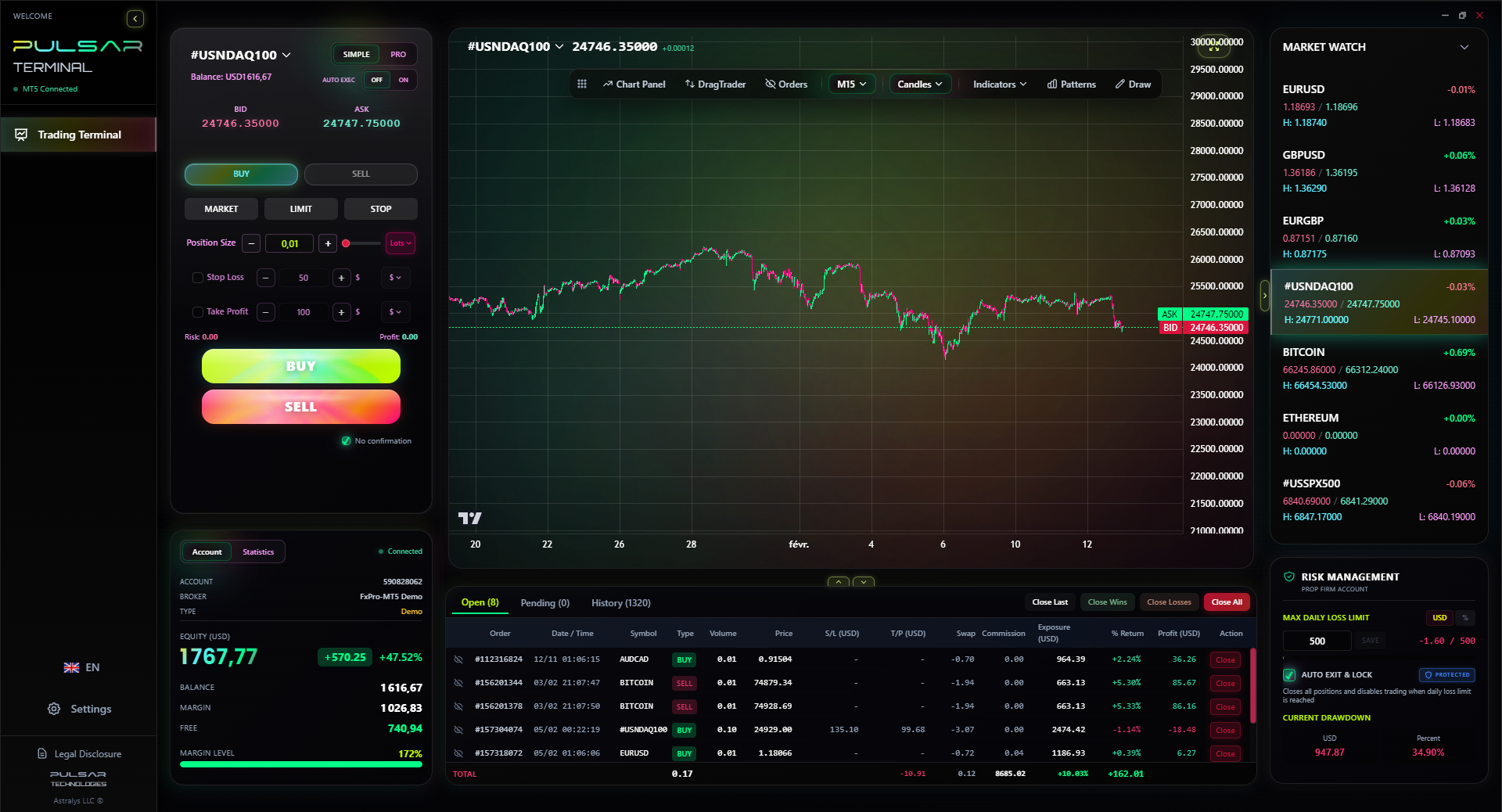
Managing multiple trades under the strict FIFO rule is a headache, but tools like Pulsar Terminal can visualize and organize your positions by entry time directly on your MT5 chart, helping you stay compliant and in control.
Pulsar Terminal
The all-in-one MT5 companion: drag-and-drop orders, multi-TP/SL, trailing stop, grid trading, Volume Profile, and prop firm protection. Used by 1,000+ traders daily.
“Accept the environment and build a strategy for it. I blew two small accounts trying to prove I could beat the system.”
Let me save you some money and heartache. Here are the traps I fell into, so you don't have to.
Chasing Offshore Dream Conditions. I spent my first year resentful of the 50:1 use. I'd watch forums where traders talked about making 5% a day with scalping and tried to force it here. It doesn't translate. The math doesn't work with our spreads and margins. I blew two small accounts trying to prove I could beat the system. Accept the environment and build a strategy for it.
Ignoring FIFO Until It Hurts. Early on, I had two long EUR/USD positions. The first was down 30 pips, the second was up 15 pips. I wanted to bank the 15-pip profit. I hit close on the second trade... and my platform closed the first, losing trade instead, locking in the 30-pip loss. The profit remained open and promptly reversed. I felt physically sick. You must always be aware of which ticket your broker will close.
Underestimating the Impact of Wider Spreads on Short-Term Trades. If your strategy aims for 5-pip profits, a 1.2-pip spread means you're giving up 24% of your profit target right off the bat. You need a much higher win rate or larger targets to overcome that. This single fact kills most imported scalping systems dead. My own early scalping strategy attempts failed spectacularly for this exact reason.
Not Using the NFA BASIC Database. This is free and crucial. Before you deposit a dime, check your broker on the NFA's website. Verify their registration, check for disciplinary history. I almost funded with a firm that had a history of client complaints about withdrawals. A five-minute search saved me a major headache.

Example: Let's say you trade EUR/USD. US Spread: 1.0 pip. Target Profit: 10 pips. Your effective gain if the trade hits target is 9 pips (10 - 1). To be profitable, your strategy must account for that 10% 'tax' on every winning trade before you even start.
💡 Winston's Tip
Wider spreads mean you need wider stops and targets. Trying to scalp 5-pip moves with a 1-pip spread is like trying to win a drag race with the parking brake on. Adjust your expectations and your strategy's parameters.
“Spot trading forex in the US is a marathon with ankle weights. It's harder, but that very difficulty can make you a more disciplined trader.”
Ready to jump in? Do it in this order. No shortcuts.
- Education First, Money Last. Understand the rules cold. Read the CFTC's forex advisories for retail traders. Know what FIFO and the hedging ban mean for your trading plan.
- Broker Selection. Choose a well-established, CFTC/NFA registered broker. Look at FOREX.com, OANDA, or IG US. Compare their spreads on the pairs you want to trade, their platform offerings, and their educational resources. Read our detailed XM review for a perspective on a global broker, but remember they operate differently for US clients.
- Open a Demo Account. Trade it for at least two months. Not two weeks. Two months. Experience a full earnings season, a major central bank announcement, and periods of low volatility. Get used to the platform and practice managing trades under FIFO.
- Develop a Rule-Based Strategy. Based on what you've learned here, build or choose a strategy suited for swing trading or longer-term position trading. Define your entry, exit, and position size calculator rules precisely.
- Start Live Small. Fund the account with the minimum, or just above it. Your goal in the first six months is not to get rich. It's to not blow up. Trade micro lots (0.01). The goal is to make the mistakes with $10 on the line, not $1,000.
- Keep a Journal. Log every trade. The pair, entry/exit, reasoning, profit/loss in pips and dollars, and - critically - your emotional state. This is how you diagnose your real weaknesses. Spot trading forex in the US is a marathon with ankle weights. It's harder than the global version, but that very difficulty can make you a more disciplined, risk-aware trader. Embrace the constraints. They might just save you from yourself.
FAQ
Q1Can I use a non-US forex broker to avoid the use limits?
Technically, you could, but it's a very bad idea. Legitimate offshore brokers that accept US clients are extremely rare due to the regulatory burden. Most that do are unregulated or poorly regulated. More importantly, you would have zero protection from the CFTC/NFA. If that broker goes under or freezes your withdrawals, you have no recourse. The safety is worth the limits.
Q2What happens if I accidentally try to hedge?
Your broker's trading platform won't let you. If you try to open a long position on EUR/USD while you already have a short open, the order will be rejected. The software is hard-coded to comply with the NFA rules. You don't have to worry about 'accidentally' breaking this one.
Q3Are there any prop firms for forex that accept US traders?
Very few, and they operate under the same US rules. This means they must enforce the 50:1 use cap, FIFO, and no hedging on their platforms. The challenges are often structured differently because of this. If you find one, scrutinize their terms and their NFA registration status. Managing a prop account's daily loss limits is a perfect use case for advanced trade management tools.
Q4Is the FIFO rule applied across all account types?
Yes. It's a regulatory rule, not a broker policy. Whether you have a standard, mini, or professional account (if you qualify), the FIFO rule applies to all retail forex trading in the United States.
Q5Why are spreads generally higher with US brokers?
Three main reasons: 1) Higher compliance and operational costs due to strict regulation. 2) The dealer model (where the broker is your counterparty) often has built-in spread costs instead of separate commissions. 3) Lower competition, as fewer firms are willing to meet the high capital requirements to operate in the US market.
Q6Can I trade gold and oil with a US forex broker?
Yes, but not as spot CFDs. US brokers offer futures-based contracts on commodities like gold (XAU/USD) and oil. These are legally structured as futures, not spot, so they may have different contract specifications, expiry dates, and margin requirements. Check out our guide on XAU/USD guide for specifics on trading gold in this environment.
Q7What's the single biggest advantage of trading with a US-regulated broker?
Security of funds. The capital requirements and client fund segregation rules are the toughest in the world. The chance of a registered US broker collapsing and you losing your deposited capital is virtually zero. For long-term, serious traders, this peace of mind is useful.
Prof. Winston's Lesson
Key Takeaways:
- ✓US use caps (50:1 majors) demand larger capital or smaller positions.
- ✓FIFO & no-hedging rules fundamentally break many common strategies.
- ✓Wider US spreads (often 0.8-1.2 pips) kill low-target scalping.
- ✓Fund security is the #1 advantage - client money is segregated.
- ✓Swing trading aligns best with the regulated US environment.
How useful was this article?
Click a star to rate
Weekly Trading Insights
Free weekly analysis & strategies. No spam.
About the Author
James Mitchell
Senior Trading Analyst
Based in New York with over 9 years of trading experience. Focuses on major USD pairs, prop firm challenges, and the US regulatory landscape.
Comments
Risk Disclaimer
Trading financial instruments carries significant risk and may not be suitable for all investors. Past performance does not guarantee future results. This content is for educational purposes only and should not be considered investment advice. Always conduct your own research before trading.
You Might Also Like

Cara Trading Forex Sukses: 7 Prinsip dari Trader Profesional
Cara trading forex sukses dengan 7 prinsip trader pro: manajemen modal, disiplin, journal trading, backtest. Data nyata, bukan janji profit palsu.
Jam Trading Forex Terbaik untuk Trader Indonesia: Panduan Lengkap dengan Tabel Waktu
Panduan jam trading forex untuk trader Indonesia. Tabel 4 sesi dunia, jam emas 20:00-00:00, sesi mana yang harus dihindari. Data akurat + tips dari trader berpengalaman.
Top 5 Sàn Forex Uy Tín Nhất 2026: Review Jujur dari Trader Indonesia
Top 5 sàn forex uy tín 2026 untuk trader Indonesia. Review jujur: spread, deposit, withdraw, dukungan lokal. Exness, XM, IC Markets & lebih.
Get Pulsar Terminal
All these calculators are built into Pulsar Terminal with real-time data from your MT5 account. One-click position sizing, automatic risk management, and instant calculations.
Get Pulsar Terminal