


Here's a brutal truth most banks won't tell you: when you send R100,000 overseas through Standard Bank, you could lose over R2,500 before the money even leaves the country.

David van der Merwe
Emerging Markets Trader ·  South Africa
☕ 10 min read
What you'll learn:
- 1What a 'Forex Calculator' Really Means (It's Not What You Think)
- 2Breaking Down Standard Bank's 2026 Forex Costs (With Real Numbers)
- 3The Regulatory Trap: SARB, SARS, and Why Your Transfer Gets Blocked
- 4Shyft App vs. A Real Forex Broker: It's Not Even Close
- 5How to Build Your Personal Forex Cost Calculator
- 6Better Alternatives & Smarter Funding Strategies
- 7Final Word: This Is Cost Management, Not Just Calculation
Here's a brutal truth most banks won't tell you: when you send R100,000 overseas through Standard Bank, you could lose over R2,500 before the money even leaves the country. That's not just the exchange rate. That's a cocktail of commissions, SWIFT fees, and beneficiary charges that most people only discover after the transaction is done. I've seen traders blow their entire month's profit on transfer costs because they didn't run the numbers first. This guide isn't about the bank's official calculator. It's about building your own mental one, so you never get surprised by the real cost of moving money in and out of South Africa.
When you hear 'Standard Bank forex calculator,' you might picture a simple tool on their website. That's the marketing version. The reality is more complex. A true forex calculator for a South African isn't one tool, but a process of adding up at least four different cost layers that eat into your capital.
First, you've got the bank's spread - the difference between the buy and sell rate they offer you. This isn't the interbank rate you see on TradingView. It's a marked-up commercial rate. Second, there's the commission, which Standard Bank charges as a percentage of the transaction. For 2026, that's 0.502% minimum for online transfers. Third, you have fixed fees: SWIFT charges (often around $15-$25) and a potential 'correspondent bank fee' that can be another $20. Finally, if you're not tax compliant with SARS, your transfer gets blocked, adding time and frustration costs.

Warning: The exchange rate shown on a bank's homepage is a 'guide rate,' not the rate you'll get. Your final rate is calculated at the moment of execution and includes their margin. Always ask for the 'all-in cost' - the total ZAR it will take to deliver a specific foreign amount to the recipient.
I learned this the hard way in 2021. I needed to fund an international broker account with $5,000. I used my bank's 'quick transfer' option without checking. The rate was 3.5% worse than the mid-market rate, and the fees totalled R1,850. I started my trading week R1,850 in the hole. That loss stung more than any bad trade.
“When you send R100,000 overseas, you could lose over R2,500 before the money even leaves the country.”
Let's get specific. Standard Bank's 2026 pricing guide is effective, and the numbers are precise. You need to know them cold.
Outward International Transfers (Sending Money Offshore)
This is where it gets expensive. Say you're sending GBP 10,000 to a UK broker for a prop firm challenge. Here’s the breakdown using 2026 electronic channel pricing:
- Commission: 0.502% of the ZAR equivalent. At R23/£1, that's roughly R115,460. 0.502% of that is about R580.
- Minimum/Maximum: The commission has a floor of R210 and a cap of R760. Our R580 calculation falls within that, so R580 stands.
- SWIFT Fee: This is separate, often around $15-$25 (R250-R415).
- Beneficiary Bank Fee: Unknown. Could be £15 (R345).
- Total Estimated Fees (before exchange rate margin): R580 + R250 + R345 = R1,175.
And we haven't even accounted for the bank's exchange rate margin, which could easily add another 1-1.5% (R1,150-R1,730). Your true cost to send that £10,000 could be R2,300 to R2,900. That's a significant chunk of your capital gone before you place a single trade. Compare this to the flat $7 fee some international brokers charge for wire deposits, and you see the disparity.
Inward Transfers & The Shyft App
Receiving money, like profits from a broker, also costs you. Standard Bank's commission is 0.448% (min R180, max R600). If you're using their Shyft app for an inward transfer, they charge a flat fee: $15, £10, or €12. For smaller, frequent withdrawals from a trading account, these percentages and fixed fees compound brutally.

Example: You withdraw $1,000 profit from your broker. With Shyft, you pay a $15 fee. That's 1.5% gone instantly. Do that four times a month, and you've paid $60 (nearly R1,000) just to access your own money. This is why your position size calculator must account for withdrawal costs as a business expense.

💡 Winston's Tip
Your first profit target on any trade should be to cover your transfer and withdrawal fees. If it doesn't, your trade size is too small or your strategy is too conservative for the costs involved.
“Shyft is for moving money. A broker is for making it. Don't confuse the two.”
This is the single biggest headache for South African traders moving money. You can have all the cash in the world, but if you don't have the right tax clearance, your money isn't going anywhere. The rules are non-negotiable.
Your annual allowances are your lifeline:
- Single Discretionary Allowance (SDA): R2 million per year (new from April 2026). This covers travel, gifts, and importantly, foreign investments. You don't need tax clearance for this, but the bank will still ask the purpose.
- Foreign Investment Allowance (FIA): An additional R10 million per year. This requires a Tax Compliance Status PIN for international transfer (TCS-AIT) from SARS.
Here's where traders get caught. You think you're using your SDA to fund a trading account. The bank asks, 'What is the purpose?' You say 'investment.' Red flag. 'Investment' purposes often trigger a request for your TCS-AIT PIN, even if you're under the R2 million threshold. If you don't have it, the transfer is declined.
I've had transfers stuck for two weeks because of this. The solution? Be strategic with your wording and always get your TCS-AIT PIN in advance, even if you don't plan to use the FIA immediately. It's like having a passport for your money. Also, remember the 30-day rule: bring back unused foreign cash and convert it to ZAR within a month, or you're breaking exchange control laws.

Pro Tip: When applying for your TCS-AIT PIN on eFiling, select 'Foreign Investment' as the reason. Have your latest tax return submitted and all taxes paid. The PIN is valid for 12 months. Keep it safe; you'll need it for every FIA transfer. This is more important than knowing the MACD indicator when trading from SA.
“Shyft is for moving money. A broker is for making it. Don't confuse the two.”
Standard Bank's Shyft app is fantastic for what it is: a digital wallet to hold, send, and spend a few major currencies. It's not a trading platform. Comparing it to a broker like IC Markets or Pepperstone is like comparing a bicycle to a Formula 1 car.
Let's look at the key differences for a trader:
| Feature | Standard Bank (Shyft / Bank Transfer) | Regulated Forex Broker (e.g., IC Markets) |
|---|---|---|
| Primary Use | Currency conversion & international payments | Speculative trading on price movements |
| Cost to Convert | ~2.5%+ (Spread + Commission + Fees) | Spreads from 0.0 pips on majors (e.g., EUR/USD) |
| use | None (1:1) | Up to 500:1 (FSCA regulated) |
| Platform | Shyft app | MT4, MT5, cTrader |
| Minimum Deposit | Effectively none | As low as R1,000 or $5 |
| Can You Short Sell? | No | Yes |
| Asset Variety | 4-5 major currencies | 60+ currency pairs, indices, commodities, crypto |
The killer is the cost. Loading your Shyft ZAR wallet by card costs 2.5%. That's R2,500 on R100,000, just to get started. On a R100,000 trading account with a broker, the spread on a EUR/USD trade might be 0.1 pips, which is about $1 (R18.50). The difference is astronomical.
Shyft is for moving money. A broker is for making it (or losing it) through trading. Don't confuse the two. Use Shyft to receive profits from your broker in USD, then convert to ZAR when the rate is good. Never use it as your primary trading vehicle.
💡 Winston's Tip
Treat your TCS-AIT PIN from SARS with the same security as your trading account password. It's the key to your R10 million Foreign Investment Allowance. Renew it annually, even if you don't plan to use it.
“If your transfer costs are regularly above 3%, you're being slaughtered on fees.”
Forget waiting for the bank. Build your own calculator in a spreadsheet. It takes 10 minutes and will save you thousands. Here are the columns you need:
- Amount to Send (ZAR): The Rand you're starting with.
- Bank's Offered Rate: Get this by starting a dummy transfer online or calling them.
- Mid-Market Rate: Use a site like XE.com for the real benchmark.
- Rate Margin (%) = (1 - (Bank Rate / Mid-Market Rate)) * 100. This is their hidden profit.
- Commission (ZAR): 0.502% of your amount, but remember the R210 min, R760 max.
- Fixed Fees (ZAR): SWIFT fee (estimate R250) + potential beneficiary fee (estimate R350).
- Total Cost (ZAR): Sum of the value lost from the rate margin + commission + fixed fees.
- Total Cost (%): (Total Cost / Amount to Send) * 100.
Run this for every transfer. You'll quickly see that for amounts under R50,000, the minimum fees make the percentage cost horrific. It often makes sense to batch smaller transfers into one larger one to reduce the percentage impact.
This calculator also shows you the true 'exchange rate' you received. If the mid-market rate is R18.50/$ and your all-in cost shows you effectively paid R19.00/$, you know you took a 2.7% hit. This clarity is power. It's the same discipline you use in swing trading - knowing your exact entry cost, including spread.
Warning: If your 'Total Cost %' is regularly above 3%, you're being slaughtered on fees. It's time to shop around for other authorised dealers or explore specialist forex companies that often offer better rates for larger amounts, though they still require SARS compliance.
“If your transfer costs are regularly above 3%, you're being slaughtered on fees.”
Standard Bank isn't your only option. As a trader, you need to think like a business minimizing operational costs.
1. Use a Local Broker with ZAR Accounts: This is the #1 hack. Brokers like XM or Exness offer local ZAR trading accounts. You deposit and withdraw in Rands via instant EFT. You trade global markets (USD-based instruments) on their platform. The currency conversion happens internally at much better rates, and you avoid international transfer fees entirely. Your only cost is the broker's spread.
2. Batch Your Transfers: Never send $1,000 ten times. Send $10,000 once. The fixed fees (SWIFT, commission minimums) murder small transfers.
3. Fund Once, Trade Long-Term: Treat your offshore trading account as a dedicated business pool. Fund it with a meaningful chunk of capital you can afford to risk, and aim to grow it internally. Frequent small withdrawals will kill you with fees. Reinvest profits in the account.
4. Understand the New Landscape: The EU delisting South Africa (Oct 2025) and the FATF greylist exit mean correspondent banks are less nervous. Transfers should be faster and slightly cheaper. The record high forex reserves ($81 billion in Feb 2026) also support the Rand. Use periods of ZAR strength (like R16.40/$ in Jan 2026) to fund offshore accounts - you get more foreign currency for your Rand.
5. Never, Ever Use Illegal Channels: The 'backdoor' forex guys offering great rates are a one-way ticket to having your money seized and facing prosecution. It's not worth it. The SARB doesn't play.
💡 Winston's Tip
The moment you think 'I'll just use a backdoor forex guy to save 1%,' you've stopped being a trader and started being a criminal. The legal risk always outweighs the financial 'saving.' Don't be stupid.
“Frequent small withdrawals will kill you with fees. Reinvest profits in the account.”
Viewing forex transfers as just a fee is a mistake. It's a direct drag on your performance as a trader. If you're a scalping strategy trader making 5% a month, a 3% transfer cost wipes out over half your profit. It's unsustainable.
The 'Standard Bank forex calculator' you need is the one in your head that immediately flags a 0.502% commission plus a R250 SWIFT fee as a major cost center. It's the knowledge that you need a SARS TCS-AIT PIN before you even think about moving serious money. It's the strategy of using a local ZAR broker account to bypass the system entirely.
I'll leave you with this: In 2023, I tracked all my financial transfer costs for the year. They totalled R22,700. That was money that didn't compound in my trading account, didn't pay for education, and didn't go into my pocket. It just vanished into the system. Since building my own calculator and switching strategies, I've cut that by over 70%. That's an extra R15,890 per year working for me, not for the bank. Your turn.
Managing these costs and your trades requires precision. Manually moving stops and calculating partial closures on MT5 while watching for a margin call is how mistakes happen.
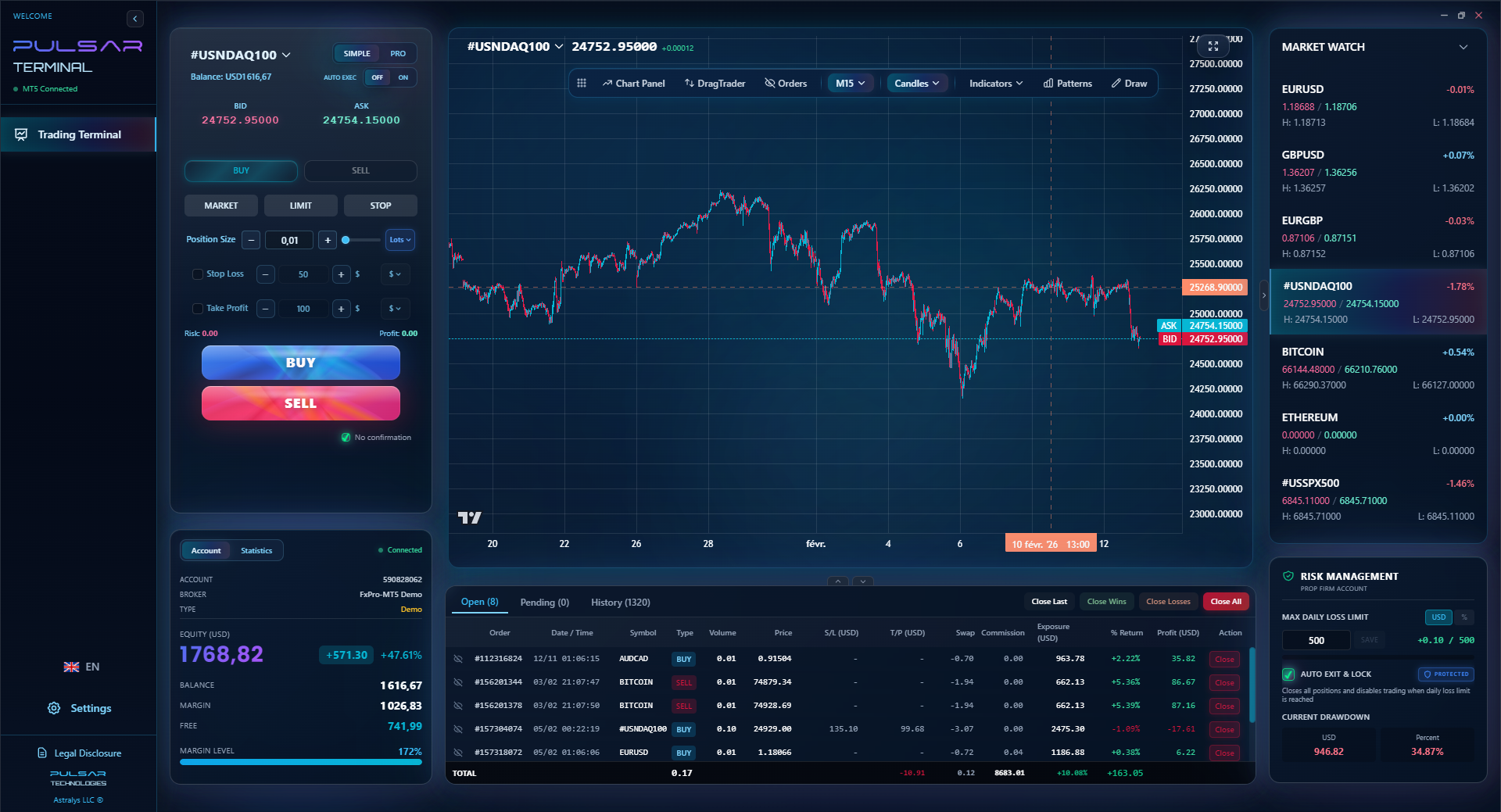
Managing these costs and your trades requires precision. Manually moving stops and calculating partial closures on MT5 while watching for a margin call is how mistakes happen. A tool like Pulsar Terminal automates this, letting you set multi-level take-profits and trailing stops with one click, so you can focus on strategy, not admin.
Pulsar Terminal
The all-in-one MT5 companion: drag-and-drop orders, multi-TP/SL, trailing stop, grid trading, Volume Profile, and prop firm protection. Used by 1,000+ traders daily.
FAQ
Q1What is the cheapest way to send money overseas from South Africa with Standard Bank?
For 2026, the cheapest way is via their electronic channels (app or online) for amounts where the 0.502% commission is above the R210 minimum. Always choose the 'SHA' (shared) option for SWIFT fees to avoid unknown beneficiary charges. But cheaper than Standard Bank is often using a specialist forex company for amounts over R100,000, or better yet, funding a local ZAR account with a forex broker to avoid international transfers completely.
Q2How much can I send overseas without tax clearance from SARS?
You can use your Single Discretionary Allowance (SDA) of R2 million per calendar year (from April 2026) without a TCS-AIT PIN from SARS. However, the bank may still question the purpose. If you label it as 'investment,' they may request clearance anyway. For anything beyond R2 million, you must use your Foreign Investment Allowance (FIA) of R10 million, which 100% requires a valid TCS-AIT PIN.
Q3Is Standard Bank's Shyft app good for forex trading?
No, absolutely not. Shyft is a digital wallet for currency conversion and spending, not a trading platform. It offers no use, you cannot short-sell, and the costs (like the 2.5% card top-up fee) are prohibitively high for trading. Use Shyft to hold or send currency, but use a regulated broker like IC Markets or Pepperstone for actual trading.
Q4What is the difference between the exchange rate I see online and the rate Standard Bank gives me?
The rate you see online (e.g., Google) is the mid-market rate, a benchmark. The rate Standard Bank gives you is a commercial rate that includes their profit margin (the spread). This margin can be 1-2% or more. The bank's 'all-in cost' (final rate after all fees) is always worse than the mid-market rate. That difference is your total cost.
Q5Can I use my Standard Bank forex calculator to compare against other banks?
Yes, and you should. The methodology is the same. Get the final 'all-in cost' (total ZAR needed to deliver a specific foreign amount) from Standard Bank, Absa, FNB, and a forex specialist. The one that delivers the foreign currency for the least amount of Rands is the cheapest. Remember to factor in speed and convenience.
Q6Why was my international transfer from Standard Bank declined?
The most common reasons for a South African are: 1) You exceeded your annual allowance and don't have tax clearance (TCS-AIT PIN). 2) You described the purpose as 'investment' or 'emigration' without the required supporting documents. 3) Your SARS tax affairs are not in order (outstanding returns or debt). 4) The recipient's name/details don't perfectly match your bank's records. Always call forex services at the bank before sending large amounts.
Prof. Winston's Lesson
Key Takeaways:
- ✓The real cost is the 'all-in cost,' not the advertised rate.
- ✓Get your SARS TCS-AIT PIN before you need it. It's non-negotiable.
- ✓Batch transfers to minimize fixed fee impact.
- ✓For trading, a local ZAR broker account bypasses international fees.
- ✓Track your annual transfer costs like a business expense.
How useful was this article?
Click a star to rate
Weekly Trading Insights
Free weekly analysis & strategies. No spam.
About the Author
David van der Merwe
Emerging Markets Trader
Johannesburg-based trader with 11 years in emerging market currencies. Specializes in ZAR pairs, FSCA-regulated trading, and South African market analysis.
Comments
Risk Disclaimer
Trading financial instruments carries significant risk and may not be suitable for all investors. Past performance does not guarantee future results. This content is for educational purposes only and should not be considered investment advice. Always conduct your own research before trading.
You Might Also Like

Cara Trading Forex Sukses: 7 Prinsip dari Trader Profesional
Cara trading forex sukses dengan 7 prinsip trader pro: manajemen modal, disiplin, journal trading, backtest. Data nyata, bukan janji profit palsu.
Jam Trading Forex Terbaik untuk Trader Indonesia: Panduan Lengkap dengan Tabel Waktu
Panduan jam trading forex untuk trader Indonesia. Tabel 4 sesi dunia, jam emas 20:00-00:00, sesi mana yang harus dihindari. Data akurat + tips dari trader berpengalaman.
Top 5 Sàn Forex Uy Tín Nhất 2026: Review Jujur dari Trader Indonesia
Top 5 sàn forex uy tín 2026 untuk trader Indonesia. Review jujur: spread, deposit, withdraw, dukungan lokal. Exness, XM, IC Markets & lebih.
Get Pulsar Terminal
All these calculators are built into Pulsar Terminal with real-time data from your MT5 account. One-click position sizing, automatic risk management, and instant calculations.
Get Pulsar Terminal