


Here's a hard truth most trading blogs won't tell you: the biggest hurdle to profitable trading in South Africa isn't your strategy.

David van der Merwe
Emerging Markets Trader ·  South Africa
☕ 10 min read
What you'll learn:
- 1The Regulatory Maze: SARB Rules You Can't Ignore
- 2Breaking Down the Real Costs: It's More Than Just the Fee
- 3The Shyft Global Wallet: Standard Bank's Own Alternative?
- 4Smarter Ways for Traders: Beyond the Traditional Bank Transfer
- 5The Other Side: Receiving Profits Back to SA
- 6Common Pitfalls & Costly Mistakes
- 7A Step-by-Step Process for a Standard Bank TT
- 8Final Verdict for Traders
Here's a hard truth most trading blogs won't tell you: the biggest hurdle to profitable trading in South Africa isn't your strategy. It's getting your money to and from your broker without the banks and SARS taking a massive bite. I've seen traders lose 5-7% of their capital before a single trade is placed, just on forex payment fees and poor exchange rates. This guide breaks down Standard Bank's forex payment system - the rules, the real costs, and the workarounds every savvy South African trader needs to know.
Trying to move money internationally without understanding SARB's rules is like trading without a stop-loss. It's only a matter of time before you get burned. Standard Bank, as an Authorised Dealer, is just the middleman enforcing these regulations. The two big allowances you need to live by are the Single Discretionary Allowance (SDA) and the Foreign Investment Allowance (FIA).
The SDA lets you move up to R1 million per calendar year out of the country for things like travel, gifts, or - crucially for us - offshore investments. You just need your tax reference number. Need to send more? That's where the FIA comes in. It allows up to R10 million per year, but you must get a Tax Clearance Certificate (TCC) from SARS first. Anything over R10 million requires a direct application to SARB, which is a whole other headache.
Every single payment, incoming or outgoing, must have a Balance of Payment (BoP) code. For funding a trading account, you're typically looking at codes for 'portfolio investment' or 'other investment'. Get this wrong, and your payment gets stuck, or worse, sent back with fees deducted. I learned this the hard way early on. I once coded a deposit to my IC Markets review account incorrectly as a 'current transfer'. The payment was held for two weeks while Standard Bank requested clarification, during which I missed a perfect setup on the EUR/USD guide.

Warning: It is illegal to use informal or unlicensed channels to buy forex. That 'guy' offering better rates can get you into serious trouble with SARS. Always stick to authorised dealers like banks or licensed forex companies.
The rules feel restrictive, and they are. But they're the playing field we have. Your first job as a trader is to know this field better than anyone else.
Standard Bank's fee schedule looks complicated because it is. But when you add it all up, the total cost can be shocking. Let's translate their pricing into what it actually means for your trading capital.
The Official Fee Structure
For sending money overseas (an Outward Telegraphic Transfer), here’s the damage if you use online banking:
- Commission: 0.5% of the amount (min R151, max R690)
- Telecom Fee: Around R108
- SWIFT Fee: Variable, but often another R100-R200
- Exchange Rate Margin: This is the silent killer. Standard Bank adds a margin of 2% to 4.5% on top of the interbank rate.
Let's run a real example from my own books. In 2022, I needed to send $10,000 to fund a new account. The interbank rate was about R17.20/$. Standard Bank's offered rate was R17.85/$.

Example:
- At Interbank Rate: $10,000 * R17.20 = R172,000 needed
- At Standard Bank Rate: $10,000 * R17.85 = R178,500 needed
- Hidden Cost (Margin): R178,500 - R172,000 = R6,500 lost
- Plus Fees: + ~R450 in commissions and telecom fees. Total Cost: Nearly R7,000, or about 4% of my capital, gone before I even logged into MT5.
Receiving money isn't much better. Inward payments get hit with a 0.43% commission (min R153), a R122 telecom fee, and sometimes a 'pension fee' of R40. If your overseas broker sends you $1,000 in profits, don't expect to see all of it.
The Foreign Currency Account Trap
You might think, "I'll open a Standard Bank US Dollar FCA to avoid conversion." Think again. The minimum opening deposit for an Optimum account is around $7,000 (roughly R132k). Transferring between your own Rand and Dollar accounts still costs a telecommunication fee of R141.90. It's a tool for holding currency, not for frequent, cost-effective trading transfers.

💡 Winston's Tip
Your first trade is the currency conversion. A 3% loss on that transfer means your entire portfolio starts at a 3% deficit. Negotiate or find a better dealer.
“The biggest hurdle to profitable trading in South Africa isn't your strategy. It's getting your money to and from your broker.”
Interestingly, Standard Bank itself offers a potential workaround: the Shyft Global Wallet app. It's a digital wallet where you can buy, hold, and send multiple currencies. The advertised exchange rates are often more competitive than the bank's standard telegraphic transfer rates, and the fees are structured differently (often a flat fee plus a smaller margin).
I've tested it for smaller transfers. The process is smoother and faster than a traditional TT. However, there are limits on how much you can send per transaction and per month, which might not suit larger trading deposits or withdrawals. Also, not all international brokers may accept payments from a digital wallet like Shyft - you need to check their accepted payment methods first. It's worth exploring for amounts under the SDA limit, but do your homework. It's not a magic bullet, but for sub-R100k transfers, it can sometimes beat their own main banking channel on total cost.
After losing thousands to bank fees over the years, I had to find better ways. Most serious South African traders I know use one of two primary methods.
1. Licensed Forex Brokers (Not Trading Brokers): These are companies specifically licensed for foreign exchange payments. They often offer significantly better ZAR/USD exchange rates - closer to the real interbank rate - and lower fixed fees. You make a Rand EFT to their local South African account, and they send the foreign currency to your overseas trading broker. The key is ensuring they are licensed and that you provide the correct BoP code for 'overseas investment'. The savings can be 2-3% compared to a big bank.
2. International E-Wallets: Services like Skrill, Neteller, or PayPal can act as a middleman. You fund the e-wallet from your SA bank account (incurring a cost), and then fund your trading broker from the e-wallet. Some brokers, like XM review and Exness review, offer these as deposit options. The advantage can be speed. The disadvantage is another layer of fees, and the exchange rate might not be optimal. I use this method only when I need to top up an account urgently for a specific trade.

Pro Tip: Always calculate the total landed cost. Don't just look at the commission fee. Ask the provider: "If I give you R100,000 today, how many US dollars will arrive in my broker account?" That final number is the only one that matters. Then compare that across banks, forex dealers, and e-wallets.
Whichever method you choose, your position size calculator should use your net capital after all transfer costs. If R100,000 only becomes $5,300 after fees, that's your starting balance, not the R100,000.
“A 2-4.5% margin on the exchange rate is a huge, recurring drag on your performance.”
Getting profits home is a great problem to have, but it comes with its own rules and costs. When your broker sends money back, it hits Standard Bank as an Inward Telegraphic Transfer. The bank will immediately deduct their fees (that 0.43%-0.55% commission, telecom fee, etc.).
The 30-Day Rule: This is critical. The bank will notify you of an incoming payment. You must provide them with the correct BoP code to explain the funds (e.g., 'repayment of original investment' or 'income from investments') within 30 days. If you don't, they will return the money to the sender, with all their fees deducted. I've heard horror stories of traders forgetting this and losing both the profit and the original deposit.
You also need to consider the tax implications. Profits from offshore trading are generally subject to South African income tax. Keep careful records of all your deposits, withdrawals, and trading statements. When you bring profits back, that's a clear taxable event. Consult with a tax professional who understands trading.
Managing multiple withdrawals and ensuring you don't breach your allowances requires organization. This is where a trading journal is non-negotiable, not just for trades, but for cash flow.
💡 Winston's Tip
Always get your Tax Clearance Certificate during a quiet market period. You don't want to be stuck when opportunity knocks.
Let me save you some money and frustration by sharing where I and others have tripped up.
- Ignoring the Total Cost: Focusing only on the 0.5% commission and missing the 3% exchange rate margin is the most common, expensive error.
- Incorrect BoP Codes: Using the wrong code causes delays. For trading, it's usually not 'travel' or 'family maintenance'. Confirm the exact code with Standard Bank before initiating the transfer.
- Letting Forex Cash Sit: If you bring physical forex cash back from a trip, you must convert it to Rand within 30 days. This is an exchange control rule.
- Not Planning for the FIA: If you're a serious trader, apply for your Tax Clearance Certificate (TCC) from SARS before you need it. The process can take time, and you don't want to miss a market opportunity because your paperwork isn't ready. Having your FIA in place gives you the flexibility to move larger amounts up to R10 million.
- Underestimating Withdrawal Time: A TT can take 2-5 business days. Don't plan to withdraw profits on a Friday to cover a bill on Monday. This lack of liquidity planning can lead to poor trading decisions.
One of the worst feelings in trading is making a great profit on a scalping strategy only to see it evaporate through inefficient banking processes. Control what you can control.
“Managing your money *to* the market is the first, and one of the most important, trades you'll ever make.”
If you decide to use Standard Bank's traditional TT service, here's how to do it right:
- Log In & Navigate: Go to 'Payments' -> 'International Payments' -> 'New Transfer' on the app or online banking.
- Enter Beneficiary Details: This is your broker's banking details. Get these 100% correct from your broker's website (Bank name, SWIFT/BIC, Account Number, Beneficiary Name). A single digit wrong can send your money into the void.
- Enter Amount & Currency: Input how much foreign currency you want to send.
- Select 'Who Pays Fees': Usually choose 'BEN' (Beneficiary) or 'SHA' (Shared). 'OUR' (all fees paid by you) is more expensive. Your broker will specify their preference.
- Crucial Step - Purpose of Payment: Select the correct BoP code from the dropdown. For trading account funding, it's often under 'Investment'. If unsure, call Standard Bank's forex desk.
- Review the Rate & Total Cost: The screen will show you the exchange rate they're applying and the total Rand amount. This is your last chance to see the hidden margin. Calculate the effective cost.
- Approve & Authenticate: Confirm with your OTP or secure device.
After this, get the SWIFT MT103 confirmation from the bank. Send this to your broker's support team to help them identify your deposit quickly. The whole process, done right, minimizes delays and ensures your capital gets to work faster.
Standard Bank's forex payment system is a secure, regulated channel that gets the job done. For compliance and safety, it's bulletproof. But for cost-effectiveness and efficiency as a trader, it's often one of the worst options on the table.
Use Standard Bank if: You are making a one-off, very large transfer (where you've negotiated a better rate), or you value the absolute security of the big bank brand over saving a few percentage points.
Look elsewhere if: You are making regular deposits and withdrawals, and you want to preserve your trading capital. The 2-4.5% margin on the exchange rate is a huge, recurring drag on your performance. A licensed forex dealer will almost always be cheaper.
Your edge in trading is slim. Don't give 3% of it away to the bank before you even start. Treat funding your account like a trade: plan it, know the exact costs (the spread), and always look for the most efficient execution. Managing your money to the market is the first, and one of the most important, trades you'll ever make.
For ongoing capital management, especially with strategies that use tools like trailing stops or multi-level take-profits, having precise control is key. Manually moving stops on dozens of trades is a hassle.
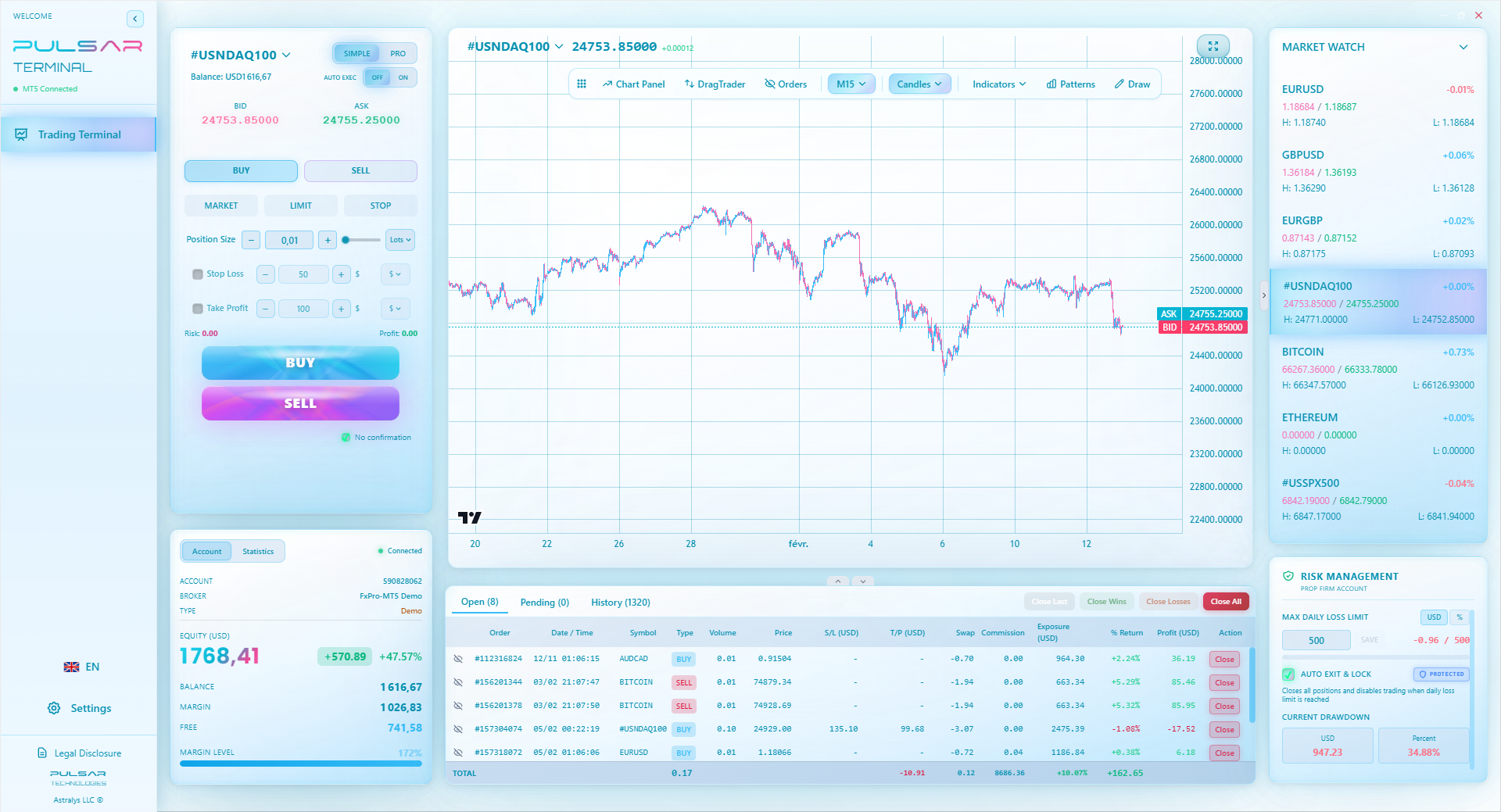
When you're managing complex trades and withdrawals, automating your trade management with tools like Pulsar Terminal frees you up to focus on the bigger picture of your capital flow.
Pulsar Terminal
The all-in-one MT5 companion: drag-and-drop orders, multi-TP/SL, trailing stop, grid trading, Volume Profile, and prop firm protection. Used by 1,000+ traders daily.
FAQ
Q1What is the cheapest way to send money to my forex broker from South Africa?
Typically, using a licensed foreign exchange dealer (not your retail bank) is cheapest. They offer exchange rates much closer to the interbank rate than Standard Bank's 2-4.5% margin. Always ask for the 'total landed cost' in US dollars for your Rand amount to compare fairly.
Q2Do I need a Tax Clearance Certificate to fund my trading account?
Not for the first R1 million per calendar year (Single Discretionary Allowance). You only need a Tax Clearance Certificate (TCC) from SARS if you want to use the Foreign Investment Allowance to send between R1 million and R10 million in a year.
Q3How long does a Standard Bank international transfer take?
A telegraphic transfer (TT) usually takes 2 to 5 business days to reach the beneficiary's account. Delays happen if beneficiary details are wrong or if the purpose of payment (BoP code) needs clarification.
Q4Can I use my Standard Bank credit card to fund a trading account?
Some international brokers accept credit card deposits. However, Standard Bank and other SA banks may block these transactions as they classify them as 'international cash advances,' which come with high fees and immediate interest. It's not a recommended or reliable method.
Q5What happens if my incoming forex payment is rejected?
If you don't provide the correct BoP code to Standard Bank within 30 days of them receiving the funds, they will return the money to the sender. All their handling fees (commission, telecom fee) will be deducted from the amount before it's sent back.
Q6Is the Shyft app better for forex payments than Standard Bank online?
For smaller amounts (under the SDA limit), Shyft can be faster and sometimes offer a better total cost due to more competitive exchange rates. However, it has transaction limits, and you must ensure your broker accepts payments from a digital wallet.
Q7Are profits from offshore forex trading taxable in South Africa?
Yes. Profits from trading are generally considered income and are taxable in South Africa, regardless of where the broker is based. You must declare this income to SARS. Keep detailed records of all transactions.
Prof. Winston's Lesson
Key Takeaways:
- ✓Bank forex margins cost 2-4.5% instantly.
- ✓Use SDA for first R1m, FIA with TCC for R1m-R10m.
- ✓Always provide the correct BoP code within 30 days.
- ✓Calculate total landed cost in USD, not just Rand fees.
- ✓Licensed forex dealers often beat bank rates.
How useful was this article?
Click a star to rate
Weekly Trading Insights
Free weekly analysis & strategies. No spam.
About the Author
David van der Merwe
Emerging Markets Trader
Johannesburg-based trader with 11 years in emerging market currencies. Specializes in ZAR pairs, FSCA-regulated trading, and South African market analysis.
Comments
Risk Disclaimer
Trading financial instruments carries significant risk and may not be suitable for all investors. Past performance does not guarantee future results. This content is for educational purposes only and should not be considered investment advice. Always conduct your own research before trading.
You Might Also Like

Cara Trading Forex Sukses: 7 Prinsip dari Trader Profesional
Cara trading forex sukses dengan 7 prinsip trader pro: manajemen modal, disiplin, journal trading, backtest. Data nyata, bukan janji profit palsu.
Jam Trading Forex Terbaik untuk Trader Indonesia: Panduan Lengkap dengan Tabel Waktu
Panduan jam trading forex untuk trader Indonesia. Tabel 4 sesi dunia, jam emas 20:00-00:00, sesi mana yang harus dihindari. Data akurat + tips dari trader berpengalaman.
Top 5 Sàn Forex Uy Tín Nhất 2026: Review Jujur dari Trader Indonesia
Top 5 sàn forex uy tín 2026 untuk trader Indonesia. Review jujur: spread, deposit, withdraw, dukungan lokal. Exness, XM, IC Markets & lebih.
Get Pulsar Terminal
All these calculators are built into Pulsar Terminal with real-time data from your MT5 account. One-click position sizing, automatic risk management, and instant calculations.
Get Pulsar Terminal