


Here's a number that should make you pause: the average spread on EUR/ZAR at a major South African retail bank is often 8 to 12 times wider than what you get from a dedicated forex broker.

David van der Merwe
Emerging Markets Trader ·  South Africa
☕ 9 min read
What you'll learn:
- 1What Are You Actually Looking At?
- 2The Spread Gap: Where Your Profit Disappears
- 3Fees, Commissions, and the 'No Commission' Illusion
- 4Trading Platforms & Execution: Stone Age vs. Space Age
- 5The South African Trader's Practical Path Forward
- 6When It Actually Makes Sense to Use Bank Rates
- 7The Big Mistakes to Avoid Right Now
Here's a number that should make you pause: the average spread on EUR/ZAR at a major South African retail bank is often 8 to 12 times wider than what you get from a dedicated forex broker. That's not a minor fee, it's a structural disadvantage built into the system. If you're checking Standard Bank forex rates for trading, you're already on the wrong path. I'm not here to bash the bank, they provide a vital service for everyday transactions and travel money. But for active trading? It's like trying to win a Formula 1 race in a family sedan. This guide will break down exactly why their model is incompatible with profitable trading, show you the real numbers you're up against, and map out the alternatives that actually make sense for South Africans.
When you look up Standard Bank forex rates, you're seeing a retail buy/sell price, not a trading price. There's a world of difference. The bank sets these rates to cover the cost and risk of holding physical currency, processing international transfers, and making a profit on the service. It's a completely different business model from the interbank market where currencies are traded electronically in massive volumes.
For you, the trader, this means two things are baked into that quoted rate: a huge spread and often a hidden commission or fee. The spread is the difference between the price you buy at and the price you sell at. At a bank, this spread is your primary cost. It's not transparent, it's just built into the worse rate you get. I once helped a client analyze a R100,000 EUR/ZAR conversion they did through their bank. The effective spread, when we worked it backwards, was over 1.5%. On a dedicated trading platform, the spread for the same trade would have been under 0.1%. They paid R1,500 for something that should have cost under R100.

Warning: Never confuse a bank's retail conversion rate with a broker's trading quote. One is designed for occasional use by the public, the other is a wholesale price for frequent transactions. Using the first for the second is a guaranteed way to bleed money.
Let's get specific. This is the core reason you can't trade using Standard Bank forex rates. The spread is your first and biggest hurdle to profitability. In trading, you need the price to move in your favor just to cover the cost of entering the trade. A wider spread means you need a larger price move just to break even.
A Real-World Example: USD/ZAR
Let's compare a typical scenario. All numbers are illustrative but based on real observations.
| Platform | Typical Buy Price (USD/ZAR) | Typical Sell Price (USD/ZAR) | Spread (ZAR) | Spread (Pips) |
|---|---|---|---|---|
| Standard Bank Retail | R18.85 | R18.65 | 0.20 | ~200 pips |
| Dedicated Forex Broker | R18.7500 | R18.7490 | 0.0010 | 10 pips |
Look at that difference. 200 pips vs. 10 pips. To break even on a buy trade with the bank, USD/ZAR needs to rally 200 pips before you see a cent of profit. With the broker, it only needs to move 10 pips. The bank's spread is 20 times larger. In the volatile ZAR market, a 200-pip move is a significant daily swing. You're giving that all away before you start.
Why This Matters for Strategy
This spread gap invalidates most short-term strategies. Scalping strategies that aim for 5-15 pip profits are impossible. Even swing trading over a few days becomes much harder because a huge chunk of your potential profit is consumed by entry and exit costs. I learned this the hard way early on, trying to trade GBP/ZAR through a bank portal. I'd be right on the direction, watch the price move 150 pips, close the trade, and see a pathetic gain. The spread was eating nearly all of it.

💡 Winston's Tip
A wide spread is a silent tax on every single trade you make. It doesn't feel like a loss, but it's money leaving your account before the market even moves.

“The bank's spread is your primary cost. It's not transparent, it's just built into the worse rate you get.”
Banks are masters of fee structures. You might see "competitive rates with no commission!" That's usually a red flag. The commission isn't zero, it's just invisibly added into that terrible spread we just discussed. It's a bundled cost.
Dedicated forex brokers typically use one of two models:
- Wider spread, no commission: Similar to the bank model, but the spreads are still vastly tighter (see table above).
- Tight raw spread + separate commission: This is often the cheapest model for active traders. You get a spread that can be as low as 0.0 pips on major pairs, and you pay a small, transparent commission per lot traded.
With a bank, you also face potential fees for:
- Transaction fees: A flat fee for executing the trade.
- Account maintenance fees: Monthly charges for holding the trading/investment account.
- Inactivity fees: If you don't trade for a period.
These fees are death by a thousand cuts for a trader. A proper international broker like IC Markets or Pepperstone might charge a $3.50 commission per $100,000 traded (a standard lot), but their spread on EUR/USD could be 0.0. Your total cost is clear and low. With a bank, your total cost is hidden and high.

Pro Tip: Always calculate your total cost per trade: (Spread in pips x Pip Value) + Commission + Any Other Fees. Do this for your bank and for a broker. The difference will shock you.
This is about more than just price. It's about capability. The platform or interface you use to access Standard Bank forex rates is likely a simplified web portal or part of their online banking. It's built for placing an occasional order, not for active trading.
What are you missing?
- Advanced Order Types: Where's your trailing stop loss? Your OCO (One-Cancels-the-Other) orders? Your ability to set multiple take-profit levels on a single trade? These are essential tools for modern risk management.
- Real-Time Charts & Analysis: Can you draw Fibonacci retracements on a 4-hour chart of USD/ZAR? Can you apply an RSI indicator or a MACD indicator? Probably not.
- Speed of Execution: In fast markets, a delay of a second can cost you pips. Bank systems are not optimized for millisecond execution.
- MetaTrader Integration: The global standard for retail forex trading is MetaTrader 4 or 5. Banks don't offer it. This locks you out of thousands of expert advisors (EAs), custom indicators, and the entire environment.
Without these tools, you're trading blindfolded with one hand tied behind your back. I tried using a bank platform for three months in 2015. The frustration of not being able to manage trades properly led to more emotional decisions and worse outcomes. The tool itself became a source of loss.
💡 Winston's Tip
Your bank is a warehouse for money. A broker is a conduit to the market. Never ask the warehouse to do the conduit's job.

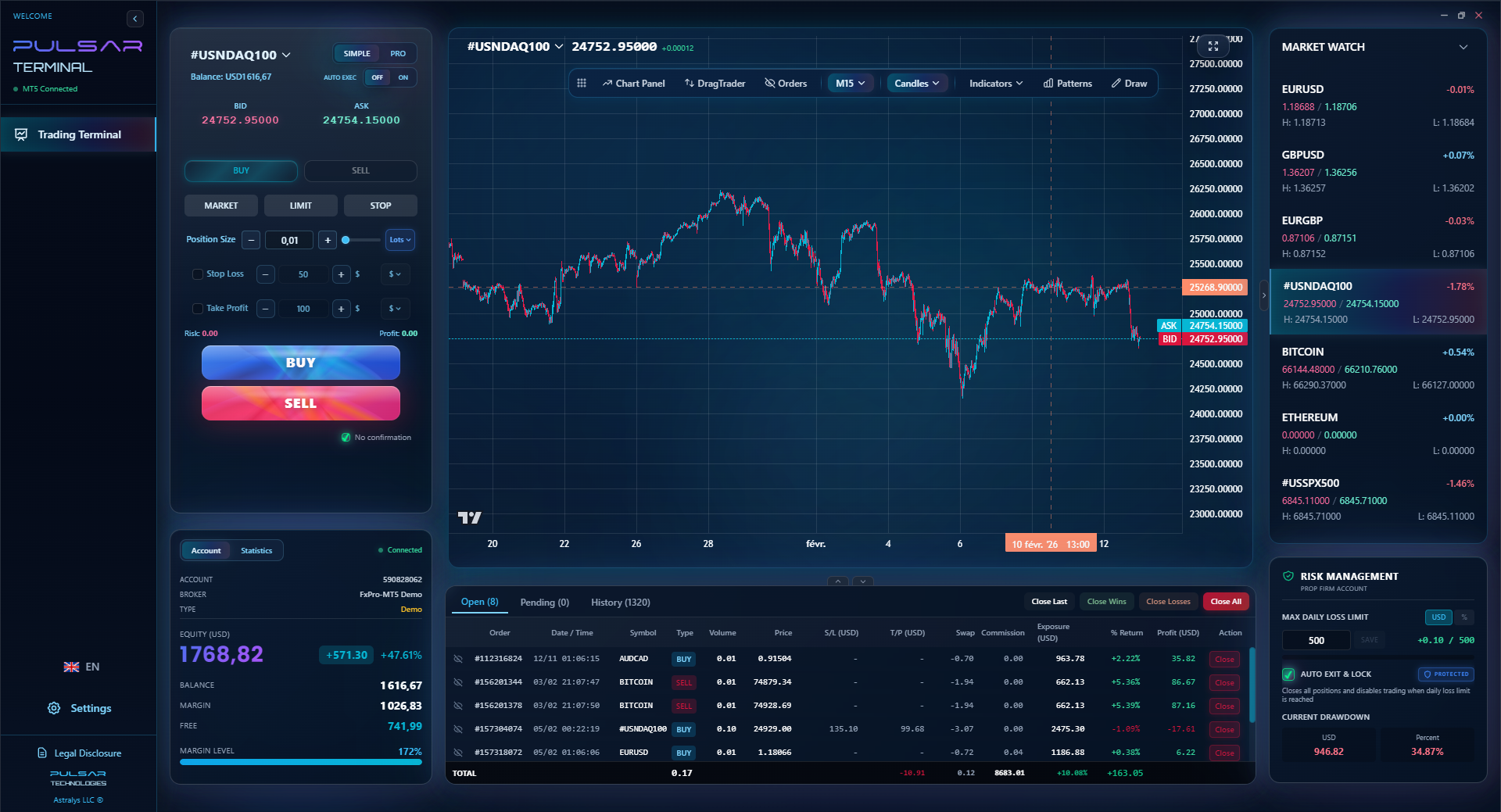
Managing complex trades on a basic bank platform is impossible, but tools like Pulsar Terminal bring advanced order types like trailing stops and multi-level take-profits directly into your MT5 workflow.
Pulsar Terminal
The all-in-one MT5 companion: drag-and-drop orders, multi-TP/SL, trailing stop, grid trading, Volume Profile, and prop firm protection. Used by 1,000+ traders daily.
“You're giving away a significant daily swing in the market before you even start your trade.”
So, if Standard Bank forex rates are a dead end, what should you do? You need a two-account structure.
Account 1: Your South African Bank Account (Nedbank, FNB, Absa, Standard Bank)
- Purpose: Your life hub. Your salary lands here. You pay bills from here. You use it for ZAR deposits and withdrawals to/from your trading broker.
- Forex Use: ONLY for converting Rands to/from foreign currency to fund your international trading account. Even here, shop around for the best conversion rate for a lump sum transfer.
Account 2: A Regulated International Forex Broker
- Purpose: All your actual trading.
- How to Fund It: You do an international EFT from your South African bank account (in ZAR) to the broker. The broker converts it to USD, EUR, or another base currency at a far better rate than the bank's retail rate. Brokers like Exness and XM have local payment options that simplify this.
- What You Gain: You now trade with tight spreads on USD/ZAR, EUR/ZAR, and GBP/ZAR. You have the full power of MT4/MT5. You can use advanced tools for swing trading the Rand pairs you understand.
Managing the Psychology
This setup feels unfamiliar. You're sending money offshore. It requires trust in a foreign entity. That's why regulation is non-negotiable. Always choose a broker regulated by a top-tier authority like the FCA (UK), ASIC (Australia), or CySEC (Cyprus). This structure isn't just about cost, it's about giving yourself a professional fighting chance.

Example: Trading USD/ZAR. With a broker, spread = 10 pips. You use a position size calculator to risk 1% of your account. Your stop-loss is 50 pips away. You need a 60-pip move to hit your profit target (10 pips to cover spread + 50 pips for the risk/reward). With a bank spread of 200 pips, you'd need a 250-pip favorable move for the same trade. Which scenario would you rather bet on?

I'm not saying banks are evil. They have a very specific, legitimate use case for their forex services. You should use Standard Bank forex rates when:
- You need physical cash for travel. Walking into a branch to get US dollars or euros for a holiday.
- You are making a once-off, large international payment for personal reasons, like buying property overseas or paying university fees. The convenience and security can outweigh the cost for a single, planned transaction.
- You are a business needing to pay an overseas supplier or invoice a client in foreign currency. The bank provides the documentation and structure for commercial transactions.
The common thread? These are transactions, not trades. They are finite events where you are exchanging currency for a specific, immediate purpose. Trading is an ongoing activity where you are trying to profit from minute-to-minute, hour-to-hour price fluctuations. The infrastructure for these two activities is, and should be, completely different.
💡 Winston's Tip
The comfort of familiarity is the enemy of optimal performance. Just because you've always banked somewhere doesn't mean you should trade there.
“These are transactions, not trades. The infrastructure for these two activities should be completely different.”
Let's crystallize the actionable pitfalls.
- Mistaking Convenience for Efficiency: Just because your bank's trading platform is a click away in your online banking doesn't make it good. The convenience is a trap.
- Not Calculating the True Cost: If you can't articulate your exact cost in Rands per trade, you don't understand your business. Do the math.
- Using Long-Term Views to Justify Bad Execution: "I'm bullish on the dollar for the year, so a big spread doesn't matter." Yes, it does. It directly reduces your final return. A 1.5% entry and exit cost turns a 10% yearly gain into a 7% gain.
- Ignoring Withdrawal Costs: The pain isn't just on entry. When you profit in USD and want to bring Rands back home, the bank will hit you with another poor conversion rate on the way out. The cycle continues.
- Fear of the Unknown: The biggest barrier for most South Africans is setting up an international account. It feels complex. But spending a few hours understanding the process can save you tens of thousands in lost opportunity and excessive costs over your trading career. Start by reading detailed broker reviews to see how the funding process works.

FAQ
Q1Is it illegal for South Africans to use international forex brokers?
No, it is perfectly legal. South African individuals are allowed to open trading accounts with foreign brokers for the purpose of trading financial markets. You are also allowed to transfer a certain amount of funds abroad per year under your Single Discretionary Allowance (SDA) and Foreign Investment Allowance (FIA). Always declare the purpose as 'investment' when doing the transfer.
Q2What is the safest way to fund an international trading account from South Africa?
The safest method is a direct international EFT (Electronic Funds Transfer) from your South African bank account to the broker's client money account, which is held at a major global bank. Use the broker's provided banking details. Never send money to a personal account or a company name that doesn't match the broker's regulated entity. Reputable brokers provide clear, audited banking details.
Q3Can I trade USD/ZAR with an international broker?
Absolutely. Most major international brokers offer USD/ZAR, EUR/ZAR, and GBP/ZAR as trading pairs. The spreads are dramatically tighter than local banks. You'll be trading the price derived from the interbank market, not a bank's retail markup.
Q4Will I pay tax on profits from an international trading account?
Yes. South African residents are taxed on their worldwide income. Profits from forex trading are generally considered capital gains or income from speculation, depending on your trading frequency and intent. You must declare these profits to SARS and pay the applicable tax. Keep detailed records of all your trades and withdrawals.
Q5What's the minimum amount I need to start with a proper broker?
This varies. Some brokers allow you to open an account with as little as $50-$100. However, for practical purposes and to manage risk effectively (using sensible position sizes), I'd recommend a starting capital of at least $1,000 (roughly R18,000-R20,000). This allows you to trade micro or mini lots without risking a huge percentage of your account on a single trade.
Q6How do I know if an international broker is trustworthy?
Check their regulation. Look for licenses from the Australian Securities and Investments Commission (ASIC), the UK Financial Conduct Authority (FCA), or the Cyprus Securities and Exchange Commission (CySEC). Read independent reviews that discuss withdrawal reliability and client feedback. Avoid brokers regulated only in offshore jurisdictions with weak oversight.
Prof. Winston's Lesson
Key Takeaways:
- ✓Bank spreads on USD/ZAR can be 200 pips vs. 10 pips at a broker.
- ✓A 1.5% effective fee turns a 10% annual gain into 7%.
- ✓Use banks for life admin, brokers for market execution.
- ✓Always calculate total trade cost: Spread + Commission + Fees.
How useful was this article?
Click a star to rate
Weekly Trading Insights
Free weekly analysis & strategies. No spam.
About the Author
David van der Merwe
Emerging Markets Trader
Johannesburg-based trader with 11 years in emerging market currencies. Specializes in ZAR pairs, FSCA-regulated trading, and South African market analysis.
Comments
Risk Disclaimer
Trading financial instruments carries significant risk and may not be suitable for all investors. Past performance does not guarantee future results. This content is for educational purposes only and should not be considered investment advice. Always conduct your own research before trading.
You Might Also Like

Cara Trading Forex Sukses: 7 Prinsip dari Trader Profesional
Cara trading forex sukses dengan 7 prinsip trader pro: manajemen modal, disiplin, journal trading, backtest. Data nyata, bukan janji profit palsu.
Jam Trading Forex Terbaik untuk Trader Indonesia: Panduan Lengkap dengan Tabel Waktu
Panduan jam trading forex untuk trader Indonesia. Tabel 4 sesi dunia, jam emas 20:00-00:00, sesi mana yang harus dihindari. Data akurat + tips dari trader berpengalaman.
Top 5 Sàn Forex Uy Tín Nhất 2026: Review Jujur dari Trader Indonesia
Top 5 sàn forex uy tín 2026 untuk trader Indonesia. Review jujur: spread, deposit, withdraw, dukungan lokal. Exness, XM, IC Markets & lebih.
Get Pulsar Terminal
All these calculators are built into Pulsar Terminal with real-time data from your MT5 account. One-click position sizing, automatic risk management, and instant calculations.
Get Pulsar Terminal