


You're probably sitting there, Googling 'Standard Bank forex trading minimum deposit,' thinking you'll open an account with your trusted local bank and start trading.

David van der Merwe
Emerging Markets Trader ·  South Africa
☕ 9 min read
What you'll learn:
- 1What Standard Bank Actually Offers (It's Not What You Think)
- 2The Real Costs: Fees That Will Eat Your Lunch
- 3The South African Rulebook: Why This Matters
- 4Where Should You Actually Trade? Broker Alternatives
- 5A Practical Path: Getting Your Money to a Broker
- 6The Tools You Need (That Banks Don't Provide)
- 7The Final Verdict: Is Standard Bank an Option?
You're probably sitting there, Googling 'Standard Bank forex trading minimum deposit,' thinking you'll open an account with your trusted local bank and start trading. I get it. It feels safe, familiar. But here's the hard truth you need to hear upfront: Standard Bank doesn't really offer the kind of retail forex trading account you're looking for. What they offer is something different, and understanding that difference could save you a lot of money and frustration. Let's unpack what's actually available, the real costs involved, and where you should really be putting your trading capital.
When you hear 'Standard Bank forex,' your mind goes to charts, use, and trading EUR/USD. That's not their main game for individuals like you and me. Standard Bank's forex services are built for two things: facilitating international business payments and helping people manage foreign currency for travel or holding offshore funds.
They have Foreign Currency Accounts (often called CFC accounts). Think of these as a USD or GBP savings account with Standard Bank. You can hold money in another currency, which is useful if you're paid in dollars or planning a big overseas purchase. They also handle telegraphic transfers (sending money abroad) and sell physical foreign cash.

Warning: Don't confuse a Foreign Currency Account with a trading account. You can't place a leveraged buy order on the Japanese Yen from your Standard Bank USD account. It's for storage and transfers, not speculation.
The closest they come to 'trading' is through their corporate or institutional desks, which isn't accessible to the average retail trader. So when you search for that minimum deposit, you're often finding information about the minimum to open one of these foreign currency accounts, not to start trading. For their Optimum foreign currency account, that opening minimum is a hefty $7,000 (roughly R132,000). That's a serious chunk of change just to park money, not trade it.

💡 Winston's Tip
A bank is for storing money. A broker is for trading it. Confusing the two is a fundamental error that costs you in fees, functionality, and opportunity.
Let's talk numbers, because this is where using a bank for forex activities gets painful. Their fee structure is designed for occasional, large transactions, not the frequent, smaller trades you'd make as an active trader.
Transfer and Conversion Fees
Sending money overseas via a telegraphic transfer? You're looking at a fee of 0.48% to 0.535% of the amount, with a minimum charge of around R190 and a max of R700. Need to convert your Rands to Dollars to fund an offshore broker? That's where the spread (the difference between the buy and sell price) comes in, and it's not pretty. Banks typically offer worse exchange rates than the interbank market you see on trading platforms.
I learned this the hard way early on. I needed to send $1,000 to an international broker. Between Standard Bank's transfer fee and the poor conversion rate they gave me, I lost over R350 before my trade was even placed. Compare that to funding a local FSCA-regulated broker in ZAR, where the cost is often zero.
Account Management Fees
If you do open a foreign currency account, get ready for monthly or quarterly admin fees. For a Standard Bank CFC account, it's about R212 per month (billed in the currency equivalent). That's R2,544 a year just to keep the account open. That's a direct drain on your capital before you've even thought about a trade.

Example: Let's say you fund a $7,000 foreign currency account. The R212 monthly fee is roughly $11.20. Over a year, you pay $134.40 in fees, which is a 1.9% drag on your capital just for having the account. A proper forex broker doesn't charge an account fee.
“Standard Bank's role in your trading journey should be limited to one thing: being the pipe.”
You can't talk about forex in South Africa without understanding the regulations. This is the framework that shapes everything, including why Standard Bank's offerings are the way they are.
The Financial Sector Conduct Authority (FSCA) is the main watchdog. Since 2021, they've capped use for retail traders at 30:1. More importantly, South African Exchange Control Regulations, managed by the South African Reserve Bank (SARB), have a golden rule: South African residents cannot speculate against the Rand.
This is huge. It means you can't directly short the USD/ZAR pair hoping the Rand will strengthen, through a South African entity. This regulation is a key reason why local banks like Standard Bank don't offer leveraged Rand pairs to retail clients for speculation.
To trade forex properly (including major pairs like EUR/USD), you typically need to send funds offshore using your allowances. You get a Single Discretionary Allowance (SDA) of R1 million per year without tax clearance, and a Foreign Investment Allowance (FIA) of R10 million per year with a SARS Tax Compliance PIN. This is the legal pipeline to international brokers. Banks like Standard Bank are 'Authorised Dealers' – they're the gatekeepers for this process, not the trading venue.
Many traders get tripped up by unregulated offshore brokers. The FSCA has been issuing warnings left and right, especially about 'signal sellers' on social media. Always check if your broker is FSCA-regulated. It's your primary protection against scams and ensures client fund segregation.
Okay, so Standard Bank isn't the right tool for the job. What is? The good news is South Africa has a healthy selection of reputable, FSCA-regulated brokers. These platforms are built for active trading, with competitive costs and the tools you need.
Here’s a quick comparison of minimum deposits with some well-known regulated brokers (this can change, so always check their sites):
| Broker | Typical Minimum Deposit (Approx. in ZAR) | Key Feature for SA Traders |
|---|---|---|
| XM | R90 ($5) | Very low barrier to entry, offers ZAR accounts. |
| FP Markets | R950 (AU$100) | Excellent raw spreads, great for scalping. |
| Tickmill | R1,850 ($100) | Low commissions, professional feel. |
| AvaTrade | R1,850 ($100) | User-friendly, lots of educational material. |
| IG | R950 ($50) | Established, strong platform. |
| Exness | Varies | Popular for its flexible account types. (Read our full Exness review for details.) |
Notice something? The minimums are a fraction of Standard Bank's $7,000 foreign account minimum. More importantly, these brokers give you access to MetaTrader 4 or 5, real-time charts, use (up to the 30:1 FSCA limit), and the ability to trade a full range of instruments.
I started with a $100 (R1,850) deposit with a broker like Tickmill. That was my 'tuition fee' to learn the markets without risking a life-changing amount. The spreads on EUR/USD were often below 0.1 pips during major sessions, compared to the several-pip-wide effective spread I'd get converting money at a bank.

Pro Tip: Look for brokers that accept ZAR deposits directly. It simplifies everything and avoids the bank transfer fees we talked about earlier. Brokers like XM and others offer this. You fund in Rands, and they handle the conversion internally at a much better rate.
💡 Winston's Tip
Your first R2,000 is for paying trading 'tuition.' Risk it wisely on a real platform, not on bank fees and poor spreads. The lessons are worth more than the profit.
“Don't lock R132,000 into a static foreign currency account when you could start learning with R2,000 on a real platform.”
Let's walk through the actual steps, because the process can be confusing.
- Choose Your FSCA-Regulated Broker: Do your homework. Read reviews like our IC Markets review or Pepperstone review. Ensure they're on the FSCA's financial services provider register.
- Open Your Trading Account: This takes minutes online. You'll choose between an MT4 or MT5 platform. I prefer MT5 for its more advanced order types and depth of market, which helps with strategies like swing trading.
- Fund It: This is where you interact with your bank. If the broker accepts ZAR, you'll do a local EFT. If you need to send USD, you'll use your SDA.
- For a USD transfer: Log into your Standard Bank online banking, go to 'International Payments.' You'll need the broker's banking details (usually an account in Cyprus, Mauritius, etc.). The purpose? 'Investment.' You'll pay the 0.48% fee (min R190). Stay within your R1 million SDA limit for the year.
- Start Small: Use a position size calculator. With a R2,000 deposit and 30:1 use, your buying power is R60,000. That doesn't mean you should use it all. Risking 1% per trade means your stop-loss should be set so you only lose R20. This discipline is everything.
I remember my first international transfer to a broker. I was nervous, waiting three days for it to clear. Now, with brokers that have local ZAR payment partners, it's often instant. The market has evolved for our convenience.
Trading successfully isn't just about placing an order. It's about analysis, risk management, and precision. Standard Bank's online platform gives you none of this. A proper trading platform is your cockpit.
You need advanced charting with indicators like the RSI indicator and MACD indicator. You need one-click trading, the ability to set stop-loss and take-profit orders the moment you enter a trade. You need to track your spread costs in real-time.
Most brokers offer MT5, which is powerful. But to really level up, you need tools that manage the mechanical side of trading. Setting a trailing stop, moving your stop to breakeven when a trade goes in your favor, or scaling out of a position with multiple take-profit levels – doing this manually on a live chart is stressful and error-prone.
Automating these tasks is a game-saver. It removes emotion and ensures your plan is executed perfectly, whether you're watching the screen or not. This is where dedicated trading terminal software becomes useful, acting as a powerful companion to your MT5 platform.
💡 Winston's Tip
Regulations aren't there to stop you; they're there to define the playing field. The smart trader learns the rules of the FSCA and SARB better than their own trading strategy.
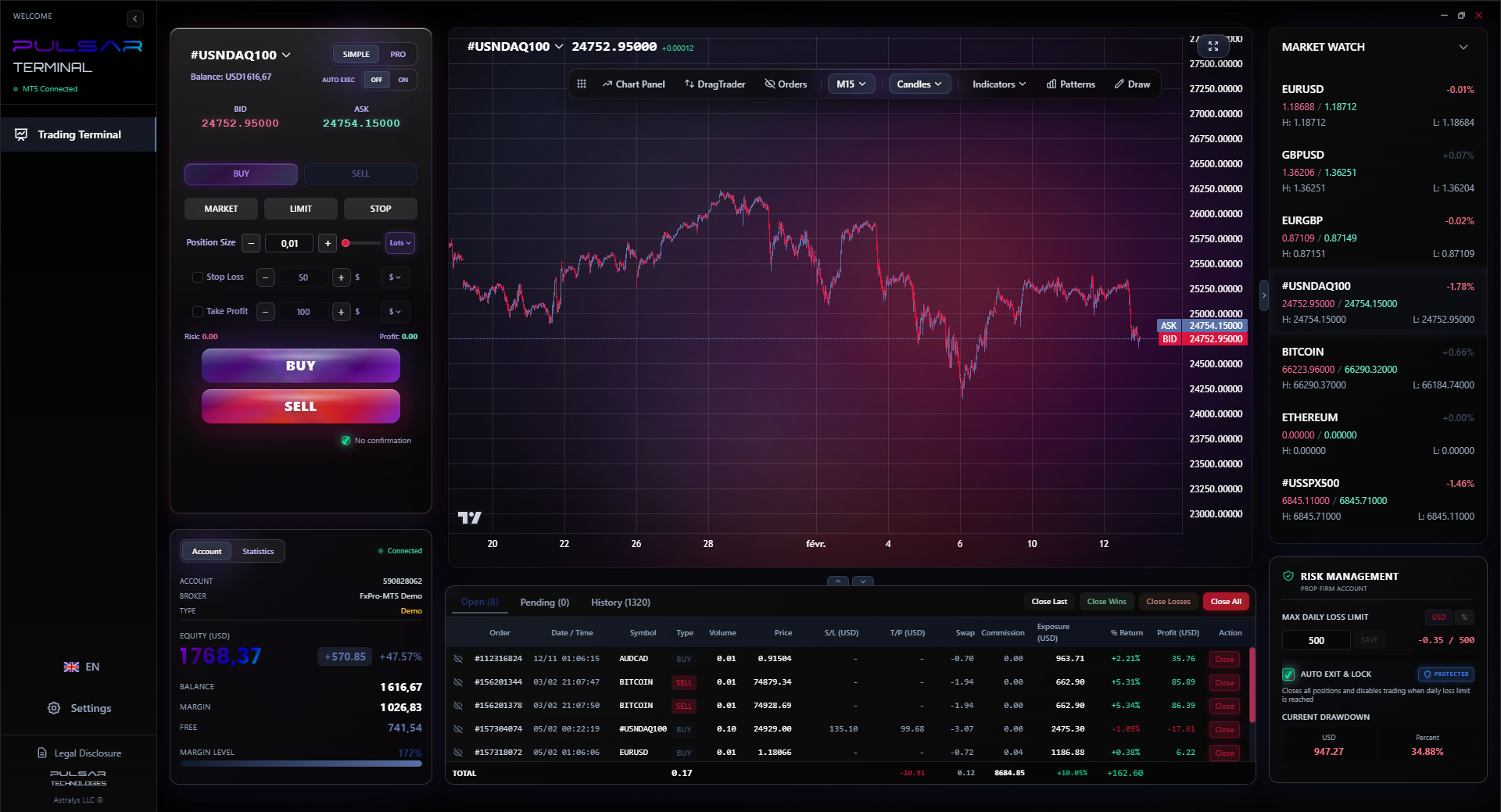
Managing complex trades and risk manually on MT5 is hard; Pulsar Terminal automates trailing stops, breakeven moves, and multi-level exits directly on your charts.
Pulsar Terminal
The all-in-one MT5 companion: drag-and-drop orders, multi-TP/SL, trailing stop, grid trading, Volume Profile, and prop firm protection. Used by 1,000+ traders daily.
“The minimums at real brokers are a fraction of Standard Bank's $7,000 foreign account minimum. More importantly, they give you the tools to trade.”
Let's be brutally honest. For speculative retail forex trading, using Standard Bank as your primary platform is a non-starter. It's like using a cargo ship to compete in a jet-ski race. The wrong tool, wrong costs, wrong functionality.
Standard Bank's role in your trading journey should be limited to one thing: being the pipe. They are the regulated Authorised Dealer that helps you legally send your Rands abroad to a proper, FSCA-regulated broker, within your allowable limits. That's it. Their fees for this service are a necessary cost of doing business, but you minimize it by using brokers with local ZAR funding.
Your capital is precious. Don't lock R132,000 into a static foreign currency account when you could start learning with R2,000 on a real platform. Don't pay R212 a month in account fees. Put your money where the markets are.
Start with a reputable broker with a low minimum. Learn the ropes on a demo account, then go live with money you can afford to lose. Focus on majors like EUR/USD or XAU/USD (gold) which have high liquidity. Manage your risk on every single trade. That's the real path forward, not searching for a minimum deposit at your local bank for a service that doesn't really exist.
FAQ
Q1What is the actual minimum deposit to start forex trading with Standard Bank?
Standard Bank doesn't offer a retail forex trading platform with a minimum deposit in the way international brokers do. The closest product is a Foreign Currency Account, which has a minimum opening deposit of around $7,000 (approx. R132,000). This is not for leveraged trading; it's simply an account to hold foreign currency.
Q2Can I trade USD/ZAR with Standard Bank?
Not for speculative purposes. South African exchange control regulations prohibit residents from speculating against the Rand (ZAR). Standard Bank, as an Authorised Dealer, enforces these rules. You can convert Rands to Dollars for approved purposes (like funding an offshore investment), but you cannot actively trade the pair with use through them.
Q3Why are the fees so high compared to online brokers?
Banks like Standard Bank are built for large, infrequent transactions like international wire transfers and currency conversion for business or travel. Their infrastructure and compliance costs are high. Online forex brokers are built for high-volume, electronic trading. They make money from the spread and/or commission on thousands of trades daily, allowing them to offer razor-thin margins and low or no fees for deposits/withdrawals.
Q4Is it legal to use an international broker as a South African?
Yes, but you must follow the rules. You must use your Single Discretionary Allowance (R1 million/year) or Foreign Investment Allowance (R10 million/year with a Tax PIN) to send funds abroad. It is strongly recommended you use an international broker that is ALSO regulated by the South African FSCA. This gives you dual protection and often simplifies deposits in ZAR.
Q5What's the absolute cheapest way to start trading forex in SA?
The lowest-cost entry is with an FSCA-regulated broker that offers a very low minimum deposit and accepts ZAR. For example, brokers like XM offer a minimum deposit of $5 (about R90). You fund your account in Rands via a local EFT (avoiding international bank fees), and you can start trading with real money on a proper platform like MT5. Always use a demo account first to practice.
Q6Will Standard Bank block my payment to a forex broker?
They might, if it appears to violate exchange controls. To avoid this, ensure you stay within your annual allowances (start with the R1 million SDA). When making the payment, use a clear purpose like 'Investment.' If you're moving larger amounts (over R1 million), you must have your SARS Tax Compliance Status PIN ready for the Foreign Investment Allowance. Using an FSCA-regulated broker also adds legitimacy to the transaction.
Prof. Winston's Lesson
Key Takeaways:
- ✓Standard Bank's $7,000 min is for holding cash, not trading.
- ✓Bank forex fees are 0.5% per transfer; broker fees are often zero.
- ✓FSCA caps use at 30:1 for your protection.
- ✓Use your R1m SDA allowance to fund regulated brokers legally.
- ✓Start with a broker's R90 minimum, not a bank's R132k minimum.
How useful was this article?
Click a star to rate
Weekly Trading Insights
Free weekly analysis & strategies. No spam.
About the Author
David van der Merwe
Emerging Markets Trader
Johannesburg-based trader with 11 years in emerging market currencies. Specializes in ZAR pairs, FSCA-regulated trading, and South African market analysis.
Comments
Risk Disclaimer
Trading financial instruments carries significant risk and may not be suitable for all investors. Past performance does not guarantee future results. This content is for educational purposes only and should not be considered investment advice. Always conduct your own research before trading.
You Might Also Like

Cara Trading Forex Sukses: 7 Prinsip dari Trader Profesional
Cara trading forex sukses dengan 7 prinsip trader pro: manajemen modal, disiplin, journal trading, backtest. Data nyata, bukan janji profit palsu.
Jam Trading Forex Terbaik untuk Trader Indonesia: Panduan Lengkap dengan Tabel Waktu
Panduan jam trading forex untuk trader Indonesia. Tabel 4 sesi dunia, jam emas 20:00-00:00, sesi mana yang harus dihindari. Data akurat + tips dari trader berpengalaman.
Top 5 Sàn Forex Uy Tín Nhất 2026: Review Jujur dari Trader Indonesia
Top 5 sàn forex uy tín 2026 untuk trader Indonesia. Review jujur: spread, deposit, withdraw, dukungan lokal. Exness, XM, IC Markets & lebih.
Get Pulsar Terminal
All these calculators are built into Pulsar Terminal with real-time data from your MT5 account. One-click position sizing, automatic risk management, and instant calculations.
Get Pulsar Terminal