


Here's a myth I hear all the time from new traders in Lagos and Port Harcourt: 'To make real money, you need to trade big.

Olumide Adeyemi
West African Trading Pioneer ·  Nigeria
☕ 11 min read
What you'll learn:
- 1What Exactly Is a Standard Lot? (It's Bigger Than You Think)
- 2Why This Matters for a Nigerian Trader
- 3When Should You Actually Use a Standard Lot?
- 4Forget Standard Lots: Calculate Your *Correct* Position Size
- 5Brokers, Platforms, and Trading with the Naira
- 6Common Mistakes Nigerian Traders Make with Lot Sizes
- 7A Realistic Path: Building Toward Standard Lots
Here's a myth I hear all the time from new traders in Lagos and Port Harcourt: 'To make real money, you need to trade big. Start with standard lots.' That's a fantastic way to turn your trading account into a donation to the market. The obsession with standard lots before you understand position sizing is the single fastest path to a margin call. I've seen it wipe out more accounts than any bad trade. Let's set the record straight on what a standard lot really means for a Nigerian trader, how to use it (or more likely, avoid it), and how to size your trades so you're still in the game next month.
A standard lot in forex is the default, old-school contract size. It's 100,000 units of the base currency in a pair. If you buy 1 standard lot of EUR/USD, you're buying 100,000 Euros. For a USD-quoted pair, one pip of movement is worth about $10. Let that sink in. A 10-pip move against you on a single trade is a $100 loss. In Naira terms, at an exchange rate of say ₦1,500/$, that's ₦150,000 gone on a relatively small market fluctuation.
We have smaller sizes for a reason. A mini lot is 10,000 units (pip ~$1). A micro lot is 1,000 units (pip ~$0.10). A nano lot is 100 units. Most Nigerian traders starting out should be thinking in micro lots, not standard lots. The brokers know this. That's why they offer accounts with "cent" or micro lot trading. Jumping straight to a standard lot is like learning to drive in a Formula 1 car on the Lagos-Ibadan Expressway during rush hour. A spectacular, expensive crash is almost guaranteed.

Warning: Don't let a broker's "high use" offering trick you into trading standard lots prematurely. use of 1:500 or 1:1000 on a standard lot means you can control a $100,000 position with just $200. This also means a 0.2% move against you wipes your margin. It's a double-edged sword that cuts beginners far more often.
Here’s a quick table to visualize the impact:
| Lot Size | Units | Approx. Pip Value (USD pairs) | 10-pip Loss in Naira (~₦1500/$) |
|---|---|---|---|
| Standard | 100,000 | $10 | ₦150,000 |
| Mini | 10,000 | $1 | ₦15,000 |
| Micro | 1,000 | $0.10 | ₦1,500 |
| Nano | 100 | $0.01 | ₦150 |
See the difference? That standard lot loss is a serious chunk of change. Before you even consider it, your trading plan and risk management must be rock solid. I recommend mastering a solid scalping strategy or swing trading approach with micro lots first.
The Naira Reality
Our currency situation makes this extra critical. You're likely funding your account in USD, EUR, or GBP from your domiciliary account or via a payment processor. When you convert your hard-earned Naira into dollars to trade, every dollar counts. Blowing $1,000 on a poorly sized standard lot trade isn't just a loss on a screen. It's the equivalent of ₦1.5 million that took real effort to save. The psychological pressure is immense, and it leads to panic decisions.
The Regulatory Shift
For years, retail forex was the wild west here. That's changing. The new Investments and Securities Act (ISA) 2025 means platforms must register with the SEC. While this aims to protect you from outright scams, it doesn't protect you from yourself. No regulator will stop you from over-leveraging a standard lot. That's on you. Understanding position size is your first line of defense, more important than any broker's license. If you're choosing a broker, check our deep dive on Exness review or IC Markets review to see how they handle lot sizes for Nigerian clients.
The True Cost: Spreads and Commissions
With a standard lot, the spread - the difference between the buy and sell price - is multiplied by 100,000. On EUR/USD, a 1.0 pip spread costs you $10 on a standard lot the moment you enter the trade. On a micro lot, it's $0.10. If your broker charges a commission (common on ECN accounts), it's often per standard lot. For example, $6 per lot per side. That's $12 round trip on a standard lot, but only $0.12 on a micro lot. These costs eat directly into your profit, or amplify your loss. You can't ignore them. Always check the spread definition and commission structure before you trade.

💡 Winston's Tip
If you can't state your exact maximum loss in Naira before you click 'buy,' you're not trading. You're donating.
“Jumping straight to a standard lot is like learning to drive in a Formula 1 car on the Lagos-Ibadan Expressway during rush hour.”
Honestly? Not for a long time. But let's talk about the right scenario, so you know what you're working towards.
You should only consider a standard lot when:
- Your account size justifies it: A common (and conservative) rule is to risk no more than 1-2% of your account on a single trade. To risk 1% on a trade where your stop-loss is 10 pips away using a standard lot ($100 risk per 10 pips), you'd need a minimum account balance of $10,000. Do you have a $10,000 trading account you're willing to risk? If not, standard lots aren't for you yet.
- Your strategy is proven over hundreds of trades: Not a hunch, not a "feeling," not because a signal group said so. You have a documented edge with a clear win rate and risk-reward ratio, tested across different market conditions.
- Your psychology is bulletproof: A $500 intraday drawdown on a standard lot position doesn't make you sweat, change your plan, or stare at the screen praying. It's just a number in your pre-defined risk framework.
Here's a personal story. Early on, I had a $5,000 account. I got cocky after a few winning micro-lot trades. I thought, "Let's scale up." I took a 0.5 standard lot position on GBP/USD (effectively 50,000 units). My stop was 20 pips away, a $100 risk. Seemed fine. The trade went against me immediately, and I moved my stop "just a little" because I couldn't stomach the loss. I turned a $100 controlled risk into a $450 disaster. That trade taught me more about myself than any indicator ever could. I wasn't ready. The size broke my discipline.

Pro Tip: If you're aspiring to trade standard lots, practice first with a "simulated standard lot" using micro lots. Want to simulate a 1-standard-lot trade? Take 10 micro-lot positions. The financial risk is 1/10th, but the mental game of managing multiple positions is similar. It's a great bridge.
This is the most important math in trading. Your position size should be a output of your risk parameters, not an input. You don't decide to trade a standard lot and then figure out the risk. You decide how much you're willing to lose, then calculate what lot size that allows.
The formula is simple but non-negotiable: Position Size (in lots) = (Account Risk in $) / (Stop-Loss in Pips * Pip Value per Standard Lot) Then, adjust for mini, micro, or nano lots.
Let's use a real example with a Nigerian twist:
- Account Balance: $1,000 (approx. ₦1.5 million)
- Risk per Trade: 1.5% = $15 (₦22,500)
- Trade: EUR/USD. You want to buy at 1.0850, with a stop loss at 1.0830.
- Stop-Loss: 20 pips.
- Pip Value per Standard Lot: ~$10.
Calculation: $15 / (20 pips * $10) = 0.075 standard lots.
That's not a standard lot. It's not even a mini lot (0.1). It's 7.5 micro lots, or 75,000 units. You'd enter this as 7 micro lots and 5 nano lots, or simply 75 nano lots, depending on your broker's flexibility. This precise sizing ensures that if your stop is hit, you lose exactly $15, protecting your capital.
I can't stress this enough: use a position size calculator. Do this before every single trade. It removes emotion. Your job is to find the trade and determine the stop loss. Let the math tell you the size. This discipline alone will put you ahead of 80% of retail traders who just guess. For more on managing the downside, understand what triggers a margin call.
💡 Winston's Tip
Your first profitable year should bore you. Same small lot sizes, same risk rules. Excitement comes from profits, not position size.
“Your position size should be an *output* of your risk parameters, not an input.”
Choosing a Broker
As a Nigerian, you have access to many international brokers. Key things to look for:
- Small Minimum Lot Sizes: Can you trade micro (0.01) and nano lots? This is essential for proper position sizing with smaller accounts.
- NGN Account Options: Some brokers, like XM, offer Naira-denominated accounts. This can simplify things mentally, but remember, the underlying asset is still in forex pairs. Your profit/loss will convert at the broker's rate.
- Local Payment Methods: How easy is it to fund and withdraw? Look for brokers supporting bank transfers to your Nigerian domiciliary account, credit/debit cards (Verve, Mastercard), and e-wallets like Skrill or Neteller. Fast, cheap withdrawals are a huge plus. Check our reviews for specifics on XM review and Pepperstone review regarding their services for Nigerian clients.
- use Offers: Be wary. A broker offering 1:1000 use isn't doing you a favor. It's a test of your discipline. Regulate yourself.
Popular Platforms
MT4 and MT5 are kings here. They're familiar, stable, and support Expert Advisors (EAs). The key is learning how to use the platform's order window to input your calculated position size precisely, not just clicking "1.00" for a standard lot.
A Word on Prop Firms
Prop firm challenges are huge in Nigeria. They often have strict daily loss limits (e.g., 5% of the account). Here's the trap: they usually give you a simulated $100,000 or $200,000 account. New traders see this big number and immediately think in standard lots. That's how you blow the challenge in one day. You must treat the prop firm account with the same position sizing rules as your own money. Risk a tiny percentage of the challenge account on each trade. If you get funded, then you can gradually scale up lot sizes as you manage the firm's capital.
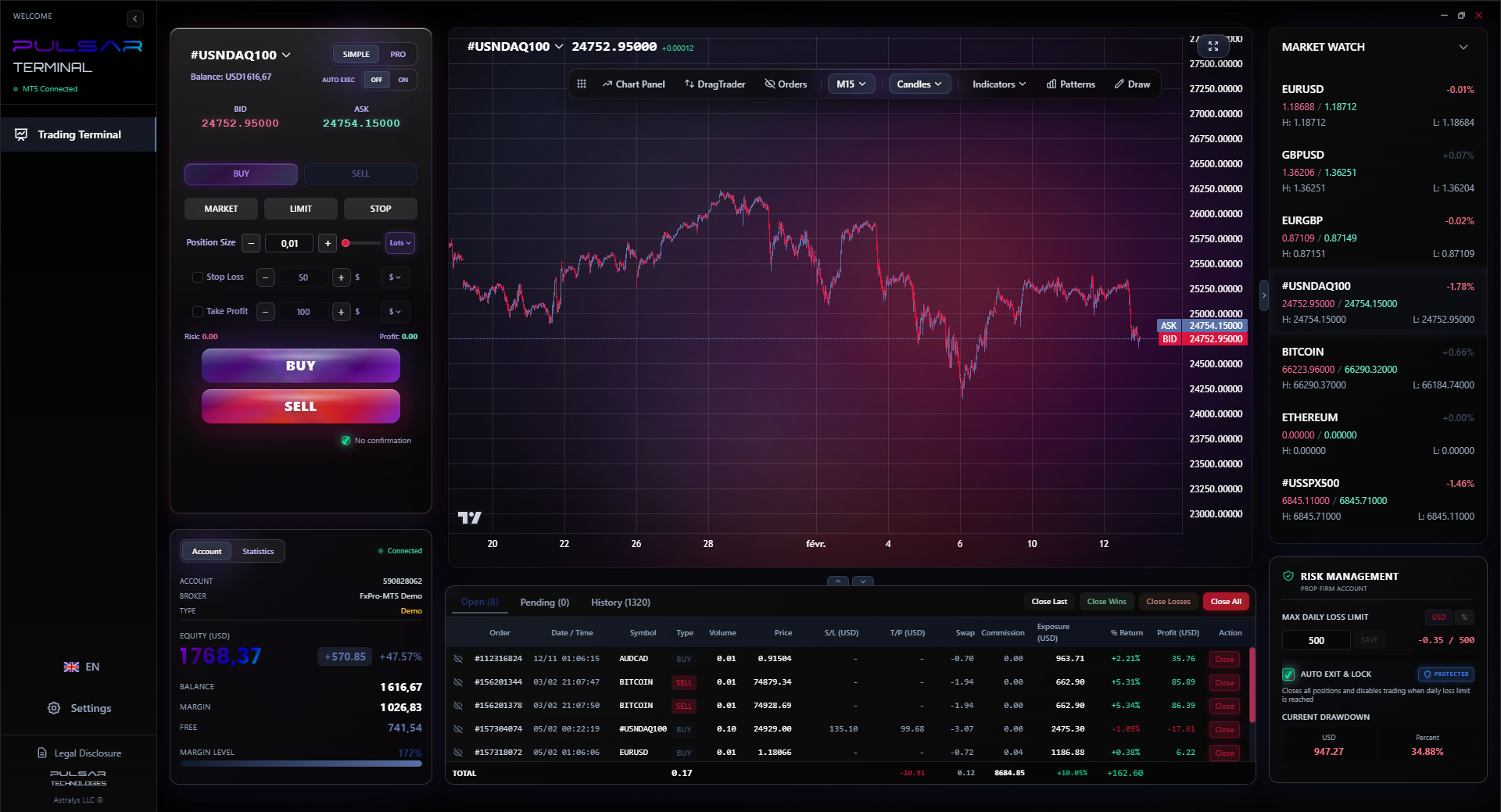
Managing precise lot sizes and multiple partial closures on a single trade is complex in MT5, but tools like Pulsar Terminal automate this with drag-and-drop order grids and multi-TP/SL functionality.
Pulsar Terminal
The all-in-one MT5 companion: drag-and-drop orders, multi-TP/SL, trailing stop, grid trading, Volume Profile, and prop firm protection. Used by 1,000+ traders daily.
- Trading Standard Lots on a Small Account: This is suicide. If your account is under $5,000, standard lots should barely be on your radar. Stick to micro and mini lots.
- Increasing Lot Size to Recover Losses: You lost ₦50,000 on a trade? The worst thing you can do is double your lot size on the next trade to "make it back quickly." This is the revenge trading death spiral. It leads to the total loss of your account. I've been there. It feels awful.
- Ignoring Currency Conversion Risk: You fund in USD, trade EUR/GBP, and your account reports in EUR. Multiple currency conversions happen behind the scenes, affecting your true P&L in Naira. Keep it simple at first. If your base currency is USD, focus on USD pairs like EUR/USD guide or XAU/USD guide (Gold).
- Letting Emotions Override the Calculator: You calculated a 0.07 lot size. The trade sets up, it looks perfect, you get greedy... and you enter 0.7 lots. You've just risked 10x your plan. This isn't trading; it's gambling. Have the discipline to stick to the number the calculator gives you.
- Not Accounting for Volatility: A 20-pip stop on EUR/USD is different from a 20-pip stop on GBP/JPY or a $20 stop on Gold. The volatility differs wildly. Your position size must adjust. A tool that helps visualize market structure, like Volume Profile, can help identify safer, more volatile areas for your stops. This is where understanding the instrument's character is key.
💡 Winston's Tip
A standard lot doesn't make you a professional. Risking 0.5% of a $100,000 account does. Focus on the percentage, not the lot.
“The market doesn't care about your ego. It will take your money if you let pride dictate your lot size.”
Here's a blunt, step-by-step path if your goal is to eventually trade standard lots professionally:
Phase 1: The Foundation (3-6 months minimum)
- Account: Start with a live account you can afford to lose. $200-$500.
- Lot Size: Micro lots (0.01) only. Your goal is not profit. Your goal is 100 consecutive trades where you follow your risk management rules EXACTLY. Use a 1% risk rule. Track every trade in a journal.
- Focus: Nail your entry/exit rules. Master your RSI indicator or MACD indicator setups without over-leveraging.
Phase 2: Scaling Consistency (6+ months)
- Account: Grow your account organically through profits, or add more capital once you're consistent. Aim for a $2,000 - $5,000 account.
- Lot Size: Move to mini lots (0.10) and micro lots. Now you're trading position sizes that can make meaningful money, but a string of losses won't destroy you.
- Focus: Work on your psychological stamina. Can you handle a 3% drawdown week without changing your system?
Phase 3: The Professional Mindset (When you've earned it)
- Account: You have a track record of at least 12 months of consistent, documented profitability. Your account is substantial ($10,000+).
- Lot Size: Now you can consider fractional standard lots (0.2, 0.5, 1.0). The standard lot is just another tool. You use it when the trade and risk parameters call for it, not because you want to feel like a "big trader."
- Focus: Capital preservation and steady growth. A single standard lot trade is just one of many in a diversified risk portfolio.
The market doesn't care about your ego. It will take your money if you let pride dictate your lot size. Start small, be ruthlessly consistent, and let your growing account balance - not a reckless desire for size - tell you when it's time to scale up.
FAQ
Q1What is a standard lot in Nigerian Naira?
A standard lot isn't directly in Naira; it's 100,000 units of a base currency. However, the impact is. With USD/NGN around ₦1,500, the pip value of a standard lot on a USD pair (~$10) is about ₦15,000. A 10-pip loss equals ₦150,000. This highlights why trading standard lots with a small Naira-converted account is extremely risky.
Q2Can I trade forex in Nigeria with just 50,000 Naira?
Yes, but you must be realistic. ₦50,000 is roughly $33. With a broker offering micro lots, you can trade. However, you must risk a tiny percentage (1-2%) per trade, which is just $0.33-$0.66. This means you'll be trading nano or micro lots with very tight stop-losses. The goal with this size is learning and proving consistency, not making life-changing money.
Q3Do Nigerian forex traders pay tax on profits?
Yes. According to Nigerian law, profits from forex trading are subject to Capital Gains Tax (CGT) at a rate of 10% on the gross profit. You are responsible for declaring this to the Federal Inland Revenue Service (FIRS), regardless of whether your broker is local or international.
Q4Is it better to have a USD or Naira trading account as a Nigerian?
For simplicity and direct cost understanding, a USD account is often better. Most forex pairs are quoted against the USD, so your profit/loss is clearer. An Naira-denominated account adds a layer of conversion by the broker, which can be opaque. Fund your USD account from your domiciliary account.
Q5What's the biggest mistake with lot sizing?
Using a fixed lot size (like always trading 0.1 lots) regardless of the trade's stop-loss distance. This means your risk is different on every trade, which is uncontrollable. Always calculate your position size based on a fixed percentage of your account risk and your specific stop-loss.
Q6How does use affect my choice of lot size?
use amplifies both gains and losses. High use (e.g., 1:500) allows you to open a standard lot position with very little margin. This tempts you to trade too large. With high use, you should actually trade smaller lot sizes (more micro lots) to keep your absolute risk in check. use is a margin tool, not a risk invitation.
Q7What is a pip, and why is it important for lot sizing?
A pip is the smallest price move a currency pair can make. For most pairs, it's 0.0001. It's the building block of your risk calculation. Knowing the pip definition and its monetary value for your chosen lot size is essential. You can't calculate your position size without knowing your stop-loss in pips and the pip's value.
Prof. Winston's Lesson
Key Takeaways:
- ✓A standard lot = 100,000 units; a 10-pip move = ~$100 (₦150k+).
- ✓Calculate position size *after* setting stop-loss and % risk.
- ✓Trade micro lots until your account exceeds $5,000.
- ✓High use demands smaller lot sizes, not bigger ones.
- ✓Profits are taxed at 10% CGT. Keep clean records.
How useful was this article?
Click a star to rate
Weekly Trading Insights
Free weekly analysis & strategies. No spam.
About the Author
Olumide Adeyemi
West African Trading Pioneer
One of Nigeria's most active forex trading educators. 8 years of experience trading from Lagos. Specializes in low-capital strategies and prop firm challenges for African traders.
Comments
Risk Disclaimer
Trading financial instruments carries significant risk and may not be suitable for all investors. Past performance does not guarantee future results. This content is for educational purposes only and should not be considered investment advice. Always conduct your own research before trading.
You Might Also Like

Cara Trading Forex Sukses: 7 Prinsip dari Trader Profesional
Cara trading forex sukses dengan 7 prinsip trader pro: manajemen modal, disiplin, journal trading, backtest. Data nyata, bukan janji profit palsu.
Jam Trading Forex Terbaik untuk Trader Indonesia: Panduan Lengkap dengan Tabel Waktu
Panduan jam trading forex untuk trader Indonesia. Tabel 4 sesi dunia, jam emas 20:00-00:00, sesi mana yang harus dihindari. Data akurat + tips dari trader berpengalaman.
Top 5 Sàn Forex Uy Tín Nhất 2026: Review Jujur dari Trader Indonesia
Top 5 sàn forex uy tín 2026 untuk trader Indonesia. Review jujur: spread, deposit, withdraw, dukungan lokal. Exness, XM, IC Markets & lebih.
Get Pulsar Terminal
All these calculators are built into Pulsar Terminal with real-time data from your MT5 account. One-click position sizing, automatic risk management, and instant calculations.
Get Pulsar Terminal