


Let's start with a hard truth.

Olumide Adeyemi
West African Trading Pioneer ·  Nigeria
☕ 11 min read
What you'll learn:
- 1Step 1: Unlearn Everything You Think You Know
- 2Step 2: Master the Absolute Basics (Not the Indicators)
- 3Step 3: Choose a Broker Like You're Choosing a Business Partner
- 4Step 4: Live in a Demo Account for 3 Months (Minimum)
- 5Step 5: Build ONE Simple Strategy and Backtest It
- 6Step 6: Develop a Written Trading Plan (Your Rulebook)
- 7Step 7: Fund Your Account With Money You Can Afford to Lose
- 8Step 8: Embrace the Journey of Continuous Review
Let's start with a hard truth. Over 90% of new traders in Nigeria lose their first account. It's not a secret. The real secret is that the process of learning is broken. Most guides sell you a dream of quick riches, skipping the brutal, boring work that actually builds skill. I've been there. I funded my first account with ₦150,000 in 2013, convinced I'd cracked the code. I was broke in six weeks. This isn't another motivational speech. This is a field manual for the 10% who survive. We'll walk through the real, sequential steps to learn forex trading, grounded in Nigeria's unique reality of CBN rules, Naira volatility, and the brokers that actually work here.
Your first job isn't to learn forex. It's to delete the nonsense. The Instagram ads showing luxury cars, the WhatsApp groups promising 100% weekly returns, the idea that trading is a side hustle you do while watching Netflix. It's all poison.
Forex trading is a probabilistic business of risk management. You will have more losing trades than winning ones. A professional might only win 40% of the time but still be profitable because their average win is much larger than their average loss. The goal isn't to be right, it's to be profitable over a series of trades.
I had to learn this the hard way. I once took 12 trades in a row on EUR/USD, convinced each new signal was 'the one.' I won 8 of them. I still lost money overall because my two biggest losses wiped out all those small wins. That's when I finally understood: profit is about the size of your wins and losses, not the frequency. Start here. Internalize that you are a risk manager first, a speculator second.

Warning: If your primary motivation is 'to get rich quick,' save yourself the heartache and capital. The market is exceptionally efficient at separating impatient money from patient skill.
Before you touch a chart, you need to speak the language. This isn't about memorizing 20 different candlestick patterns. It's about understanding the mechanics of a trade.
The Non-Negotiables
You must be able to define these in your sleep:
- Currency Pairs: What is USD/NGN? (You're selling Naira to buy Dollars). What moves EUR/USD or GBP/USD?
- Pip: The smallest price move. If EUR/USD moves from 1.0850 to 1.0851, that's 1 pip.
- Lot Size: A standard lot is 100,000 units of currency. A mini lot is 10,000. This determines how much each pip is worth.
- Spread: The difference between the buy (ask) and sell (bid) price. This is your transaction cost. A tight spread on a major pair like EUR/USD might be 0.6 pips with a good broker.
- use & Margin: use is a loan from your broker. 1:100 use means you control $10,000 with $100 of your own money (margin). It amplifies both gains and losses. This is the number one killer of new accounts.
The Nigerian Context
Understand how the CBN's policies affect you. You can't use the official CBN window to fund a trading account. You'll use a domiciliary account, a card, or an e-wallet like Paystack. Also, remember that any profit is subject to a 10% Capital Gains Tax by the FIRS. Factor that into your calculations from day one.

Example: Let's say you trade a mini lot (10,000 units) of EUR/USD. If the pip value is roughly $1, and you use a 20-pip stop-loss, you're risking $20 on that single trade. If your account is $200, that's 10% of your capital on one trade. That's dangerously high. This is why a position size calculator is not optional gear.
“Your first goal with real money is NOT to double your account. Your goal is to survive for 6 months.”
This is a critical step most Nigerians rush. You're not just picking a platform, you're picking who holds your money and executes your orders. Regulation is your first filter. While the CBN oversees the broader FX market, many Nigerian traders use internationally regulated brokers for access to global markets.
Look for brokers regulated by top-tier authorities like the UK's FCA, Australia's ASIC, or Cyprus's CySEC. Then, check their local suitability.
Here’s a quick comparison of popular options among serious Nigerian traders:
| Broker | Key Feature for Nigerians | Min. Deposit (Approx.) | Regulation |
|---|---|---|---|
| Exness | Very popular for its low raw spreads and acceptance of local deposits. | $10 (Standard) | FCA, CySEC, FSCA |
| XM | Strong educational resources, $5 minimum deposit. | $5 | ASIC, CySEC, IFSC |
| IC Markets | Favoured for raw spreads & true ECN execution. | $200 | ASIC, CySEC, FSA |
| Pepperstone | Excellent for active traders, tight spreads. | $0 (but fund to trade) | ASIC, FCA, CySEC |
| HFM | Offers Naira-denominated accounts. | ~₦4,000 (via processor) | FCA, FSCA, CySEC |
I started with an unregulated bucket shop because they offered 'bonuses.' My withdrawal was delayed for months. I switched to a broker like IC Markets and never looked back. The peace of mind is worth the slightly stricter sign-up process.
Your broker must offer:
- Reliable Naira deposit/withdrawal methods (bank transfer, cards, e-wallets).
- The MT4 or MT5 platform.
- Clear, transparent pricing with no hidden fees.
Read our deep-dive reviews like this one on Exness to see the full picture, including withdrawal times and customer service experiences from Nigerian users.

💡 Winston's Tip
Your first profitable month is your most dangerous. It validates your genius and invites overconfidence. That's when you'll break your rules and give it all back. Stay humble.
Open a demo account with your chosen broker. This is your flight simulator. Your goal here is not to make fake money. Your goal is to build habits.
I want you to do three things for 90 days:
- Trade a realistic amount. Don't trade a $100,000 demo account if you only have $500 real capital. Simulate your real future size. Start with the equivalent of $200 or $500.
- Practice executing your plan, not your emotions. Write down a simple rule before you open the demo. 'I will only buy if price is above the 200-period moving average on the 1-hour chart.' Then follow it blindly, even when you have a 'gut feeling' to do the opposite. The goal is discipline.
- Document every trade. Use a journal. Entry, exit, reason, emotional state. After 50 trades, look for patterns. Are you closing winners too early? Letting losers run? This data is gold.
My biggest demo lesson? I learned I was a terrible scalping trader. The fast pace made me anxious and I overtraded. The demo showed me my personality was better suited to the patience of swing trading. That single realization saved me thousands in real losses.

Pro Tip: Don't just trade randomly. Use your demo to test one specific concept at a time. One week, only trade pullbacks in a trend. The next, only trade support and resistance bounces. Isolate the variables to learn what actually works for you.
“Complexity is the enemy of consistency. You don't need 10 indicators.”
Complexity is the enemy of consistency. You don't need 10 indicators. Find one price action concept or one or two indicators and learn them inside out.
A classic, simple framework could be:
- Trend Filter: Use the 200-period Exponential Moving Average (EMA) on the 4-hour chart. Only take trades in the direction of the trend (price above EMA for longs, below for shorts).
- Entry Signal: Use a pullback to a dynamic support/resistance level, like the 50-period EMA on the 1-hour chart, or wait for a basic indicator crossover like the MACD histogram to turn positive in an uptrend.
- Risk Management: Place a stop-loss 1.5x the recent Average True Range (ATR) away from your entry. Aim for a risk-to-reward ratio of at least 1:2. So, if you risk $10, your target profit is $20.
Now, backtest. Go back on your charts for 6 months. Mark every time your setup occurred. Did you enter? Where would your stop-loss be? Would the trade have hit your target or your stop first? Don't cheat. Do this manually for at least 50-100 instances.
When I backtested my first 'brilliant' RSI strategy, I found it had a 35% win rate with a poor risk-to-reward. It was a losing strategy. I abandoned it before it cost me real money. Backtesting is the cold shower that wakes you up.
Your trading plan is your constitution. It removes emotion in the heat of the moment. It must be in writing.
Your plan must answer:
- What markets do I trade? (e.g., Only EUR/USD and GBP/USD during London/NY overlap).
- What is my strategy? (Define the exact setup from Step 5).
- What is my risk per trade? (Never more than 1-2% of your account balance). Use a calculator for this.
- What is my daily/weekly loss limit? (e.g., Stop trading for the day if I lose 5% of my account). This is how you avoid the death spiral.
- What are my position sizing rules? (How many lots do I trade based on my account size and stop-loss distance?).
- When do I take profits? (Fixed target? Trailing stop?).
My plan in 2015 had a hard rule: 'No trading within 1 hour of major US news (NFP, CPI).' I broke it once to chase a NFP move, got whipped around, and took a loss that was triple my usual size. The rule was there for a reason. The written plan is what you fall back on when your brain wants to gamble.
This is also where tools matter. Managing a trailing stop or a multi-level take-profit order manually is stressful. Having a tool that can automate those mechanics, like setting a breakeven stop after price moves a certain distance, lets you focus on analysis. It's the difference between driving a manual and an automatic car in Lagos traffic.
💡 Winston's Tip
The difference between a 1% risk per trade and a 3% risk seems small. Over a 10-trade losing streak, a 1% risk loses 10% of your capital. A 3% risk loses 30%. One is a setback. The other is a blow-up.
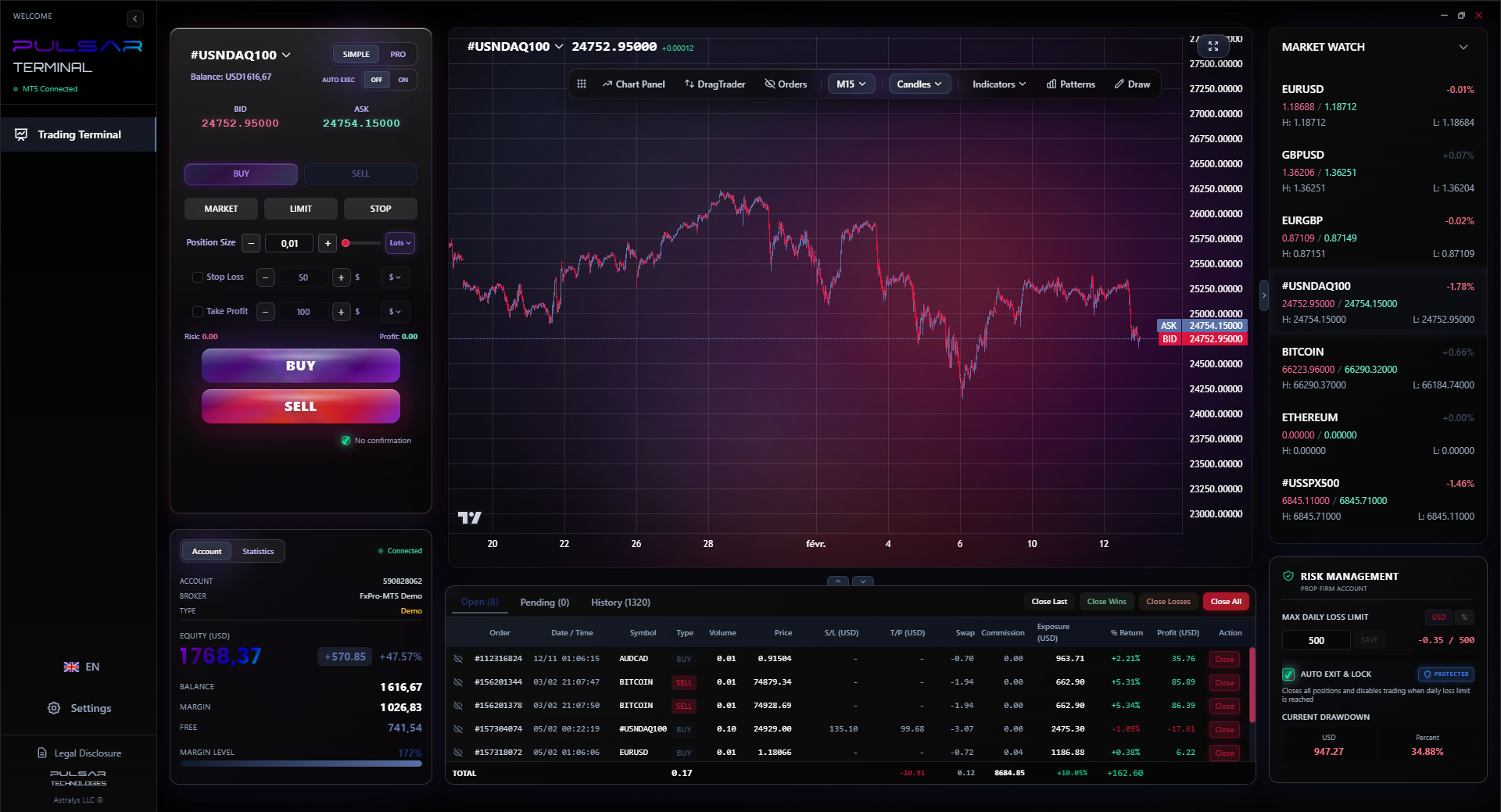
A written plan is useless if you can't execute it under pressure; tools like Pulsar Terminal automate key risk management rules like trailing stops and breakeven orders directly on your MT5 chart.
Pulsar Terminal
The all-in-one MT5 companion: drag-and-drop orders, multi-TP/SL, trailing stop, grid trading, Volume Profile, and prop firm protection. Used by 1,000+ traders daily.
“The moment you think you've 'made it' is the moment the market humbles you.”
This is the moment of truth. After your 3+ month demo apprenticeship, fund a live account.
The Nigerian Reality Check:
- Start Small. The brokers might allow $5, but that's pointless for learning real position size management. A realistic starter amount is between ₦150,000 and ₦500,000 ($200 - $500 equivalent). This is enough to feel the psychological pressure without it being life-changing money.
- This is risk capital. It should be money that, if lost entirely, does not affect your rent, bills, or family responsibilities. It is an educational investment.
- Use your plan. Trade the exact same way you did in your demo. The same lot size relative to your capital, the same strategy. The only thing that has changed is the psychological weight.
Your first goal with real money is NOT to double your account. Your goal is to survive for 6 months. Your goal is to execute your plan with discipline for 100 trades. If you can do that, you're in the top 20% already.
I see too many Nigerians pour in ₦2,000,000 from a business savings account, desperate for a return. They trade with fear and greed from the first click and are usually down 30% in a week. Start small. Prove you can follow your rules when real Naira is on the line. Scaling up comes later, after consistent profitability.
Learning forex trading never stops. The market changes. You must adapt.
Weekly Review: Every Sunday, look at your trade journal. What was your win rate? Your average win vs. average loss? Are you sticking to your risk limits? Why did you deviate from your plan on that losing trade on Wednesday?
Market Context: Stay informed on what moves your pairs. For EUR/USD, that's ECB and Fed policy. For USD/NGN, it's CBN actions, oil prices, and local liquidity. Don't trade in a vacuum.
The Psychology Battle: You will have losing streaks. A 5-loss streak with a 50% win-rate strategy is statistically normal. This is when most traders blow up. They abandon their plan, double their size to 'recover,' and trigger a margin call. Your plan must account for this. Your weekly review reminds you of the long-term statistics when short-term emotions are screaming.
I've been trading for over a decade. I still have a weekly review session. I still have a coach I answer to. The moment you think you've 'made it' is the moment the market humbles you. Treat this as a craft to be honed for years, not a hack to be mastered in months.
Pro Tip: The best traders are not the ones with the most complex strategies. They are the most disciplined executors of a simple plan. They are obsessed with process, not profits. The profits are a byproduct of a good process, consistently applied.
💡 Winston's Tip
The market doesn't care about your rent, your dreams, or your ego. It is a pure probability machine. The sooner you stop taking trades personally, the sooner you can start thinking clearly.
FAQ
Q1Is forex trading legal in Nigeria?
Yes, retail forex trading is legal for individuals in Nigeria. The Central Bank of Nigeria (CBN) and the Securities and Exchange Commission (SEC) provide the overarching framework. However, you cannot use the official CBN foreign exchange window to fund a trading account. You must use personal domiciliary accounts, cards, or approved e-wallets.
Q2How much money do I need to start forex trading in Nigeria?
While some brokers allow deposits as low as $5, a realistic and responsible starting amount for proper risk management is between $200 and $500 (roughly ₦300,000 to ₦700,000, depending on the exchange rate). This allows you to trade sensible position sizes without risking a huge percentage of your capital on a single trade. Never start with money you cannot afford to lose entirely.
Q3Which is the best broker for beginners in Nigeria?
There's no single 'best,' but good beginner-friendly brokers for Nigerians often include XM (for its strong education and low minimum deposit) and Exness (for its local popularity and flexible accounts). The key is choosing a broker that is well-regulated internationally, offers reliable Naira deposit methods, and provides the MT4/MT5 platform. Always do your own research, starting with our detailed XM review and Exness review.
Q4How do I avoid losing all my money?
By implementing strict risk management from day one. This means: 1) Never risk more than 1-2% of your account on a single trade. 2) Always use a stop-loss order. 3) Have a daily loss limit (e.g., stop trading if you're down 5%). 4) Start with a demo account to practice discipline without real money. 5) Follow a written trading plan. Most losses come from emotional trading and poor position sizing.
Q5Do I pay tax on forex trading profits in Nigeria?
Yes. According to Nigerian law, profits from forex trading are subject to a 10% Capital Gains Tax, which should be declared and paid to the Federal Inland Revenue Service (FIRS). This applies whether your broker is local or international. Factor this into your profit calculations.
Q6How long does it take to learn forex trading?
Expect a minimum of 6-12 months of dedicated study and practice before you can trade live with consistent discipline. The 3-month demo period is a bare minimum. Becoming consistently profitable often takes 2-3 years. This is a professional skill, not a weekend course. Anyone promising mastery in weeks is selling a lie.
Q7What is the best time to trade forex in Nigeria?
The most liquid and volatile periods are during the overlap of major market sessions. For Nigeria (West Africa Time, WAT), the best window is typically between 1:00 PM and 6:00 PM WAT. This covers the late London session and the opening of the New York session, which is when you'll see the most movement in major pairs like EUR/USD and GBP/USD.
Prof. Winston's Lesson
Key Takeaways:
- ✓Risk only 1-2% of capital per trade.
- ✓Demo trade for 3 months minimum.
- ✓Master one simple strategy first.
- ✓Write and follow a trading plan.
- ✓Tax your profits at 10% for FIRS.
How useful was this article?
Click a star to rate
Weekly Trading Insights
Free weekly analysis & strategies. No spam.
About the Author
Olumide Adeyemi
West African Trading Pioneer
One of Nigeria's most active forex trading educators. 8 years of experience trading from Lagos. Specializes in low-capital strategies and prop firm challenges for African traders.
Comments
Risk Disclaimer
Trading financial instruments carries significant risk and may not be suitable for all investors. Past performance does not guarantee future results. This content is for educational purposes only and should not be considered investment advice. Always conduct your own research before trading.
You Might Also Like

Cara Trading Forex Sukses: 7 Prinsip dari Trader Profesional
Cara trading forex sukses dengan 7 prinsip trader pro: manajemen modal, disiplin, journal trading, backtest. Data nyata, bukan janji profit palsu.
Jam Trading Forex Terbaik untuk Trader Indonesia: Panduan Lengkap dengan Tabel Waktu
Panduan jam trading forex untuk trader Indonesia. Tabel 4 sesi dunia, jam emas 20:00-00:00, sesi mana yang harus dihindari. Data akurat + tips dari trader berpengalaman.
Top 5 Sàn Forex Uy Tín Nhất 2026: Review Jujur dari Trader Indonesia
Top 5 sàn forex uy tín 2026 untuk trader Indonesia. Review jujur: spread, deposit, withdraw, dukungan lokal. Exness, XM, IC Markets & lebih.
Get Pulsar Terminal
All these calculators are built into Pulsar Terminal with real-time data from your MT5 account. One-click position sizing, automatic risk management, and instant calculations.
Get Pulsar Terminal