


The screen was a sea of red.

David van der Merwe
Emerging Markets Trader ·  South Africa
☕ 10 min read
What you'll learn:
- 1Who The Hell Is Steve Hopwood?
- 2The South African Forex Reality Check
- 3The Real Costs of Trading Here (It's Not Just The Spread)
- 4Brokers That Actually Work For South Africans
- 5How To Use (Not Follow) Hopwood's Analysis
- 6Local Market Drivers Steve Hopwood Won't Tell You About
- 7Building Your Own System: The Hybrid Approach
- 8Final Verdict: Is Steve Hopwood Forex Worth It For A South African?
The screen was a sea of red. It was March 2020, and the ZAR was in freefall against the USD. My phone buzzed with an alert from a Steve Hopwood forecast I’d been following, calling for a major support level on USD/ZAR at 17.80. The price was 18.50 and dropping fast. I remember thinking, ‘This guy’s either a genius or we’re all about to get wiped out.’ I didn’t take the trade. The rand blew straight through that level, eventually hitting 19.35. That moment taught me more about applying foreign analysis locally than any winning trade ever could. Let’s talk about what Steve Hopwood forex actually means for you, trading from South Africa.
Steve Hopwood isn't some mysterious guru. He's a UK-based technical analyst who's been publishing daily forex forecasts for years. His main thing is his website, stevehopwoodforex.com, where he posts free daily technical analysis for major pairs. No fancy sales pitch, just charts with his drawn levels. His approach is pure price action – support, resistance, trend lines. He doesn't talk about SARB meetings or load-shedding's impact on the rand. That's your first clue.
For a South African trader, this is both useful and dangerously incomplete. His analysis on EUR/USD or GBP/USD can be spot-on for global flows. I've used his resistance zones on GBP/USD to time exits on my ZAR pairs, because when the Pound gets whacked, GBP/ZAR usually follows. But treating his word as gospel for our local market is a quick way to lose money. The ZAR has its own unique drivers that a London-based analyst isn't factoring into his lines on a chart.

Warning: Foreign analysis often ignores local liquidity. A perfect technical setup on USD/ZAR can be destroyed by a sudden SARB intervention or a major corporate forex conversion, events a global analyst won't see coming.
Trading here isn't like trading in London or New York. We have layers. First, you've got the regulator, the FSCA. They're the ones who decide if your broker can legally take your money. Then you've got the South African Reserve Bank (SARB) watching every cent that tries to leave the country. This shapes everything.
The FSCA Rules The Roost
Every legit broker operating here needs an FSCA license. It's not optional. This license (a Category I or II FSP) forces them to keep client money segregated, report regularly, and have a local key individual. This is good for you. It means if an FSCA-regulated broker like Exness or FP Markets goes under, your funds aren't just gone. Always, and I mean always, check the FSP number on the FSCA's website. I learned this the hard way in 2015 with an ‘offshore’ broker that vanished with R50,000 of my capital.
The SARB's Invisible Hand
The SARB's exchange controls are the silent partner in every trade you make. They limit how much you can move offshore. As an individual, if you cease to be a tax resident, you can move up to R10 million per year out. But for active trading? Most of us are using locally licensed brokers who handle the ZAR side internally. This is why using a broker with a proper ZAR account is non-negotiable. It saves you a fortune in bank conversion fees. Capitec, for instance, charges R350 for an incoming foreign payment. That's a 1.4 pip spread on a standard lot before you even place a trade.

💡 Winston's Tip
A foreign analyst's chart is a map of their country, not yours. Learn to read the terrain of your own market first.
“A 1-pip difference in spread is R100 per lot. That's the real cost of choosing the wrong broker.”
Let's get specific. When you see ‘spreads from 0.0 pips,’ you're only seeing half the picture. Here’s what actually comes out of your pocket.
| Cost Type | What It Is | Typical Amount (ZAR Equivalent) |
|---|---|---|
| Spread | Broker's built-in fee | 0.5 - 1.5 pips on EUR/USD (R50-R150 per lot) |
| Commission | Per-trade fee on ‘raw’ accounts | $3-$6 per lot per side (R55-R110) |
| Overnight Swap | Interest for holding past 10pm GMT | Varies wildly by pair & direction. Can be R±200 per lot. |
| Bank Fees | EFT/Deposit/Withdrawal | R0 (good brokers) to R350 (bad bank routes) |
| Currency Conversion | If your account isn't in ZAR | ~1% of the transaction, a silent killer. |
A real example from my book: On a scalping strategy with FP Markets, I'd trade 5 lots of EUR/USD per day. The raw spread was 0.1 pips, commission $3 per lot. Daily cost: (0.1 pip * R10 * 5 lots) + ($3 * 2 sides * 5 lots * R18.5) = R5 + R555 = R560 just in fees. You need to win more than that to be profitable. This is why you must use a position size calculator religiously.

Pro Tip: Always choose a ‘ZAR account’ with your broker. It eliminates the hidden 1% conversion fee the broker's bank charges when your deposit is converted from Rands to Dollars. That's R1,000 gone on a R100,000 deposit before you click buy.
Forget the flashy international ads. You need a broker that understands our market. Based on my experience and their FSCA licenses, here are the ones that consistently deliver.
- Exness (FSP 51024): My go-to for beginners. Why? The minimum deposit is about R180 ($10). Withdrawals to FNB are often same-day, with zero fees. Their spreads on majors are decent, and the platform just works. I've funded an account with R500 just to test a new strategy without sweating.
- FP Markets (FSP 50926): For the serious trader. Their raw spreads are consistently tight (I regularly see 0.1 pips on EUR/USD), and the $3 commission is fair. They offer MT4, MT5, and cTrader. Their customer service actually picks up the phone in SA business hours.
- Tickmill (FSP 49464): Speed demons. If you're into scalping or news trading, their average execution is 0.20 seconds. That matters when the US Non-Farm Payrolls data hits and USD/ZAR moves 100 pips in a blink. Minimum deposit is $100.
A word on use: The FSCA caps it at 50:1 for newbies and 100:1 for ‘experienced’ traders. This is a good thing. Anyone offering you 500:1 is not FSCA-regulated, and you're not a client, you're a target. High use is the fastest path to a margin call.
“Spending money on his paid services? I wouldn't. The value isn't there for us.”
Steve Hopwood's daily forecasts are a tool, not a strategy. Here’s how I integrate them without letting them dictate my trading.
First, I look at his key levels for the majors – especially EUR/USD and GBP/USD. The ZAR often takes directional cues from global risk sentiment, which these pairs reflect. If Hopwood identifies a strong resistance zone on EUR/USD at 1.0850 and price is approaching it, I'm not looking to sell EUR/USD. I'm checking if EUR/ZAR is showing similar exhaustion. It often does, with a lag. This gave me a great short entry on EUR/ZAR at 20.45 in January 2024, netting 220 pips as the Euro sold off globally.
Second, I completely ignore his analysis if the local driver is overwhelming. In late 2025, when SA's credit rating was upgraded, the ZAR strengthened across the board. Any Hopwood forecast suggesting USD/ZAR strength based on technicals was useless against that fundamental tidal wave. This is where you need your own brain. Tools like the MACD indicator or RSI on your local pair are more valuable than a foreign forecast.

Example: Hopwood calls for GBP/USD support at 1.2600. Instead of trading that, I watch GBP/ZAR. It finds support at 23.80, aligns with a daily bullish RSI divergence. That's a higher-probability, locally-confirmed trade idea inspired by, not copied from, his work.
💡 Winston's Tip
The most important analysis you'll do today is calculating your position size. Everything else is secondary.
This is the crucial chapter. Your edge as a South African trader isn't in copying a UK analyst; it's in understanding what he misses.
- SARB Interest Rate Decisions: We're in a cutting cycle in 2026. When the SARB cuts rates, the ZAR typically weakens (all else equal). This can override any technical support on USD/ZAR. You need to trade the expectation before the announcement.
- Eskom & Logistics: Seriously. A stage 6 load-shedding announcement can cause a sudden spike in USD/ZAR as foreign investors panic. It's an irrational, liquidity-driven move that doesn't respect trend lines.
- SA Bond Flows: Our bonds have been outperforming. When foreign money pours into our bond market, they buy ZAR to do it, strengthening the currency. This was a huge driver of rand strength in 2025, completely disconnected from the Dollar's global trend.
- Corporate Actions: Large SA companies converting billions in offshore profits back to ZAR for dividends creates massive, temporary demand for our currency. You won't see this on a chart until it happens.
I got caught by this in 2021. Perfect swing trading setup on USD/ZAR, bullish. Then a massive, unexpected corporate forex conversion hit the market, spiking the bid for ZAR and stopping me out for a 1.5% loss. The chart gave no warning.
“High use is the fastest path to a margin call.”
So how do you build something strong? You take the useful global context from analysts like Hopwood and fuse it with local execution.
Step 1: The Global Filter. Start your day with a quick look at the technical picture for the major Dollar pairs (EUR/USD, GBP/USD). Is the Dollar strong or weak globally? This sets the background for USD/ZAR. Use free resources for this, nothing fancy.
Step 2: The Local Lens. Now switch to your ZAR pairs. Apply your own technical analysis. Look for confluences. Does the support on USD/ZAR align with a 200-day moving average AND a key Fibonacci level? Is there a divergence on the hourly RSI? This is your primary analysis.
Step 3: The Fundamental Overlay. Check the calendar. Is there a SARB speech today? A major SA data release (CPI, GDP)? What's the load-shedding schedule? This tells you whether to trust the technicals or sit on your hands.
Step 4: Execute on a Local Platform. Use an FSCA-regulated broker with tight spreads on ZAR pairs. Place your trade with disciplined risk management. A tool that lets you set multiple take-profit levels and a trailing stop is useful for locking in profits on our volatile pairs.
This hybrid approach turns you from a follower into a strategist. You're using global flow information to inform your local trade, not dictate it.
💡 Winston's Tip
If you wouldn't take the trade without seeing Hopwood's chart, you shouldn't take it after seeing it either. Conviction must be your own.
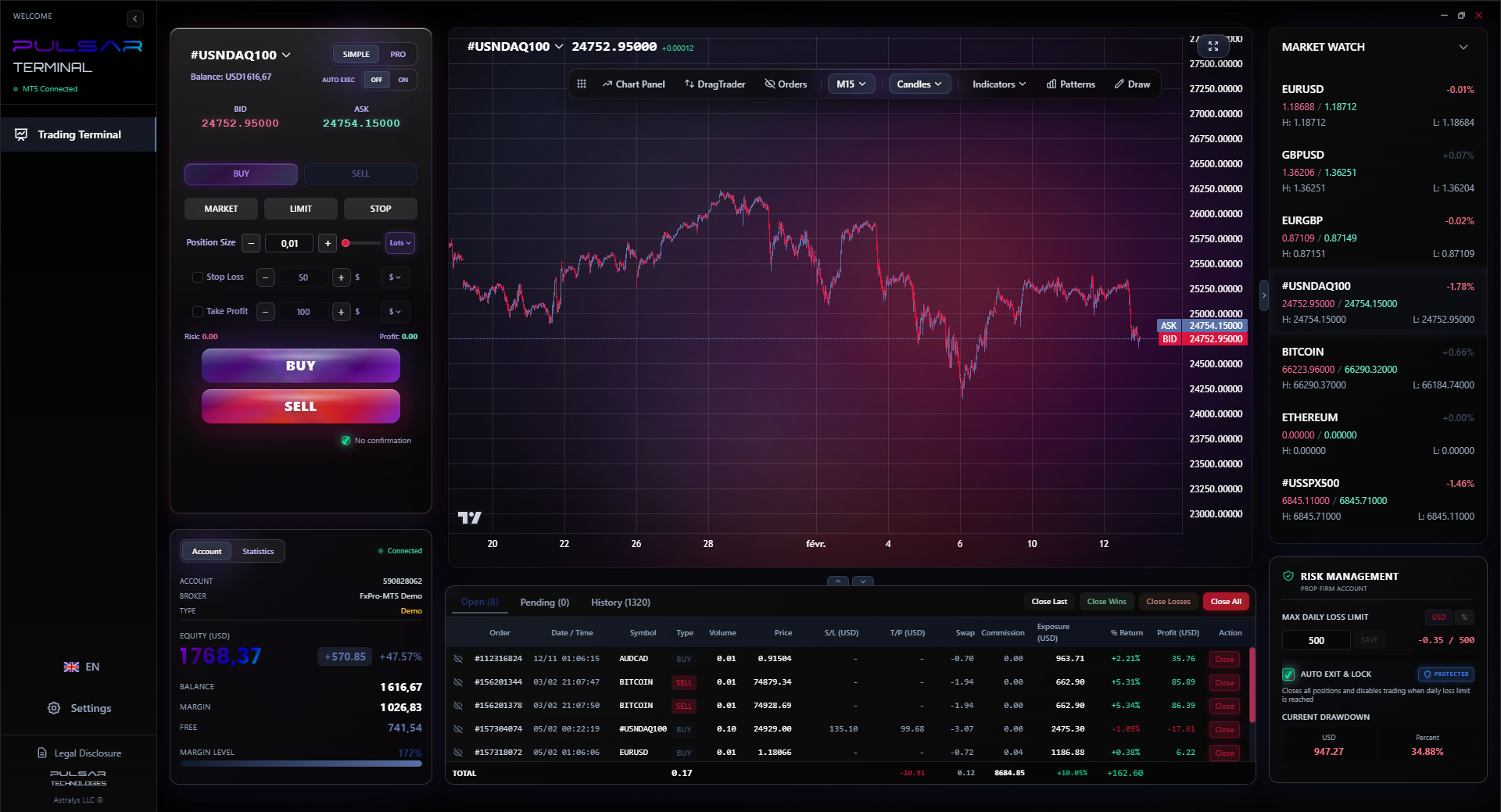
Managing volatile ZAR pairs requires precise order tools, and Pulsar Terminal's drag-and-drop orders and multi-level take-profit features let you execute complex local strategies directly on MT5.
Pulsar Terminal
The all-in-one MT5 companion: drag-and-drop orders, multi-TP/SL, trailing stop, grid trading, Volume Profile, and prop firm protection. Used by 1,000+ traders daily.
Here's my blunt take after 12 years: Steve Hopwood's free daily analysis is a useful, zero-cost weather vane for global forex winds. It's worth a 30-second glance in your morning routine. But it is absolutely not, and never will be, a substitute for understanding the South African market.
Spending money on his paid services? I wouldn't. The value isn't there for us. The cost of a monthly subscription would be better spent on a quality data feed for SA-specific news or saved as trading capital.
Your success will be determined by how well you manage risk on the ZAR's wild swings, how cheaply you can execute trades with a good local broker like Pepperstone or XM, and how disciplined you are in cutting losses when local fundamentals blow up your chart. No foreign analyst can do that for you.
Focus on the things you control: your broker choice, your position size, your knowledge of SARB policy. Use global analysis as background noise, not a trading signal. That's how you survive and thrive trading forex from South Africa.
FAQ
Q1Is Steve Hopwood regulated or licensed to give advice in South Africa?
No. Steve Hopwood is a UK-based technical analyst providing general market commentary. He is not licensed by the South African FSCA to provide financial advice. His analysis is for informational purposes only and should not be considered a recommendation to trade.
Q2What is the best broker for trading ZAR pairs in South Africa?
The 'best' depends on your style. For low costs and ease, Exness is great for beginners. For tight raw spreads and professional tools, FP Markets or IC Markets are top choices. The non-negotiable is that the broker must be FSCA-regulated (check their FSP number) and offer a ZAR account to avoid conversion fees.
Q3How do exchange controls affect my forex trading?
SARB controls limit how much money you can send abroad annually. However, by using an FSCA-regulated broker with a local presence, you are typically trading within a South African legal entity. Your deposits and withdrawals in ZAR are domestic transfers, so the strict offshore limits don't directly apply to your trading activity. Always confirm this with your specific broker.
Q4Can I use Steve Hopwood's signals for trading Gold (XAU/USD)?
Potentially, but with the same caution. Gold is a global market, so his technical analysis on XAU/USD may have more direct relevance than for ZAR pairs. However, you must still factor in costs (like spreads and swaps) from your South African broker and manage your risk independently.
Q5What use can I get as a South African trader?
The FSCA mandates maximum use of 50:1 for retail clients classified as 'beginners'. If you can prove sufficient experience and knowledge, you may be eligible for up to 100:1. Any broker offering you significantly more (like 500:1 or 1000:1) is not complying with FSCA rules and should be avoided.
Q6Why does the ZAR sometimes move opposite to what global USD analysis suggests?
Because of local drivers. A global USD sell-off might weaken USD/ZAR, but if there's simultaneous bad news in South Africa (like a credit downgrade warning or severe load-shedding), the ZAR can weaken even faster, causing USD/ZAR to rise. The local factor often outweighs the global trend.
Prof. Winston's Lesson
Key Takeaways:
- ✓Always verify FSCA regulation (FSP number) before depositing.
- ✓Use a ZAR account to avoid hidden 1% conversion fees.
- ✓Global analysis is context, not a signal, for ZAR pairs.
- ✓Factor in ALL costs: spread, commission, swap, bank fees.
- ✓Local drivers (SARB, Eskom, bonds) override global technicals.
How useful was this article?
Click a star to rate
Weekly Trading Insights
Free weekly analysis & strategies. No spam.
About the Author
David van der Merwe
Emerging Markets Trader
Johannesburg-based trader with 11 years in emerging market currencies. Specializes in ZAR pairs, FSCA-regulated trading, and South African market analysis.
Comments
Risk Disclaimer
Trading financial instruments carries significant risk and may not be suitable for all investors. Past performance does not guarantee future results. This content is for educational purposes only and should not be considered investment advice. Always conduct your own research before trading.
You Might Also Like

Cara Trading Forex Sukses: 7 Prinsip dari Trader Profesional
Cara trading forex sukses dengan 7 prinsip trader pro: manajemen modal, disiplin, journal trading, backtest. Data nyata, bukan janji profit palsu.
Jam Trading Forex Terbaik untuk Trader Indonesia: Panduan Lengkap dengan Tabel Waktu
Panduan jam trading forex untuk trader Indonesia. Tabel 4 sesi dunia, jam emas 20:00-00:00, sesi mana yang harus dihindari. Data akurat + tips dari trader berpengalaman.
Top 5 Sàn Forex Uy Tín Nhất 2026: Review Jujur dari Trader Indonesia
Top 5 sàn forex uy tín 2026 untuk trader Indonesia. Review jujur: spread, deposit, withdraw, dukungan lokal. Exness, XM, IC Markets & lebih.
Get Pulsar Terminal
All these calculators are built into Pulsar Terminal with real-time data from your MT5 account. One-click position sizing, automatic risk management, and instant calculations.
Get Pulsar Terminal