


I was staring at a $14,000 unrealized loss on a single TSLA position.

James Mitchell
Senior Trading Analyst
☕ 12 min read
What you'll learn:
- 1What the Hell is a Stock Prop Firm, Really?
- 2Why Bother? The Pros Are Actually Pretty Compelling
- 3The Dark Side: Fees, Rules, and Psychological Warfare
- 4Picking Your Poison: How to Choose a Stock Prop Firm
- 5The Evaluation Gauntlet: A Step-by-Step Game Plan
- 6You Passed. Now the Real Work Begins.
- 7Is There Another Way? Honest Alternatives
- 8The Final Verdict: Who Should Actually Do This?

I was staring at a $14,000 unrealized loss on a single TSLA position. My heart wasn't pounding, my palms weren't sweaty. It was a Tuesday. The firm's risk manager had already pinged me twice. That's the reality of trading with a stock prop firm. It's not your money, and they never let you forget it. I've traded for prop shops in Chicago, New York, and remotely. Some were golden tickets, others were glorified scams with fancy offices. Let's cut through the marketing nonsense and talk about what this world is actually like.
Forget the sleek websites. At its core, a stock prop firm gives you capital to trade in exchange for a chunk of your profits. You're not a customer. You're a contractor, a revenue source. They provide the use, the technology (sometimes), and the seat on the exchange. You provide the skill (or luck) and assume 100% of the career risk.
There are two main models, and confusing them is a rookie mistake that costs people money.
The Traditional House Model
This is the old-school way. You show up to an office, often in a financial hub like Chicago or NYC. You get trained (sometimes), you get a desk, and you trade the firm's capital. Your losses are their losses, up to a point. Blow through your daily or monthly loss limit, and you're packing your box. The profit split might start at 50/50 and scale up to 80/20 or even 90/10 in your favor as you prove yourself. This model is about retention. They want consistent producers, not lottery ticket winners.
The Modern Challenge Model
This is the online beast you see advertised everywhere. You pay a fee - say, $300 - to take a 'challenge.' You trade a simulated account with specific rules: hit a profit target (e.g., 10%) without violating a daily loss limit (e.g., 5%) or a max drawdown. Pass, and you get a 'funded' account. Your fee is often refunded. Then you trade, and they take a slice of your profits, usually 80/20 in your favor. Your max loss is the fee you paid. Their max loss is theoretically the capital they allocated, but their risk controls are so tight it's almost impossible for them to lose big.

Warning: The challenge model is a numbers game for the firm. They collect fees from thousands of hopefuls. Most fail. The ones who pass and become profitable are pure upside. Always read the rules on trailing drawdowns - it's where most get caught.
The key difference? In the traditional model, the firm's risk is real. In the challenge model, their risk is heavily mitigated before you ever see real money. I made my early bones in a traditional house. The pressure was immense, but the education was real. The first time I had to explain a 3% drawdown on my book to the head trader was more formative than any book I've read.

💡 Winston's Tip
When evaluating a firm, ignore the 'up to' profit split. Ask for the *starting* split and the exact, written criteria to scale it higher. Vague promises are worth less than the paper they're not printed on.
If it's so tough, why do it? Because when it works, it's a fast track you can't replicate on your own.
Access to Capital: This is the big one. You're 25, a great trader, but you have $10,000 in savings. Good luck building real wealth with that. A prop firm might give you $100,000, $500,000, or even a million dollars in buying power. Your skill is now leveraged 10x, 50x, 100x. I went from trading a $30k personal account to managing a $250k line at a firm. The mental shift alone was huge.
Better Technology & Costs: Direct market access (DMA) platforms, ultra-low latency feeds, and institutional commission rates. Your cost per trade plummets. When you're scalping for pennies, this is the difference between profit and loss. My per-share commission dropped from $0.005 to $0.001. That's $4 saved on every 1000-share lot. It adds up fast.
Structure and Discipline: This is the hidden benefit. You have rules. Daily loss limits, position size caps, restricted stocks. It forces discipline that most retail traders lack. You can't YOLO into a meme stock. That structure saved me from myself more times than I can count.
Profit Potential: Let's run numbers. Say you get a $100k funded account with an 80/20 split. You make a 15% return in a year ($15,000). Your take-home is 80%: $12,000. On a personal $10k account, a 50% return (which is much harder) only nets you $5,000. The math is compelling, provided you can pass their gates.

“The money isn't in the funding. It's in the consistency you develop to get it and keep it.”
It's not free money. The barriers are designed to weed people out.
The Fee Trap: Challenge fees are non-refundable if you fail. Fail twice, and you've donated $600 to the firm's marketing budget. Some firms offer 'free retries' or discounts, but it's a cost of entry you must factor in. Never risk money on a challenge fee you can't afford to light on fire.
Byzantine Rulebooks: This is where they get you. The profit target might be 10%, but you have a 5% trailing drawdown from your equity peak. So you get to 9%, have a small losing day that drops your equity to 8.5%, and now your drawdown limit has trailed up. Your new max loss might now be only 0.5% away. It's brutal. You must understand the margin call and loss mechanics inside out.
The Payout Hustle: Some firms have monthly minimum profit thresholds to get a payout. Or they hold your first payout for 60 days. Or they only pay out 50% of your earned split until you hit a certain milestone. Read the payout terms more carefully than the trading rules.
It's Isolating: Trading from home for a challenge-based firm can be lonely. No pit banter, no veteran to glance at your screen and mutter 'you're an idiot.' You need serious self-motivation. I failed my first two remote challenges purely from a lack of structure. I treated it like a hobby, not a job. Big mistake.

Pro Tip: Before paying a fee, find the firm's rulebook and calculate the actual risk. If you have a $100k eval account with a 5% max loss and 3% daily loss, your real risk is $5,000. But with a trailing drawdown, your risk window shrinks as you profit. Use a position size calculator religiously from day one.
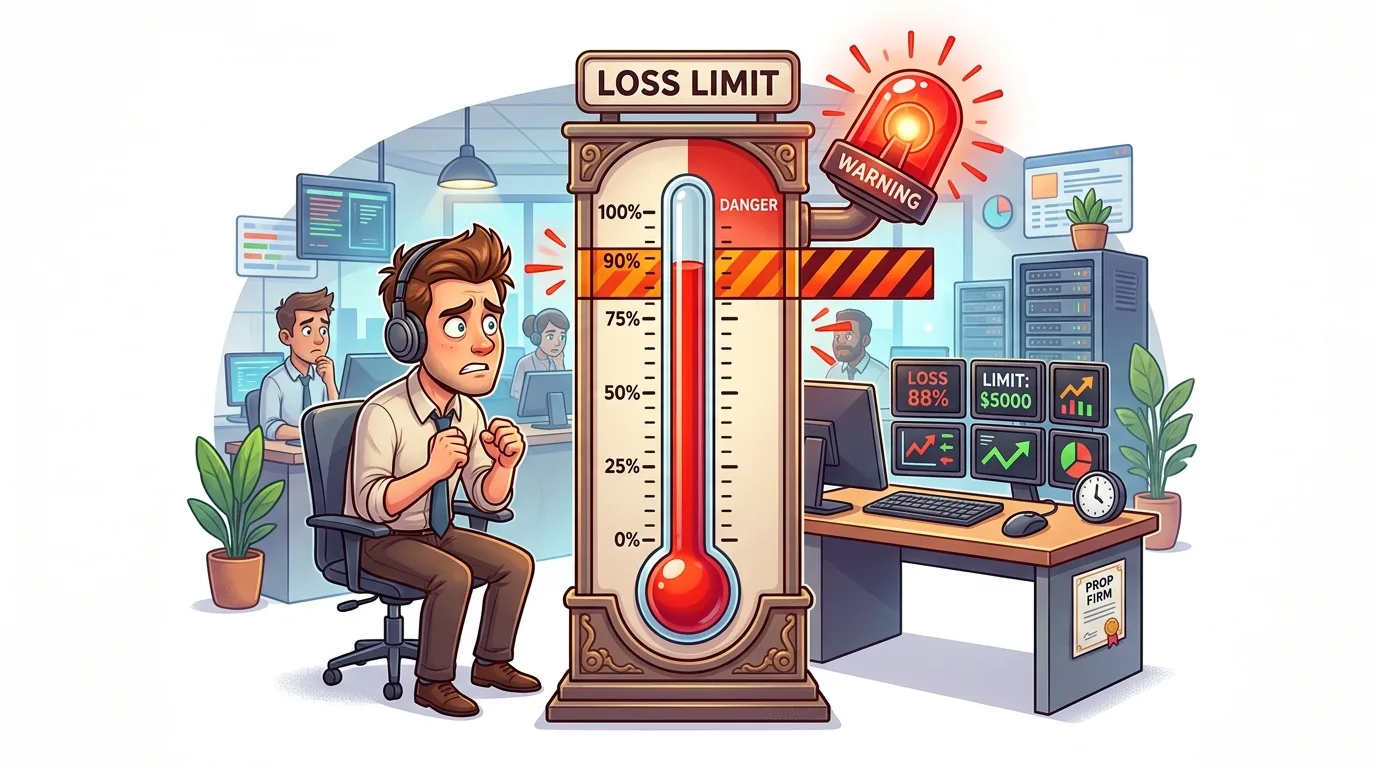
Don't just Google 'best prop firm.' You need a checklist.
| Criteria | What to Look For | Red Flag |
|---|---|---|
| Profit Split | 80/20 or better for you. Clear scaling plan (e.g., move to 90/10 after consistent profits). | Anything starting below 70/30. Opaque scaling. |
| Payout Terms | Weekly or bi-weekly payouts. No ridiculous minimums. First payout within 30 days. | Monthly payouts with high minimums. 'Reserve' accounts that hold your money. |
| Trading Rules | Clear, static rules. Sensible daily loss limits (3-5%). Understandable drawdown model. | Constantly changing rules. 'Maximum position size' that's tiny relative to account size. |
| Platform & Fees | A professional platform (Thinkorswim, Sterling, DAS). Low, transparent commission rates. | Proprietary, clunky platform. High 'data fees' deducted from profits. |
| Reviews & Reputation | Long track record (3+ years). Actual trader testimonials you can verify on independent forums. | Brand new firm with excessive YouTube influencer promotions. |
My Experience: I once joined a firm with a great split (85/15) but a proprietary platform that was slower than molasses. I was scalping EUR/USD and the 200ms delay in order execution killed my edge. I lost $2,300 of the firm's money in two days and was shown the door. The tech stack matters as much as the split.
Also, consider what you trade. Some firms specialize in equities, others in futures or forex. If you're a stock picker, a firm focused on forex won't give you the tools you need. Most stock prop firms will let you trade major ETFs and liquid large-caps, but may ban penny stocks or low-float momentum plays.

“Passing the challenge is a tactical mission, not trading. You must suppress every gambling instinct.”
Passing the challenge is a tactical mission, not trading. You must suppress every gambling instinct.
Phase 1: The Grind (First 50% of Target) Your only goal is survival. Trade tiny. I mean, ridiculously small. If your max daily loss is $2,500, your first trades should risk no more than $50. Your mission is to compound slowly and avoid ever touching that daily loss limit. Use boring, high-probability setups. Think swing trading a major index ETF like SPY with a tight stop. Forget alpha. Seek consistency.
Phase 2: The Middle Game (50%-80% of Target) You have a cushion. You can slightly increase position size, but never more than 1-2% of your account risk per trade. The psychology here is tricky. You're close, which makes you prone to either over-trading to 'get it done' or freezing up. Stick to your system. This is where a tool for managing multiple take-profit levels is useful, letting you bank partial profits and reduce risk.
Phase 3: The Endgame (80%-100% Target) This is the most dangerous phase. Go back to trading tiny. Your goal is to nickle-and-dime your way across the finish line. Once you hit the target, STOP TRADING. Submit for verification immediately. I know a guy who hit his 10% target on a Friday afternoon, decided to 'go for 11%' on one more trade, and blew through his daily loss limit. He failed. Don't be that guy.

Example: You have a $100k challenge. Profit target: $10,000 (10%). Max total loss: $5,000. Your game plan? Aim for $200 profit days risking $100 per trade. That's 50 successful days. Sounds boring? It is. But it's a business, not a casino. After passing, you can adjust your strategy for the live account, where the rules might be slightly looser.
💡 Winston's Tip
Your first goal in a funded account isn't to maximize returns. It's to secure your first three consecutive payouts. Consistency builds your internal confidence and the firm's trust in you, which is your real capital.
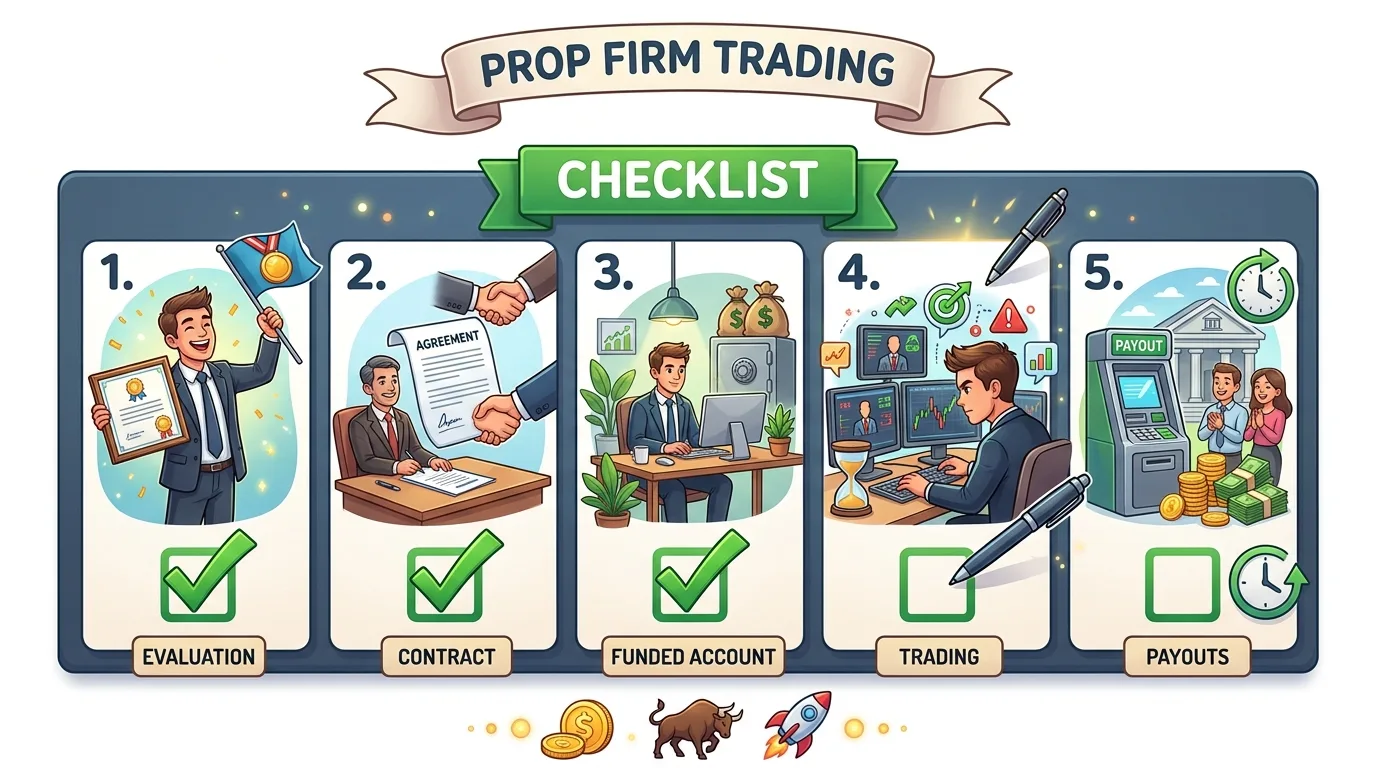
Congratulations. You now have a funded account. The psychology shifts again. Now you're trading for payouts, not just a pass/fail.
The First Payout is Critical: Your first goal is to trigger a payout. It makes it real. It builds trust with the firm (and with yourself). Don't go for a home run. Aim for the minimum payout threshold with low-risk trading.
You Will Be Monitored: They track your Sharpe ratio, win rate, average win vs. average loss. They're looking for consistency, not a one-hit wonder. A string of 10 small, green days is better than 9 losers and one massive winner.
Scale Gradually: Most firms will increase your capital allocation after a period of consistent profits. Don't rush this. When they offer you a larger account, your first move should be to reduce your position size relative to the new capital until you're comfortable. More capital amplifies both gains and mistakes.
I remember my first major payout from a funded account. It was $8,400. After months of sim trading and challenges, seeing that wire hit my bank account was the validation I needed. It also came with a brutal lesson: I got overconfident, doubled my size the next week, and gave back 30% of it. The firm's risk manager called me. He didn't yell. He just calmly asked, 'Did your strategy change, or did your discipline?' I had no good answer. It was a cheap lesson that felt expensive at the time.
Managing a live prop account requires a different kind of stamina. Tools that help automate risk management - like setting automatic trailing stops or breakeven points - become essential to protect you from yourself. The goal is to make the process boringly repeatable.
Managing the complex risk rules of a prop firm live account is exhausting; Pulsar Terminal automates daily loss limits and trailing drawdown protection directly on your MT5 chart.
Pulsar Terminal
The all-in-one MT5 companion: drag-and-drop orders, multi-TP/SL, trailing stop, grid trading, Volume Profile, and prop firm protection. Used by 1,000+ traders daily.

“A string of 10 small, green days is better than 9 losers and one massive winner.”
Prop firms aren't the only path. For some, they're the wrong path.
Build Your Own Account Slowly: This is the purest way, but the slowest. It requires extreme discipline and living well below your means to reinvest profits. Use a reputable broker like Pepperstone or IC Markets with tight spreads. The advantage? 100% of the profits are yours. The disadvantage? It might take years to get to meaningful capital.
Find a Mentor or Small Collective: This is a hybrid. A group of traders pools capital or shares ideas. Less formal than a prop firm, but with some community and accountability. You often need to bring some capital or a proven track record to the table.
The Retail Grind: Use margin on a personal account. This is high-risk. A 2:1 margin on a $25k account gives you $50k in buying power, but a 10% drop wipes out 20% of your equity. The margin call risk is all on you. I don't recommend this for most.
For me, the prop firm route was the accelerator I needed. I didn't have the patience to grind a $5k account for five years. I needed the structure, the capital, and the pressure of having to answer to someone. But it's not for the faint of heart. If you have a steady job and can treat trading as a slow-build side hustle, that's a perfectly valid - and often saner - path.

After 12 years, here's my blunt assessment.
A stock prop firm is RIGHT for you if:
- You have a proven, written trading strategy with a positive expectancy (backtested, forward-tested on sim).
- You possess monk-like discipline and can follow rules robotically.
- You need capital to scale but don't have it.
- You thrive under structured pressure.
- You can afford to lose the challenge fees without it affecting your rent.
A stock prop firm is WRONG for you if:
- You're looking for a 'get rich quick' scheme.
- You're still searching for a 'winning strategy.'
- You're emotionally volatile; losses ruin your week.
- You can't stick to a trading plan.
- The challenge fee is a significant portion of your savings.
The industry has democratized access, but it's also attracted sharks. Do your due diligence. Start with the smallest challenge account you can. Treat it like the hardest job interview of your life.
, stock prop firms are a tool. A very sharp, double-edged tool. In the right hands, they can build a career faster than any other route available to the average person. In the wrong hands, they're just an expensive way to learn that you're not cut out for this game. And there's no shame in that last part. Knowing what you don't want to do is just as valuable as knowing what you do.
I'll leave you with this: The money isn't in the funding. It's in the consistency you develop to get it and keep it. Focus on that, and the splits and the payouts will follow.
FAQ
Q1What's the typical profit split at a stock prop firm?
For modern challenge-based firms, 80/20 in your favor is standard for the first tier. Traditional houses might start at 50/50 but scale to 80/20 or 90/10 as you prove yourself. Always read the scaling plan - a high starting split with no scaling can be worse than a lower split that grows.
Q2Can I trade options or futures with a stock prop firm?
It depends entirely on the firm. Most 'stock' prop firms focus on equities and ETFs. Some offer futures trading, and a few might allow equity options. You must check their instrument list. Don't assume. If you're an options trader, seek out a firm that specifically supports that asset class.
Q3How much do I need to start with a prop firm?
Your startup cost is the evaluation fee, which typically ranges from $200 to $500 for a standard challenge. You should also have at least 3-6 months of living expenses saved separately. Never fund a challenge with money you need for bills.
Q4Is passing a prop firm challenge mostly luck?
No. While luck can influence a single trade, passing a challenge that requires hitting a profit target over time without violating loss limits is overwhelmingly a test of risk management and discipline. Luck-based traders get weeded out quickly by the drawdown rules.
Q5What happens if I lose the firm's money in a live account?
In a traditional firm, you'd likely be terminated. In a challenge-based funded account, you'll hit your max drawdown limit and the account will be closed. You may be offered a discount to retake the challenge. You are not personally liable for the losses beyond the loss of the account.
Q6Are prop firm payouts taxed?
Yes, in the US, your profit split is considered self-employment income. You will receive a 1099 form and are responsible for income tax and self-employment tax (Social Security & Medicare). Set aside 25-30% of every payout for taxes.
Q7Can I trade for multiple prop firms at once?
Technically, yes, if you have the mental bandwidth. However, most firms require you to disclose this, and some prohibit it in their terms. Juggling multiple rule sets and risk limits is a recipe for costly mistakes. I'd master one firm first.
Prof. Winston's Lesson
Key Takeaways:
- ✓Treat challenge fees as a business cost, not an investment.
- ✓Your max risk per trade in an eval should be 0.5% or less.
- ✓The trailing drawdown rule is where 70% of traders fail.
- ✓Choose firms with a 3+ year track record and weekly payouts.
How useful was this article?
Click a star to rate
Weekly Trading Insights
Free weekly analysis & strategies. No spam.
About the Author
James Mitchell
Senior Trading Analyst
Based in New York with over 9 years of trading experience. Focuses on major USD pairs, prop firm challenges, and the US regulatory landscape.
Comments
Risk Disclaimer
Trading financial instruments carries significant risk and may not be suitable for all investors. Past performance does not guarantee future results. This content is for educational purposes only and should not be considered investment advice. Always conduct your own research before trading.
You Might Also Like

Cara Trading Forex Sukses: 7 Prinsip dari Trader Profesional
Cara trading forex sukses dengan 7 prinsip trader pro: manajemen modal, disiplin, journal trading, backtest. Data nyata, bukan janji profit palsu.
Jam Trading Forex Terbaik untuk Trader Indonesia: Panduan Lengkap dengan Tabel Waktu
Panduan jam trading forex untuk trader Indonesia. Tabel 4 sesi dunia, jam emas 20:00-00:00, sesi mana yang harus dihindari. Data akurat + tips dari trader berpengalaman.
Top 5 Sàn Forex Uy Tín Nhất 2026: Review Jujur dari Trader Indonesia
Top 5 sàn forex uy tín 2026 untuk trader Indonesia. Review jujur: spread, deposit, withdraw, dukungan lokal. Exness, XM, IC Markets & lebih.
Get Pulsar Terminal
All these calculators are built into Pulsar Terminal with real-time data from your MT5 account. One-click position sizing, automatic risk management, and instant calculations.
Get Pulsar Terminal