


Here's a fact that should make you sit up: over 90% of retail forex traders lose money.

Olumide Adeyemi
West African Trading Pioneer ·  Nigeria
☕ 10 min read
What you'll learn:
- 1What is a Supply and Demand Forex Strategy? (Forget Everything You Think You Know)
- 2Trading Legally in Nigeria: The Real Situation
- 3How to Identify Real Supply and Demand Zones on Your Chart
- 4Entry, Exit, and Confirmation: Your Trade Execution Plan
- 5Applying This Strategy to the Nigerian Trader's Reality
- 6The 5 Most Common Mistakes (I've Made Them All)
- 7Choosing Your Timeframe: Are You a Sniper or a Sniper's Commander?
- 8Brokers, Tools, and Getting Started in Nigeria
Here's a fact that should make you sit up: over 90% of retail forex traders lose money. Yet, the banks and institutions consistently profit. The difference isn't just capital, it's methodology. They trade where the real orders are - at supply and demand zones. This isn't another indicator-based system that lags behind price. It's about understanding where the market is likely to reverse because that's where the big money has placed its bets. For Nigerian traders navigating a market with a volatile Naira and regulatory gray areas, mastering this approach isn't just smart, it's a survival tactic.
Let's clear this up right now. A supply and demand forex strategy has nothing to do with economic news headlines about oil production or GDP. That's fundamental analysis. We're talking about pure price action. It's the visual footprint of institutional order flow on your chart.
Think of it this way: price moves because of an imbalance. When there are way more buyers than sellers at a certain price, the price rockets up until it finds sellers. That leaving point is a demand zone. The opposite is a supply zone. These aren't thin lines like support and resistance. They are areas, or zones, where the market previously decided value was wrong and moved aggressively.
I used to trade with a dozen indicators on my screen. It was a mess of conflicting signals. The moment I stripped it all back and just learned to read these zones, my consistency improved. I'm not saying it's easy, but it's cleaner. The goal is to buy low in a demand zone (where banks are likely buying) and sell high in a supply zone (where they're likely selling). Your job is to find where they left their orders.
Before we draw a single zone, we need to address the elephant in the room. Is this even legal for you? Yes, 100%. You, as an individual Nigerian, can legally open an account with an international broker and trade forex. The confusion comes from the local regulatory "gray area."
The Securities and Exchange Commission (SEC) has said online retail forex is currently unregulated here. That doesn't make it illegal for you, but it means there's no Nigerian government body protecting you if a local "broker" runs off with your money. This is critical: do not use an unregulated Nigerian-based forex outfit.
Your safe path is through internationally regulated brokers that accept Nigerian clients. I'm talking about firms like Exness, IC Markets, and XM. They are regulated by bodies like the FCA (UK) or ASIC (Australia), and they offer services tailored to us, including Naira accounts and local payment methods. Your profits are subject to a 10% Capital Gains Tax with FIRS, so keep a clean record.
Funding can be a headache with card limits. The pros use domiciliary accounts, e-wallets like Skrill, or P2P transfers. Many brokers now offer direct NGN deposits, which simplifies things massively.
“Supply and demand trading is boring in comparison to the market's noise. It requires patience to wait for price to come to you.”
This is where most students get it wrong. They mark every little bounce. A real zone is defined by a strong, impulsive move away from a price area. Look for the "rally-base-drop" or "drop-base-rally."
The Anatomy of a Strong Zone
A high-probability zone has three features:
- A Strong Impulse Move (The Rally/Drop): This is a large candlestick or a series of candles with big bodies and small wicks, moving rapidly. It shows urgency and imbalance.
- A Consolidation (The Base): A tight area where price churned briefly before the big move. This is where the orders were likely clustered.
- The Leave: Price then leaves this base area and doesn't look back for a significant period.
The zone is drawn from the high to the low of that base consolidation. If price drops from a base, that's a supply zone above you. If it rallies from a base, that's a demand zone below you.

Warning: The fresher the zone, the stronger it tends to be. A zone that price has revisited and tested 5 times is weak. It's been "used up." Look for zones price has only touched once or twice.
I learned this the hard way. In early 2023, I kept shorting a supply zone on GBP/JPY that had already been tested four times. I thought, "Fifth time's the charm." It wasn't. Price blew straight through it, and I took a 2% account loss. That trade taught me to prioritize fresh zones over recycled ones.

💡 Winston's Tip
A zone isn't a line, it's a battlefield. The wider the base consolidation before the big move, the more orders were fought over there, and the stronger the zone will be when price returns.
Finding the zone is only step one. Jumping in blindly is a recipe for disaster. You need a confirmation signal.
The Entry Process:
- Identify the Zone on a Higher Timeframe: Start on the Daily or 4H chart. Mark your zones.
- Drop Down to a Lower Timeframe: Move to the 1H or 15M chart to fine-tune your entry.
- Wait for Price to Return: Let price come back to your marked zone.
- Look for a Rejection Pattern: This is your confirmation. It could be a bullish engulfing candle at a demand zone, a pin bar (wick rejection), or a simple strong candle closing outside the zone in the direction you expect.
- Enter on a Retest: Often, after the initial rejection, price will pull back and retest the edge of the zone. This is a high-probability entry with a tighter stop loss.
Where to Place Your Stop Loss and Take Profit:
- Stop Loss: Place it just on the other side of the zone. If you're buying in demand, your stop goes below the demand zone. You're wrong if price settles back inside the zone.
- Take Profit: Your first target should be at the next obvious supply or demand zone in the opposite direction. A good rule of thumb is to aim for a risk-reward ratio of at least 1:2. Use a position size calculator to ensure your risk per trade is correct (I never risk more than 1%).

Pro Tip: Don't get greedy. If you're in a trade and price is approaching a major zone on the higher timeframe, consider taking partial profits. Banking some gain is always better than watching a winner turn into a breakeven trade.
“A zone is either valid or it's not. If price is moving against you past your stop, the zone has failed. Take the loss and re-assess.”
Trading from Nigeria isn't the same as trading from London. Our context matters.
The Naira Pairs (USD/NGN, GBP/NGN): Be extremely careful. These can be highly illiquid for retail traders and subject to sudden gaps due to CBN policy changes. The supply and demand zones on these charts can be massive and unpredictable. I generally advise sticking to major forex pairs like EUR/USD or XAU/USD where liquidity is deep and zones are cleaner.
Volatility and Your Broker: Ensure your broker has reliable execution during volatile news events (like CBN MPC announcements). Slippage can kill a supply/demand trade where your stop is tight. This is why a broker with a good reputation like Pepperstone matters - they have the infrastructure to handle it.
Mindset: The Nigerian market is full of noise - "get-rich-quick" schemes and signal sellers. Supply and demand trading is boring in comparison. It requires patience to wait for price to come to you. It's a discipline. You might only get 2-3 high-quality setups a week. That's okay. Quality over quantity every single time.
A personal example: During a period of Naira volatility last year, I ignored the noise and focused on a clear demand zone on the EUR/USD daily chart. Price tapped it, formed a clear pin bar rejection. I entered, placed my stop below the zone, and walked away. Three days later, I had a 1:3 risk-reward win. No stress, no chasing. That's the power of the method.
💡 Winston's Tip
If you're unsure whether a zone is supply or demand, look at what price did AFTER leaving the area. A drop means it was supply. A rally means it was demand. Price tells you everything.
Let me save you some money and frustration.
- Trading Every Zone You See: Over-trading is the killer. Not every return to a zone is a trade. Wait for the confirmation. I used to mark 10 zones a day and felt compelled to trade them all. It was unsustainable.
- Placing Stops Too Tight: If your stop loss is inside the zone, you're likely to get stopped out by market noise before the real rejection happens. Your stop needs to be beyond the zone, giving the trade room to breathe.
- Ignoring Higher Timeframe Context: A beautiful demand zone on the 15-minute chart means nothing if it's sitting right in the middle of a massive supply zone on the 4-hour chart. Always zoom out. The higher timeframe trend dominates.
- Adding to a Losing Trade: "The zone is still there, I'll just average down." This is how accounts blow up. A zone is either valid or it's not. If price is moving against you past your stop, the zone has failed. Take the loss and re-assess.
- Not Using a Trading Journal: This is non-negotiable. Screenshot your zone, note your entry/exit reasoning, and review it weekly. You'll see patterns in your mistakes. My journal showed I was terrible at trading zones during the Asian session. I just stopped trying, and my win rate improved.
Integrating tools like the RSI indicator or MACD indicator for extra confluence can help, but never let them override the clear price action of the zone itself.
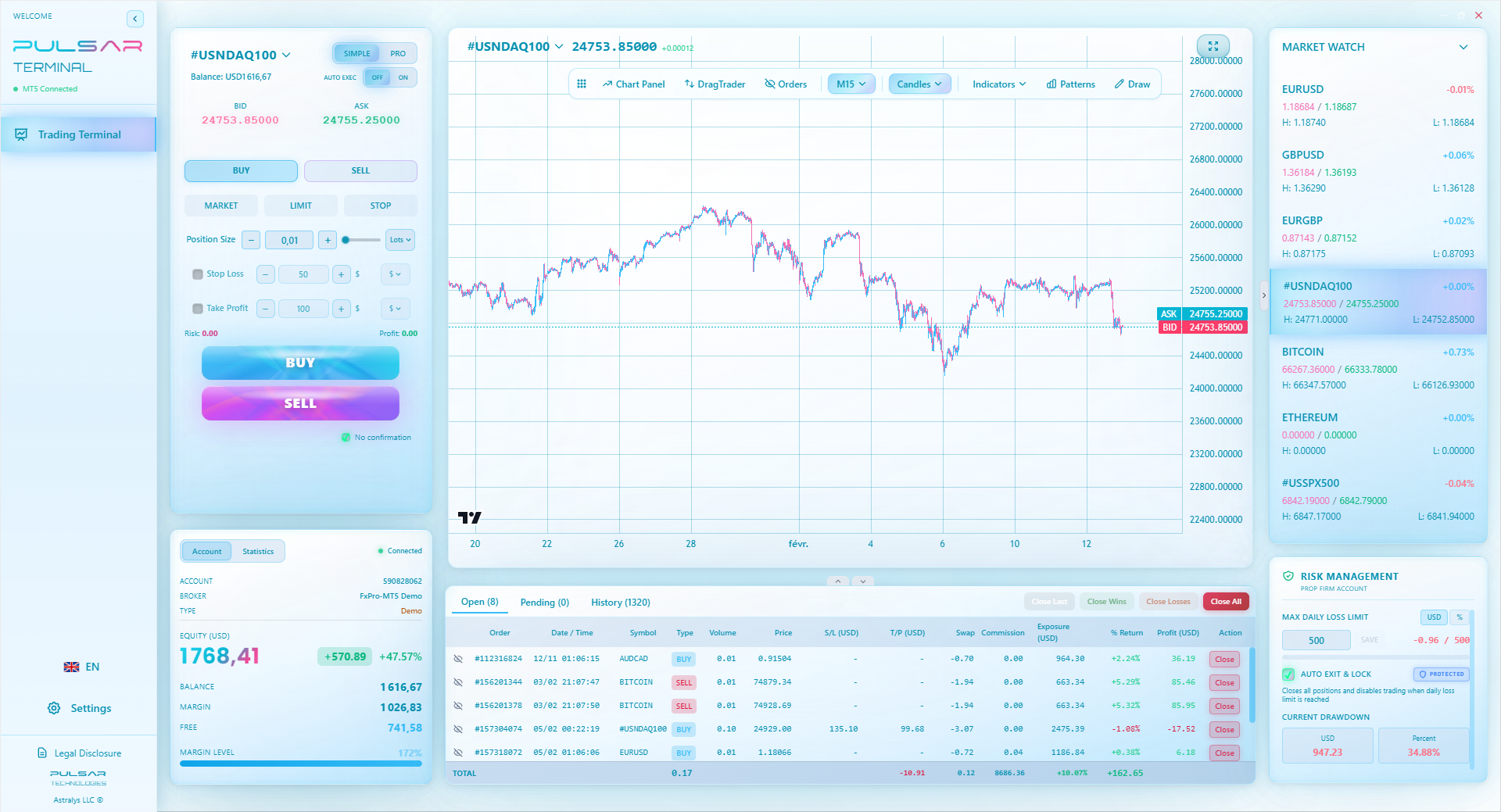
Managing multiple trades at different supply and demand zones is complex, but tools like Pulsar Terminal allow you to set multi-level take-profits and trailing stops directly on your MT5 chart, automating the exit strategy for your zone trades.
Pulsar Terminal
The all-in-one MT5 companion: drag-and-drop orders, multi-TP/SL, trailing stop, grid trading, Volume Profile, and prop firm protection. Used by 1,000+ traders daily.
“Trying to scalp from Lagos with occasional network issues was a fast track to ulcers.”
Your personality dictates your timeframe, and your timeframe dictates your version of this strategy.
| Timeframe | Style | What You're Doing | Nigerian Reality Check |
|---|---|---|---|
| 15M - 1H | Scalping / Short-Term | Trading minor zones from the 4H chart. Quick in-and-out. | Difficult if you have a day job or unreliable power/internet. Execution speed is critical. |
| 4H - Daily | Swing Trading | Trading major zones from the Daily/Weekly chart. Holds for days. | The most realistic for most Nigerian traders. Less screen time, less stress, aligns with institutional flow. |
| Weekly+ | Position Trading | Capturing fundamental trend changes. Holds for weeks/months. | Requires significant patience and capital to withstand swings. |
I am a swing trader at heart. I do my analysis on Sunday night, mark my weekly zones on the 4H and Daily charts, and then maybe check the charts once in the evening. This fits a normal life. Trying to scalp from Lagos with occasional network issues was a fast track to ulcers.
Find your rhythm. If you can't watch the screen all day, don't trade the 5-minute chart. It's that simple.
💡 Winston's Tip
Your most profitable zones will often be the ones you find boring to wait for. The excitement of a 'perfect' but over-tested zone is usually a trap.
Let's get practical. You need the right platform.
Choosing a Broker:
- Regulation is Key: As said, use internationally regulated brokers.
- Spreads & Costs: For supply/demand trading, you often enter on a limit order, so spreads matter slightly less than for news traders. But low costs always help. Look for raw spreads from 0.0 pips on majors (with a commission) or fixed spreads around 0.8 pips in commission-free accounts. Check our reviews for Exness, IC Markets, and XM for current numbers.
- Naira Accounts & Deposits: This is a huge plus. Brokers like HFM offer NGN-denominated accounts with minimum deposits as low as 4,000 NGN. It removes the currency conversion headache.
Essential Tools:
- MT4/MT5: The standard. Perfect for drawing zones.
- A Good Internet Connection: Invest in it. A trade failing because of network lag is infuriating.
- A Position Size Calculator: Never guess your risk.
- A Simple Journal: A Google Sheet is fine.
The First 100 Hours: Don't trade with real money. Go back on your MT4 history and practice. Mark zones, see how price reacted. Then, move to a demo account and practice your entries for a full month. Track your demo performance like it's real. Only then should you fund a live account with money you can afford to lose.
Remember, understanding the spread definition and how a margin call works is part of your basic training before you place a single live trade.
FAQ
Q1Is the supply and demand strategy better than using indicators?
It's not about better, it's about foundational. Indicators are derivatives of price; they lag. Supply and demand zones are the cause of the price movement itself. I use them as the primary reason for a trade and might use an indicator like the RSI for extra confluence, but the zone is the boss.
Q2What is the best timeframe to draw supply and demand zones?
Start big. Draw your zones on the Daily and 4-Hour charts first. These are the institutional zones that matter most. Then, drop down to the 1-Hour or 4-Hour to find your entry. Never draw a zone on a 5-minute chart without checking if it aligns with a higher timeframe zone.
Q3How do I know if a supply or demand zone is still valid?
A zone is valid until price breaks through it and closes comfortably on the other side with momentum. The fresher it is (fewer previous tests), the stronger it's considered. A zone that's been tested 5+ times is weak and likely to break.
Q4Can I use this strategy for trading USD/NGN?
You can, but I strongly advise against it as a beginner. The USD/NGN market for retail traders can be illiquid, have huge spreads, and gap violently due to CBN policies. It's much harder to identify clean zones. Practice on major pairs like EUR/USD first.
Q5How much money do I need to start trading supply and demand in Nigeria?
You can start with a broker that has a low minimum deposit, even as low as $5 or 4,000 NGN. However, the real question is about risk per trade. With a small account, proper position sizing is even more critical. You need enough so that a single 1% risk loss doesn't force you into taking reckless trades to recover.
Q6Do Nigerian traders pay tax on forex trading profits?
Yes. Profits from forex trading are considered capital gains and are subject to a 10% Capital Gains Tax, payable to the Federal Inland Revenue Service (FIRS). You are responsible for declaring this income.
Q7How does this strategy work with prop firm challenges?
Very well, because it emphasizes high risk-reward trades and strict stop losses - key for passing challenges. The discipline of waiting for high-probability zones prevents over-trading, which is the #1 reason people fail prop firm evaluations.
Prof. Winston's Lesson
Key Takeaways:
- ✓Trade zones, not lines. Draw areas from the base of impulsive moves.
- ✓Fresh zones (1-2 tests) are strong. Old zones (5+ tests) are weak.
- ✓Always place your stop loss BEYOND the zone, not inside it.
- ✓The higher timeframe trend direction overrules any lower timeframe zone.
- ✓Risk a maximum of 1% per trade, no exceptions.
How useful was this article?
Click a star to rate
Weekly Trading Insights
Free weekly analysis & strategies. No spam.
About the Author
Olumide Adeyemi
West African Trading Pioneer
One of Nigeria's most active forex trading educators. 8 years of experience trading from Lagos. Specializes in low-capital strategies and prop firm challenges for African traders.
Comments
Risk Disclaimer
Trading financial instruments carries significant risk and may not be suitable for all investors. Past performance does not guarantee future results. This content is for educational purposes only and should not be considered investment advice. Always conduct your own research before trading.
You Might Also Like

Cara Trading Forex Sukses: 7 Prinsip dari Trader Profesional
Cara trading forex sukses dengan 7 prinsip trader pro: manajemen modal, disiplin, journal trading, backtest. Data nyata, bukan janji profit palsu.
Jam Trading Forex Terbaik untuk Trader Indonesia: Panduan Lengkap dengan Tabel Waktu
Panduan jam trading forex untuk trader Indonesia. Tabel 4 sesi dunia, jam emas 20:00-00:00, sesi mana yang harus dihindari. Data akurat + tips dari trader berpengalaman.
Top 5 Sàn Forex Uy Tín Nhất 2026: Review Jujur dari Trader Indonesia
Top 5 sàn forex uy tín 2026 untuk trader Indonesia. Review jujur: spread, deposit, withdraw, dukungan lokal. Exness, XM, IC Markets & lebih.
Get Pulsar Terminal
All these calculators are built into Pulsar Terminal with real-time data from your MT5 account. One-click position sizing, automatic risk management, and instant calculations.
Get Pulsar Terminal