


Most Indian swing traders fail because they treat indicators like a magic 8-ball.

Rajesh Sharma
Senior Forex Analyst ·  India
India
☕ 11 min read
What you'll learn:
- 1The Foundation: Why Swing Trading Fits India
- 2The Trend Is Your Friend: Moving Averages
- 3Momentum and 'Overbought/Oversold': RSI
- 4The Trend Confirmer: MACD
- 5Volatility and Support/Resistance: Bollinger Bands
- 6Putting It All Together: A Real Setup
- 7What to Avoid: Common Indicator Mistakes
- 8Choosing Your Platform and Next Steps
Most Indian swing traders fail because they treat indicators like a magic 8-ball. They pile on five oscillators, get conflicting signals, and blow up their account. The truth is, in a market where transaction costs can eat up to 0.26% of your trade value, you need clarity, not clutter. I've seen more accounts wrecked by an overbought RSI in a strong uptrend than by any bear market. This guide cuts through the noise. We'll look at the indicators that actually work for holding stocks for days or weeks, how to use them under India's new 2026 regulations, and how to keep your hard-earned ₹ from vanishing into STT and brokerage fees.
Swing trading sits in the sweet spot for the average Indian retail trader. It's not the frantic pace of scalping, which gets murdered by our higher delivery STT (0.1% on buy and sell), and it's not the years-long commitment of investing. You're catching moves that last a few days to several weeks. This timeframe lets you actually have a life while still capitalizing on short-term trends and news-driven volatility, which our market has in spades.
The 2026 regulatory changes, especially the new SEBI (Stock Brokers) Regulations, actually make a cleaner environment for this. The focus on clearer rules and investor protection is a net positive, even if it means your broker has more paperwork. Just remember, your profits from these short-term holds are taxed as Short-Term Capital Gains (STCG) at a flat 20% rate. Every setup you consider needs to account for that haircut right from the start.

Warning: Don't even think about using the Margin Trading Facility (MTF) for swing trades unless you're an expert. That 12-18% annual interest will silently eat your profits if a "few days" turns into a few weeks. I learned this the hard way on a HDFC Bank trade that went sideways for a month. The interest cost was more than the eventual tiny profit.
Forget fancy algorithms. In swing trading, your first job is to figure out the damn trend. Moving averages smooth out the daily noise and show you the underlying direction. In India, I don't use the standard ones you read about in American books. Here's what works on our charts.
The 20 & 50 EMA Combo
This is my bread and butter. The 20-period Exponential Moving Average (EMA) tracks short-term momentum, and the 50-period EMA shows the medium-term trend. A basic but powerful rule: price above both EMAs suggests an uptrend for long setups. Price below both suggests a downtrend for shorting (or staying out). When the 20 EMA crosses above the 50, it's a potential trend change signal (a golden cross). The reverse is a death cross. But here's the key: wait for the price to confirm. I got chopped up in 2023 blindly shorting every death cross in Reliance, only to see it power higher.
The 200 SMA – The Market Sentiment Gauge
The 200-period Simple Moving Average (SMA) is the granddaddy. It's less about precise entries and more about context. Is the stock (or the Nifty) trading above its 200 SMA? If yes, the long-term bias is up. Swing trading against that bias is a low-probability game. I use it as a filter. I only look for long swing setups in stocks above their 200 SMA, and short setups in stocks below it. It keeps you on the right side of the big money.

Example: Let's say you're looking at Tata Motors. Price is at ₹950. The 20 EMA is at ₹940, the 50 EMA is at ₹920, and both are sloping up. The 200 SMA is way down at ₹850. This tells you: 1) Short-term momentum is up (price > 20 EMA), 2) The medium-term trend is up (20 & 50 EMAs rising, price > 50), and 3) The long-term tide is also bullish (price > 200 SMA). That's a high-probability environment for a long swing trade.

💡 Winston's Tip
Stop looking for the 'perfect' indicator. The perfect indicator is the one you understand completely and can apply with discipline, even when it's giving you a signal you don't like.
“Most Indian swing traders fail because they treat indicators like a magic 8-ball.”
The Relative Strength Index (RSI) is the most abused indicator in India. Everyone sees it hit 70 and screams "overbought, sell!" That's a great way to miss the entire rally in a stock like Bajaj Finance. The RSI indicator measures momentum speed, not a guaranteed reversal point.
For swing trading, I use it two ways. First, divergence. This is powerful. If the stock price makes a new high but the RSI makes a lower high, that's bearish divergence – the momentum is weakening even as price rises. It's a warning sign the uptrend may be exhausting. I spotted this on ITC in late 2024 around ₹480. Price inched higher, RSI slumped. I exited my long swing position at ₹478. It then corrected to ₹450. That's the RSI giving you an early exit signal.
Second, I use the 50 level as a trend filter. In a strong uptrend, the RSI will often bounce between 40 and 80, not 30 and 70. If the RSI dips to 40-45 and holds during a pullback in an uptrending stock, that's often a great re-entry point. Conversely, in a downtrend, a rally that only pushes the RSI to 55-60 before failing can be a shorting opportunity. Never use RSI in isolation. Pair it with your moving averages for trend context.
The MACD indicator is another workhorse. It's slower than the RSI, which makes it great for confirming swing trade signals, not generating them. The MACD line crossing above the signal line is a buy signal; crossing below is a sell signal. Simple, right? The trap is taking every single crossover.
My rule: I only act on MACD crossovers that happen in the direction of the broader trend defined by my 50 and 200-period averages. Also, I pay close attention to MACD histogram bars. These bars show the difference between the MACD and signal lines. When the bars are increasing in height, momentum is accelerating. When they start shrinking while price is still rising (positive histogram divergence), it's like the RSI divergence – a warning that the move is losing steam. This saved me on a swing trade in Asian Paints. Price was grinding higher, but the MACD histogram was making a series of lower peaks. I got out at ₹3,450. The stock then entered a 2-month consolidation. It didn't crash, but my capital wasn't stuck doing nothing either.
Remember, the MACD is built on moving averages, so it's a lagging indicator. Use it to confirm a move already suggested by price action or other setups, not to predict the future.
“In a powerful uptrend, the price will often ride the upper Bollinger Band. This isn't 'overbought'; it's a sign of strength.”
Bollinger Bands are a dynamic duo: they show trend and volatility simultaneously. The middle band is a 20-period SMA. The upper and lower bands are standard deviations away from it. When the bands squeeze together, volatility is low, and a big move is often brewing. When they expand, the move is on.
For swing entries, I love the "walking the band" concept in a strong trend. In a powerful uptrend, the price will often ride the upper Bollinger Band. This isn't "overbought" in the traditional sense; it's a sign of strength. A pullback to the middle band (the 20 SMA) in such a trend is a classic swing buy setup. I used this repeatedly during the 2025 rally in banking stocks.
Conversely, the lower band acts as support in a downtrend. The classic reversal signal is when price closes outside the bands and then closes back inside. This can signal an exhaustion move. But again, align it with the trend. A reversal signal off the lower band while the stock is below its 200 SMA has a higher chance of just being a pause before more selling. Always use a position size calculator here, as volatility (band width) directly impacts how wide your stop loss needs to be.
💡 Winston's Tip
Your first loss is often your smallest loss. If a swing trade goes against your indicator-based thesis immediately, don't 'wait for the RSI to turn.' Just get out. The market is telling you your read was wrong.
Theory is useless without execution. Let me walk you through a swing trade I took in February 2026 on a mid-cap stock (I'll keep the name generic for compliance).
- Trend Filter: The stock was trading above its rising 200 SMA. Long-term bias = UP. Good.
- Entry Signal: After a consolidation, the price broke above a minor resistance level on above-average volume. The 20 EMA (₹520) had just crossed above the 50 EMA (₹515). MACD histogram had turned positive and was growing. RSI was at 58 and rising – strong, not overbought.
- The Trade: I entered at ₹525. My stop loss was placed at ₹499, just below the recent swing low and the 50 EMA. My target was ₹600, near a major historical resistance zone. This gave me a risk of ₹26 per share for a potential reward of ₹75 – a risk-to-reward ratio of almost 1:3. I used my position size calculator to ensure this loss would be only 1% of my swing trading capital.
- Management: The trade worked. Price rode the upper Bollinger Band up. When the RSI hit 78 and the MACD histogram started to shrink on the daily chart, I didn't exit immediately, but I moved my stop loss up to ₹575 to lock in most profits. The price eventually hit my ₹600 target and I exited.
Total hold time: 18 trading days. After STT, brokerage, and other charges (that ~0.26%), my net return was solid. This is the process: filter, confirm, execute, manage.

Pro Tip: Your trading platform matters. I use a combination of TradingView for analysis and my broker's platform (like Zerodha Kite) for execution. The speed and reliability of your charting software, especially for setting alerts on your indicators, is non-negotiable for swing trading.
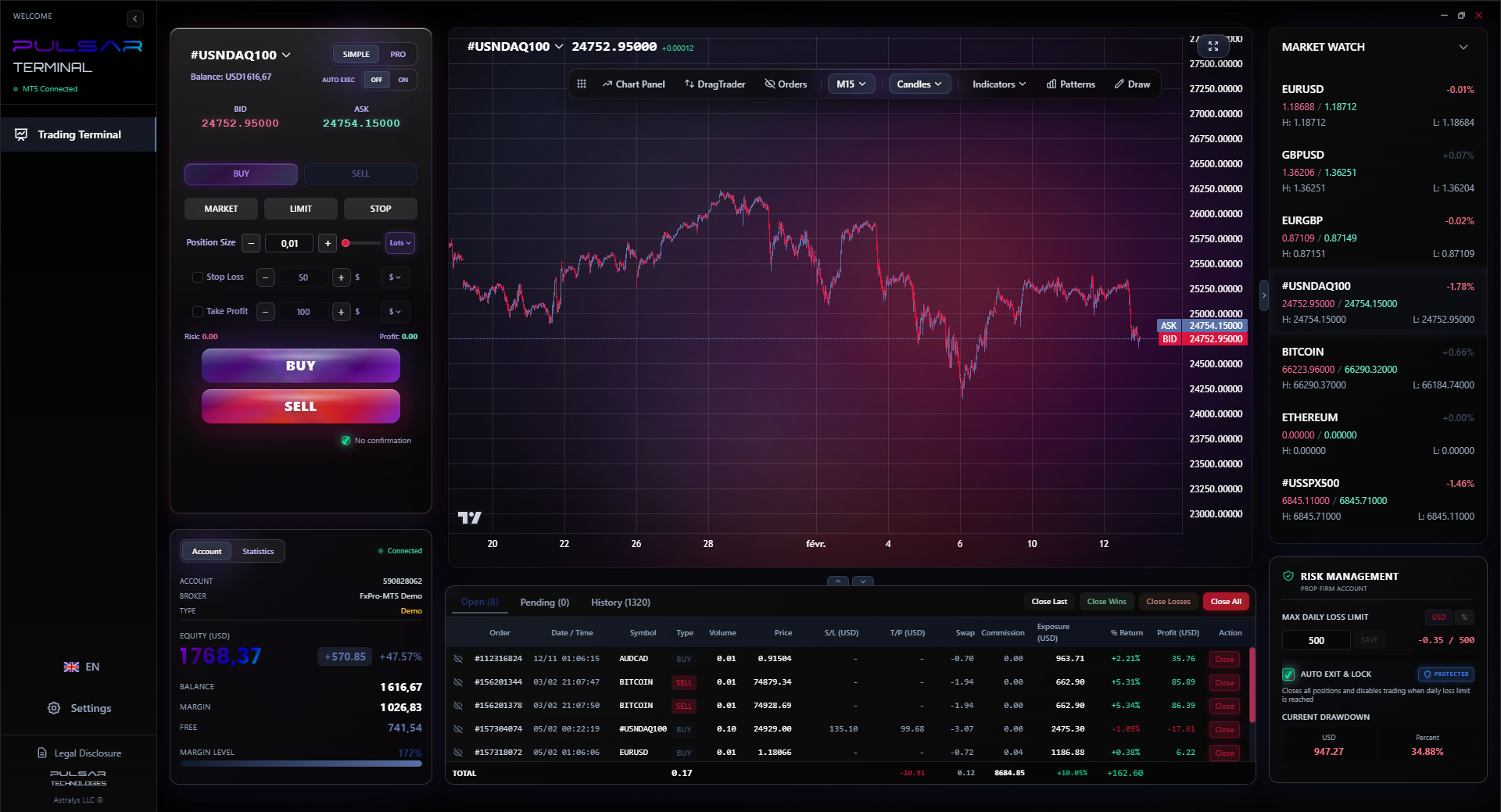
Managing multiple swing trades with manual stop losses is a headache; Pulsar Terminal lets you set multi-level take-profits and trailing stops automatically on your MT5 platform.
Pulsar Terminal
The all-in-one MT5 companion: drag-and-drop orders, multi-TP/SL, trailing stop, grid trading, Volume Profile, and prop firm protection. Used by 1,000+ traders daily.
“Your first loss is often your smallest loss. If a swing trade goes against your thesis immediately, just get out.”
I've made these mistakes so you don't have to.
The Indicator Overload: Your chart looks like a rainbow threw up on it. You have 3 moving averages, RSI, MACD, Stochastic, and Bollinger Bands all fighting for attention. They will give contradictory signals. Pick a trend tool (like EMAs), a momentum tool (like RSI), and a confirmation tool (like MACD). That's it.
Ignoring Price Action: The indicators are derived from price. If price breaks a key support level but your RSI is "oversold," the price is right. The indicator is lagging. Price always leads.
Trading Against the Higher Timeframe Trend: This is the #1 reason for losing swing trades. You see a bullish crossover on the hourly chart and go long, while the daily chart shows the stock crashing below its 200 SMA. The higher timeframe always wins. Always check the daily chart before placing any swing trade.
Forgetting About Costs: That beautiful 8% swing trade gain? Knock off 0.26% for transaction costs and 20% for tax on the net profit. Your actual bank account sees far less. Every setup must have enough potential room (a good risk-to-reward) to make these costs irrelevant. Small, choppy ranges are a trap.
Not Backtesting: Don't just take my word for it. Use a platform like TradingView or Amibroker to test your 2-3 indicator combo on historical Indian stock data. See how it would have performed through bull markets, bear markets, and sideways chops. You'll quickly see which signals are strong and which lead to a margin call.
You need a broker that's SEBI-registered and offers a strong platform. I've used many. Zerodha Kite is excellent for most Indian swing traders – clean charts, good indicator selection, and reliable. Upstox is another solid contender with a powerful pro version. For more advanced charting, I pay for a TradingView Pro subscription and link it to my broker for execution.
Your next step isn't to find a new indicator. It's to master the combination of 2 or 3. Go back to the last 6 months on your chart. Apply just the 20/50 EMA trend filter and the RSI for momentum. Mark where you would have entered and exited. Then add the MACD as a confirmation filter. See how it improves or changes the trades.
Finally, paper trade this process for a month. Get a feel for the pace. Swing trading requires patience. You'll have days, even weeks, with no action. That's okay. It's about quality, not quantity. In the Indian market, with its unique rhythms and costs, a disciplined, indicator-informed swing strategy isn't just a way to trade. It's a way to survive and consistently grow your capital over time.
FAQ
Q1What is the best single indicator for swing trading in India?
There isn't one. But if I had to pick a foundation, it's the combination of the 20 and 50 Exponential Moving Averages (EMAs). They help you define the trend, which is the single most important thing to get right before you even think about an entry. No oscillator will save you if you're trading against the primary trend.
Q2How much money do I need to start swing trading in India?
Technically, you can start with ₹5,000-₹10,000. Practically, I recommend at least ₹50,000 to ₹1 Lakh. This allows for proper position sizing and diversification across 2-3 stocks. With less capital, transaction costs and the inability to place sensible stop losses (due to large spreads relative to your capital) will cripple you.
Q3How do I avoid the high STT and brokerage fees when swing trading?
You don't avoid them; you account for them. You must only take trades where the potential profit (your target minus entry) is significantly larger than the total cost (approx. 0.26% of trade value + taxes). This forces you to hunt for higher-probability setups with better risk-to-reward ratios, like 1:3 or more. Chasing small 2-3% moves is a loser's game after costs.
Q4Can I use these indicators for trading USD/INR or other currencies?
The core principles are the same, but the parameters might change due to different volatility. A 20-period EMA on a currency pair like EUR/USD can be more reactive than on a stock. Always test on the specific asset. Also, forex trading for Indians is restricted to currency derivatives on the NSE or through international brokers, which is a whole different regulatory ball game.
Q5What time frame chart should I use for swing trading indicators?
The Daily chart is your primary decision-making timeframe for classic swing trades (holds of days to weeks). Use the 4-hour or hourly chart to fine-tune your entry and exit timing. Never make your primary trend decision based on a timeframe lower than 4-hour.
Q6My RSI is overbought, but the stock keeps going up. Should I sell?
Probably not. An overbought RSI (above 70) in a strong uptrend is a sign of strength, not an automatic sell signal. Look for bearish divergence (price makes a new high, RSI makes a lower high) or a break of a key trendline or moving average as a more reliable exit signal. I've missed huge moves by selling just because RSI was high.
Q7Are automated trading systems based on these indicators good for swing trading?
They can be, but they're incredibly difficult to build robustly for the Indian market. They must account for gaps (our markets don't trade 24/7), corporate actions, and liquidity issues in smaller stocks. A human trader who can interpret the context (news, sector movement) alongside the indicators will almost always outperform a basic automated system. Start manually before you even think about automation.
Prof. Winston's Lesson
Key Takeaways:
- ✓Use the 20 & 50 EMA combo as your primary trend filter.
- ✓RSI divergence often provides better signals than overbought/oversold levels.
- ✓Always account for the ~0.26% transaction cost before entering.
- ✓Swing trade in the direction of the daily chart trend.
How useful was this article?
Click a star to rate
Weekly Trading Insights
Free weekly analysis & strategies. No spam.
About the Author
Rajesh Sharma
Senior Forex Analyst
Trading Indian and South Asian markets for over 10 years. Started with NSE currency derivatives before moving to international forex. Specializes in USD/INR and emerging market pairs.
Comments
Risk Disclaimer
Trading financial instruments carries significant risk and may not be suitable for all investors. Past performance does not guarantee future results. This content is for educational purposes only and should not be considered investment advice. Always conduct your own research before trading.
You Might Also Like

Cara Trading Forex Sukses: 7 Prinsip dari Trader Profesional
Cara trading forex sukses dengan 7 prinsip trader pro: manajemen modal, disiplin, journal trading, backtest. Data nyata, bukan janji profit palsu.
Jam Trading Forex Terbaik untuk Trader Indonesia: Panduan Lengkap dengan Tabel Waktu
Panduan jam trading forex untuk trader Indonesia. Tabel 4 sesi dunia, jam emas 20:00-00:00, sesi mana yang harus dihindari. Data akurat + tips dari trader berpengalaman.
Top 5 Sàn Forex Uy Tín Nhất 2026: Review Jujur dari Trader Indonesia
Top 5 sàn forex uy tín 2026 untuk trader Indonesia. Review jujur: spread, deposit, withdraw, dukungan lokal. Exness, XM, IC Markets & lebih.
Get Pulsar Terminal
All these calculators are built into Pulsar Terminal with real-time data from your MT5 account. One-click position sizing, automatic risk management, and instant calculations.
Get Pulsar Terminal