


I lost ₹47,200 in three weeks.

Rajesh Sharma
Senior Forex Analyst ·  India
India
☕ 13 min read
What you'll learn:
- 1What Swing Trading Really Means in India (It's Not Investing)
- 2The 5 Reasons 90% of Indian Swing Traders Blow Their Accounts
- 3Forget the Hype: 3 Core Swing Trading Frameworks That Actually Work
- 4Your Survival Kit: Risk Management for the Indian Context
- 5The Real Cost of Trading in India: Brokerage, Fees & The Tax Trap
- 6From PDF to Plan: Building Your Personal Swing Trading System
- 7Essential Tools & The Truth About 'Free' Resources
I lost ₹47,200 in three weeks. It was 2015, and I was convinced I'd cracked swing trading. I'd bought into a 'hot tip' on a mid-cap stock, held through a 15% dip because a PDF strategy said 'respect the trend,' and watched my stop-loss get taken out in a gap-down opening. The problem wasn't the market. It was me. I was treating swing trading like a hobby, not a business with real costs, real taxes, and real psychological traps. Most Indian traders fail for the same reasons. Let's fix that.
In India, swing trading sits in the messy middle ground between intraday gambling and long-term investing. You're holding positions for days or weeks, trying to catch the meat of a move. But here's the kicker: the Indian market's structure makes this uniquely challenging.
You need a Demat account. That's non-negotiable. The T+1 settlement cycle means your shares from Monday's trade land on Tuesday. This seems simple, but it affects your cash flow and margin. More critically, you're now subject to Short-Term Capital Gains (STCG) tax if you hold for less than a year. As of July 2024, that's a flat 20% on your profits (plus cess). That tax bill alone can turn a winning strategy into a loser if you don't account for it.

Warning: Many 'guru' PDFs forget to mention the hidden costs. On a ₹1 lakh trade, you're not just paying brokerage (maybe ₹20 flat). Add DP charges (₹15-25 when you sell), SEBI turnover fees (₹10 per crore), exchange charges, stamp duty, and 18% GST on most of it. On small, frequent trades, these fees eat you alive.
I learned this the hard way. In 2018, I had a great run with 12 winning swing trades in a row on Nifty stocks. My net profit was around ₹1.2 lakh. After accounting for all fees and setting aside 20% for tax, my actual take-home was closer to ₹85,000. That's a 29% haircut before I even saw the money. A swing trading strategies PDF that doesn't start with this math is setting you up for failure.
Your battlefield is usually the cash segment (going long on stocks) or the F&O segment (for shorting or use). With the new STT hikes on F&O effective April 2026, the cost of playing in derivatives just went up significantly. This changes the risk-reward math for many classic swing setups.
The statistics are brutal. Only about 5-10% of active traders are consistently profitable. In India, the failure rate feels even higher because of specific local pitfalls.
1. Ignoring Position Size & the 1% Rule. This is the suicide move. You have ₹2 lakh in your account. You see a 'sure-shot' breakout on Tata Motors and put ₹50,000 into it. That's 25% of your capital on one idea. A 4% adverse move wipes out 1% of your total account. But you're not risking 4%, you're risking 25%. I've done it. In 2019, I put 30% of my account into a Bank Nifty futures swing trade. A single bad news event caused a 5% overnight gap against me. I lost 1.5% of my total account in seconds. The rule is simple: never risk more than 1-2% of your total trading capital on a single trade. Use a position size calculator religiously.
2. Trading Illiquid Stocks. That small-cap 'multibagger' tip from a Telegram group? Its average daily volume might be 50,000 shares. Your entry is fine, but your exit will be a nightmare. The bid-ask spread will be wide, and selling even a modest amount can crash the price. Stick to highly liquid stocks, typically in the Nifty 200 universe, where you can enter and exit like a ghost.
3. Not Accounting for Gap Risk. Indian markets are prone to gap openings based on global cues, election results, or budget announcements. Your perfect technical stop-loss placed at ₹150 is useless if the stock opens at ₹142. You need to size your positions knowing that your actual risk is often the gap risk, not the stop-loss distance.
4. Chasing 'Free' PDF Strategies Without Backtesting. You download a swing trading strategies PDF that uses a 20 EMA and RSI crossover. It has pretty charts. Do you know its win rate on Indian stocks over the last 5 years? Its average profit factor? Of course not. You're trading on faith. Every strategy has periods of drawdown. If you don't know what that drawdown looks like historically, you'll abandon the strategy the first time it has three losing trades in a row.
5. Misunderstanding 'Trend Following' in a Ranging Market. Indian indices can grind sideways for months. A trend-following strategy from a PDF will get chopped to pieces, generating small loss after small loss. You need to identify the market regime first. Is this a trending phase for Nifty, or a consolidation phase? Your strategy choice depends on the answer. Tools like the MACD indicator can help identify momentum shifts, but they're not a crystal ball.

💡 Winston's Tip
The market doesn't care about your opinion. Your trading plan is your boss. If it says exit, you exit. No debate.
“A swing trading strategies PDF that doesn't start with the math of fees and taxes is setting you up for failure.”
Let's move beyond vague PDFs to specific, actionable frameworks. These aren't 'set-and-forget' systems, but mental models for finding high-probability setups.
The Pullback to a Moving Average
This is classic for a reason. In a strong trending stock (like Reliance in an uptrend), the price will often pull back to a key moving average like the 20-period or 50-period EMA on the daily chart. The entry trigger is a bullish reversal candlestick pattern (like a hammer or bullish engulfing) at or just above the MA. Your stop-loss goes below the recent swing low of the pullback.
My Trade Example: In Jan 2023, Infosys was in a steady uptrend. It pulled back to its 20-day EMA around ₹1480. I saw a bullish engulfing candle form right on the EMA. Entered at ₹1492. Stop-loss at ₹1455 (below the pullback low). Target was a move back to the prior high near ₹1600. I scaled out at ₹1580 and ₹1590. Risk: ₹37 per share. Reward: ~₹100 per share. A clean 2.7:1 risk-reward setup.
The Range Breakout (With a Retest)
Indian stocks love to consolidate in rectangles. The naive approach is to buy the second the price breaks above resistance. That's how you get fakeouts. The smarter play is to wait for the breakout, then buy the first pullback to the breakout level (which now becomes support).

Pro Tip: Volume is key. The breakout bar should have above-average volume. The retest bar should have low volume, showing a lack of selling interest. If volume spikes on the retest, the breakout is likely failing.
The Momentum Divergence Reversal
This is for catching turns. You use an oscillator like the RSI indicator. Look for a stock making a new high in price, but the RSI is making a lower high. This is bearish divergence, signaling weakening momentum. You don't short immediately. You wait for price to break a short-term trendline or a key support level on the hourly/daily chart to confirm.
What DIDN'T Work: I used to try to trade 'head and shoulders' patterns from PDFs religiously. The failure rate was huge. The pattern would form, but the neckline break had no follow-through. I realized I was ignoring the broader market trend. Trying to short a head and shoulders in a raging bull market is like trying to stop a train with a pebble. The context matters more than the pattern.
Your strategy gets you into the game. Your risk management decides if you stay in it. Here's the non-negotiable toolkit.
1. The 1% Rule (Again, Because You'll Forget). Calculate it before every trade. Total Capital: ₹5,00,000. 1% Risk = ₹5,000. Stock Entry: ₹520. Stop-loss: ₹500. Risk per share = ₹20. Position Size = ₹5,000 / ₹20 = 250 shares. That's it. You don't buy 500 shares because you're 'confident.' This rule alone will save you from account death.
2. Stop-Loss Placement: Technical, Not Emotional. Your stop-loss isn't 'how much you're willing to lose.' It's the price level that proves your trade thesis wrong. For a pullback trade, it's below the swing low. For a breakout, it's below the breakout level. If that distance represents more than 1-2% of your capital, you either reduce share count or find a different trade. Never widen your stop-loss to fit your desired position size.
3. The Tax-Aware Profit Target. When setting targets, think in net terms. If you need a 10% return to make a trade worthwhile, and you'll pay 20% STCG, your gross target needs to be roughly 12.5% to net you that 10%. Factor this in during trade planning. Also, use multiple profit targets. Take 50% off at your first target (1.5x risk), move your stop to breakeven, and let the rest run. This psychologically locks in wins and lets you participate in bigger moves.
4. Daily & Weekly Loss Limits. Set a hard line. If you lose 3% of your total capital in a day, you're done. Log off. If you lose 6% in a week, you're done for the week. This prevents revenge trading and the dreaded 'downward spiral.' I set these as hard rules in my trading journal after a week in 2020 where I lost 4% on Monday and proceeded to lose another 8% by Friday trying to 'get it back.'
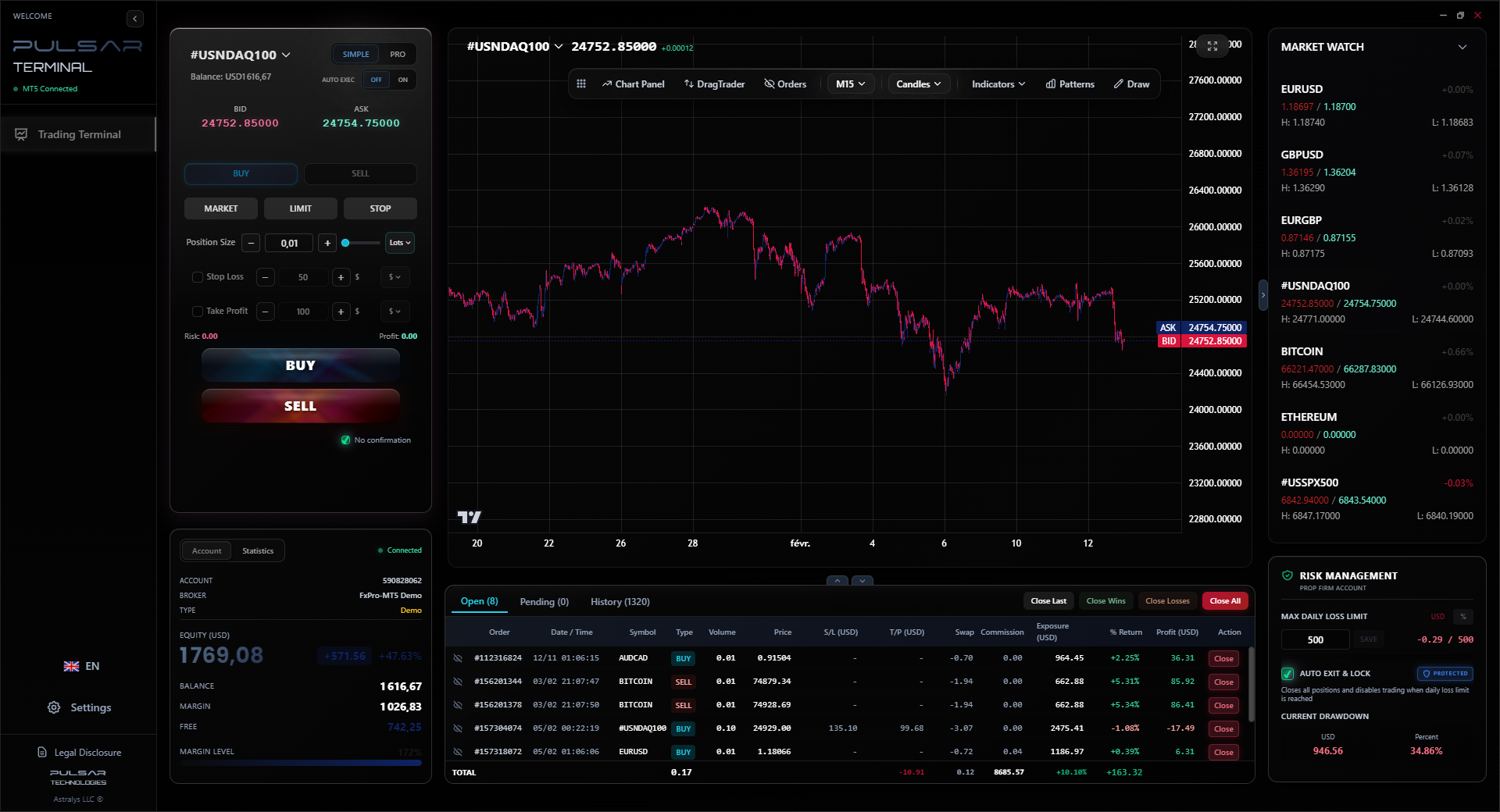
Managing these orders manually on a platform like MT5 is a pain. This is where a tool like Pulsar Terminal shines - it lets you set multi-level take-profits and a trailing stop with a few clicks directly on your chart, so your exit plan is executed automatically, removing emotion.
💡 Winston's Tip
Your first loss is often your smallest loss. Adding to a losing swing trade is like pouring petrol on a fire to put it out.

Manually managing multi-level exits and trailing stops on swing trades is prone to error; Pulsar Terminal automates this execution directly on your MT5 chart, enforcing your plan.
Pulsar Terminal
The all-in-one MT5 companion: drag-and-drop orders, multi-TP/SL, trailing stop, grid trading, Volume Profile, and prop firm protection. Used by 1,000+ traders daily.
“Your stop-loss isn't 'how much you're willing to lose.' It's the price level that proves your trade thesis wrong.”
Let's get brutally honest about where your money really goes. That ₹500 profit isn't ₹500.
Here’s a breakdown of a typical ₹1,00,000 equity delivery (swing) trade:
| Fee Component | Approximate Cost | Notes |
|---|---|---|
| Brokerage (Discount) | ₹20 (per order) | Flat fee common at brokers like Zerodha. |
| DP Charges (on Sell) | ₹18.90 | ₹15.34 + 18% GST. A fixed cost per scrip. |
| SEBI Turnover Fee | ₹1.00 | ₹10 per crore of turnover. |
| Exchange Charge (NSE) | ₹2.97 | ~0.00297% of turnover. |
| Stamp Duty (Buy) | ₹15.00 | 0.015% of buy value (state varies). |
| GST (on fees) | ~₹7.75 | 18% on (Brokerage + Exchange + SEBI Fee). |
| Total Direct Cost | ~₹65.62 | Just to open and close the trade. |
So, before you've even made a rupee in profit, you're down ~0.066%. Now, let's say you make a 5% gain, or ₹5,000.
- Net before tax: ₹5,000 - ₹65.62 = ₹4,934.38
- STCG Tax (20% + 4% cess): ~₹1,026.35
- Your actual take-home profit: ~₹3,908.03
That '5% gain' is actually a 3.9% net gain. Your strategy's edge must overcome this friction. This is why scalping strategy with tiny targets is a nightmare for most - the costs consume the edge.
The Prop Firm Angle: Many traders look at prop firms to trade larger capital. A critical tool for passing their strict daily loss limits is automated risk management. Platforms that can hard-stop your day after a defined loss are useful here, as one emotional overtrade can fail the challenge.
Choosing a low-cost, reliable broker is critical. We have detailed reviews on platforms like Zerodha (a dominant Indian discount broker) and ICICI Direct for a more full-service approach. Read them to understand their specific swing trading conditions.
A downloaded swing trading strategies PDF is a recipe. You need to build your own kitchen. Here's how.
Step 1: Instrument Selection. Don't trade everything. Create a focused watchlist of 15-25 highly liquid stocks (Nifty Next 50 is a good hunting ground) and maybe the Nifty and Bank Nifty indices. Know their sector, typical volatility, and news drivers.
Step 2: Define Your Entry with Precision. Vague: 'Buy on RSI oversold.' Precise: 'Buy when the daily RSI(14) crosses above 30 from below, AND price is at or above the 50-day EMA, AND a bullish hammer candle closes.' Your rules must be so clear a computer could execute them.
Step 3: Define Your Exit Before You Enter. This is the whole game. Where is your stop-loss? Where is your first profit target? Will you trail a stop? Use a tool like the position size calculator to lock this in on your trading slip before you hit 'buy.'
Step 4: Journal Religiously. Every trade. Entry, exit, reason, screenshot, emotional state. I review my journal every Sunday. Not to beat myself up, but to find patterns. Am I consistently cutting winners short? Am I ignoring my stops on losing trades? The journal tells the truth your P&L statement hides.
Step 5: Backtest & Adapt. Take that strategy from the PDF. Don't use it on live money. Go to TradingView or your broker's platform. Use the replay mode. Go back 2-3 years and 'paper trade' the setup 50 times. Write down the results. What was the win rate? The average win vs. average loss? Only then will you know if it has an edge, and more importantly, if you have the temperament to sit through its inevitable losing streaks.

Example: I backtested a simple 20/50 EMA crossover strategy on HDFC Bank from 2020-2023. It generated 22 signals. 10 were winners, 12 losers (45% win rate). The average winner was ₹85. The average loser was ₹35. The profit factor (Gross Profit/Gross Loss) was positive. That told me the strategy had a statistical edge, but I had to be prepared to be wrong more often than I was right. That knowledge is power.
💡 Winston's Tip
Spend 80% of your time learning to identify high-probability market environments, and 20% on entry techniques. Context is king.

“That '5% gain' after costs and STCG tax is actually a 3.9% net gain. Your edge must overcome this friction.”
You need the right gear. But you don't need to spend a fortune.
Charting Platforms:
- TradingView: The industry standard for a reason. The social ideas are noise, but the charting, scripting (Pine Script), and backtesting are superb. Worth the paid plan if you're serious.
- Your Broker's Platform: Zerodha's Kite, Dhan, etc. They're fine for execution and basic charts. Don't get lost in indicator overload.
Brokers: Focus on reliability, low costs, and good execution. We've reviewed many; see our deep dives on Angel One and Upstox for specifics on their swing trading offerings.
The 'Free PDF' Reality Check: Most free swing trading strategies PDFs you find online are either:
- Very Basic Primer: They explain what a moving average is. Useful for a total beginner, but not a system.
- Bait for a Paid Course: The PDF gives you 20% of a strategy, then says 'for the secret entry filter, join my mentorship.'
- Outright Nonsense: Complex systems with 10 indicators that are curve-fitted to past data and will fail in real-time.
The real resource is your own effort. Study price action. Understand support/resistance. Learn about swing trading psychology. Read market structure. This knowledge, combined with your own backtesting, will build a strategy that you understand and trust - which is the only kind that survives a drawdown.
Finally, understand the new SEBI algo rules if you're tech-inclined. By April 2026, if you're using any automated tools or APIs, you need to ensure your broker is compliant and your activities are tagged. The regulatory landscape is tightening, aiming for more safety but adding complexity.
FAQ
Q1What is the best time frame for swing trading in India?
Most serious swing traders use the daily chart for primary trend analysis and the 1-hour or 4-hour chart for precise entry timing. The daily chart smooths out intraday noise and aligns better with the multi-day holding period. Avoid using timeframes below 15 minutes, as that drifts into day trading territory.
Q2How much money do I realistically need to start swing trading?
While you can technically start with ₹10,000, it's impractical. With a 1% risk rule, you'd only risk ₹100 per trade, making fees a huge percentage. A more realistic minimum is ₹1-2 lakh. This allows you to take 5-8 positions with ₹15,000-₹25,000 each while properly managing risk. Remember, capital preservation is your first goal.
Q3Can I swing trade Forex in India?
Yes, but with major restrictions. The RBI only allows trading in INR-based currency pairs (like USD/INR, EUR/INR) through exchanges like NSE, BSE, or MCX-SX. You cannot legally trade international Forex pairs (like EUR/USD) with Indian brokers. The liquidity and trends can be different, so don't directly apply strategies from global EUR/USD guide PDFs without adaptation.
Q4How do I handle dividend announcements while swing trading?
This is a crucial local nuance. If you hold a stock on the record date, you get the dividend, but the stock price typically drops by the dividend amount on the ex-date. Your stop-loss orders are also adjusted downward. Factor this into your trade management. Sometimes, it's better to exit before a large dividend if your technical setup is near completion.
Q5Is a 50% win rate good for swing trading?
A 50% win rate can be excellent, average, or terrible - it depends entirely on your risk-reward ratio. If you win ₹1,000 on winning trades but lose ₹2,000 on losing trades, a 50% win rate will bankrupt you. Aim for a system where your average winner is significantly larger than your average loser. A 40% win rate with a 3:1 reward-to-risk is far more profitable than a 60% win rate with a 1:1 ratio.
Q6What's the single biggest mistake Indian swing traders make?
Turning a swing trade into a long-term investment after it goes against them. They buy at ₹100, plan to stop at ₹95, watch it fall to ₹90, and then say 'I'll just hold for the long term.' This destroys your risk management framework and ties up capital in a losing idea. A stop-loss is a business decision, not a personal failure. Respect it.
Prof. Winston's Lesson
Key Takeaways:
- ✓Risk a maximum of 1% of capital per trade. No exceptions.
- ✓Factor in all costs & 20% STCG tax before calculating profit.
- ✓Backtest any PDF strategy 50+ times before using real money.
- ✓Liquidity is non-negotiable. Stick to Nifty 200 stocks.
- ✓A 40% win rate with a 3:1 reward ratio beats a 60% win rate at 1:1.
How useful was this article?
Click a star to rate
Weekly Trading Insights
Free weekly analysis & strategies. No spam.
About the Author
Rajesh Sharma
Senior Forex Analyst
Trading Indian and South Asian markets for over 10 years. Started with NSE currency derivatives before moving to international forex. Specializes in USD/INR and emerging market pairs.
Comments
Risk Disclaimer
Trading financial instruments carries significant risk and may not be suitable for all investors. Past performance does not guarantee future results. This content is for educational purposes only and should not be considered investment advice. Always conduct your own research before trading.
You Might Also Like

Cara Trading Forex Sukses: 7 Prinsip dari Trader Profesional
Cara trading forex sukses dengan 7 prinsip trader pro: manajemen modal, disiplin, journal trading, backtest. Data nyata, bukan janji profit palsu.
Jam Trading Forex Terbaik untuk Trader Indonesia: Panduan Lengkap dengan Tabel Waktu
Panduan jam trading forex untuk trader Indonesia. Tabel 4 sesi dunia, jam emas 20:00-00:00, sesi mana yang harus dihindari. Data akurat + tips dari trader berpengalaman.
Top 5 Sàn Forex Uy Tín Nhất 2026: Review Jujur dari Trader Indonesia
Top 5 sàn forex uy tín 2026 untuk trader Indonesia. Review jujur: spread, deposit, withdraw, dukungan lokal. Exness, XM, IC Markets & lebih.
Get Pulsar Terminal
All these calculators are built into Pulsar Terminal with real-time data from your MT5 account. One-click position sizing, automatic risk management, and instant calculations.
Get Pulsar Terminal