


In January 2026, the Tata Gold ETF shot up nearly 9% in a single day.

Rajesh Sharma
Senior Forex Analyst ·  India
India
☕ 10 min read
What you'll learn:

In January 2026, the Tata Gold ETF shot up nearly 9% in a single day. That kind of move in a commodity ETF isn't just noise, it's a signal. After trading everything from forex to futures for over a decade, I've learned that when a new fund like this rockets to a ₹5867 crore AUM in just over two years, you pay attention. This isn't your grandfather's gold savings scheme. It's a liquid, exchange-traded instrument, and it demands a trader's mindset, not just a buy-and-hope strategy. Let's break down what trading the Tata Gold ETF is really like.
Forget the complex jargon. The Tata Gold Exchange Traded Fund (TATAGOLD) is, at its core, a stock that tracks the price of gold. You buy a unit on the NSE or BSE, just like you'd buy a share of Reliance, and each unit represents a tiny fraction of physical gold sitting in a vault. It launched in January 2024, which makes it a relative newcomer, but it's grown fast.
The key detail every trader needs to know is the 2026 regulatory shift. Starting April 1, 2026, SEBI changed the rules. These ETFs are no longer valued based on the London gold price (LBMA). Now, they use polled spot prices from Indian exchanges like the MCX. This is huge. It means the NAV of your Tata Gold ETF unit now more accurately reflects the Indian gold price, which includes local factors like import duties and demand. The fund has to keep at least 95% of its assets in gold or approved gold instruments. As of late February 2026, it was holding about 97.68% in physical gold.

Example: If the domestic gold price on the MCX is ₹62,000 per 10 grams, the ETF's NAV will be calculated based on that, not a London price of $1,800 an ounce. This reduces a layer of pricing disconnect we used to have to account for.
There's also a Tata Gold ETF Fund of Fund (FoF). This doesn't hold gold directly. It holds units of the main Tata Gold ETF. Think of it as a wrapper. The expense ratio is higher (0.69% for the regular plan), and it has a small exit load if you sell within 7 days. For active traders, I'd stick with the plain ETF. You want the purest, most direct exposure with the lowest friction.
This is where most blogs gloss over the details that kill your returns. Let's get specific with the Tata Gold ETF numbers as of early 2026.
The Obvious Costs:
- Expense Ratio: 0.42% per year for the regular plan. It's taken from the fund's assets, so you don't see a direct bill, but it drags on performance. The direct plan is cheaper at 0.38%. Always, always buy the direct plan if your broker offers it.
- Brokerage: This depends on your broker. Many discount brokers like Zerodha or Groww offer zero brokerage for delivery-based equity trades (buying and holding in your Demat). If you're day-trading it, standard intraday brokerage applies.
- STT (Securities Transaction Tax): You pay this on both buy and sell transactions. It's a small percentage, but it adds up with frequent trades.
The Hidden Cost: The Spread. This is a trading instrument, not a mutual fund you buy at the day's end NAV. You buy at the ask price and sell at the bid price. The difference is the spread. In highly liquid times, it's tiny. During volatile gold moves or off-market hours, it can widen. I've seen spreads on gold ETFs widen to 5-10 paisa per unit when news hits. That's your immediate, silent loss on entry.
The Big One: Taxation. You must get this right. Gold ETFs have a special tax treatment.
- Hold for less than 12 months: Any profit is added to your total income and taxed at your slab rate. If you're in the 30% bracket, that's a 30% cut.
- Hold for more than 12 months: Long-term capital gains tax is a flat 12.5% (without indexation benefit).
This tax structure fundamentally shapes your strategy. A quick scalp for a 2% gain can be demolished by a 30% tax hit. It pushes you towards a longer-term swing trading or positional mindset for your core holdings. I learned this the hard way early on, booking a nice short-term gain on another gold ETF only to see a third of it vanish at tax time. Now, I use a position size calculator that factors in post-tax returns.

💡 Winston's Tip
The 12.5% long-term tax rate is your friend. Structure your core gold position with at least a one-year horizon. It turns a good trade into a great one.
“A quick scalp for a 2% gain can be demolished by a 30% tax hit.”
Trading a gold ETF is different from trading a stock. You're not analyzing company earnings. You're trading a global macro commodity, but through a local, rupee-denominated lens. Here's my approach.
Understanding the Drivers
Forget Tata Motors news. The price of TATAGOLD moves with:
- International Gold Price (in USD): The primary driver. War, inflation, Fed rates – the usual suspects.
- USD/INR Exchange Rate: If gold is flat in dollars but the rupee weakens, rupee-denominated gold (and this ETF) goes up.
- Local Indian Demand: Wedding season, festivals like Diwali, and local investment demand can create premiums in the domestic price, which the ETF now tracks more closely post-April 2026.
A Practical Trade Setup
I don't use complex indicators here. Price action and simple tools work best.
My Go-To Setup: I watch for a confluence between the international gold chart (like XAU/USD) breaking a key level and the USD/INR showing weakness. Then I look at TATAGOLD on a daily chart.
Here's a real example from my journal: In late January 2026, when gold spiked, I saw XAU/USD break above a consolidation. The rupee was also under pressure. TATAGOLD was trading around ₹14.90. I entered a long at ₹14.95, not as a scalp, but as a swing trade with the intent to hold for weeks. I set a stop loss at ₹14.40, accepting a ~3.7% risk.

Warning: A common mistake is to see gold trending up in dollar terms and blindly buy the ETF without checking if the rupee is strengthening and offsetting the move. You have to watch both.
I use the RSI indicator here not for overbought/oversold signals, but to gauge momentum strength during breakouts. A strong breakout with RSI holding above 50 can be a good continuation signal. For managing the trade, the ability to set a trailing stop is gold (pun intended). Letting winners run while protecting profits is key in trending commodity moves.

Pro Tip: Don't try to scalping this ETF daily. The combination of spreads, STT, and short-term taxation makes it a high hurdle. Use it for directional, longer-term plays on the gold-rupee story.

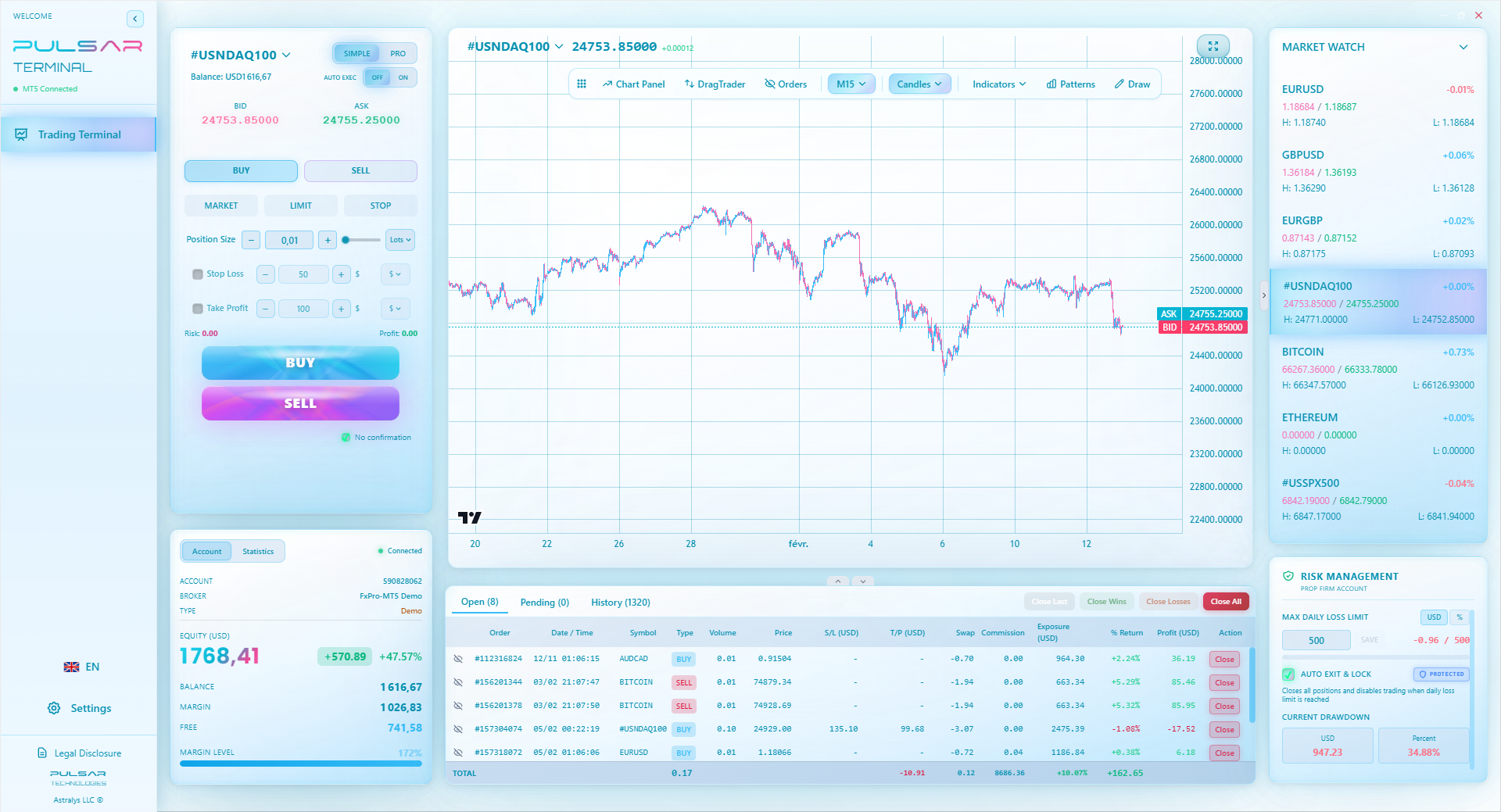
Managing a swing trade in a volatile instrument like this requires precise order tools, which platforms like Pulsar Terminal provide directly on MT5.
Pulsar Terminal
The all-in-one MT5 companion: drag-and-drop orders, multi-TP/SL, trailing stop, grid trading, Volume Profile, and prop firm protection. Used by 1,000+ traders daily.
As a trader, you have choices. Here’s my blunt comparison from the trenches.
| Feature | Tata Gold ETF | Physical Gold (Bars/Coins) | Gold Futures (MCX) |
|---|---|---|---|
| Liquidity | High during market hours (9:15-3:30 IST). Sell instantly. | Low. Finding a buyer at a fair price takes time. | Extremely High. Deep market, 24-hour trading in sessions. |
| Carry Cost/Spread | Expense ratio (~0.4%). Small bid-ask spread. | Huge. You buy at a ~12-15% premium over spot (making charges, GST). Sell at a discount to spot. | No physical cost. Only the broker spread, which is very tight. |
| use | None. You pay full amount. | None. | High. You trade on margin. Can amplify gains and losses dramatically. |
| Storage/Security | Vault held by fund. Zero hassle. | Your problem. Bank locker costs, theft risk. | Not applicable. |
| Trading Flexibility | Basic. Buy, sell, maybe a trailing stop with your broker. | None. | Advanced. Options, complex orders, different expiries. |
| Suitability | Long-term investor or swing trader wanting easy, secure exposure. | Emotional holder who wants to touch the metal. Not for traders. | Active trader or hedger comfortable with use and derivatives. |
I used to dabble in MCX futures. The use is seductive. But I've also been on the wrong side of a margin call when volatility spiked overnight. The ETF is cleaner. You own the asset, there's no use blowing up your account, and you can sleep at night. For building a core, long-term gold position as part of a portfolio, the ETF wins. For pure, short-term tactical bets on gold prices, futures might offer more tools, but with significantly higher risk. The new SEBI rule allowing ETFs to hold some gold futures is interesting - it might let funds manage liquidity better, but for you, the end trader, the product feels the same.
💡 Winston's Tip
Never analyze this ETF in isolation. Keep a USD/INR chart pinned next to it. The currency move is often half the trade.

“I was right on the commodity, wrong on the currency pair.”
Let's get vulnerable. I've lost money learning these lessons.
1. Ignoring the Rupee: My first major trade in a gold ETF was in 2014. Gold in dollars was rising steadily, and I piled into the then-popular ETF. What I missed was that the rupee was strengthening even faster. My ETF position went nowhere for months while my analysis of 'gold' was supposedly correct. I was right on the commodity, wrong on the currency pair. Now, I have a simple USD/INR chart next to my gold chart. Always.
2. Trading Around Festivals Clichés: "Buy before Diwali, sell after." Everyone knows this. That means the smart money often prices it in early. I've entered long in October expecting a seasonal bump, only to see the ETF sell off on the news. The trade was crowded. Now, if I play seasonality, I aim to enter weeks before the common narrative hits the papers, and I use tighter stops.
3. Chasing Liquidity at Open/Close: The ETF is liquid, but not like a Nifty stock. If you place a market order right at the open when gold has gapped up on international news, the spread can be nasty. I once paid a 0.8% premium to NAV just because I was impatient. Use limit orders. Always.
4. Forgetting It's Still an 'Equity' for Your Broker: This is operational. If you're also trading stocks, remember your gold ETF holdings contribute to your overall portfolio margin. A sharp drop in your equity holdings could trigger a margin call that forces you to sell your gold ETF position at a bad time, even if the gold thesis is intact. Manage your portfolio risk as a whole.
The biggest lesson? Treat it with respect. It's not a passive 'set-and-forget' investment. It's a tactical asset that requires active monitoring of global and local factors. A tool like the MACD indicator on the weekly chart can help identify the major trend, but the day-to-day noise requires discipline.
After all this, is the Tata Gold ETF a good fit for you?
You SHOULD consider Tata Gold ETF if:
- You want exposure to gold without the hassle of physical storage.
- You're an Indian investor/trader thinking in rupees and want a direct play on domestic gold prices.
- You have a medium to long-term horizon (over 1 year) to benefit from lower tax rates.
- You want to add a non-correlated asset to your stock portfolio but need the liquidity to adjust sizes quickly.
- You believe in the long-term story of gold but don't want the volatility of futures.
You should probably look ELSEWHERE if:
- You are a short-term day trader looking for quick, leveraged profits. (Look at futures, but know the risks).
- You cannot monitor the USD/INR exchange rate as part of your analysis.
- You expect zero costs. The expense ratio and taxes are real drags.
- You want to trade 24/7. The market hours are limited.
For me, it's become a core holding. I use it to hedge my broader equity portfolio and to take directional views on the gold-rupee dynamic. It's not the most exciting tool in the shed, but it's reliable, transparent post-2026 rules, and does its job well. Just go in with your eyes open to the costs and the tax implications. Start small, get a feel for how it moves, and always, always use a stop loss. Even for gold.

FAQ
Q1What is the minimum investment amount for Tata Gold ETF?
You can start with as little as ₹100 for a lump sum investment in the Tata Gold ETF. There's no minimum for additional investments or SIPs in the regular plan, making it very accessible.
Q2How is the Tata Gold ETF taxed?
If you sell your ETF units within 12 months of buying, the profit is added to your income and taxed at your normal slab rate. If you hold for more than 12 months, a long-term capital gains tax of 12.5% applies to the profit. Remember, STT is also charged on transactions.
Q3Can I redeem Tata Gold ETF for physical gold?
Generally, no, for retail investors. You buy and sell the ETF units on the stock exchange for cash. Direct redemption for physical gold is typically only for Authorised Participants dealing in large 'Creation Unit' sizes or under specific, large-value or stress scenarios outlined by the fund.
Q4What is the difference between Tata Gold ETF and its Fund of Fund (FoF)?
The main Tata Gold ETF holds physical gold. The FoF holds units of the main ETF. The FoF usually has a higher expense ratio (0.69% vs. 0.42% for regular plans) and has a small exit load for redemptions within 7 days. For most traders, the direct ETF is the simpler, cheaper choice.
Q5How does the new 2026 SEBI valuation rule affect me?
The April 1, 2026 rule means the ETF's Net Asset Value (NAV) is now based on Indian gold spot prices (from MCX/BSE), not London prices. This better reflects local costs like import duty. For you, the ETF's price should more closely track the gold price you hear about in Indian news, reducing tracking error from international benchmarks.
Q6Is there a dividend payout with Tata Gold ETF?
The Tata Gold ETF offers both Growth and Dividend options. The Growth option reinvests gains, increasing the NAV per unit. The Dividend option periodically pays out gains. As a trader focused on total return and tax efficiency, I typically prefer the Growth option to avoid the tax event of a dividend payout.
Prof. Winston's Lesson
Key Takeaways:
- ✓Always factor in the 12.5% LTCG tax for holds >1 year.
- ✓Monitor USD/INR as closely as gold charts.
- ✓Use limit orders to avoid wide bid-ask spreads.
- ✓The 0.4% expense ratio is a silent drag on returns.
How useful was this article?
Click a star to rate
Weekly Trading Insights
Free weekly analysis & strategies. No spam.
About the Author
Rajesh Sharma
Senior Forex Analyst
Trading Indian and South Asian markets for over 10 years. Started with NSE currency derivatives before moving to international forex. Specializes in USD/INR and emerging market pairs.
Comments
Risk Disclaimer
Trading financial instruments carries significant risk and may not be suitable for all investors. Past performance does not guarantee future results. This content is for educational purposes only and should not be considered investment advice. Always conduct your own research before trading.
You Might Also Like

Cara Trading Forex Sukses: 7 Prinsip dari Trader Profesional
Cara trading forex sukses dengan 7 prinsip trader pro: manajemen modal, disiplin, journal trading, backtest. Data nyata, bukan janji profit palsu.
Jam Trading Forex Terbaik untuk Trader Indonesia: Panduan Lengkap dengan Tabel Waktu
Panduan jam trading forex untuk trader Indonesia. Tabel 4 sesi dunia, jam emas 20:00-00:00, sesi mana yang harus dihindari. Data akurat + tips dari trader berpengalaman.
Top 5 Sàn Forex Uy Tín Nhất 2026: Review Jujur dari Trader Indonesia
Top 5 sàn forex uy tín 2026 untuk trader Indonesia. Review jujur: spread, deposit, withdraw, dukungan lokal. Exness, XM, IC Markets & lebih.
Get Pulsar Terminal
All these calculators are built into Pulsar Terminal with real-time data from your MT5 account. One-click position sizing, automatic risk management, and instant calculations.
Get Pulsar Terminal