


I was staring at my screen on January 29, 2026.

Rajesh Sharma
Senior Forex Analyst ·  India
India
☕ 11 min read
What you'll learn:
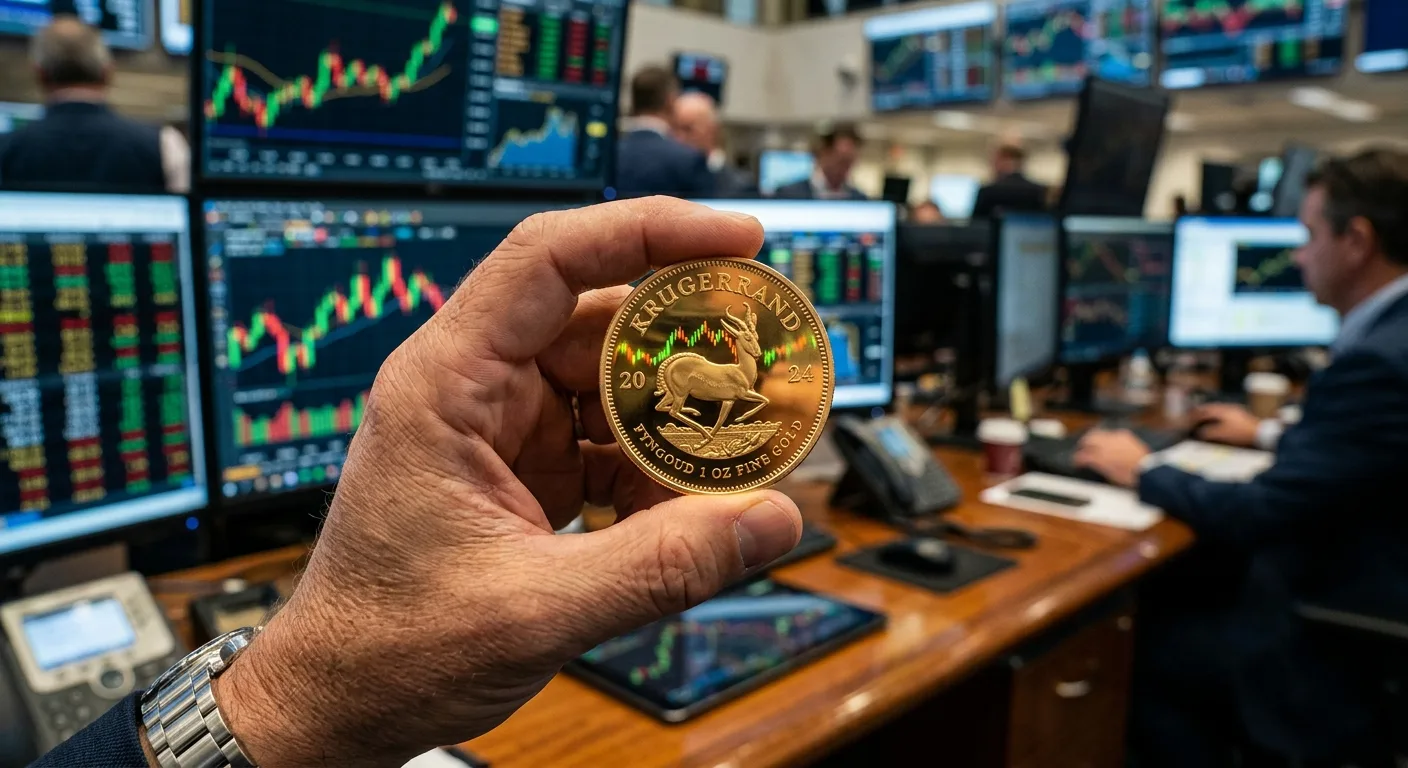
I was staring at my screen on January 29, 2026. The Tata Gold ETF had just printed a fresh 52-week high of ₹17.70. My gut said to take profits, but the charts screamed momentum. I held. The next week, it pulled back 8%. That moment, watching paper profits evaporate, taught me more about trading this instrument than any textbook ever could. The Tata Gold Exchange Traded Fund share price isn't just a number; it's a direct play on gold, filtered through India's unique market structure, taxes, and investor psychology. Let's break down how to trade it properly.
When you buy a share of the Tata Gold ETF, you're not buying a stock of a mining company. You're buying a tiny, tradable slice of physical gold bullion sitting in a vault. The fund launched in January 2024 and, as per SEBI rules, must keep at least 95% of its assets in actual gold or approved gold instruments. Think of it as digital gold with a Demat account number.
The price you see, like ₹14.39 as of April 7, 2026, is the Net Asset Value (NAV). It represents the value of the underlying gold per unit, minus the fund's expenses. The beauty? You can buy and sell it on the NSE or BSE just like Reliance or TCS, during market hours. No worrying about purity, storage, or making a trip to the jeweller.

Warning: Don't confuse it with a Gold Fund of Fund (FoF). The ETF trades on the exchange. A Gold FoF is a mutual fund that invests in the ETF. You buy the FoF at the day's closing NAV; you trade the ETF at live prices throughout the day. For active trading, you want the ETF in your Demat.
The Tata Gold ETF share price primarily tracks domestic gold prices. But it's not a perfect mirror. Several forces pull at it.
Global Gold Price (in USD)
This is the big one. When international gold (like XAU/USD) moves, it sets the base direction. Geopolitical tension, US Fed policy, and dollar strength are the usual global suspects. You need to watch these, but remember, you're trading the Indian price.
The USD/INR Exchange Rate
This is the critical filter. If international gold is flat but the rupee weakens against the dollar, the cost of importing gold rises. That pushes up domestic gold prices, and thus, the ETF. I learned this the hard way in late 2025. I was bullish gold, but a sharp, unexpected rally in the rupee wiped out my expected gains on a Tata Gold ETF position. You're always trading gold and the rupee.
Domestic Demand & Regulations
Indian festivals, wedding season, and rural demand can create seasonal strength. More importantly, government policy matters. The import duty on gold, which was cut to 6% from 15% in 2024, directly affects the landed cost. The new SEBI valuation rule, effective April 1, 2026, is a game-changer (there, I said it). Now, the fund must value its gold using polled spot prices from Indian exchanges, not the London (LBMA) benchmark. This aims to better reflect local supply/demand and taxes. In theory, this should make the NAV more transparent and responsive to Indian conditions.
Tracking Error & Liquidity
The ETF has an expense ratio (around 0.38-0.42%). This creates a slight drag, a 'tracking error,' against the actual gold price. Also, check the average daily volume. While it's decent for a Gold ETF, a large market order can cause a temporary price mismatch versus the underlying gold value. Always use limit orders.

Example: Let's say international gold is at $2,150/oz and USD/INR is at 83.50. The rough domestic price per 10 grams is calculated, then duties and local premiums are added. The ETF's NAV is derived from that. If gold stays at $2,150 but USD/INR jumps to 84.50, the ETF price will rise.

💡 Winston's Tip
The new SEBI valuation rule means the ETF's NAV now breathes with the Indian market's lungs, not London's. Watch for increased sensitivity to local news and rupee flows.

“You're not just trading gold; you're trading gold filtered through the USD/INR exchange rate.”
You can approach this like any other asset. Here’s how I’ve traded it, with real numbers.
Swing Trading the Trends
This is my preferred method. Gold trends can be powerful and last for months. I use weekly and daily charts. A simple strategy: wait for a pullback to a key moving average (like the 50-day or 100-day EMA) when the overall trend is up, then enter. In November 2025, I bought at ₹9.85 after a pullback to the 50-day EMA. The trend resumed, and I sold at ₹14.20 two months later. Not a home run, but a solid 44% swing trade. Tools like the MACD indicator and RSI indicator work well for confirming momentum and spotting divergences at extremes.
Using it as a Portfolio Hedge
This is its classic role. When equities (Nifty) look shaky, I might allocate 5-10% of my portfolio to the Gold ETF. It’s not for aggressive returns; it’s for insurance. During the market panic in mid-2025, while my tech stocks bled, the Gold ETF position was up 18%. It softened the blow.
What Doesn't Work (My Mistake)
Trying to scalp this ETF intraday is tough. The spreads can be wider than major forex pairs, and the movement isn't always fluid enough for quick, small gains. I once lost ₹700 in brokerage and slippage trying to scalp 30-paise moves. It's not worth the stress. Save the scalping for more liquid instruments.

Pro Tip: Pair your analysis. Don't just look at the ETF chart. Have a chart of international gold (XAU/USD) and USD/INR open side-by-side. Often, the story becomes clear when you see all three moving together - or against each other.

This is where many new traders get a nasty surprise. The returns you see aren't the returns you keep.
Brokerage & Costs:
- Expense Ratio: The fund charges ~0.4% annually. It's baked into the NAV, so you don't pay it directly, but it's a drag on performance.
- Brokerage: You pay this on every buy and sell order. It varies by broker but typically ranges from 0.05% to 0.5% per trade. On a ₹1,00,000 trade, that's ₹50 to ₹500 each way.
- No Exit Load: A plus. You can sell anytime without a fund penalty.
- STT & GST: Securities Transaction Tax (STT) and GST on brokerage apply. It adds up.
Taxation (The Critical Part): The rules changed in 2023, and it's brutal for traders.
- For investments made ON or AFTER April 1, 2023: All gains are treated as Short-Term Capital Gains (STCG), regardless of how long you hold. You hold for 3 years? STCG. Hold for 3 days? STCG. These gains are simply added to your total income and taxed at your income tax slab rate (could be 30% or more).
- For investments made BEFORE April 1, 2023: The old rules apply (36 months for LTCG at 20% with indexation). But for anyone starting now, this is irrelevant.
This tax rule fundamentally changes the game. It removes the benefit of long-term holding for tax purposes. It makes the ETF more suitable for shorter-term tactical trades or as a non-tax-efficient hedge. Always, always factor this into your profit calculations. A 15% gain can quickly become a 10% gain after tax.
SEBI's New Valuation Rule (2026): As mentioned, funds now use Indian exchange spot prices, not LBMA. For you, the trader, this should mean the NAV reacts faster to local news and currency moves. Watch for any increased volatility around this change as the market adapts.
💡 Winston's Tip
That 72% return in 2025 was an outlier, not a promise. Trade the chart in front of you, not the memory of last year's glory.

“The 2023 tax change removed the benefit of patience. All gains are short-term now, so trade actively or hedge tactically.”
It's straightforward if you're already in the markets.
- Accounts: You need a Demat account and a trading account. Almost any major Indian broker provides this: Zerodha, Upstox, ICICI Direct, HDFC Securities, Angel One, etc.
- Finding it: In your trading terminal, search by its symbol. On the NSE, it's TATAGOLDETF. The ISIN is INE0HHL01014.
- Placing an Order: Log in, go to buy/sell, enter the symbol, quantity, and order type.
- Market Order: Fills immediately at the best available price. Risky if liquidity is low.
- Limit Order: You set the price. I almost always use this. It prevents bad fills.
- Settlement: T+1 day. The units land in your Demat account, and the money is debited/credited.
- SIP Option: You can't SIP directly into the ETF on the exchange, but many brokers offer an auto-invest feature that mimics a SIP by placing a buy order for you at regular intervals. Alternatively, you can buy the Tata Gold ETF Fund of Fund through a mutual fund SIP, but then you're not trading the live price.
Warning: Always check the iNAV (Indicative NAV), which many brokers and exchange websites display during market hours. It's a real-time estimate of the NAV. If the ETF's market price is trading at a significant premium or discount to the iNAV, be cautious. You might be overpaying or getting a bargain, but there's usually a reason (like low liquidity at that moment).
Gold isn't just gold in India. Here’s how your options stack up.
| Feature | Tata Gold ETF | Physical Gold (Jewellery/Coins) | Sovereign Gold Bonds (SGBs) |
|---|---|---|---|
| Ownership | Units in Demat | Physical possession | Government bond in Demat |
| Purity/Storage | Assured (99.5%), Vaulted | Risk of impurity, Need safe storage | Notional gold, No storage |
| Liquidity | High (Sell on exchange anytime) | Low (Finding a buyer, making charges loss) | Moderate (Trade on exchange after lock-in) |
| Transaction Cost | Brokerage, STT | Making charges (8-25%), GST, buy-sell spread | Nil if held to maturity |
| Extra Return | None | None (Jewellery is for use) | 2.5% p.a. interest paid semi-annually |
| Tax on Gains | STCG (Slab rate) | LTCG after 3yrs (20% with indexation) | LTCG tax-free if held to 8y maturity |
| Best For | Active traders, short-term hedges | Cultural needs, personal use | Long-term investors (8-year horizon) |
The Verdict:
- For trading and tactical allocations: The ETF wins. Liquidity is king.
- For a pure, long-term (8-year) investment: SGBs are unbeatable due to the tax-free status and interest. It's a no-brainer.
- For weddings and gifts: You still need physical. The ETF won't impress the in-laws.
I use a mix. My core long-term gold exposure is in SGBs. My trading and hedging book uses the Tata Gold ETF for its flexibility. Physical? That's my wife's department.
💡 Winston's Tip
With all gains taxed as short-term, your holding period is now a purely strategic decision, not a tax one. This turns gold from a 'set-and-forget' asset into an active tactical tool.
“For trading, the ETF's liquidity is king. For a 8-year investment, Sovereign Gold Bonds' tax-free status is unbeatable.”
Gold feels safe, but trading it isn't risk-free. Here’s how to protect your capital.
1. Never Forget the Rupee: Your biggest risk might not be gold going down, but the rupee going up. Hedge your view. If you're super bullish gold but think the RBI will strengthen the rupee, your trade has an internal conflict.
2. Use Position Sizing: This is non-negotiable. Don't bet the farm because it's 'safe-haven.' Use a position size calculator. I never risk more than 1-2% of my trading capital on a single Gold ETF trade. In early 2026, I got overconfident after a few wins and put on a 5% risk position. A swift 5% drop in the ETF triggered my stop and hurt my monthly P&L badly. Lesson relearned.
3. Have a Clear Stop-Loss: Gold can have sharp, volatile downdrafts. Decide your stop before you enter. Is it 5% below entry? A break of a key support level on the daily chart? Stick to it. A margin call is unlikely with an ETF, but a large drawdown is very possible.
4. Avoid the 'Buy and Forget' Trap (Now): With the new tax law (all gains are STCG), the old 'buy, lock in Demat, forget for 10 years' strategy loses its tax advantage. You need to be more active in managing the position, booking profits, and re-entering.
5. Liquidity Gaps: Avoid trading in the first and last 15 minutes if you're placing large orders. The spread (difference between buy and sell price) can be wider. Check the average daily volume; it's healthy but not infinite.
Common Mistake I See: People see the 72% return in 2025 and expect that every year. That was an exceptional year driven by unique global fear. The long-term average return for gold is much more modest. Chase trends, not fantasies.

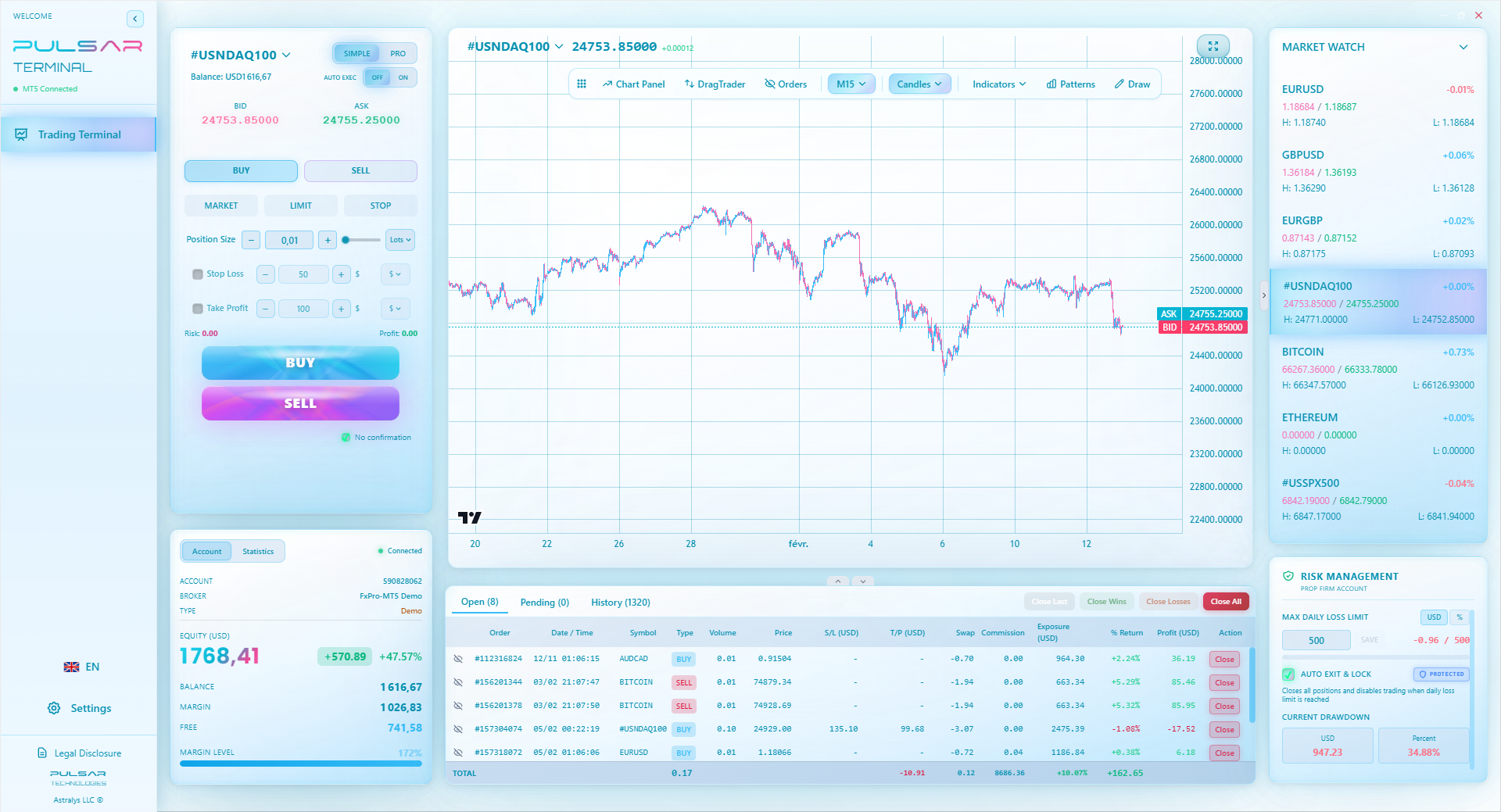
Managing multiple profit targets and a trailing stop on a trending gold ETF trade is complex, but Pulsar Terminal lets you set it all up with a single drag-and-drop order directly on your MT5 chart.
Pulsar Terminal
The all-in-one MT5 companion: drag-and-drop orders, multi-TP/SL, trailing stop, grid trading, Volume Profile, and prop firm protection. Used by 1,000+ traders daily.
FAQ
Q1What is the current Tata Gold Exchange Traded Fund share price?
The price fluctuates throughout the trading day. As of April 7, 2026, it was around ₹14.39 per unit. You should always check your trading terminal or a financial website for the live price, which is based on the underlying gold's value in rupees.
Q2Is Tata Gold ETF a good investment for the long term?
For a pure long-term hold (8+ years), Sovereign Gold Bonds (SGBs) are generally better due to tax-free gains and 2.5% annual interest. The ETF is more suited for medium-term holds, tactical trading, or as a liquid hedge within a portfolio, especially given the tax treatment of all gains as short-term.
Q3How is the Tata Gold ETF share price calculated?
The price, or NAV, is based on the value of the physical gold held by the fund. Since April 1, 2026, SEBI mandates this be valued using polled domestic spot gold prices from Indian exchanges (not London prices), plus/minus the fund's expenses (the ~0.4% expense ratio).
Q4What are the tax implications of selling Tata Gold ETF?
For units bought after April 1, 2023, any profit you make is considered Short-Term Capital Gains (STCG), regardless of your holding period. This profit is added to your total annual income and taxed at your applicable income tax slab rate (which could be 30% or higher).
Q5Can I buy Tata Gold ETF without a Demat account?
No. To buy and sell the ETF on the stock exchange, you must have a Demat account to hold the units electronically. You can, however, invest in the Tata Gold Fund of Fund (FoF) without a Demat account, but that is a different product that buys the ETF for you.
Q6What is the minimum investment amount?
You can start with a very small amount. The minimum investment for a lump sum in the Tata Gold ETF is just ₹100. However, remember that brokerage fees will eat into small investments, so it's more practical to invest a larger amount, say a few thousand rupees, to make costs negligible.
Q7Why does the ETF price differ from the physical gold price?
There's usually a small difference due to the ETF's expense ratio (tracking error) and intraday trading sentiment. Also, the ETF price reflects expectations and liquidity on the exchange, while the physical gold price you see quoted includes different local premiums and may be for different quantities and purities.
Prof. Winston's Lesson
Key Takeaways:
- ✓Always pair gold analysis with USD/INR charts.
- ✓Post-2023, all ETF gains are taxed at your income slab rate.
- ✓Use limit orders to avoid bad fills in low liquidity.
- ✓SEBI's 2026 rule ties NAV directly to Indian spot prices.
- ✓Never trade it without a predefined stop-loss.
How useful was this article?
Click a star to rate
Weekly Trading Insights
Free weekly analysis & strategies. No spam.
About the Author
Rajesh Sharma
Senior Forex Analyst
Trading Indian and South Asian markets for over 10 years. Started with NSE currency derivatives before moving to international forex. Specializes in USD/INR and emerging market pairs.
Comments
Risk Disclaimer
Trading financial instruments carries significant risk and may not be suitable for all investors. Past performance does not guarantee future results. This content is for educational purposes only and should not be considered investment advice. Always conduct your own research before trading.
You Might Also Like

Cara Trading Forex Sukses: 7 Prinsip dari Trader Profesional
Cara trading forex sukses dengan 7 prinsip trader pro: manajemen modal, disiplin, journal trading, backtest. Data nyata, bukan janji profit palsu.
Jam Trading Forex Terbaik untuk Trader Indonesia: Panduan Lengkap dengan Tabel Waktu
Panduan jam trading forex untuk trader Indonesia. Tabel 4 sesi dunia, jam emas 20:00-00:00, sesi mana yang harus dihindari. Data akurat + tips dari trader berpengalaman.
Top 5 Sàn Forex Uy Tín Nhất 2026: Review Jujur dari Trader Indonesia
Top 5 sàn forex uy tín 2026 untuk trader Indonesia. Review jujur: spread, deposit, withdraw, dukungan lokal. Exness, XM, IC Markets & lebih.
Get Pulsar Terminal
All these calculators are built into Pulsar Terminal with real-time data from your MT5 account. One-click position sizing, automatic risk management, and instant calculations.
Get Pulsar Terminal