


Here's a number that might sting: the UK government's tax-free allowance for trading gains has been slashed by 75% in just two years.

Sarah Collins
Trading Strategist ·  United Kingdom
☕ 11 min read
What you'll learn:
- 1The Big Tax Bomb: Spread Betting vs. CFDs
- 2Capital Gains Tax: Rates and That Shrinking Allowance
- 3When Forex Trading Becomes a 'Business' (And Why You Might Not Want It To)
- 4How to Record Your Trades (Without Losing Your Mind)
- 5Using Losses and Basic Tax Efficiency
- 6Does Your Broker Choice Affect Your Tax Bill?
- 7The Top Tax Mistakes (And How to Avoid an HMRC Letter)
- 8When to Get an Accountant (It's Sooner Than You Think)
Here's a number that might sting: the UK government's tax-free allowance for trading gains has been slashed by 75% in just two years. That £12,300 buffer you might remember is now a measly £3,000. If you're making more than a few hundred quid a month from forex, you're almost certainly on HMRC's radar now. The rules around tax on forex trading aren't just confusing, they're actively changing to catch more of your profit. I've seen too many traders have a killer year only to get a nasty surprise come January. Let's break down exactly what you owe, how to report it, and a few legal ways to keep more of your hard-earned cash.
This is the single most important distinction for UK traders, and getting it wrong can cost you thousands. Most beginners don't even realise they're choosing a tax status when they pick an account type.
Spread betting is, legally speaking, gambling. I know, it feels like trading – you're analysing charts, setting stops, the whole bit. But in HMRC's eyes, it's a bet on price movement. The huge benefit? Profits are generally free from Capital Gains Tax and Income Tax. It's tax-free income. I used this for years when I was building my capital.
CFD (Contract for Difference) and spot forex trading is treated as investing. Your profits are subject to Capital Gains Tax (CGT). The trade-off? Your losses can be offset against other capital gains, which is a tool you don't get with spread betting.

Warning: The 'tax-free' status of spread betting isn't absolute. If it becomes your sole or main source of income, HMRC could argue it's a trade and hit you with Income Tax. This is rare, but it happens to full-time, highly systematic traders.
Here’s a real example from my own books. In 2022, I made a £15,000 profit spread betting on GBP/USD volatility. That money landed in my bank account, and that was that. No tax form. The same year, I also ran a small CFD account for a specific scalping strategy that netted £4,000. That £4,000 went on my Self-Assessment as a capital gain.
The choice isn't just about tax, though. Spread betting prices include the broker's fee in the spread, while CFD accounts often have tighter spreads but charge a commission. You need to crunch the numbers for your style. A high-frequency scalper might save more on raw costs with a CFD account from a broker like Pepperstone than they'd pay in tax on smaller profits.
If you're trading CFDs or spot forex, this is your reality. Let's talk numbers, because the goalposts have seriously moved.
The Annual Exempt Amount (AEA)
This is your tax-free allowance for gains. It used to be a generous £12,300. As of the 2024/25 tax year (starting April 6th, 2024), it's just £3,000. That's it. Make a £3,001 profit? You're paying tax on that single pound. This change alone has dragged thousands of casual traders into the tax net.
The Tax Rates
Once your net gains (total profits minus total losses) bust through that £3,000 allowance, here's what you pay:
- Basic Rate Taxpayers: 10% on your gains.
- Higher or Additional Rate Taxpayers: 20% on your gains.
Figuring out which rate you pay depends on your total taxable income (salary, rental income, etc.) PLUS your taxable gains. Add it all up, and see which band the total falls into.

Example: Let's say you're a basic rate taxpayer from your day job. You make a £10,000 net gain from CFD trading in a year.
- Subtract your AEA: £10,000 - £3,000 = £7,000 taxable gain.
- Add this £7,000 to your other income. If it doesn't push you into the higher rate band, you pay 10%.
- Your tax bill: £7,000 x 0.10 = £700.
You report this through a Self-Assessment tax return. The deadline is January 31st following the end of the tax year (so January 31st, 2026, for the 2024/25 year). Miss it, and the fines start adding up fast.

💡 Winston's Tip
The first £3,000 of your CFD profit each year is your 'free trade'. Once you hit that, every pip of profit has a 10-20% partner you need to account for. Plan your risk accordingly.
“Spread betting is tax-free gambling, CFD trading is taxable investing. You choose your tax status when you pick your account type.”
This is the grey area that keeps some traders awake at night. HMRC has something called the 'Badges of Trade' test. If enough of these 'badges' apply to your activity, they can decide you're not an investor subject to CGT, but a trader running a business. This is a big deal.
Business trading means Income Tax and National Insurance, not CGT. The rates are higher (20%, 40%, 45%), but you can also claim many more expenses against your profit – think a portion of your home office, software subscriptions, even some education costs.
HMRC looks for things like:
- Frequency: Are you placing dozens of trades a day? That's a strong badge.
- Profit-seeking motive: Obviously, we all are. But is it your primary intent?
- Organisation: Do you have a dedicated office, use sophisticated software, keep detailed business records?
- Source of finance: Are you using borrowed money (like high use)?
I had a scare with this a few years back. I was trading full-time, using a prop firm model, and my accountant flagged that my activity could be viewed as a business. The potential tax jump was frightening. We had to carefully document how my trading was speculative and capital-focused, not a service. It was a headache.
For most retail traders using their own capital, CGT is the likely category. But if you're scaling up, maybe using a prop firm challenge structure to trade larger capital, the lines can blur. Get professional advice if you're in doubt.
HMRC requires you to keep records for at least 5 years after the January 31st filing deadline. If you get investigated, "my broker platform shows it" won't cut it. You need your own records.
I learned this the hard way after a platform migration wiped a chunk of my early trade history. Now, I keep it simple but bulletproof.
What you MUST record for every single trade:
- Asset (e.g., EUR/USD)
- Trade date and time
- Buy/Sell price
- Number of units (lot size)
- Closing date and time
- Closing price
- Gross profit or loss
- Any commissions, fees, or financing charges (swap)
My System: I use a simple Google Sheet. One tab per tax year. Each row is a trade. At the end of the year, I total the profit/loss column. My broker's annual statement (which all FCA-regulated brokers like IC Markets or XM provide) is then used to cross-check and verify my totals. The statement is my backup proof.

Pro Tip: Export your trade history as a .CSV file at the end of each month. Label it clearly (e.g., "MT4_Account1234_2025_04.csv") and store it in a dedicated folder. This monthly habit takes 2 minutes and saves you a weekend of panic at tax time.
This record-keeping is also essential for understanding your own performance. You can't improve what you don't measure. Knowing your exact win rate, average win/loss, and net profit is the bedrock of any serious swing trading or long-term strategy.
💡 Winston's Tip
Your most valuable trading journal entry isn't your analysis, it's your profit/loss figure with fees. That's the number HMRC cares about. Log it religiously.
“A losing trade is a painful tax asset. It reduces your net gain for the year, so record every single one.”
Here's where a little planning can save you a lot of money. Losses aren't just painful, they're a tax asset if you're trading CFDs.
Offsetting Losses: Your net gain for CGT is total profits minus total losses in the same tax year. Let's say you have a terrible quarter and lose £5,000, then a great one and make £8,000. Your net taxable gain is £3,000. That wipes out your Annual Exempt Amount, resulting in a £0 tax bill. You can also carry forward unused losses to offset future gains.
Tax Year Planning: The UK tax year runs April 6th to April 5th. This timing can be useful. If you're sitting on a nice profit in early March, be aware that closing the trade books it into the current tax year. Could you hold until after April 6th to push the gain into the next year's allowance? Sometimes, yes. But never let the tax tail wag the trading dog – if the chart says take profit, take it.
Bed & Breakfasting Rule: You can't just sell an asset to crystalise a gain or loss and buy it back immediately to manipulate your tax position. HMRC's '30-day rule' says if you repurchase the same asset within 30 days, the sale and repurchase are matched. This is more relevant for shares, but the principle applies.
The most powerful tool for tax efficiency, honestly, is a good position size calculator. Consistent, controlled risk management leads to smoother equity curves, which avoids the nightmare of a massive winning year followed by a losing one where you can't offset those previous gains.
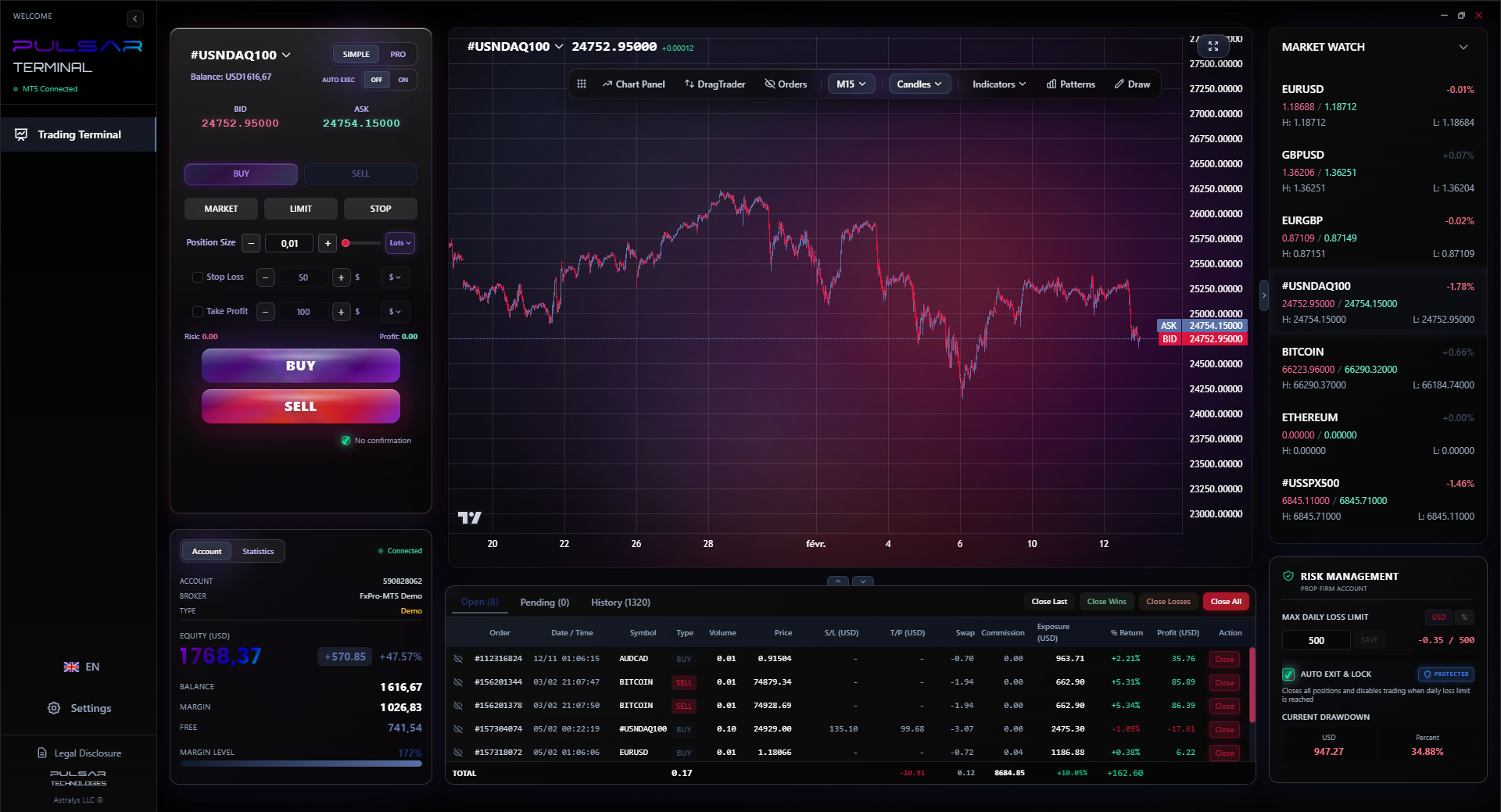
Managing multiple trades and partial closures for tax purposes is complex, but Pulsar Terminal's multi-TP/SL and grid trading features let you execute and track sophisticated strategies directly on MT5 with precision.
Pulsar Terminal
The all-in-one MT5 companion: drag-and-drop orders, multi-TP/SL, trailing stop, grid trading, Volume Profile, and prop firm protection. Used by 1,000+ traders daily.
Indirectly, yes. Your broker doesn't calculate or withhold your tax for you (that's your job), but the type of accounts they offer dictates your options.
FCA Regulation is Non-Negotiable. This ensures your broker adheres to strict standards, including negative balance protection and client money segregation. It also means they'll provide the legally required annual statement for your tax records. Never, ever trade with an unregulated broker to try and 'hide' activity. It's not worth the risk.
Account Type is Key:
- Spread Betting Account: Offered by most UK-focused brokers. This is your route to potential tax-free profits. Check the spreads and overnight financing costs.
- CFD/Spot Forex Account: This is your taxable investing account. Look for tight spreads and clear commission structures. A broker like Pepperstone on their Razor account might offer EUR/USD from 0.0 pips plus a small commission, which is ideal for high volume.
Many traders, myself included, run two accounts: a spread betting account for most trades, and a small CFD account for strategies where the raw pricing is critical. It's a hassle, but it can be the most cost-effective setup overall.
Remember, all trading costs – the spread, commissions, swap fees – reduce your net profit. A lower net profit means a lower taxable gain. So, in a roundabout way, choosing a cost-efficient broker is a form of tax planning.
“HMRC doesn't care about your perfect RSI divergence. They care about the net number on your annual statement.”
I've made a few of these, and I've seen friends get into proper scrapes. Here's what to watch for.
- Ignoring It Altogether: The 'head in the sand' approach. HMRC gets data from banks and increasingly from electronic platforms. They can and do cross-reference. A sudden £20,000 deposit in your current account from a broker will raise a flag.
- Mixing Personal and Trading Money: Use a dedicated bank account for your trading deposits and withdrawals. It makes tracking everything infinitely easier and looks more professional if you are investigated.
- Forgetting About Losses: You must report net gains or losses. If you have a losing year, you should still file a Self-Assessment to register that loss with HMRC, so you can carry it forward. I forgot one year and lost the ability to offset about £2,000 of losses. A costly oversight.
- Not Understanding the 'Trading Allowance': There's a £1,000 tax-free trading allowance, but it's for casual, non-business income like selling crafts online. It generally does not apply to organised financial trading like forex. Don't assume you can use it.
- Poor Record Keeping: As discussed, this is the quickest way to a nightmare if HMRC asks questions. They can go back years.
If you do get an enquiry letter, don't panic. Gather your records (those monthly .CSV files will be gold), and consider hiring an accountant who specialises in trading. It's worth the fee for the peace of mind and their knowledge of how to present your case to HMRC.
My rule of thumb? If your taxable trading profits are consistently above the Annual Exempt Amount (£3,000), it's time to at least consult one. The cost of a mistake is almost always higher than their fee.
A good accountant who understands financial markets will:
- Confirm your correct trading status (CGT vs. Business).
- Ensure you're claiming all allowable expenses.
- Help with tax-year planning to use your allowances efficiently.
- Deal with HMRC correspondence on your behalf.
Look for an accountant or firm that mentions 'financial traders', 'spread betting', or 'CFDs' specifically. Your local high street accountant who does books for plumbers might not have a clue.
I hired my accountant when my trading profits first crossed £15,000. His first move was to review my spread betting vs. CFD split and suggest a more optimal structure. He also identified some software subscriptions I could legitimately claim. His fee paid for itself in the first year.
Think of it as a business expense for your trading operation. It lets you focus on the charts, not the tax code.
💡 Winston's Tip
An accountant's fee is a deductible expense if trading is your business. If you're paying tax, you can likely use their service to reduce the tax you pay. It's a no-brainer.
FAQ
Q1Is forex trading tax-free in the UK?
It depends entirely on how you trade. Profits from spread betting are generally tax-free for most individuals. Profits from trading forex CFDs or spot forex are subject to Capital Gains Tax once you exceed the £3,000 annual allowance.
Q2What is the tax-free allowance for forex trading profits in 2024/25?
The Capital Gains Tax Annual Exempt Amount for the 2024/25 and 2025/26 tax years is £3,000. This is the total profit (from CFDs/spot forex) you can make before you start owing tax. This allowance has been drastically reduced from £12,300 just a few years ago.
Q3Do I pay tax on losses in forex trading?
You don't pay tax on losses, but they are crucial for your tax calculation. If you trade CFDs, your losses can be offset against your profits in the same year to reduce your net taxable gain. You can also carry forward unused losses to future years. Losses from spread betting cannot be offset against other taxable income.
Q4How do I report my forex trading profits to HMRC?
You report taxable profits (from CFD/spot trading) through a Self-Assessment tax return. You need to register for Self-Assessment if you haven't already. The deadline for online submission is January 31st following the end of the tax year. You must keep detailed records of all your trades for at least 5 years.
Q5Can HMRC find out if I don't declare my forex profits?
Yes, it is increasingly likely. HMRC receives data from UK banks and building societies about large deposits. A series of regular deposits from a known forex broker could easily trigger an enquiry. The penalties for deliberate non-declaration are severe, including hefty fines and potential criminal prosecution.
Q6Should I trade as a sole trader or limited company for forex?
For the vast majority of retail traders, trading as an individual (subject to CGT or as a sole trader for Income Tax) is sufficient and simpler. Forming a limited company adds significant accounting and administrative costs. It's usually only worth considering if you have very large, consistent profits and want to explore different ways of extracting money. Always get specialist advice before going down this route.
Q7Does my broker report my profits to HMRC?
FCA-regulated brokers in the UK do not automatically report your individual profits or losses to HMRC. However, they are required to provide you with an annual statement for your tax records. HMRC can request information from them if an investigation is opened. The responsibility for declaring taxable income rests entirely with you, the trader.
Prof. Winston's Lesson
Key Takeaways:
- ✓Spread betting profits are usually tax-free; CFD profits are not.
- ✓Your Capital Gains Tax allowance is now only £3,000 per year.
- ✓Losses from CFD trading offset profits, reducing your tax bill.
- ✓Keep detailed, bulletproof records of every trade for 5+ years.
- ✓Get a specialist accountant before profits exceed £10k.
How useful was this article?
Click a star to rate
Weekly Trading Insights
Free weekly analysis & strategies. No spam.
About the Author
Sarah Collins
Trading Strategist
London-based trading strategist with 12 years in financial markets. Former analyst at a City of London brokerage. Covers GBP pairs, European markets, and FCA-regulated trading.
Comments
Risk Disclaimer
Trading financial instruments carries significant risk and may not be suitable for all investors. Past performance does not guarantee future results. This content is for educational purposes only and should not be considered investment advice. Always conduct your own research before trading.
You Might Also Like

Cara Trading Forex Sukses: 7 Prinsip dari Trader Profesional
Cara trading forex sukses dengan 7 prinsip trader pro: manajemen modal, disiplin, journal trading, backtest. Data nyata, bukan janji profit palsu.
Jam Trading Forex Terbaik untuk Trader Indonesia: Panduan Lengkap dengan Tabel Waktu
Panduan jam trading forex untuk trader Indonesia. Tabel 4 sesi dunia, jam emas 20:00-00:00, sesi mana yang harus dihindari. Data akurat + tips dari trader berpengalaman.
Top 5 Sàn Forex Uy Tín Nhất 2026: Review Jujur dari Trader Indonesia
Top 5 sàn forex uy tín 2026 untuk trader Indonesia. Review jujur: spread, deposit, withdraw, dukungan lokal. Exness, XM, IC Markets & lebih.
Get Pulsar Terminal
All these calculators are built into Pulsar Terminal with real-time data from your MT5 account. One-click position sizing, automatic risk management, and instant calculations.
Get Pulsar Terminal