


Here's a fact that might sting a bit: a significant chunk of traders I've met in Mumbai and Delhi focus so hard on making profits, they forget the government gets a cut.

Rajesh Sharma
Senior Forex Analyst ·  India
India
☕ 11 min read
What you'll learn:
- 1The Legal Maze: FEMA, RBI, and What You Can Actually Trade
- 2Business Income vs. Capital Gains: Where Your Profits Land
- 3The Numbers: Slab Rates, Advance Tax, and That ₹10,000 Rule
- 4What You Can (and Can't) Deduct: Lowering Your Tax Bill
- 5The GIFT City Loophole (It's Not a Loophole)
- 6Pitfalls to Avoid: From Notices to Margin Calls
- 7Your Burning Questions, Answered
- 8Your Tax Season Action Plan
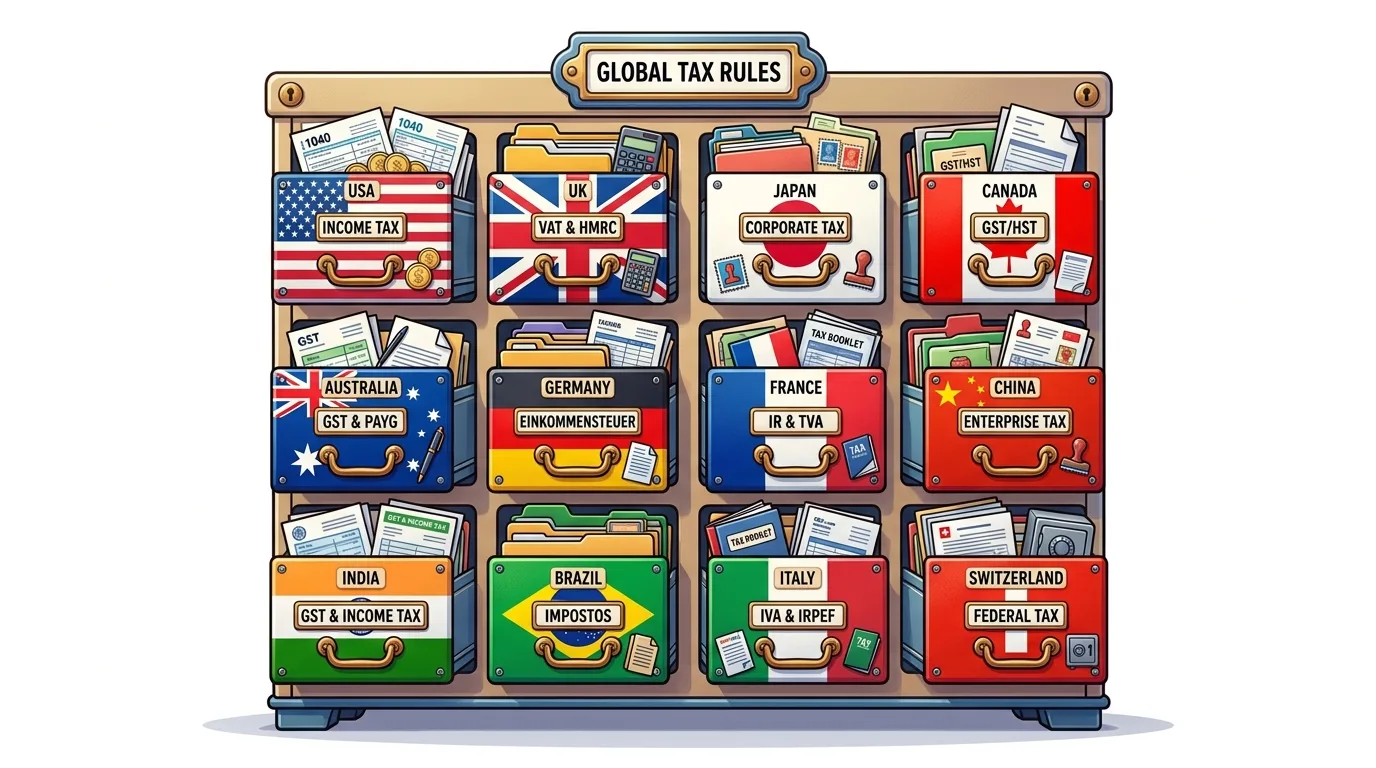
Here's a fact that might sting a bit: a significant chunk of traders I've met in Mumbai and Delhi focus so hard on making profits, they forget the government gets a cut. The tax on forex trading in India isn't just a footnote; it's a core part of your P&L. Get it wrong, and you could be handing over way more than you should, or worse, facing a nasty notice from the tax department. Let's break down exactly how your trading profits get taxed, what's legal, and how to keep more of your hard-earned money in your pocket.
First things first, you can't just open an account with any international broker and go wild on the EUR/USD. The rules here are strict, and they come from the Foreign Exchange Management Act (FEMA). The RBI and SEBI are the watchdogs.
The big rule? You're generally only allowed to trade INR-based pairs on Indian exchanges like the NSE or BSE. Think USD/INR, EUR/INR, GBP/INR. That's your playground. Trading major pairs like EUR/USD or GBP/JPY through an offshore broker? That's officially a no-go under FEMA for speculative trading. I learned this the hard way early on, trying to fund an account using a card. The bank blocked the transaction and called me for a "clarification." It was a hassle I didn't need.
There's one big, shiny exception: GIFT City. The RBI's Liberalised Remittance Scheme (LRS) does allow you to remit money to invest in securities within an International Financial Services Centre (IFSC). In plain English, you can fund an account with a broker registered in GIFT City to trade global markets legally. This is the primary legal gateway for Indian retail traders who want access to the real forex market.

Warning: Don't try to use the LRS to fund an account with a regular offshore broker like Exness or IC Markets for speculative trading. The RBI has explicitly said that's not allowed. If you get caught, funds can be frozen or penalties applied.
This is the heart of the matter. How your profit is taxed depends entirely on how the tax department sees your activity. It's not about what you call yourself, but what your trading looks like.
The Business Income Route
If you're trading frequently, it's your main gig, or you have a systematic approach, your profits will likely be treated as Business Income. This gets added to your total income (salary, rent, etc.) and taxed at your normal income tax slab rate. The good news? You can deduct expenses. We're talking broker commissions, data fees, a portion of your internet bill, even the cost of trading journals or educational courses. You need to maintain proper books of account.
I file my trading as business income. One financial year, I made a net profit of about ₹8.5 lakhs from trading. After deducting legitimate expenses (brokerage, software subscriptions, a new monitor), my taxable income from trading came down to around ₹7.2 lakhs. That deduction made a real difference in my final tax bill.
The Capital Gains Route
This is for the more occasional trader. If you're not in it daily and it feels more like an investment, profits might be classed as capital gains.
- Short-Term Capital Gains (STCG): If you hold a 'capital asset' (like a forex contract) for less than 36 months, the profit is STCG. It's simply added to your income and taxed at your slab rate.
- Long-Term Capital Gains (LTCG): Hold for more than 36 months? The gain is LTCG, taxed at 10% for gains above ₹1 lakh. Honestly, in forex trading, holding a position for three years is virtually unheard of, so LTCG is rarely applicable for direct trading.
The classification isn't always clear-cut. The tax officer will look at transaction frequency, volume, and your intent. When in doubt, or if you're trading actively, assume it's business income.

💡 Winston's Tip
Your trading journal is your first line of tax defense. A well-kept log isn't just for strategy review; it's auditable proof of your business activity and expenses.

“The tax on forex trading in India isn't a footnote; it's a core part of your P&L.”
Let's talk numbers. If your trading income is classified as business income or STCG, it's taxed at these slab rates (for FY 2023-24):
| Income Slab (₹) | Tax Rate |
|---|---|
| Up to 3,00,000 | 0% (with rebate u/s 87A) |
| 3,00,001 to 7,00,000 | 5% |
| 7,00,001 to 10,00,000 | 10% |
| 10,00,001 to 12,50,000 | 15% |
| 12,50,001 to 15,00,000 | 20% |
| Above 15,00,000 | 30% |
Now, here's the critical part almost everyone misses until they get an interest penalty: Advance Tax.
If your total tax liability for the year (from all sources, including trading) is likely to be more than ₹10,000, you must pay advance tax in installments. You can't just wait until March 31st. The due dates are:
- 15th June: Pay 15% of your estimated liability.
- 15th Sept: Pay up to 45% total.
- 15th Dec: Pay up to 75% total.
- 15th March: Pay 100%.

Pro Tip: Set aside a percentage of every profitable trade immediately for tax. I use a simple 30% rule for my business income. When I close a trade for a ₹50,000 profit, ₹15,000 goes straight to a separate savings account marked 'Tax.' This prevents a huge, painful payout in March.
Missing advance tax payments means you'll pay interest under Sections 234B and 234C. I got hit with this once in my second year of serious trading. I had a great Q4 and my tax liability shot up. The interest penalty was over ₹8,000 – a stupid mistake that came straight from my profits.
This is your best tool for managing the tax on forex trading in India. If you're filing as business income, you can deduct expenses incurred to earn that income. Be careful. Keep receipts and invoices.
Common Deductible Expenses:
- Brokerage fees and commissions (your biggest one).
- Subscription fees for trading terminals, news wires (like Reuters), or charting software.
- Internet and phone bills (a reasonable percentage used for trading).
- Depreciation on computers, monitors, and other hardware used for trading.
- Fees paid for market data or research reports.
- Office rent (if you have a dedicated space) or a portion of home rent/equated monthly installment (EMI) if you trade from home.
- Interest on loans taken for trading capital (be very careful with this and document everything).
- Accounting and legal fees related to your trading business.
What You Likely Can't Deduct:
- Personal living expenses.
- Losses from other hobbies or investments.
- Fines or penalties paid to exchanges or brokers.
The key is to be reasonable and have proof. You can't claim 100% of your ₹5,000/month rent if you also use the room to sleep. A common method is to calculate the square footage of your trading area versus your total home and apply that percentage.
Using a good position size calculator is a business expense in my book - it's a tool to protect your capital, which is your business's primary asset.

“Assuming your offshore trading profits are invisible to the taxman is a fantasy from a bygone era.”
Trading through a GIFT City broker is the legal way to access global forex pairs. But how does taxation work here? It's different.
Your activity is considered an investment in an IFSC. The income generated is still taxable in India, but the classification can be tricky. Often, profits from such trading may be treated as capital gains from foreign assets. The holding period rules (36 months for LTCG) still apply, but you're dealing with a different asset class (foreign securities).
The tax treatment for IFSC income is still evolving. It's crucial to consult with a CA who specializes in this area. One thing is clear: you must report this foreign income in your Indian tax return. The days of assuming offshore income is invisible are long gone.

Example: Let's say you fund a GIFT City account with $10,000 via LRS. You trade EUR/USD and end the year with a $2,000 profit. That $2,000 (converted to INR at the yearly average rate) is taxable income in India. You need to figure out if it's business income or capital gains based on your activity within that account.
Brokers like Exness or IC Markets have IFSC entities, but you must ensure you're opening the account with their specific GIFT City registration, not their global entity. Always check the regulatory details on their website. A good starting point is to read reviews of their IFSC offerings, like this Exness review that should detail their India-specific setup.
💡 Winston's Tip
That separate bank account for trading? Fund it with an initial 'capital contribution' and treat it like a business ledger. Every in and out should be for trading only. It simplifies everything.
I've seen traders make expensive errors. Don't be one of them.
- Not Filing at All: Thinking your trading profits are too small or 'off the books' is a huge risk. The tax department's data matching is getting scarily good.
- Ignoring Advance Tax: That ₹10,000 liability threshold is low. If you have a decent job and make even small trading profits, you'll likely cross it. Pay in installments.
- Mixing Personal and Trading Funds: Use a separate bank account for all trading activity - funding, withdrawals, expenses. It makes accounting 10 times easier and looks professional if you're ever questioned.
- No Record Keeping: No receipts, no trade logs, just a bank statement. This won't fly if you're claiming deductions. Use a simple spreadsheet or journal. Note every trade, even the losers.
- Misunderstanding Losses: Trading losses from business income can be carried forward for 8 years to set off against future business income. But you must file the return on time to claim this carry-forward.
Also, remember that poor tax planning can force bad trading decisions. If you haven't set aside money for tax, a large tax bill might mean you have to prematurely close positions or can't deploy capital effectively. It's all connected. Poor risk management that leads to a margin call can also wreck your yearly P&L and tax situation in one go.

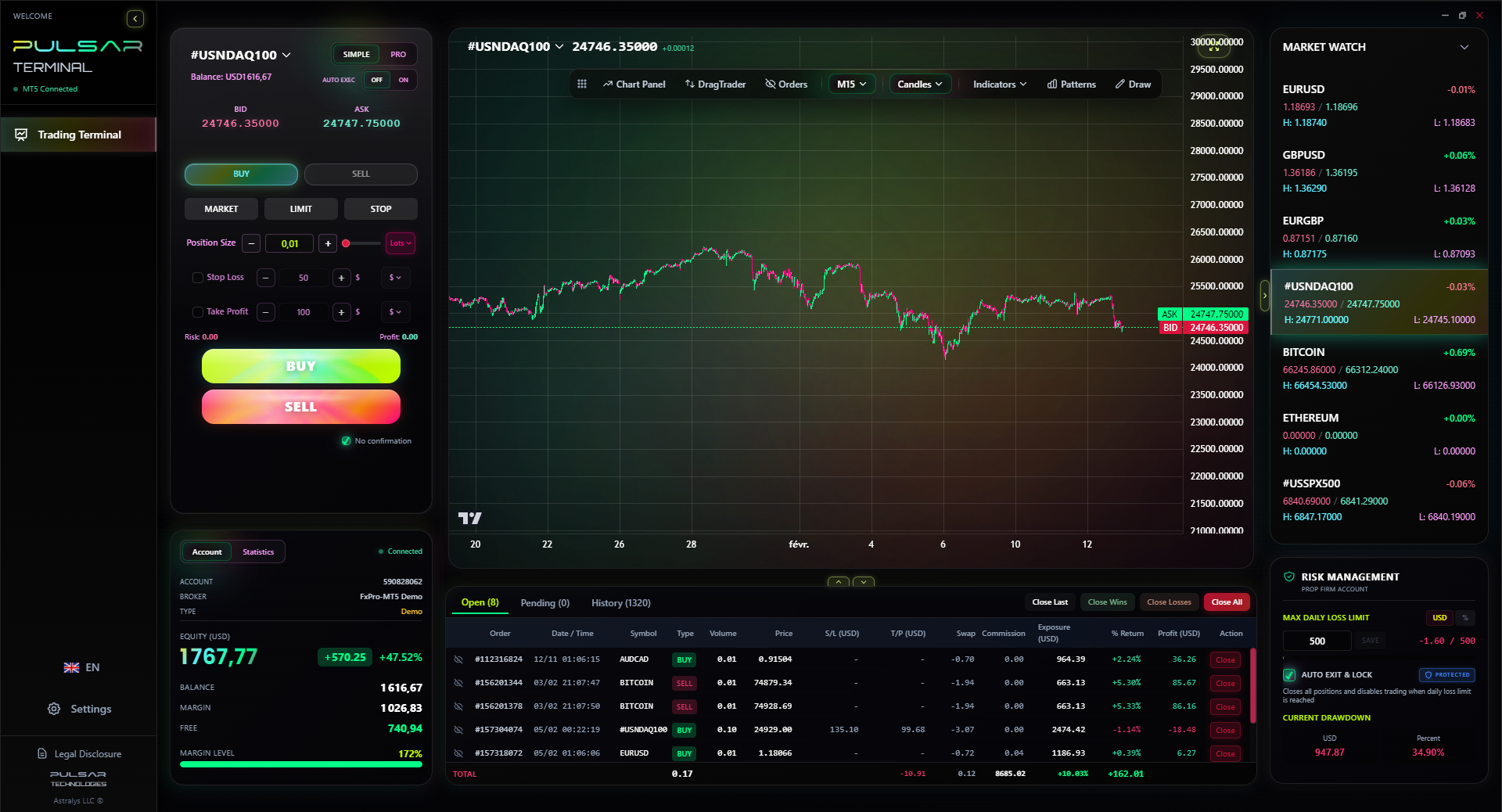
Accurate trade logging is critical for tax reporting, and Pulsar Terminal's detailed trade journal and analytics export directly to CSV, making quarterly profit calculations and expense tracking seamless.
Pulsar Terminal
The all-in-one MT5 companion: drag-and-drop orders, multi-TP/SL, trailing stop, grid trading, Volume Profile, and prop firm protection. Used by 1,000+ traders daily.
“Not setting aside money for tax is a form of use you don't want - it forces bad trading decisions later.”
Q: Do I pay tax if I make a loss in forex trading? A: You still need to file your tax return if your total income exceeds the basic exemption limit. The loss can be carried forward to set off against future trading profits (if filed as business income), but only if you file the return before the due date.
Q: Is TDS deducted on forex trading profits? A: Generally, no. Brokers don't deduct TDS on your trading profits. It's your responsibility to calculate and pay the tax directly.
Q: Can I trade forex as a company to save tax? A: Possibly. A private limited company pays a flat tax on profits (currently 25% for small companies). However, setup costs, compliance (audits, GST), and the fact that when you take money out as salary/dividend, it's taxed again (double taxation) make it worthwhile only beyond a certain scale. Talk to a CA.
Q: How do I report income from an international broker (if I still use one)? A: You report it as foreign income. Convert all profits and losses to INR using the RBI's financial year average exchange rate. Be prepared to explain the source of funds and the nature of the income. It's a red flag area, so again, consult a professional.
Q: Does trading style (scalping, swing trading) affect tax? A: Indirectly, yes. A scalping strategy with hundreds of trades a month strongly points to business income. A few swing trading positions held for weeks might have an argument for capital gains, but it's not guaranteed.

Don't wait until January. Start now.
- Segregate: Open a dedicated bank account for trading today.
- Track: Use a spreadsheet, an app, or just a notebook. Log every single trade. Note the date, pair, entry/exit, P&L in INR, and brokerage paid.
- Hoard Receipts: Create a digital folder. Screenshot or scan every invoice for brokerage, software, data feeds. Save PDFs of your broker's monthly statements.
- Estimate Quarterly: At the end of each quarter (June, Sept, Dec, March), tally your net profit. Use a tax calculator to estimate if you owe advance tax. Pay it.
- Find a CA: Not just any CA. Find one who has other traders or investors as clients. Their experience is worth every rupee. Introduce them to your record-keeping system early.
Managing the tax on forex trading in India is a non-negotiable part of the job. It's boring, it's administrative, but getting it right is what separates the serious trader from the hopeful gambler. It protects you, lets you plan your finances, and honestly, it lets you sleep better at night knowing you won't get an unexpected letter. Now go check your trade logs from last month – I bet you need to update them.

FAQ
Q1What is the tax rate for forex trading income in India?
There's no single rate. If your trading is considered business income (which is common for active traders), profits are added to your total income and taxed at your applicable income tax slab rate, which can be 5%, 10%, 15%, 20%, or 30%. You can deduct expenses to lower the taxable amount.
Q2Is forex trading legal in India, and how does that affect tax?
Forex trading is legal but heavily regulated. You can legally trade INR pairs on Indian exchanges (like NSE) or trade global pairs through SEBI-regulated brokers in GIFT City. Profits from any legal trading activity are fully taxable in India. Trading through illegal offshore platforms doesn't make your profits tax-free; it just adds legal risk to your tax risk.
Q3Can I deduct losses from forex trading on my taxes?
Yes, but with conditions. If you file your trading as a business, net losses can be carried forward for up to 8 years to set off against future business income from trading. However, you must file your Income Tax Return (ITR) on time to claim this carry-forward benefit.
Q4Do I have to pay GST on forex trading?
No, you don't pay GST on your trading profits. However, the brokerage fees and commissions you pay to your broker are subject to GST (currently 18%). This GST you pay is part of your business expense and is deductible when calculating your taxable trading income.
Q5How do I calculate my taxable income from forex trading?
Start with your gross profit from all closed trades in the financial year. Then, subtract your total trading expenses (brokerage, data fees, software costs, a portion of internet, etc.). The result is your net profit, which is your taxable business income. Keep detailed records of both profits and expenses.
Q6What happens if I don't pay tax on my forex trading profits?
You could face penalties, interest charges on the unpaid tax, and in severe cases, prosecution. The Income Tax Department can issue a notice, and you'll have to pay the due tax plus interest (which can be significant). It's always cheaper and less stressful to be compliant from the start.
Prof. Winston's Lesson
Key Takeaways:
- ✓Classify trading as business income to deduct expenses.
- ✓Pay Advance Tax if liability exceeds ₹10,000.
- ✓Use GIFT City for legal global market access.
- ✓Keep careful records of all trades and receipts.
How useful was this article?
Click a star to rate
Weekly Trading Insights
Free weekly analysis & strategies. No spam.
About the Author
Rajesh Sharma
Senior Forex Analyst
Trading Indian and South Asian markets for over 10 years. Started with NSE currency derivatives before moving to international forex. Specializes in USD/INR and emerging market pairs.
Comments
Risk Disclaimer
Trading financial instruments carries significant risk and may not be suitable for all investors. Past performance does not guarantee future results. This content is for educational purposes only and should not be considered investment advice. Always conduct your own research before trading.
You Might Also Like

Cara Trading Forex Sukses: 7 Prinsip dari Trader Profesional
Cara trading forex sukses dengan 7 prinsip trader pro: manajemen modal, disiplin, journal trading, backtest. Data nyata, bukan janji profit palsu.
Jam Trading Forex Terbaik untuk Trader Indonesia: Panduan Lengkap dengan Tabel Waktu
Panduan jam trading forex untuk trader Indonesia. Tabel 4 sesi dunia, jam emas 20:00-00:00, sesi mana yang harus dihindari. Data akurat + tips dari trader berpengalaman.
Top 5 Sàn Forex Uy Tín Nhất 2026: Review Jujur dari Trader Indonesia
Top 5 sàn forex uy tín 2026 untuk trader Indonesia. Review jujur: spread, deposit, withdraw, dukungan lokal. Exness, XM, IC Markets & lebih.
Get Pulsar Terminal
All these calculators are built into Pulsar Terminal with real-time data from your MT5 account. One-click position sizing, automatic risk management, and instant calculations.
Get Pulsar Terminal