


I blew my first prop firm challenge in 2018.

Sarah Collins
Trading Strategist ·  Australia
☕ 11 min read
What you'll learn:
- 1Prop Firm TA Isn't Retail TA: The Mindset Shift
- 2The Non-Negotiable Technical Analysis for Any Evaluation
- 3Australian Nuances: AUD Pairs, Platforms, and Payouts
- 4Building a Prop-Firm-Specific Chart System
- 5Technical Analysis Pitfalls That Fail Challenges
- 6What Technical Analysis Content Should You Actually Study?
- 7Evolving Your TA for a Funded Career
I blew my first prop firm challenge in 2018. Not with a bang, but a slow bleed. I was up 7% on a $50k AUD eval account, feeling clever with my RSI divergences and textbook head-and-shoulders patterns. Then the AUD/USD news hit. I didn't have a plan for that. I froze, watched my stop get run, and triggered the daily loss limit. Gone. The $399 AUD challenge fee? A very expensive lesson. That failure taught me the brutal truth: the technical analysis content that works for a personal account will get you slaughtered in a prop firm environment. The rules, psychology, and goals are completely different.
When you trade your own money, technical analysis is about finding the biggest move. When you trade a prop firm's capital, technical analysis is about finding the safest, most consistent move that keeps you within their rulebook. It's a constraint-based game.
Retail traders often chase 'setups' with high reward potential. Prop firm traders must prioritise 'setups' with high probability of staying within daily loss limits and drawdown rules. Your entire chart reading process changes. You start looking for confirmation not just for entry, but for where you'll place a stop that's tight enough to protect the firm's capital, yet wide enough to not get picked off by market noise.
I learned this the hard way. On a personal account, I'd let a trade run a 20-pip stop on the EUR/USD. For a prop firm with a 5% max daily loss on a $100k account, that same stop, with my usual position size, could represent 2% of my daily risk budget on one trade. That's unsustainable. I had to rebuild my entire approach to the MACD indicator and support/resistance, not for profit, but for survival first.

Warning: The biggest mistake is importing your retail trading journal into a prop firm challenge. The win-rate and risk/reward ratios that feel comfortable with your own $5k are often mathematically incompatible with a firm's strict loss limits.

💡 Winston's Tip
A prop firm's rulebook is your primary indicator. Plot your daily max loss as a horizontal line on your chart in dollar terms. If a trade's potential risk touches that line, it's not a trade.
“The technical analysis that works for a personal account will get you slaughtered in a prop firm environment.”
To pass a challenge, your technical analysis content must explicitly address the firm's rules. This isn't optional.
The Daily Loss Drill
Every single trading idea must begin with stop-loss placement. Before you even consider the entry or target, ask: 'If I'm wrong, where is my stop?' Then, you must run that stop-loss distance through a position size calculator. You need to know, in dollars and cents (or AUD and cents), what that loss represents as a percentage of your account and your daily loss limit.
Let's say your challenge has a $100k account with a 5% max daily loss ($5,000). You see a beautiful pin bar on the XAU/USD (gold). Your stop needs to be $15 away from entry. If you take a 1-lot position, each $1 move in gold is $10 per lot. A $15 stop is a $150 risk.
That seems fine. But what if your analysis says you need a $25 stop to be safe from noise? Now that's $250 risk. Take two losing trades like that in a day, and you're down $500. That's 10% of your daily risk budget gone on two trades. Your technical analysis must justify that wider stop with concrete chart evidence - like a clear swing high/low - otherwise, you shouldn't take the trade.
The Drawdown Monster
This is the silent killer. Most firms have a trailing drawdown or an overall drawdown limit (e.g., 10% from the starting balance). Your technical analysis must include a 'wor-case scenario' map. If you enter a swing trading position, you need to identify on the higher timeframes where price would need to go to hit your max drawdown. Is it a major weekly level? If so, maybe the trade is okay. If hitting your drawdown would just be a random spot on the chart with no significance, your trade is poorly planned.

Example: In a $100k account with a 10% max drawdown ($10,000), your starting balance is $100k. If you profit and your balance rises to $104k, your drawdown level might trail up to $94k (100k - 10%). Your technical analysis for any new trade must ensure your stop-loss won't breach that $94k level if hit. This means constantly calculating your 'cushion'.
“Prop firm trading isn't about finding the biggest move; it's about finding the safest move that fits the rulebook.”
Trading for an Aussie-based or international prop firm from Australia adds layers. First, the currency. Your profits are likely converted to AUD for payout. This makes AUD pairs - like the AUD/USD, AUD/JPY, and AUD/NZD - inherently attractive. You're taking off the currency risk on your profit split. I started paying much closer attention to the EUR/USD guide for global risk sentiment, but my bread and butter for consistent, smaller gains became the AUD/NZD. It's less volatile, often trends cleanly, and fits a prop firm's consistency model perfectly.
Platforms matter too. Most prop firms use MetaTrader 4 or 5, or sometimes cTrader. Your technical analysis content needs to be platform-agnostic in theory, but in practice, you must know how to quickly set alerts, draw lines, and measure risk on your chosen platform. Wasting time fumbling with charts eats into your analysis time.
Payment methods are a practical concern. When you pass, you want your money fast. Many firms now offer crypto payouts (USDT, Bitcoin) or fast AUD bank transfers. This doesn't change your analysis, but it should change your profit-taking mindset. Taking a profit at a logical technical level (like a previous swing high) to secure a payout is smarter than letting it ride for an extra few pips and risking a reversal.
Also, remember the tax man. The ATO sees prop firm earnings as taxable income. Your trading journal isn't just for analysis, it's for your accountant. careful record-keeping of every trade, including the technical rationale for entry and exit, is crucial.
“Prop firm trading isn't about finding the biggest move; it's about finding the safest move that fits the rulebook.”
Forget the 20-indicator madness. Prop trading demands clarity and speed. Here's the system I evolved after failing that first challenge.
1. The Rule Layer: This is drawn directly on your chart. Horizontal lines marking your daily loss limit in price terms for your standard position size. Another line for your max drawdown level. These are non-negotiable boundaries. No trade can be taken if its technical stop would breach these lines.
2. The Market Structure Layer: Pure price action. Use higher timeframes (4H, Daily) to mark clear support and resistance, trendlines, and recent swing points. This frame tells you the overall direction and key levels. A firm like Pepperstone review might offer tight spreads, but if your analysis ignores the daily trend, you'll fight the market and lose.
3. The Trigger Layer: This is your entry timeframe (1H, 15M). This is where you look for confluences with your higher-timeframe structure. Use one, maybe two, momentum indicators like the RSI indicator to spot divergences at key levels. The goal here is not to predict, but to confirm. A bounce off a major daily support with an RSI oversold reading? That's a high-probability, rule-friendly setup.
4. The Risk Layer: The final step. You have a setup. Now, zoom in. Where is the nearest obvious invalidation level? That's your stop. Measure the distance in pips. Calculate the dollar risk. Does it fit within your daily risk budget? If yes, proceed. If no, either reduce position size (if the firm allows micro-lots) or skip the trade. This is where most traders fail. They fall in love with the setup and force the numbers to work.
My second challenge attempt, I used this system on a $100k eval with FTMO (before many local options existed). I passed in 18 days. The trades were boring. Small, 0.5% risks, targeting 1-1.5%. But they were built on this layered technical analysis that always respected the rules first.
💡 Winston's Tip
The best technical setup in the world is worthless if it requires a stop-loss that breaches your allowed drawdown. Always map your 'disaster scenario' on the weekly chart before entering.
“Passing the challenge is just the ticket to the game. Now you need to play for keeps.”
Let's talk about what gets people blown out. I've seen it all, and I've done most of it.
Over-trading on Lower Timeframes: Scalping strategy content is sexy. It's also the quickest path to a margin call in a prop challenge. Why? Because the spread definition costs and slippage on 1-minute charts will eat your tiny profits and magnify your losses. You might win 7 trades in a row making $50 each, then one loss hits your stop and a news spike causes slippage, turning a $100 loss into a $300 loss. There goes your daily limit. Firms like IC Markets review have great execution, but no broker can save you from a bad, high-frequency strategy under strict loss rules.
Ignoring Economic Calendar Context: This is a technical analysis failure. You see a perfect triangle breakout on the GBP/USD. You enter. You forget the US CPI data is released in 30 minutes. The news obliterates your technical pattern, runs your stop, and triggers your daily loss. Your analysis was technically correct but contextually stupid. Your chart system must include a visual check for high-impact news events.
Chasing 'Lost' Profits: You target 5% profit for the challenge. You're at 4.8%. You see a mediocre setup. You take it anyway to 'get over the line.' This is emotional, not technical. The market doesn't care about your profit target. This trade has a lower technical probability, and you're now risking the entire challenge on it. I did this on a FundedNext challenge. I was at 9.8% profit, needed 10%. Took a rushed trade on the NASDAQ. Lost 1.2% in minutes. It took me two more anxious weeks to finally pass. Never again.
Misusing use: ASIC caps retail use at 30:1, but some prop firms offer up to 100:1 or even 200:1 on forex. This is a trap disguised as a benefit. Higher use means smaller price movements have larger impacts. Your technical stop needs to be impossibly tight, which increases the chance of being stopped out by noise. Stick to effective use that allows for sensible, technically-derived stop placements.
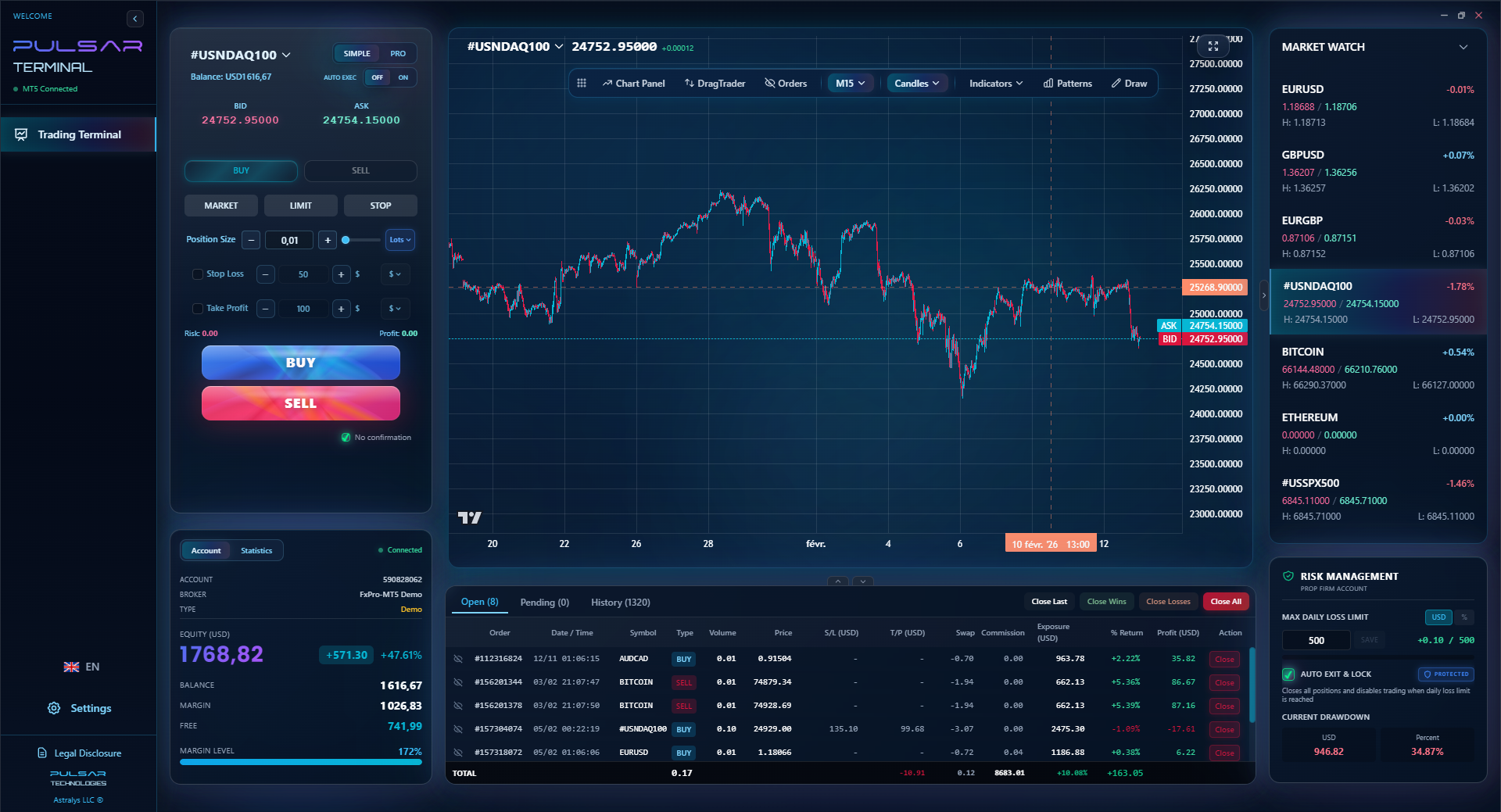
Managing multiple trades and strict prop firm risk limits is complex, but tools like Pulsar Terminal automate stop-loss and take-profit calculations directly on your MT5 charts, turning your technical rules into enforced actions.
Pulsar Terminal
The all-in-one MT5 companion: drag-and-drop orders, multi-TP/SL, trailing stop, grid trading, Volume Profile, and prop firm protection. Used by 1,000+ traders daily.
“Passing the challenge is just the ticket to the game. Now you need to play for keeps.”
The internet is full of noise. Here’s what’s worth your time and AUD.
Skip: The flashy YouTube videos promising '100% win rate secret indicator.' The expensive mentorships ($11,500 AUD for a year-long course is a massive commitment) unless they have a proven, verifiable track record of producing funded traders. Generic 'forex trading' courses that don't mention prop firm rules once.
Focus On: Content that discusses trading psychology under constraints. Books like 'Trading in the Zone' are more valuable than any indicator guide. Free content from prop firms themselves - their webinars often detail exactly how they expect you to manage risk. The ATAA's introductory course (around $450 AUD) is solid for pure technical analysis foundations.
Practice with a position size calculator until it's second nature. Backtest your strategy not for profitability first, but for maximum consecutive losses and drawdown. Would your strategy have survived the worst periods while obeying a 5% daily loss rule?
Study the specific guides for instruments you'll trade. Don't just wing it on gold; understand the drivers by reading a dedicated XAU/USD guide.
Finally, learn from broker reviews. While you won't be depositing with them directly, reviews of Exness review, XM review, and others often discuss execution quality and slippage - critical factors for your tight prop firm stops.
💡 Winston's Tip
Your first profit target in a challenge should always be to reach the point where your drawdown level moves to breakeven. That's the most important technical level on your chart.
“Your funded trading journal isn't just for analysis; it's the logbook for your trading business.”
Passing the challenge is just the ticket to the game. Now you need to play for keeps. Your technical analysis must evolve from 'challenge mode' to 'scaling mode.'
The consistency that got you funded is your greatest asset. Don't abandon it. Now, with real capital, you can gradually increase position size within your proven risk framework. The analysis is the same; the dollar amounts are larger.
Your profit splits (often 80% or more with Aussie firms) mean you keep most of the gains. This allows for more conservative technical targeting. You don't need to hit home runs. A steady stream of singles and doubles, built on high-probability technical confluences, compounds dramatically.
Document everything. Your funded trading journal is your business log. Which technical setups had the highest win rate? Which pairs performed best with your rule set? This data is gold when you negotiate for scaling plans (some firms scale you up to $1.5M or more).
Remember, the goal shifts from passing a test to preserving a lucrative partnership. Your technical analysis content is no longer just a set of rules; it's the blueprint for a sustainable trading business. Every line you draw, every level you identify, is in service of protecting that relationship and growing your share of the capital. It’s a different, more rewarding kind of pressure entirely.
FAQ
Q1Is technical analysis enough to pass a prop firm challenge?
No, it's only one part. Technical analysis gives you entry and exit points. But without rigorous risk management that strictly adheres to the challenge's daily loss and drawdown rules, even the best technical setup will fail. You need to integrate your TA with a firm-specific risk framework.
Q2What's the most important technical analysis skill for prop firms?
Accurate support and resistance identification. Knowing where price is likely to reverse or stall allows you to place logical, tight stop-losses and realistic profit targets. This is fundamental for managing the firm's capital within their strict risk limits.
Q3Do Australian prop firms have different rules that affect my TA?
The core rules (profit targets, loss limits) are similar globally. The difference for Aussies is in the practicalities: favouring AUD pairs can reduce currency risk on payouts, and you must factor in the tax implications (ATO treats profits as income), which might influence your profit-taking strategy on the charts.
Q4How much should I spend on technical analysis education for prop trading?
Be very cautious. You can build a strong system with free, high-quality content on risk management and classic price action. Expensive courses (like a $11,500 AUD year-long program) are a major investment. Only consider them if you're certain they address prop firm constraints directly. Start with low-cost options like the ATAA's $450 AUD introductory course.
Q5Can I use automated trading or EAs in a prop challenge?
Most firms allow it, but with caveats. The EA must not exploit latency or loopholes. Crucially, its logic must be built to respect the challenge's loss limits absolutely. An EA that doesn't factor in daily drawdown can blow an account just as fast as a human. You need to understand the technical rules it's following.
Q6Why do so many traders fail the evaluation phase?
They treat it like personal trading. They use position sizes that are too large for the loss limits, chase profits instead of following technical plans, and trade too frequently. They apply technical analysis to find opportunities, but not to define and limit risks according to the firm's rulebook.
Q7Should I focus on one pair or multiple pairs?
Start with one or two major pairs (like EUR/USD or AUD/USD). Master their technical behaviour - their average daily ranges, typical support/resistance levels. This deep knowledge helps you set better stops and targets. Adding too many pairs too soon dilutes your focus and increases the chance of misreading a technical setup.
Prof. Winston's Lesson
Key Takeaways:
- ✓Calculate risk in dollars before analysing the entry.
- ✓Map max drawdown on the weekly chart for every trade.
- ✓AUD pairs reduce currency risk on your profit split.
- ✓A 5% daily loss limit means a 20-pip stop can cost 2% of your budget.
How useful was this article?
Click a star to rate
Weekly Trading Insights
Free weekly analysis & strategies. No spam.
About the Author
Sarah Collins
Trading Strategist
London-based trading strategist with 12 years in financial markets. Former analyst at a City of London brokerage. Covers GBP pairs, European markets, and FCA-regulated trading.
Comments
Risk Disclaimer
Trading financial instruments carries significant risk and may not be suitable for all investors. Past performance does not guarantee future results. This content is for educational purposes only and should not be considered investment advice. Always conduct your own research before trading.
You Might Also Like

Cara Trading Forex Sukses: 7 Prinsip dari Trader Profesional
Cara trading forex sukses dengan 7 prinsip trader pro: manajemen modal, disiplin, journal trading, backtest. Data nyata, bukan janji profit palsu.
Jam Trading Forex Terbaik untuk Trader Indonesia: Panduan Lengkap dengan Tabel Waktu
Panduan jam trading forex untuk trader Indonesia. Tabel 4 sesi dunia, jam emas 20:00-00:00, sesi mana yang harus dihindari. Data akurat + tips dari trader berpengalaman.
Top 5 Sàn Forex Uy Tín Nhất 2026: Review Jujur dari Trader Indonesia
Top 5 sàn forex uy tín 2026 untuk trader Indonesia. Review jujur: spread, deposit, withdraw, dukungan lokal. Exness, XM, IC Markets & lebih.
Get Pulsar Terminal
All these calculators are built into Pulsar Terminal with real-time data from your MT5 account. One-click position sizing, automatic risk management, and instant calculations.
Get Pulsar Terminal