


I was staring at my screen on October 11, 2023, watching USD/ZAR rip through R19.20.

David van der Merwe
Emerging Markets Trader ·  South Africa
☕ 11 min read
What you'll learn:
I was staring at my screen on October 11, 2023, watching USD/ZAR rip through R19.20. My trade was up 120 pips, but my broker's platform had frozen. The price kept moving, but my sell order wouldn't submit. By the time it came back, half my profit was gone. That moment wasn't about strategy; it was about trust. In South Africa, finding the most trusted forex broker isn't about who has the flashiest ads or the biggest bonuses. It's about who doesn't disappear when the market gets wild. Let's cut through the noise.
Most traders think a fancy website equals trust. They're wrong. In South Africa, trust starts with one acronym: FSCA. The Financial Sector Conduct Authority isn't just some government office. They're the reason your money isn't vaporized when a broker goes belly up.
Here's what real FSCA regulation means for you:
- Client fund segregation: Your trading capital sits in a separate bank account from the broker's operating funds. If the broker hits financial trouble, your money should be untouchable. I say 'should' because enforcement matters.
- The 30:1 use cap: Since 2021, the FSCA capped retail use at 30:1. Any broker offering you 500:1 or 1000:1 to South African residents is either breaking the law or operating from an offshore entity that doesn't answer to local regulators. That's not an opportunity, it's a red flag.
- Dispute resolution: You have a local path for complaints. Try getting a hearing from some offshore regulator in Cyprus or the Seychelles when you've got a problem.

Warning: An FSCA license number on a website means nothing if it's for a different entity. Some international brokers get a 'light' FSCA license for a subsidiary that doesn't actually hold client funds. Always check which entity you're actually signing up with.
I learned this the hard way early on. I deposited with a well-known international brand, attracted by their tight spreads. Only later did I realize my account was with their St. Vincent and the Grenadines entity, not their FSCA-regulated one. When I had a withdrawal delay, my emails went into a black hole for weeks. The FSCA couldn't help me because I wasn't technically their client.
That's why your first question to any broker should be: "Which legal entity will hold my ZAR deposit, and what is its FSCA license number?" If they can't answer clearly, walk away. For a clear look at how a major broker structures this, our Exness review breaks down their different entities and who they serve.

💡 Winston's Tip
A broker's trust is proven during withdrawals, not deposits. The easiest money for them to process is yours coming in. Watch how they handle it going out.
“In South Africa, trust starts with one acronym: FSCA.”
Trust also means no hidden fees. South African traders get nickel-and-dimed in ways Europeans or Americans never see, mainly through currency conversion.
Let's break down a real trade. Say you deposit ZAR 10,000 into a USD-denominated account.
The Hidden Tax: The Deposit Conversion Most brokers use their own marked-up exchange rate. A 1.2% fee on that ZAR 10,000 deposit is ZAR 120 gone before you place a single trade. That's a full pip on a mini lot of USD/ZAR, vanished.
The Ongoing Drain: The Spread & Commission Look at the advertised EUR/USD spreads:
| Broker Type | Advertised EUR/USD Spread | Real Effective Cost (per round lot) |
|---|---|---|
| 'Raw Spread' Broker | 0.1 pips | $6 commission ($3 per side) = ~0.7 pips total cost |
| Standard Broker | 0.9 pips | $9 in spread costs, no commission |
| 'Zero Spread' Broker | 0.0 pips | $12-$15 commission |
The cheapest isn't always the one with the lowest number on the homepage. You have to do the math. For a scalping strategy where you're in and out fast, the raw spread account usually wins. For a swing trading style with fewer trades, a slightly wider spread with no commission might be better.
The Silent Killer: Overnight Swaps Trading ZAR pairs? The swap rates can be brutal. Holding USD/ZAR overnight might cost you $5-$10 per lot, every single night. That adds up faster than you think. A trusted broker makes these financing costs crystal clear before you open the trade, not buried in a FAQ page.

Example: In 2022, I tried to swing trade GBP/ZAR. I was right on the direction, up about 200 pips over two weeks. But the daily swap fees ate ZAR 1,850 of my profit. I netted less than if I'd taken a 50-pip profit on day one. I didn't respect the cost of holding, and it cost me.
Always, always use a position size calculator that includes swap fees in its projections, especially for ZAR pairs. What looks like a profit on your screen might be a loss in your account once financing is deducted.
“The cheapest broker isn't always the one with the lowest number on the homepage. You have to do the math.”
This is where the rubber meets the road. A broker can be perfectly regulated and have cheap spreads, but if their execution stinks during South African news events, you're going to lose money.
The USD/ZAR Liquidity Test The real test of a broker's infrastructure is how they handle USD/ZAR around 3:00 PM SAST when local liquidity peaks, or during a South African Reserve Bank (SARB) interest rate announcement. Does the spread blow out from 50 pips to 300? Does your market order get filled 100 pips away from where you clicked?
I've traded through SARB announcements with three different FSCA-regulated brokers. The difference was shocking:
- Broker A (Major Int'l Brand): Platform lagged by 4-5 seconds. My limit order filled 70 pips past my entry point. Slippage cost me ZAR 1,400 on a single mini lot.
- Broker B (Local SA Broker): Spread widened predictably (about 80 pips), but execution was instant. No requotes, no crazy slippage.
- Broker C (Another Major Brand): Orders were disabled entirely for 90 seconds after the announcement. By the time I could trade, the big move was over.
A trusted broker has the technology and liquidity partnerships to provide consistent execution, not just when the London session is calm, but when South Africa's market is moving. Ask them directly: "What is your policy on slippage and requotes during high volatility on USD/ZAR?" If they give you a marketing answer, you have your answer.
Withdrawals: The Final Exam The ultimate test of trust is getting your money back. A trustworthy FSCA broker processes ZAR withdrawals to a South African bank account within 24-48 hours. If it takes a week and involves 'processing fees' they never mentioned, you've got a problem. I consider any withdrawal that takes longer than 3 business days a major warning sign. Our IC Markets review details their specific withdrawal times and methods for South African clients, which is a good benchmark.
“The cheapest broker isn't always the one with the lowest number on the homepage. You have to do the math.”
So, do you go with a pure South African broker or the local arm of a global giant? There's no perfect answer, only trade-offs.
The Case for a Local FSCA Broker (Like Khwezi Trade)
- Proximity: They understand the local market, ZAR liquidity, and SA news flow. Your support call goes to Cape Town or Johannesburg, not a call center in Asia.
- ZAR-First: Your account is in ZAR. No conversion fees on deposits or withdrawals. This alone can save you 1-2% on every transaction.
- Local Accountability: They're physically here. The FSCA has direct oversight.
- Con: Often smaller product range. Might only offer MT4/MT5, lacking proprietary platforms. Research tools might be less sophisticated.
The Case for a Global Broker's FSCA Entity (Like IG or Tickmill)
- Resources: Massive tech budgets mean (usually) more stable platforms, advanced charting, and a wider range of instruments beyond forex.
- International Access: Better pricing on major pairs like EUR/USD due to deeper global liquidity pools.
- Features: Often have better educational content, auto-chart pattern tools, and advanced order types.
- Con: You might be a small fish in a big pond. SA-specific issues might not be a priority. Your USD-denominated account subjects you to those hidden conversion fees.
My personal rule? If you're primarily trading ZAR pairs and value simplicity, a strong local broker is hard to beat. If you trade a global portfolio and want access to everything from Nasdaq to XAU/USD, a global broker's FSCA entity is the way. Just make absolutely sure you're onboarded through their South African website onto their FSCA-regulated entity. Don't just google 'Broker X login' and end up on their .com international site.
💡 Winston's Tip
The FSCA's 30:1 use cap isn't a limitation, it's a life raft. The traders I've seen blow up fastest were always the ones chasing 500:1 from offshore bucketshops.
“The ultimate test of trust is getting your money back.”
After 12 years and blowing up two accounts early on (yes, it happens), I've developed a checklist of instant disqualifiers.
- Offshore Regulators as Primary License: If their biggest selling point is registration in Vanuatu, Mauritius, or St. Vincent, run. These are not regulators; they're company registries. They offer zero investor protection.
- 'Guaranteed' Profits or Bonuses: Any broker promising profits or offering a 100% deposit bonus is playing a different game. That bonus always comes with impossible withdrawal conditions. It's a lure, not a gift.
- Difficulty Withdrawing Profits: If making a deposit is instant with a credit card but withdrawing requires 'additional verification' that takes weeks, it's a scam. Full stop. A trustworthy broker makes withdrawing as easy as depositing.
- No Clear Risk Warnings: The FSCA mandates specific risk disclosures. If the broker's website is all lambos and beaches with tiny risk disclaimers, they're targeting gamblers, not traders.
- Pressure to Deposit More: If your 'account manager' calls you weekly pushing you to deposit more to 'recover losses,' that's not service. That's predation. A real broker might offer educational resources, not pressure tactics.

Pro Tip: Before depositing a single rand, do a test withdrawal. Deposit a small amount (like ZAR 500), then immediately request to withdraw it. See how they handle it. Any resistance, delays, or fees not disclosed upfront tells you everything about how they'll treat your R50,000 later.
I ignored the offshore regulator flag in 2014. I was greedy for the 500:1 use. The broker was 'great' until I had a R25,000 winning streak. Suddenly, my trades were being cancelled due to 'irregular price feeds.' My account was frozen for 'investigation.' I never saw that money again. The 'regulator' never replied to my emails. Trust is expensive to lose.
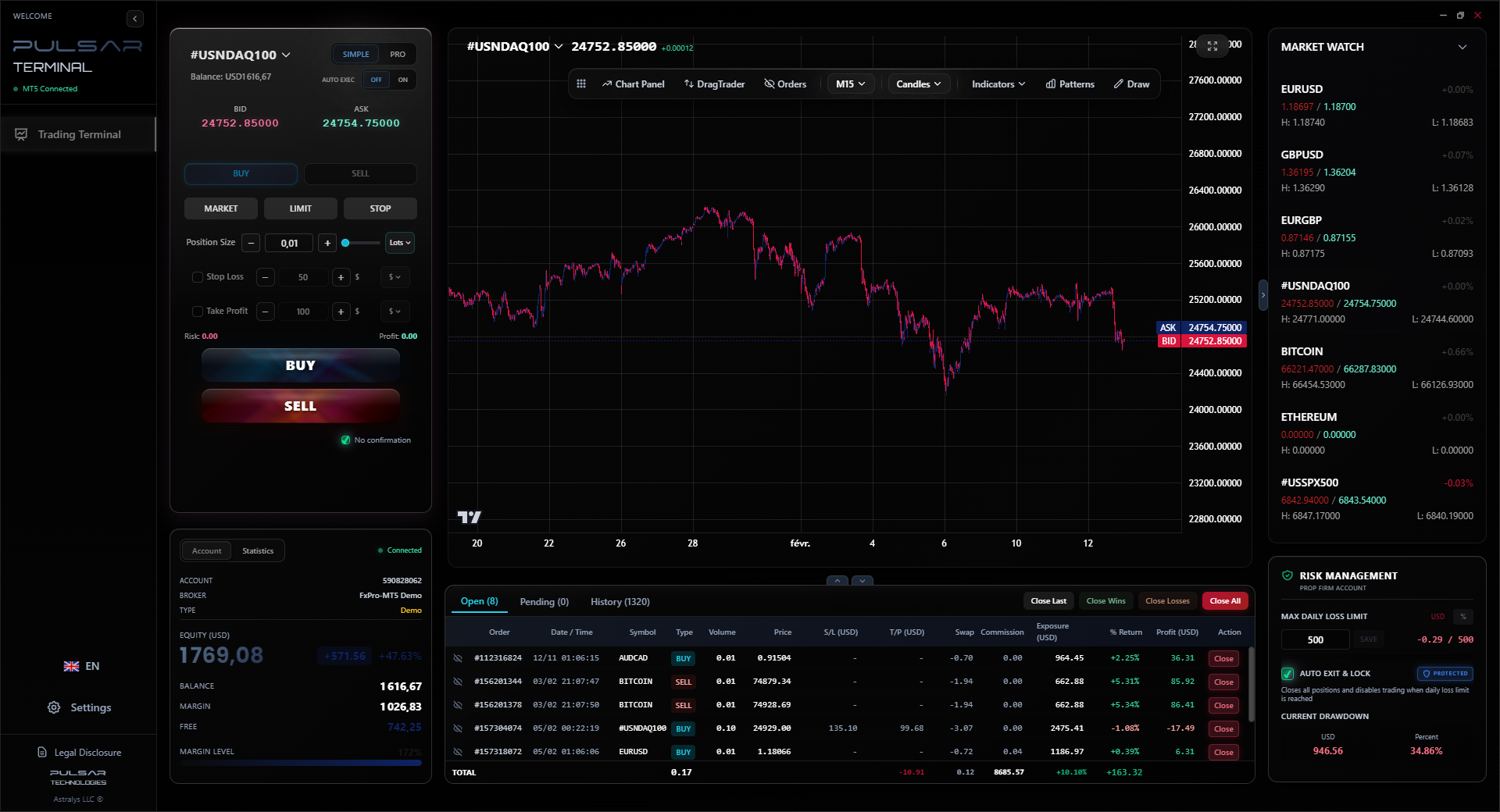
Managing risk with a trusted broker is key, and having precise control over your trades is non-negotiable. Pulsar Terminal's drag-and-drop orders and automated multi-level take-profit/stop-loss tools let you execute your plan on MT5 without hesitation or error.
Pulsar Terminal
The all-in-one MT5 companion: drag-and-drop orders, multi-TP/SL, trailing stop, grid trading, Volume Profile, and prop firm protection. Used by 1,000+ traders daily.
“The ultimate test of trust is getting your money back.”
Don't take my word for it. Build your own due diligence list. Here's a template you can use right now.
Step 1: Regulatory Verification
- Go to the FSCA's website (www.fsca.co.za).
- Use their 'Search for an Financial Services Provider' tool.
- Enter the broker's FSP number. Verify the name matches EXACTLY, the license is active, and it includes 'Over-the-Counter Derivative Provider' authority.
Step 2: The Pricing & Fee Audit
- Find their full schedule of fees. Not the marketing page, the legal document.
- Note: Minimum deposit, withdrawal fees, inactivity fees, currency conversion fees.
- For spreads, don't look at the 'from' figure. Use a demo account during volatile periods (London open, US non-farm payrolls) and check USD/ZAR and EUR/USD yourself.
Step 3: The Platform Stress Test
- Open a demo account.
- Place orders during busy times. Do you get requotes?
- Practice setting stop-losses and take-profits. Are they executed reliably?
- Check if they offer the tools you need. If you use the MACD indicator or RSI in specific ways, can you set it up?
Step 4: The Support Interrogation
- Contact support via live chat and phone. Ask a technical question like: "What's your model for calculating swap rates on USD/ZAR?"
- Gauge their knowledge and response time. If they can't answer basic questions about their own product during demo, imagine a real margin call scenario.
Step 5: The Community Check
- Search for the broker's name + 'withdrawal problem South Africa' or 'FSCA complaint'.
- Look for patterns, not one-off rants. Every broker has a few unhappy clients. Look for repeated issues about the same problem (e.g., slow withdrawals, bad execution).
Doing this takes an afternoon. It's boring. It's not as fun as analyzing charts. But it's the most important trade you'll ever make - the trade where you decide who gets to hold your capital. For examples of brokers who've been vetted through this process, see our deep dives on Pepperstone and XM, which detail their FSCA standing and local performance.
“Trust is built over hundreds of uneventful trades and smooth withdrawals, not one big win.”
The most trusted forex broker for you in South Africa won't be found through a Google ad. It'll be the one that passes your ruthless checklist. It's the one whose platform doesn't fail when USD/ZAR gaps at the Tokyo open. It's the one that sends your ZAR back to your FNB or Standard Bank account without drama.
Remember, regulation is the baseline, not the ceiling. An FSCA license means they've met minimum standards. Your job is to find who exceeds them consistently.
Start with the assumption that no one is trustworthy. Make them prove it. Deposit small. Trade small. Test withdrawals. Trust is built over hundreds of uneventful trades and smooth withdrawals, not one big win.
In this game, the broker is your partner. You wouldn't go into battle with a partner you don't trust. Don't trade with one either. Do the work, find your fit, and then you can focus on the only thing that really matters: your trading decisions.
FAQ
Q1Is Forex trading legal in South Africa?
Yes, absolutely. Forex trading is legal and regulated by the Financial Sector Conduct Authority (FSCA). The key is to trade with an FSCA-licensed broker to ensure you have legal protection and that your funds are segregated.
Q2What is the maximum use I can get in South Africa?
For retail traders, the FSCA has capped use at 30:1. Any broker offering you higher use (like 100:1 or 500:1) is either breaking South African law or is signing you up with an offshore entity that doesn't offer FSCA protection. This is a major red flag.
Q3Should I choose a South African broker or an international one?
It depends on your needs. A local FSCA broker (like Khwezi Trade) offers ZAR accounts, local support, and deep understanding of the Rand. An international broker's FSCA entity (like IG or Tickmill) often offers more platforms, instruments, and global research. The critical point is that whichever you choose, it must be the specific entity that holds an active FSCA license.
Q4What are the hidden costs I should look out for?
Watch for: 1) Currency conversion fees (1-2% when depositing/withdrawing ZAR to/from a USD account), 2) Inactivity fees (can be $50+ per quarter), 3) High swap/rollover rates on ZAR pairs, and 4) Withdrawal fees that aren't clearly stated upfront. Always read the full schedule of charges.
Q5How can I verify a broker's FSCA license?
Go directly to the FSCA's official website (www.fsca.co.za). Use their 'Search for an FSP' tool. Enter the broker's provided FSP number. Verify the company name matches exactly, the license status is 'Active', and the license category includes 'Over-the-Counter Derivative Provider'.
Q6What should I do if I have a problem with my broker?
First, escalate through the broker's official complaints channel. If unresolved, you can lodge a formal complaint with the FSCA. This is a powerful recourse you only have if you're with an FSCA-licensed entity. This path doesn't exist with offshore brokers.
Q7Is a low minimum deposit a sign of a good broker?
Not necessarily. A low minimum deposit (like $5 or $10) is a marketing tool to get you in the door. It says nothing about their execution quality, customer service, or trustworthiness. Focus on regulation and real trading costs, not the entry ticket price.
Prof. Winston's Lesson
Key Takeaways:
- ✓Verify the FSCA license yourself, don't just trust the logo.
- ✓30:1 use is the law; more than that is a major red flag.
- ✓Test withdrawal speed before depositing serious capital.
- ✓ZAR conversion fees can silently eat 1-2% of your money.
- ✓Execution during USD/ZAR volatility reveals true broker quality.
How useful was this article?
Click a star to rate
Weekly Trading Insights
Free weekly analysis & strategies. No spam.
About the Author
David van der Merwe
Emerging Markets Trader
Johannesburg-based trader with 11 years in emerging market currencies. Specializes in ZAR pairs, FSCA-regulated trading, and South African market analysis.
Comments
Risk Disclaimer
Trading financial instruments carries significant risk and may not be suitable for all investors. Past performance does not guarantee future results. This content is for educational purposes only and should not be considered investment advice. Always conduct your own research before trading.
You Might Also Like

Cara Trading Forex Sukses: 7 Prinsip dari Trader Profesional
Cara trading forex sukses dengan 7 prinsip trader pro: manajemen modal, disiplin, journal trading, backtest. Data nyata, bukan janji profit palsu.
Jam Trading Forex Terbaik untuk Trader Indonesia: Panduan Lengkap dengan Tabel Waktu
Panduan jam trading forex untuk trader Indonesia. Tabel 4 sesi dunia, jam emas 20:00-00:00, sesi mana yang harus dihindari. Data akurat + tips dari trader berpengalaman.
Top 5 Sàn Forex Uy Tín Nhất 2026: Review Jujur dari Trader Indonesia
Top 5 sàn forex uy tín 2026 untuk trader Indonesia. Review jujur: spread, deposit, withdraw, dukungan lokal. Exness, XM, IC Markets & lebih.
Get Pulsar Terminal
All these calculators are built into Pulsar Terminal with real-time data from your MT5 account. One-click position sizing, automatic risk management, and instant calculations.
Get Pulsar Terminal