


I was staring at my screen in late 2023, watching EUR/NGN absolutely collapse.

Olumide Adeyemi
West African Trading Pioneer ·  Nigeria
☕ 9 min read
What you'll learn:
- 1Beyond the Hype: What Real Wealth Looks Like
- 2The Nigerian Trader's Reality: Rules, Taxes, and Funding
- 3The Mindset: This Is Where 90% Fail
- 4Strategy Breakdown: From Theory to Execution
- 5Building Your Edge: Education and Tools
- 6The Prop Firm Pathway: A Modern Shortcut?
- 7Your Roadmap: From Where You Are to Where You Want to Be
I was staring at my screen in late 2023, watching EUR/NGN absolutely collapse. The CBN had just floated the Naira, and the chart was a sheer cliff. My first instinct was panic - my import-export business calculations were in shambles. But then I remembered a conversation with a mentor who'd made millions during the 2016 devaluation. 'The biggest moves create the biggest opportunities,' he'd said, 'but only if you're positioned right.' That moment crystallized what separates the hopeful from the truly successful in Nigeria's volatile market. Let's talk about what the richest forex trader in Nigeria actually does, beyond the Instagram flexes and Lamborghini photos.
When you hear 'the richest forex trader in Nigeria,' your mind probably jumps to flashy cars and private jets. I did too, early on. It's a distraction. The real measure isn't the lifestyle, it's the consistency of the bank balance and the sophistication of the strategy.
The names you see - Uche Paragon, Dapo Willis, others - they didn't get there by scalping NGN pairs on a phone app with $100. Paragon's estimated $16-20 million net worth reportedly came from a foundation in oil and commodity trading, using fundamentals and large position sizing. Willis's $10 million is built on deep technical analysis and running an education firm. Their trading capital is likely in the hundreds of thousands of dollars, if not millions, allowing them to take calculated swings on higher timeframes.
I made the mistake early on of trying to copy the 'vibe' without the infrastructure. In 2019, after a few good weeks of scalping strategy EUR/USD, I withdrew profits and bought a fancy watch. It felt like success. Then a volatile week wiped out two months of gains because my risk management was still amateur. The watch was a liability, a reminder of poor priority. The truly wealthy traders reinvest their profits into their trading business: better data, faster internet, deeper education, and larger, safer capital bases.

Warning: A trader's displayed wealth is often a marketing tool for their academy or signal service. The real money is usually made from the business built around trading, not just from the trading itself. Always separate the persona from the portfolio.
“The real money is usually made from the business built around trading, not just from the trading itself.”
You can't talk about building wealth here without understanding the unique obstacles. It's a different game from trading in the UK or US.
First, funding. The CBN's restrictions on international spending with Naira cards are a nightmare. That $20-$50 monthly limit? It's real. I've had to use multiple bank accounts and sometimes resort to peer-to-peer (P2P) crypto transfers to fund my international broker accounts, like IC Markets or Exness. This adds friction, cost, and time.
Then there's tax. A flat 10% capital gains tax on all gross profits. Let that sink in. If you make a 20% return on your capital, the government takes half of your profit. It makes compounding significantly harder and forces you to aim for higher returns just to break even after tax. You must account for this in every single trade calculation. I learned this the hard way after a big win on XAU/USD in 2022; I hadn't set aside the tax portion and it messed up my cash flow for the next quarter.
The Regulatory Gap
There's no strong local regulator for retail spot forex. The SEC doesn't license these brokers, and the CBN's new 2024/25 reforms (like the EFEMS platform) are for the wholesale interbank market, with minimum trades of $100,000. That leaves us retail traders in a gray zone. We rely on international brokers with offshore licenses (FSCA, FSA Seychelles). It's legal to trade with them, but you have little local recourse if something goes wrong. Your protection is your own due diligence.

Pro Tip: Always calculate your profit target after the 10% tax. If you need a 100-pip gain to make a trade worthwhile, you actually need about 110 pips to net the same result. Factor it into your position size calculator from the start.

💡 Winston's Tip
The 10% tax isn't a suggestion, it's the law. Calculate your post-tax profit target first, then work backwards to find your entry. It changes your entire risk-reward math.
“If you need a 100-pip gain to make a trade worthwhile, you actually need about 110 pips to net the same result after tax.”
This is the unsexy truth. The technicals matter, but the psychology is everything, especially in our environment. The richest forex trader in Nigeria has a fortress mentality.
Patience Over Greed: The Nigerian hustle culture pushes for quick money. Trading punishes that. The most successful traders I've met might only take 2-3 high-conviction trades a month. They wait for what my old mentor called 'the fat pitch.' I used to trade every day, chasing the action. My journal from 2020 shows 47 trades in one month, with a net profit of $120. The next month, I took 4 trades based on weekly chart confirmations and made $950.
Embracing Volatility, Not Fighting It: The Naira's volatility isn't your enemy; it's your edge if you know how to use it. But you don't do that by trading NGN pairs directly (the spreads are often horrific). You do it by trading instruments affected by commodity flows and EM sentiment. When oil prices spike, CAD/JPY might offer a cleaner, more liquid play on risk sentiment than trying to guess USD/NGN.
Business Discipline: They treat trading like a CEO runs a company. There's a monthly P&L, a risk management protocol, and a clear separation between personal and business funds. The first thing they do after a big win isn't to celebrate; it's to move the tax portion to a separate account and assess if their strategy edge is still valid.
“If you need a 100-pip gain to make a trade worthwhile, you actually need about 110 pips to net the same result after tax.”
Let's get concrete. What does a high-probability setup look like for a serious trader here?
They Trade the World, Not Just Forex: This was a revelation. The wealthiest Nigerian traders aren't just forex specialists. They trade global indices (US30, GER40), commodities (Gold, Oil), and maybe some select crypto CFDs. This diversifies their risk away from pure currency movements. My own portfolio now is roughly 60% forex (mostly EUR/USD and GBP/JPY), 30% indices, and 10% commodities.
Higher Timeframes Are King: The noise on the 5-minute chart will drive you mad and bleed your account with spreads. The real money is made on the Daily and Weekly charts. They use the 4-hour or 1-hour chart for precise entry, but the decision is made on the higher timeframe. A classic setup? A strong MACD indicator divergence on the Weekly chart, with price bouncing off a major support level, confirmed by a bullish engulfing candle on the Daily.
Risk Management is Non-Negotiable: They never, ever risk more than 1-2% of their capital on a single trade. This sounds basic, but under the pressure of a losing streak or the euphoria of a win, it's the first rule broken. I have a scar from 2021: I risked 5% on a 'sure thing' GBP/USD short. It wasn't sure. I got stopped out and lost over $2,500 in minutes. That single trade set my progress back six months. Now, I use a hard rule: my trading platform won't let me place an order if the risk exceeds 1.5%. Tools that automate this are useful.

Example: A $10,000 account. 1.5% risk = $150 per trade. On a EUR/USD trade with a 30-pip stop loss, your position size is: $150 / (30 pips * $1 per pip) = 5 mini lots. That's your max. No debate.
💡 Winston's Tip
Your greatest asset in a volatile market isn't a prediction, it's a pre-defined exit. Know where you're wrong before you enter. A bad entry with a good exit beats a good entry with no plan.
“The Naira's volatility isn't your enemy; it's your edge if you know how to use it.”
You can't outwork the market, but you can out-prepare the other retail traders. The edge comes from superior preparation and execution.
Continuous Education: Not just YouTube videos. I mean structured learning - books on market microstructure, courses on auction market theory, understanding the Commitment of Traders (COT) report. The richest forex trader in Nigeria is almost certainly a student of market profile or volume analysis, which reveals where big banks are placing their orders.
The Right Tools: A reliable broker with tight spreads and fast execution is non-negotiable. I've had good experiences with Pepperstone for raw spreads and XM for their local support. But beyond the broker, you need charting tools that give you an edge. Manual swing trading is fine, but automating parts of your process - like moving stops to breakeven after a certain move, or scaling out of positions at multiple targets - saves you from emotional errors and captures more profit.
Journaling Relentlessly: Every trade. Entry, exit, rationale, emotional state. I review mine every Sunday. The pattern that emerged? My winning trades had an average duration of 2.5 days. My losing trades were mostly intraday. That told me to stop trying to be a day trader and focus on my strength, which was 2-5 day swing trading setups.
“The Naira's volatility isn't your enemy; it's your edge if you know how to use it.”
This is a huge part of the conversation now. Many aspiring traders see funded account challenges as a way to access large capital without risking their own. It's valid, but it's a specific skill test.
Prop firms test discipline above all else. You have strict drawdown limits (often 5-10% total, 5% daily). This is where most Nigerians fail - they can't handle the psychological pressure of trading someone else's rules. I failed two challenges before I passed one. The reason? I violated the daily loss limit trying to 'recover' from a small loss. It was pure ego.
The key is to trade the challenge exactly like you'd trade a $1 million account, because that's the goal. Use tiny risk (0.5% or less), focus on consistency over home runs, and use every tool at your disposal to protect the capital. The rules are designed to trigger a margin call on emotional traders. Passing requires robotic adherence to a plan.
If you can pass, it's a phenomenal capital boost. But remember, it's still a simulation until you get the live account. And even then, profit splits apply. It's a career path, not a lottery ticket.
💡 Winston's Tip
If you can't explain your trade's edge in one sentence - 'Price is at weekly support with bullish RSI divergence' - you don't have an edge. You have a hope.
Managing the strict daily loss limits of a prop firm challenge is a huge psychological burden, but tools like Pulsar Terminal can automate this protection directly on your MT5 chart, removing emotion from the equation.
Pulsar Terminal
The all-in-one MT5 companion: drag-and-drop orders, multi-TP/SL, trailing stop, grid trading, Volume Profile, and prop firm protection. Used by 1,000+ traders daily.
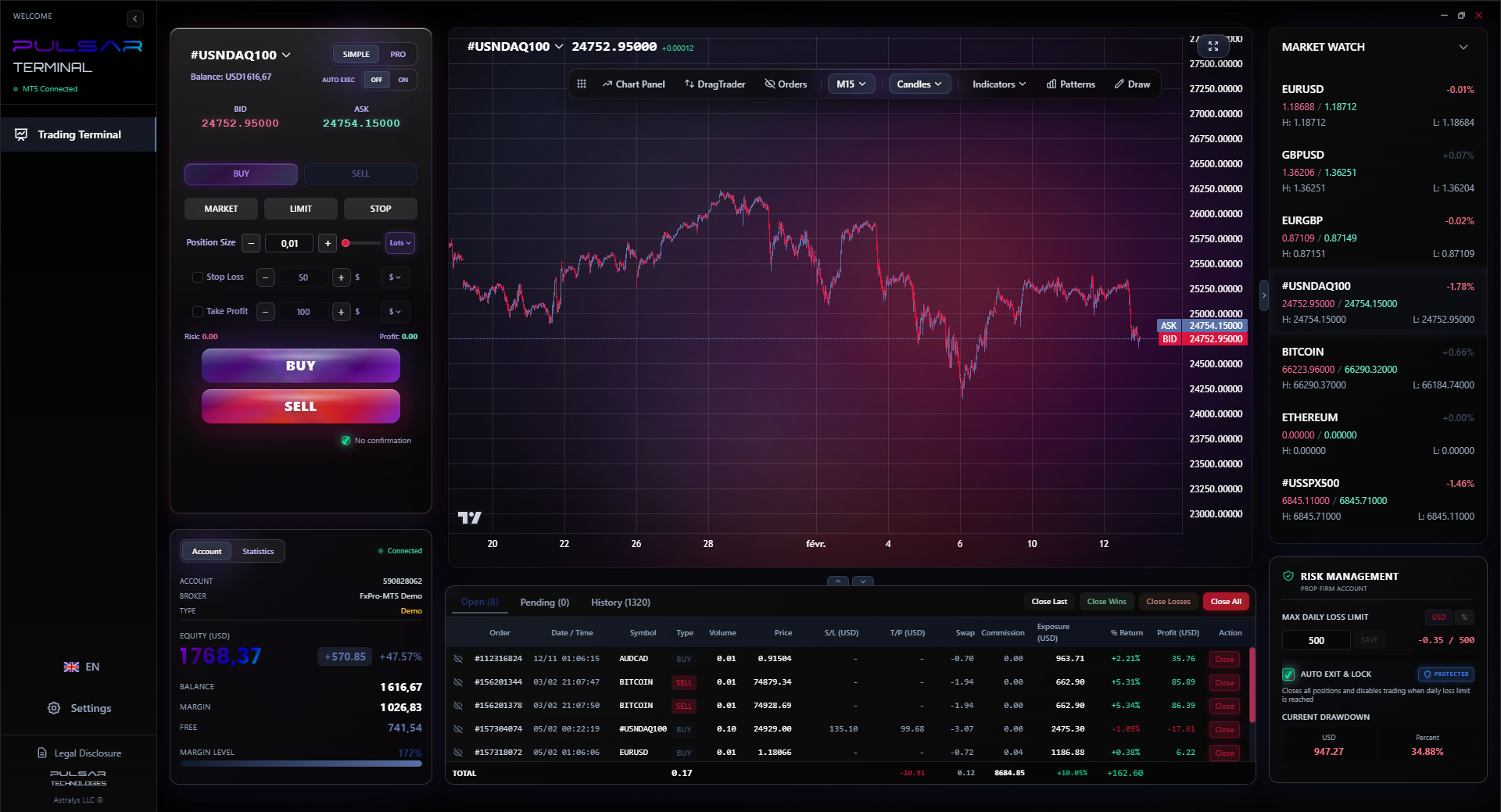
“Passing a prop firm challenge requires robotic adherence to a plan. The rules are designed to trigger a margin call on emotional traders.”
Let's build a realistic, multi-year plan. Forget 'get rich quick.'
Year 1: Survival & Education.
- Goal: Don't blow up your account. Learn to break even.
- Action: Trade a micro account ($200-$500). Master one strategy. Journal every trade. Your success metric is adherence to your plan, not P&L.
Year 2: Consistency & Scaling.
- Goal: Achieve consistent monthly returns of 3-5%.
- Action: Move to a standard account. Refine your strategy. Begin to incorporate fundamental analysis for context. Start setting aside your 10% tax liability automatically.
Year 3: Capital Growth & Diversification.
- Goal: Scale your capital and add a second asset class.
- Action: Consider a prop firm challenge with a portion of your capital. Begin trading indices or commodities alongside forex. Build a 6-month living expense buffer separate from your trading capital.
The path of the richest forex trader in Nigeria followed a similar arc - just over a longer period and with larger sums. The principles are scalable. It's a marathon of discipline, fought in the mind, executed on the charts.
FAQ
Q1Who is officially the richest forex trader in Nigeria?
There's no official ranking, but Uche Paragon is most frequently cited with an estimated net worth of $16-20 million, built from a foundation in oil/commodity trading and his education business, not just retail forex.
Q2Is forex trading illegal in Nigeria?
No, it's completely legal for individuals. However, you'll be using international brokers regulated abroad (like FSCA or FSA Seychelles), as Nigeria's SEC doesn't currently license local retail forex brokers.
Q3How much tax do I pay on forex profits in Nigeria?
You pay a 10% capital gains tax on your gross trading profits. This is a significant cost that must be calculated into your profit targets from the beginning.
Q4Why is it so hard to fund my international trading account?
The Central Bank of Nigeria (CBN) restricts international spending on Naira debit cards, often to as low as $20-$50 per month. Many traders use peer-to-peer (P2P) crypto transfers or multiple bank accounts to work around this limitation.
Q5Can I become a millionaire trading forex in Nigeria?
It's statistically very rare, but possible. The documented millionaires (like Damilare Ogundare) typically combined skilled trading with building a related business (like an academy). Pure trading wealth requires very large starting capital, exceptional skill, and years of disciplined risk management.
Q6What's the best broker for Nigerian traders?
There's no single 'best.' Look for international brokers with reliable P2P deposit options, tight spreads on majors, and strong regulation. Many Nigerians use brokers like Exness, IC Markets, or XM due to their accessibility and local payment support.
Q7Should I trade Naira pairs like USD/NGN?
Generally, no. The spreads are usually very wide, and the volatility is extreme and often driven by local policy news that's hard to interpret. Most professional traders focus on major forex pairs (EUR/USD, GBP/JPY) and global assets.
Prof. Winston's Lesson
Key Takeaways:
- ✓Factor the 10% capital gains tax into every single trade plan.
- ✓Risk a maximum of 1.5% per trade, no exceptions, no matter how 'sure'.
- ✓Trade higher timeframes (Daily/Weekly) for direction, lower for entry.
- ✓Build wealth through the business of trading, not just trading alone.
How useful was this article?
Click a star to rate
Weekly Trading Insights
Free weekly analysis & strategies. No spam.
About the Author
Olumide Adeyemi
West African Trading Pioneer
One of Nigeria's most active forex trading educators. 8 years of experience trading from Lagos. Specializes in low-capital strategies and prop firm challenges for African traders.
Comments
Risk Disclaimer
Trading financial instruments carries significant risk and may not be suitable for all investors. Past performance does not guarantee future results. This content is for educational purposes only and should not be considered investment advice. Always conduct your own research before trading.
You Might Also Like

Cara Trading Forex Sukses: 7 Prinsip dari Trader Profesional
Cara trading forex sukses dengan 7 prinsip trader pro: manajemen modal, disiplin, journal trading, backtest. Data nyata, bukan janji profit palsu.
Jam Trading Forex Terbaik untuk Trader Indonesia: Panduan Lengkap dengan Tabel Waktu
Panduan jam trading forex untuk trader Indonesia. Tabel 4 sesi dunia, jam emas 20:00-00:00, sesi mana yang harus dihindari. Data akurat + tips dari trader berpengalaman.
Top 5 Sàn Forex Uy Tín Nhất 2026: Review Jujur dari Trader Indonesia
Top 5 sàn forex uy tín 2026 untuk trader Indonesia. Review jujur: spread, deposit, withdraw, dukungan lokal. Exness, XM, IC Markets & lebih.
Get Pulsar Terminal
All these calculators are built into Pulsar Terminal with real-time data from your MT5 account. One-click position sizing, automatic risk management, and instant calculations.
Get Pulsar Terminal