


I lost ₹87,000 in a single week back in 2018.

Rajesh Sharma
Senior Forex Analyst ·  India
India
☕ 10 min read
What you'll learn:
- 1The Legal Reality Check: What You Can Actually Trade
- 2Top SEBI-Regulated Brokers (The Legal Path)
- 3Top International Brokers (The Grey Market)
- 4Costs & Fees: The Real Numbers That Eat Your Profits
- 5How to Choose & Deposit: A Practical Walkthrough
- 6Red Flags & What to Avoid
- 7Final Verdict & My Recommendations

I lost ₹87,000 in a single week back in 2018. Not from a bad trade, but from a broker 'freezing' my withdrawal. I was using an offshore platform to trade EUR/USD, chasing the dream I saw on YouTube. The platform wasn't on the RBI's alert list back then, but it was a classic unregulated bucket shop. They cited 'suspicious activity' on my profitable account until I gave up. That loss taught me the first, brutal lesson about trading from India: your broker choice isn't about spreads or use. It's about whether you'll ever see your money again. Let's cut through the noise and look at the real top 10 forex brokers in India, splitting the truly legal from the risky grey market.
Most articles on this topic are dangerously vague. Let's be clear. Under the Foreign Exchange Management Act (FEMA), as a resident Indian, you are NOT legally allowed to trade the global spot forex market. That means no EUR/USD, no GBP/JPY, no XAU/USD on MetaTrader with an international broker for speculative purposes. Full stop. The RBI is very specific about this. What IS legal? Trading INR-based currency derivatives (futures and options) on SEBI-regulated Indian exchanges like the NSE or BSE. You can trade pairs like USD/INR, EUR/INR, GBP/INR, and JPY/INR. That's it. The entire 'grey market' of using international brokers exists in a regulatory limbo. While these brokers accept Indian clients and you can fund accounts, you are technically violating FEMA. The enforcement is sporadic, but the risk of penalties or, more commonly, having no legal recourse if the broker scams you, is 100% real. I'm not your lawyer, but I am your trading mentor: you need to know this cold before you deposit a single rupee.

Warning: The RBI's 'Alert List' is public. If your chosen international broker is on it, you are explicitly violating Indian law. Funding such an account via your Indian bank could lead to account freezes or penalties.

If you want to trade forex legally from India, this is your list. These brokers provide access to exchange-traded currency derivatives. The experience is more like trading stocks: specific market hours, defined lot sizes, and transparency. You won't get 500:1 use, but you will get the protection of Indian law.
Zerodha
This is where most modern Indian traders start. Their Kite platform is excellent for charts and execution. For currency futures, the fee is around ₹0.05 per lakh of turnover + GST. It's clean, cheap, and reliable. I've used them for years for USD/INR trades. The lack of overnight positions in some segments can be limiting for a swing trading approach, but for intraday, it's solid.
Upstox
A strong competitor to Zerodha, with similarly low costs. Their Pro web platform and mobile app are very user-friendly for beginners. Execution is fast, and customer support is decent. They're a fully regulated entity, so your funds are safe in the Indian context.
Angel One
Offers strong research and advisory alongside trading. Their platform, Angel BEE, is feature-rich. They tend to cater to a slightly more traditional audience but are perfectly capable for currency derivatives. Fees are competitive, though sometimes slightly higher than the pure discount brokers.
ICICI Direct & HDFC Securities
These are the traditional giants. You're paying for the brand name and the integration with your banking. Their platforms aren't as slick as Zerodha's, and fees are significantly higher. However, if you want the perceived safety of a major bank and don't mind the costs, they are legitimate options. I find their charts and tools outdated for serious technical analysis.
The Bottom Line: For pure, legal forex exposure to the Indian Rupee, these are your best bets. The product is limited to INR pairs, but the environment is secure. Your biggest risk here is a market margin call, not broker insolvency.

💡 Winston's Tip
Your first ₹50,000 should go to a SEBI broker. Learn to make 2% consistently on USD/INR before you even think about the grey market. Mastery of one instrument beats dabbling in twenty.

“Your broker choice in India isn't about spreads or use. It's about whether you'll ever see your money again.”
This is the list everyone secretly searches for. These brokers accept Indian clients and offer the global forex market. I use some of them. You must understand you're operating in a grey area. Your protection comes from the broker's international regulator (like ASIC or CySEC), not SEBI. Do your own deep due diligence.
Here’s a comparison of key features:
| Broker | Key Feature for Indian Traders | Min. Deposit (Approx.) | Avg. EUR/USD Spread | Best For |
|---|---|---|---|---|
| IC Markets | Raw spreads, great for EAs | $200 (~₹16,600) | 0.1 pips + commission | Algorithmic & high-volume traders |
| Pepperstone | Excellent balance of cost & platform | $10 (~₹830) | 0.1 pips (Razor) | All-rounders, MT4/MT5 users |
| XM | Very low entry barrier | $5 (~₹415) | 1.7 pips (Standard) | Beginners with small capital |
| FxPro | Multiple platform choice (MT4, MT5, cTrader) | $100 (~₹8,300) | 1.5 pips (Standard) | Traders who like platform options |
| AvaTrade | Fixed spreads, user-friendly | $100 (~₹8,300) | 0.9 pips | Beginners wanting predictability |
IC Markets Review
My primary international account for years. Their raw spreads are genuine. I've seen EUR/USD at 0.0 pips during London open. The $3.50 commission per lot is fair. Execution is lightning-fast, crucial for scalping. They accept Indian bank transfers, but the process can take 2-3 business days. Their support isn't the warmest, but it's efficient. Read our full IC Markets review for more.
Pepperstone Review
A fantastic alternative. Their Razor account is similar to IC Markets. I find their customer support a notch better for resolving deposit/withdrawal queries, which is a common pain point for Indian traders. The Pepperstone review details their cTrader platform, which is superb for manual trading.
XM Review
Where I started internationally. The $5 minimum is a gimmick, but it lets you test everything with real money. Spreads are higher, but there are no commissions. For a beginner wanting to feel out MT4 with a few hundred dollars, it's a low-risk entry point. Their XM review shows they offer a lot of educational material.

Pro Tip: When funding international brokers, use a method that gives you a clear transaction trail. Wise (TransferWise) often offers better INR to USD rates than broker-converted deposits, saving you 1-2% on the exchange.
Brokers advertise 'zero commission' but get you on the spread. Or they advertise raw spreads but hit you with a commission. Let's translate.
Legal (SEBI) Trading:
- Brokerage: Zerodha charges ~₹20 per order for intraday or 0.03%. For a ₹10 lakh USD/INR futures trade, that's ₹20.
- Statutory Charges: SEBI turnover fee (0.0001%), GST (18% on brokerage), STT, etc. On that ₹10 lakh trade, total fees might be ₹40-₹60. It's transparent.
International (Grey Market) Trading: You have two main account types:
- Standard (No Commission): The broker's profit is built into the spread. A 1.7 pip spread on EUR/USD means you start a trade $17 in the hole on a standard lot. Over 100 trades, that's $1,700 in built-in cost.
- Raw/ECN (Plus Commission): You pay a tight spread (0.1 pips) plus a commission. IC Markets charges $3.50 per lot per side. So a 1-lot round turn (enter and exit) costs $7.00.
Which is cheaper? It depends on your trade size. For micro lots, the Standard account is often better. For larger volumes, Raw/ECN wins. I did the math: on my typical 2-lot EUR/USD trades, switching from a 1.5-pip standard account to a 0.1-pip raw account with commission saved me over $280 per month. Use a position size calculator that includes commission to see your true break-even.
The Hidden Killer for Indians: Currency Conversion. If your broker auto-converts INR deposits to USD at a poor rate, you could lose 2% before you even trade. Always check the final USD amount credited against the interbank rate.

“High use isn't a feature; it's a weapon they give you to blow yourself up with.”
Your choice isn't just about charts. It's about practicality.
Step 1: Define Your Goal.
- Want to trade only based on RBI policy and INR volatility? Go SEBI (Zerodha/Upstox).
- Want to trade global macros, ECB meetings, or the XAU/USD guide patterns? You're looking at international brokers, accepting the risk.
Step 2: Check Funding & Withdrawal. This is the biggest hurdle. International brokers typically offer:
- Local Bank Transfer (to their Indian partner bank): Usually works, can be slow.
- Cryptocurrency: Increasingly common, fast, but volatile.
- E-wallets (Neteller, Skrill): Fast, but fees stack up.
I tested a $500 deposit with Pepperstone via local transfer. It took 48 hours and cost a ₹500 bank fee + a 2% conversion markup by the intermediary bank. The net amount that hit my trading account was about $485. That's a 3% instant loss.
Step 3: Start SMALL. Deposit the absolute minimum. Test the platform, test the withdrawal process. Withdraw your money back first. If that's smooth, you have slightly more confidence. I never deposit more than I'm willing to lose with an international broker, because the legal recourse is a foreign court.

Example: You deposit ₹50,000 with an international broker. After a 2.5% conversion loss, you have $609 in your account (assuming 82 INR/USD). You need to make a 2.5% return just to get back to your starting rupee value. This is your first trade's hidden hurdle.
💡 Winston's Tip
When testing an international broker, your first trade should be a withdrawal. If getting your own money back is a struggle, imagine trying to withdraw profits.
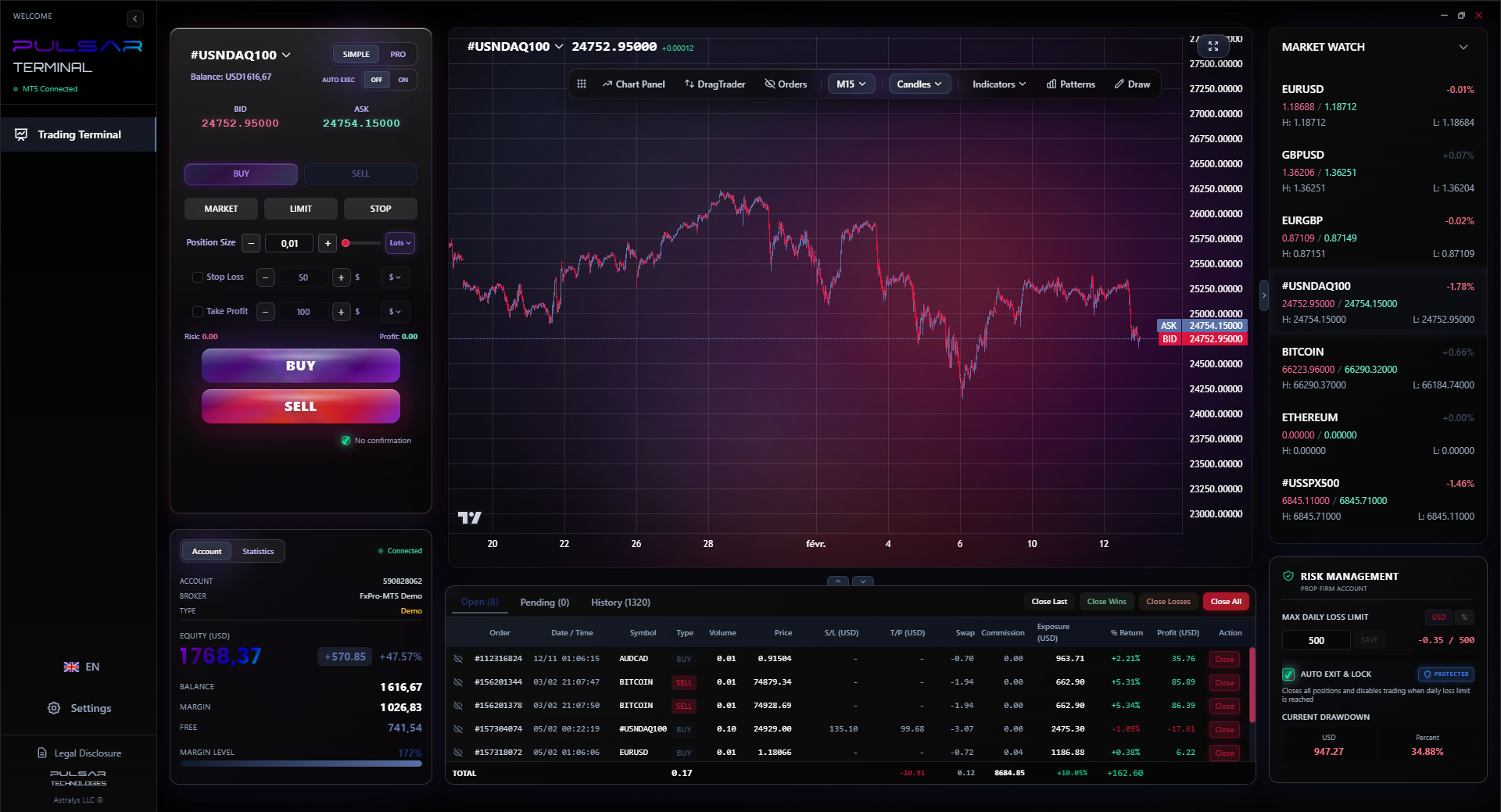
Managing risk on international platforms is harder without the right tools; Pulsar Terminal's automated trailing stop and breakeven functions on MT5 help protect profits on those fast-moving forex pairs.
Pulsar Terminal
The all-in-one MT5 companion: drag-and-drop orders, multi-TP/SL, trailing stop, grid trading, Volume Profile, and prop firm protection. Used by 1,000+ traders daily.
After 12 years and seeing countless traders get burned, here's my blunt list.
Avoid brokers that:
- Promise guaranteed profits or 'signals' with insane accuracy. This is always a scam.
- Have no clear, top-tier regulation (ASIC, FCA, CySEC, MAS). If they're only registered in offshore islands like St. Vincent, your money is at extreme risk.
- Make withdrawal difficult. If they ask for endless 'verification' documents you already submitted, or charge outrageous withdrawal fees, run.
- Offer bonuses for deposit. These almost always come with impossible withdrawal conditions (trade 50x the bonus volume). It's a lock-in scheme.
- Have consistently poor reviews about withdrawals on independent sites like Trustpilot. Don't just look at the rating, read the one-star reviews.
A personal mistake: I once used a broker offering 1000:1 use. It felt like power. On a GBP/JPY trade, a 10-pip move against me wiped 40% of my account. The platform had no negative balance protection. High use isn't a feature; it's a weapon they give you to blow yourself up with. A good broker offers risk management tools, not just insane use.

“The safest long-term bet is to master the legal USD/INR market. It's deep, liquid, and moves on real economics.”
So, who are the top 10 forex brokers in India? It's two separate lists.
For the Legal, Sleep-at-Night Trader:
- Zerodha
- Upstox
- Angel One (These are the top contenders. The bank-based brokers are fine but costlier.)
For the Grey Market, Global-Market Trader (with open eyes):
- IC Markets / Pepperstone (tie for best execution/cost)
- XM (best for tiny account testing)
- FxPro
- AvaTrade *(This rounds out a list of 10 when combined with the legal ones.)
My personal setup: I use Zerodha for all my USD/INR directional bets based on RBI policy. I use IC Markets for everything else: EUR/USD guide patterns, gold trades, and algorithmic strategies. This split keeps most of my capital in the regulated Indian system while allowing me to play in global markets with a portion I've mentally written off.
The landscape is tightening. With new FEMA regulations coming in late 2026, the grey market path may get narrower. Your safest long-term bet is to master the legal USD/INR market. It's deep, liquid, and moves on real economics. If you must go international, treat it like a casino visit: take only the money you can afford to lose, and be thrilled if you walk out with more.

FAQ
Q1Is forex trading legal in India?
Yes, but only specific types. Trading INR-based currency derivatives (like USD/INR futures) on SEBI-regulated exchanges like NSE is legal. Trading global forex pairs (like EUR/USD) through international brokers for speculation is not permitted under FEMA rules, putting it in a legal grey area with real risks.
Q2What is the minimum deposit for forex trading in India?
It varies wildly. For legal SEBI brokers like Zerodha, you can start with a few thousand rupees. For international brokers, minimums range from $5 (XM) to $200 (IC Markets). Remember, with international brokers, currency conversion fees can significantly eat into a small deposit.
Q3Can I use MetaTrader 5 (MT5) in India?
Yes, but not for legal forex trading. SEBI-regulated brokers use their own platforms (like Kite). International brokers like IC Markets and Pepperstone offer MT5 for trading global markets, but this falls under the grey market activity we discuss in the article.
Q4How do I withdraw profits from an international broker to my Indian bank account?
The broker will typically process a wire transfer back to your bank account in the currency you deposited (often USD). Your bank will convert it to INR, often at a less favorable rate than the interbank rate, and may ask for documentation on the source of funds. The process can take 3-7 business days and incur fees.
Q5What is the RBI Alert List?
It's a public list maintained by the Reserve Bank of India naming entities that are not authorized to deal in forex or operate electronic trading platforms in India. Trading with a listed entity is a clear violation of Indian law. Always check this list before considering any broker.
Q6Which is better for beginners: a SEBI broker or an international one?
For a complete beginner in India, a SEBI broker like Zerodha or Upstox is unequivocally better. You trade a simpler product (INR pairs), your funds are protected under Indian law, and you learn the basics without the legal overhang and complex currency conversion of the grey market.
Q7Do I pay tax on forex trading profits in India?
Yes. Profits from legal currency derivatives trading are treated as business income or speculative business income and are taxed as per your applicable income tax slab. Profits from international trading are also taxable, but the complexity of reporting foreign income is high. Consult a CA.
Prof. Winston's Lesson
Key Takeaways:
- ✓Legal forex in India is ONLY INR pairs (USD/INR, EUR/INR).
- ✓International brokers are a grey market with no SEBI protection.
- ✓Test withdrawals before making large deposits.
- ✓Hidden currency conversion costs can be a 2-3% instant loss.
How useful was this article?
Click a star to rate
Weekly Trading Insights
Free weekly analysis & strategies. No spam.
About the Author
Rajesh Sharma
Senior Forex Analyst
Trading Indian and South Asian markets for over 10 years. Started with NSE currency derivatives before moving to international forex. Specializes in USD/INR and emerging market pairs.
Comments
Risk Disclaimer
Trading financial instruments carries significant risk and may not be suitable for all investors. Past performance does not guarantee future results. This content is for educational purposes only and should not be considered investment advice. Always conduct your own research before trading.
You Might Also Like

Cara Trading Forex Sukses: 7 Prinsip dari Trader Profesional
Cara trading forex sukses dengan 7 prinsip trader pro: manajemen modal, disiplin, journal trading, backtest. Data nyata, bukan janji profit palsu.
Jam Trading Forex Terbaik untuk Trader Indonesia: Panduan Lengkap dengan Tabel Waktu
Panduan jam trading forex untuk trader Indonesia. Tabel 4 sesi dunia, jam emas 20:00-00:00, sesi mana yang harus dihindari. Data akurat + tips dari trader berpengalaman.
Top 5 Sàn Forex Uy Tín Nhất 2026: Review Jujur dari Trader Indonesia
Top 5 sàn forex uy tín 2026 untuk trader Indonesia. Review jujur: spread, deposit, withdraw, dukungan lokal. Exness, XM, IC Markets & lebih.
Get Pulsar Terminal
All these calculators are built into Pulsar Terminal with real-time data from your MT5 account. One-click position sizing, automatic risk management, and instant calculations.
Get Pulsar Terminal