


Thinking about trading with a prop firm's capital but drowning in a sea of slick marketing and confusing rules? You're not alone.

James Mitchell
Senior Trading Analyst
☕ 11 min read
What you'll learn:
- 1What Exactly Is a Prop Firm? (And How It Really Works)
- 2How We Picked This List: Our Evaluation Criteria
- 3The Top 10 Prop Firms for US Traders in 2026
- 4The Real Cost Breakdown: Fees, Splits, and Hidden Charges
- 5Understanding the Rules: Your Key to Actually Passing
- 6The US Regulatory Outlook: What's Changing in 2026?
- 7Getting Started: My Practical Advice
Thinking about trading with a prop firm's capital but drowning in a sea of slick marketing and confusing rules? You're not alone. The landscape has exploded, and picking the right firm is more critical than ever. I've traded with a few, watched friends succeed and fail with others, and seen the industry change drastically. This isn't just a list; it's a breakdown of the top 10 prop firms for US traders right now, with the gritty details on fees, rules, and what they don't tell you in the sales pitch.
Let's cut through the jargon. A proprietary trading firm (prop firm) gives you a chance to trade with their money. But first, you have to prove you can handle it by passing an evaluation, which is basically a simulated account with strict rules. Pass that, and you get a funded account where you split the profits.
Here's the core deal: they're selling you a test. You pay an evaluation fee (anywhere from $39 to over $600), and if you can hit a profit target without breaking their risk rules (like a daily loss limit or a max drawdown), you 'graduate.' The firm's main revenue stream? Those evaluation fees from the vast majority who don't pass. It's a tough business model, but when you find a good one, it can be a game-changer for your capital access.

Warning: This is not passive income or a get-rich-quick scheme. It's a performance-based job interview where you pay for the audition. Most traders fail. The industry-wide pass rate is brutally low, around 14%. Only a tiny fraction, something like 0.07%, actually get consistent payouts. Your mindset needs to be that of a professional proving their edge.
The legal side in the US is... fuzzy. Most aren't regulated like brokers. They operate as service businesses selling evaluations. This means your fee isn't a deposit in a segregated account; it's gone if you fail. This lack of direct oversight is why picking a reputable firm from our top 10 prop firms list is so important. You're trusting them to pay you if you win.

💡 Winston's Tip
The evaluation isn't about making money. It's about not losing money. Your primary goal is capital preservation within their rules. Profits are a secondary byproduct of not breaking the drawdown.
“The prop firm's main revenue stream? Those evaluation fees from the vast majority who don't pass.”
I didn't just Google 'best prop firm.' This list is based on a mix of hard data, trader community feedback, payout reliability, and my own experience. Here's what we weighed heavily:
- Payout History & Trust: Does the firm actually pay, and pay on time? We looked for firms with long track records or transparent, verified payout systems. A firm that's been around since 2020 and paid out millions is more trustworthy than a flashy new one.
- Rule Fairness: Are the rules designed for you to succeed, or just to make you fail? We favored firms with no unreasonable time limits on challenges and clear, consistent risk parameters.
- Cost Structure: Upfront fees, reset costs, and hidden commissions. We calculated the total cost of attempting and maintaining an account.
- Profit Split & Scaling: That 90% split sounds great, but is it realistic? We looked at the baseline split and how you can grow your account size over time.
- Platform & Instruments: Can you trade what you want, how you want? Support for platforms like MT5, cTrader, or TradingView and a range of assets (forex, indices, futures) was key.
- US Trader Accessibility: This is crucial. Many international firms have started restricting or complicating access for US residents due to regulatory concerns. We focused on firms that actively and reliably accept US traders.
The Numbers That Matter Most
Forget the marketing. Focus on these three numbers for any firm: the evaluation pass rate (if they publish it), the average payout processing time, and the reset fee as a percentage of your original challenge cost. A reset fee that's 80% of the original cost is a red flag; it suggests they want you to keep buying challenges. A reasonable reset is around 20-40%.
“A $10,000 account with rules that fit your strategy is better than a $100,000 account where you can't hold trades overnight.”
Alright, here's the main event. Remember, "best" depends on your style. A scalper needs different conditions than a swing trader.
| Firm | Best For | Key Feature | Max Starting Capital | Profit Split |
|---|---|---|---|---|
| FTMO | The Established Veteran | Industry pioneer, paid over $500M, extremely trusted. | $200,000 | Up to 90% |
| The5ers | Long-Term Growth | Focus on scaling traders over time, unlimited time challenges. | $250,000 | Up to 100% at high tiers |
| Apex Trader Funding | US Futures Traders | 100% of first $25k per account, up to 20 accounts. | $300,000 (futures) | 100%/90% |
| DNA Funded | Low-Cost Entry & Tech | Broker-backed, TradeLocker platform, very competitive pricing. | $600,000 | Up to 90% |
| BrightFunded | High-Frequency & EAs | Unlimited scaling plan, supports EAs and news trading. | $200,000 | 80%-100% |
| Fxify | Fast First Payout | On-demand first payout after first funded trade closes. | $400,000 | Up to 90% |
| Take Profit Trader | Simple Futures Evaluation | Single-phase eval, no time limit, allows news trading. | $150,000 | 80%-90% |
| FundedNext | Flexible Funding Paths | Multiple challenge types, good for various strategies. | $200,000 | Up to 90% |
| OneFunded | Refundable Challenge Fee | Challenge fee is 100% refunded with your first payout. | $200,000 | Up to 90% |
| AquaFunded | High-Profit-Split Futures | 100% on first $15k, then 90%. Instant funding options. | $150,000 | 100%/90% |

Pro Tip: Don't just go for the biggest starting capital. A $10,000 account with rules that fit your scalping strategy is better than a $100,000 account where you can't hold trades overnight if you're a swing trader.
Let me get personal for a sec. I passed a $50k challenge with The5ers back in 2024. Their unlimited time limit took the pressure off, letting me wait for my A+ setups. I grew it to a $120k account in about 8 months. My biggest mistake earlier was with a different firm (not on this list) that had a hidden 'consistency rule' I violated, voiding my payout. Always, always read the full rulebook.
Another experience: I tried a futures firm with Apex's model. The 100% on the first $25k is real. I made $18,500 on my first funded account, kept it all, and the psychology of that was huge. It builds a cushion fast. Just remember, futures moves fast, and you need to be on top of your position size calculator.
“A $10,000 account with rules that fit your strategy is better than a $100,000 account where you can't hold trades overnight.”
This is where dreams get priced. Let's talk real numbers.
Evaluation Fee: This is your ticket. For a $10,000 account, expect to pay $100-$200. For a $100,000 account, it can be $500-$650. Firms run sales constantly (think 50% off), so rarely pay full price.
Reset Fee: You blow the account. A reset typically costs 20-40% of the original eval fee. So that $200 challenge might cost $60 to reset. DNA Funded and others sometimes offer free retries if you're close, which is a nice perk.
Activation/Subscription Fee: Once you pass, some firms charge a one-time fee ($50-$150) to activate your live funded account. Others charge a monthly fee (like $80-$150 for futures data and platform). Apex, for example, has a monthly fee for their Rithmic data feed.
Profit Split: The standard is 80% to you, 20% to the firm. Many offer 90% with an add-on purchase or after scaling. The 100% splits are usually promotional (first payout only) or tier-based. AquaFunded's 100% on the first $15k is a standout real offer.
Commissions: Mainly for futures firms. Can be $5-$8 per round turn. This eats into profits fast if you're a high-volume trader.

Example: Let's say you pass a $50k challenge with a 90% split. You make $10,000 in profit. You get $9,000, the firm gets $1,000. If you paid a $299 eval fee and a $99 activation fee, your total cost was $398. Your net take is $8,602. Not bad.
The biggest hidden cost? Your time and psychological capital. Failing a 2-phase challenge can take months. I've seen traders cycle through $2,000 in eval fees before passing one. It's a grind.
💡 Winston's Tip
Treat the profit target as a marathon, not a sprint. Divide it by 20. That's your daily goal. Hit it? Stop. Miss it? Stop if you hit your daily loss limit. Consistency is the only metric they, and the market, truly reward.
“The biggest hidden cost? Your time and psychological capital.”
The rules aren't suggestions; they're the law. Violate them by a single pip, and you're out. Here are the common ones and how to manage them.
Profit Target: Usually 8-10% for the evaluation. For a $100k account, that's $8k-$10k. Break it into daily/weekly goals. Don't chase it in one trade.
Daily Loss Limit: Often 5%. On a $100k account, you can't lose more than $5,000 in a single day. This is your circuit breaker. If you hit it, STOP TRADING. Walk away.
Maximum Drawdown: The total loss allowed from the account's starting balance or its highest point (peak). This is usually 10-12%. This is the killer. It's trailing, so if you hit $106k then drop to $94k on a $100k account (a $12k drop from peak), you're often out, even if you're still in profit from the start.
No Overleveraging: This is about survival. Use a fraction of the margin they offer. If they give you 1:30 use, use 1:10. A single bad trade can trigger a margin call scenario in their system and blow your drawdown. I keep my risk per trade below 1% of the account's evaluation balance, always.
Time Limit: Some firms have them (30 days), many top ones don't. An unlimited time limit is a massive advantage. It lets you trade only when your edge is present.
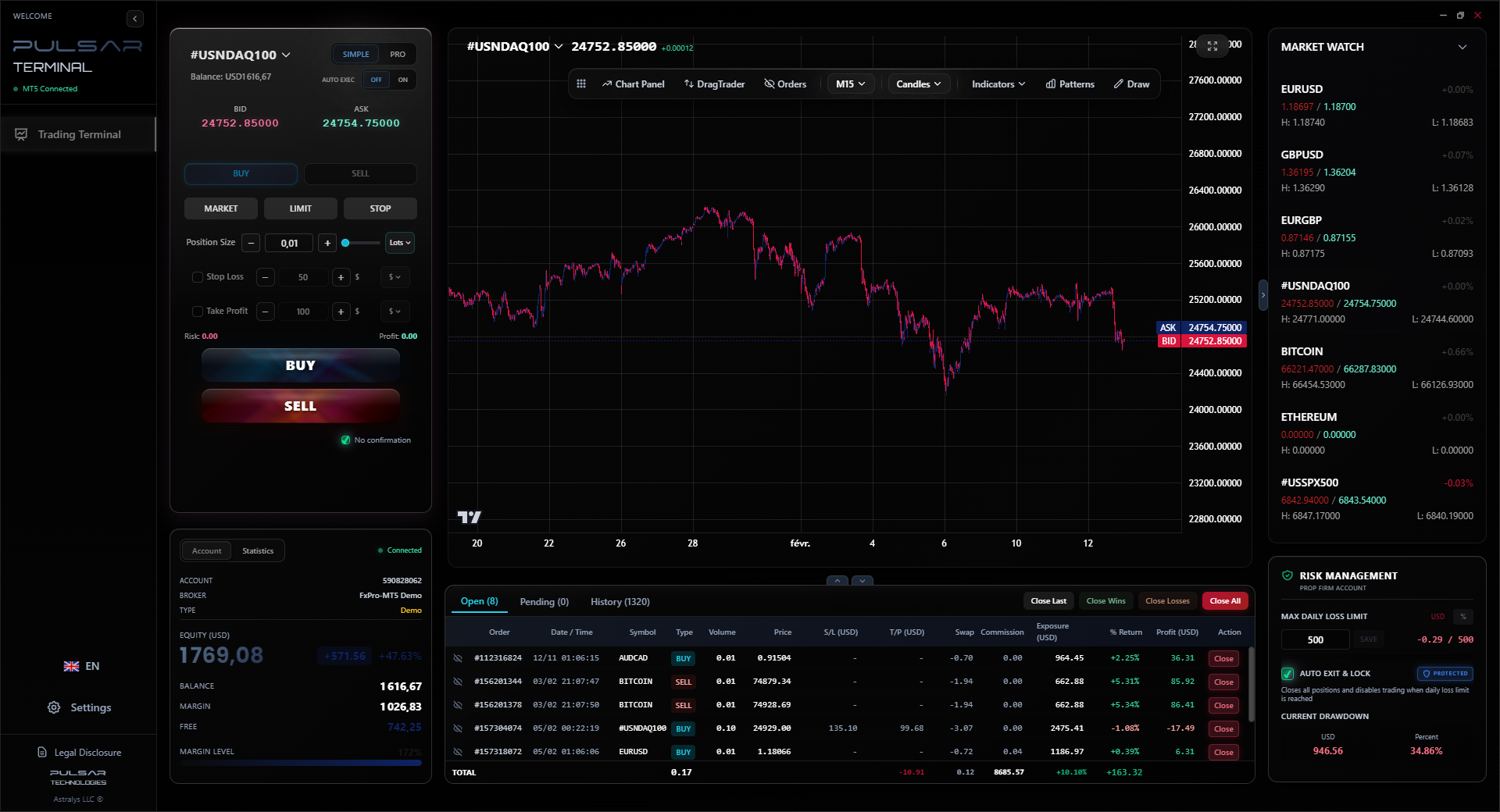
The strategy? Trade small. Be boring. Consistency over home runs. Use tools to automate rule protection. This is where a platform add-on like Pulsar Terminal can be a lifesaver - you can set hard stops based on daily loss limits right on your MT5 chart, so you physically can't break the rule.
Managing prop firm rules like daily loss limits manually is stressful and error-prone; Pulsar Terminal automates hard stops and rule protection directly on your MT5 chart, so you can focus on trading.
Pulsar Terminal
The all-in-one MT5 companion: drag-and-drop orders, multi-TP/SL, trailing stop, grid trading, Volume Profile, and prop firm protection. Used by 1,000+ traders daily.
“The biggest hidden cost? Your time and psychological capital.”
This is the million-dollar question for US traders. The party's getting more organized, and the cops are starting to look at the noise.
Right now, most retail prop firms operate in a gray area. They're not brokers, so they're not regulated by the CFTC or SEC in the same way. They're just companies selling you a test. But as the industry has ballooned (over 1,200% growth in a few years), regulators have taken notice.
The big debate: Should these firms be classified as Commodity Trading Advisors (CTAs)? If so, they'd need licenses, have capital requirements, and provide way more disclosure. The CFTC has been asking questions since late 2024.
What does this mean for you?
- Stricter KYC/AML: You'll see more rigorous identity and address checks. This is already happening. It's a pain, but it weeds out bad actors.
- Firm Shakeout: The 'gold rush' is over. In 2024-2025, over 100 prop firms folded. The ones on this list have survived the first wave. We're moving toward consolidation around reputable players.
- Potential Rule Standardization: Regulations might force more uniform and fairer rules across the board, which would be good for traders.
- US-Based Futures Firms Are Safer Bet: Firms like Apex and Take Profit Trader, dealing in regulated CME futures contracts, already operate in a clearer framework. They feel like the safer long-term bet for US residents.
The bottom line: The regulatory risk is real, but it's pushing the industry toward legitimacy. Sticking with the established top 10 prop firms is your best hedge against a firm suddenly changing rules or shutting down due to compliance issues.
“The regulatory risk is real, but it's pushing the industry toward legitimacy.”
Feeling overwhelmed? Here's a step-by-step plan from someone who's been through it.
- Pick Your Battlefield: Are you a forex trader or a futures trader? Your instrument choice will narrow the list fast. If you trade forex, check out our EUR/USD guide for core strategies. For gold, the XAU/USD guide is key.
- Start Small: Your ego wants the $200k account. Your wallet and sanity need the $10k account. Buy the smallest challenge from your chosen firm. The goal is to learn their system and get a payout, not to get rich on attempt one.
- Paper Trade the Rules First: Don't pay a dime yet. Take your strategy and apply the firm's specific rules (daily loss, max drawdown) to a demo account for a month. Can you be profitable within that cage? If not, you need to adjust your strategy first.
- Choose the Right Broker/Platform: Your prop firm will assign you a broker. Many top firms use reputable ones like those behind Exness, IC Markets, or Pepperstone for forex. Do a quick check on the broker's execution and spread quality.
- Document Everything: Screenshot your starting balance, every trade, your progress. If there's a dispute, you have evidence.
- Withdraw Early and Often: Once funded, take your first payout as soon as you're eligible. It proves the process works and gets you back your evaluation fee. It's a huge psychological win.
My final, non-negotiable piece of advice: Your trading plan is everything. It should define your entry, exit, and risk management before you click buy. Use indicators like the RSI indicator or MACD indicator as part of a system, not as a crystal ball. The prop firm challenge is a test of your plan's durability under constraints. If you don't have a written, tested plan, you're just donating your evaluation fee.
FAQ
Q1Can US traders legally use international prop firms?
It's complex. Many international firms have started blocking US residents due to regulatory fears. The firms on this list currently accept US traders, but this can change overnight. Always check the firm's latest terms before paying. US-based futures firms (like Apex) are the safest legal bet.
Q2What's the single biggest reason traders fail prop firm challenges?
Overtrading and violating the maximum drawdown rule. Traders get impatient, increase position size after a loss, and one or two bad trades wipe out their progress and hit the trailing drawdown limit. Discipline and tiny position sizes are key.
Q3Are the 'instant funding' accounts a good idea?
Rarely. They usually come with much stricter profit targets or higher fees, and the rules are often designed for quick failure. The traditional evaluation process, while slower, is a better filter and learning experience. Start with a standard challenge.
Q4How often do prop firms change their rules?
More than you'd like. Reputable firms give notice (30+ days). Shady ones change them overnight. This is another reason to stick with established names like FTMO or The5ers - their core rules have been stable for years.
Q5Do I need a special tax form for prop firm payouts?
In the US, yes. You'll likely receive a 1099-MISC or 1099-NEC form from the firm for your profit share earnings. This is considered self-employment income. Talk to a tax professional familiar with trading income.
Q6Is it better to trade forex or futures with a prop firm?
It depends on your experience. Forex offers more flexibility in account size and is familiar to most. US-based futures trading has a clearer regulatory path and often better profit splits initially (like Apex's 100% on first $25k). Trade what you know best.
Prof. Winston's Lesson
Key Takeaways:
- ✓Pass rates are ~14%; focus on rule adherence, not profits.
- ✓Start with the smallest account size to learn the system.
- ✓Maximum drawdown is the #1 account killer; manage trailing risk.
- ✓US futures firms offer clearer regulatory safety in 2026.
How useful was this article?
Click a star to rate
Weekly Trading Insights
Free weekly analysis & strategies. No spam.
About the Author
James Mitchell
Senior Trading Analyst
Based in New York with over 9 years of trading experience. Focuses on major USD pairs, prop firm challenges, and the US regulatory landscape.
Comments
Risk Disclaimer
Trading financial instruments carries significant risk and may not be suitable for all investors. Past performance does not guarantee future results. This content is for educational purposes only and should not be considered investment advice. Always conduct your own research before trading.
You Might Also Like

Cara Trading Forex Sukses: 7 Prinsip dari Trader Profesional
Cara trading forex sukses dengan 7 prinsip trader pro: manajemen modal, disiplin, journal trading, backtest. Data nyata, bukan janji profit palsu.
Jam Trading Forex Terbaik untuk Trader Indonesia: Panduan Lengkap dengan Tabel Waktu
Panduan jam trading forex untuk trader Indonesia. Tabel 4 sesi dunia, jam emas 20:00-00:00, sesi mana yang harus dihindari. Data akurat + tips dari trader berpengalaman.
Top 5 Sàn Forex Uy Tín Nhất 2026: Review Jujur dari Trader Indonesia
Top 5 sàn forex uy tín 2026 untuk trader Indonesia. Review jujur: spread, deposit, withdraw, dukungan lokal. Exness, XM, IC Markets & lebih.
Get Pulsar Terminal
All these calculators are built into Pulsar Terminal with real-time data from your MT5 account. One-click position sizing, automatic risk management, and instant calculations.
Get Pulsar Terminal