


Every new trader in South Africa asks the same thing: 'Who are the top 5 forex traders in South Africa?' They want names, Instagram handles, and secret signals.

David van der Merwe
Emerging Markets Trader ·  South Africa
☕ 10 min read
What you'll learn:
- 1The Guru Trap: Why Chasing 'Top Traders' Will Cost You
- 2The Real Top 5: FSCA-Regulated Brokers for South Africans
- 3The Silent Killers: Trading Costs in South Africa
- 4Forget Personalities, Adopt Proven Strategies
- 5The Non-Negotiable: Risk Management for ZAR Accounts
- 6Your Action Plan: How to Build Your Own Top Trader Profile
Every new trader in South Africa asks the same thing: 'Who are the top 5 forex traders in South Africa?' They want names, Instagram handles, and secret signals. I get it. I wanted a guru too when I started. But here's the brutal truth I learned after blowing my first account: chasing other people's success is the fastest way to lose your own money. The real 'top traders' aren't flashy influencers; they're the disciplined systems, the regulated brokers, and the proven strategies that survive market chaos. Let's set the record straight on what actually matters for a South African trader.
Let's be blunt. The internet is flooded with 'South Africa's #1 Forex Trader' claims. They've got rented Lambos, Dubai skylines, and promises of 500% monthly returns. I fell for it in 2015. Sent R5,000 to a 'mentor' in Cape Town who promised a 'guaranteed' gold trading system. The system was a lagging moving average crossover he probably copied from a 2004 forum. I was stopped out in three trades. Poof. Money gone, mentor ghosted.
The FSCA doesn't rank traders. There's no official leaderboard. Any 'top 5' list you find is usually marketing, affiliate bait, or pure fiction. The metrics are fake. That R10 million profit screenshot? Easily faked with a demo account or Photoshop. The real top traders are often quiet. They're not selling courses because their trading capital provides more than enough. Your goal shouldn't be to find them. It should be to become one of them. That starts by ignoring the noise and focusing on the framework that actually works: a solid broker, a clear strategy, and iron-clad risk management. The first step in that framework is picking a broker you can actually trust with your rands.

Warning: If a 'top trader' is more focused on selling you a dream (courses, signals, mentorship) than showing a verifiable, multi-year track record from a third-party platform like Myfxbook, run. They are a marketer, not a trader.

💡 Winston's Tip
A 'top trader' is just a statistician who respects their stop-loss. Your P&L is a function of your risk management, not your brilliant market predictions.
“Chasing other people's success is the fastest way to lose your own money.”
This is the only 'top 5' list that matters with real, verifiable data. You need a broker that's legally allowed to operate here, keeps your money safe, and doesn't rip you off with insane costs. The FSCA is our watchdog. A broker with its license has met strict capital and conduct requirements. Your funds are in segregated accounts. This isn't optional. I've seen too many guys try to sneak onto unregulated offshore platforms for 1000:1 use, only to find they can't withdraw their 'winnings'.
Based on spreads, platform stability, and local support, here are five brokers that consistently deliver for South African traders. I have personal accounts with two of them.
| Broker | Why It's a Contender | Key Detail for ZAR Traders |
|---|---|---|
| IG Markets | Tier-1 global brand with direct FSCA regulation. Their proprietary platform is excellent for analysis. | Minimum deposit is around £250 (roughly R5,800). Spreads on EUR/USD average 0.98 pips. They're solid, but not the cheapest. |
| Exness | FSCA-regulated. Known for ultra-low raw spreads and instant withdrawals. My go-to for scalping. | Offers ZAR accounts. Minimum deposit from $10. On their Raw Spread account, I've seen EUR/USD at 0.0 pips with a $3.5 commission per lot. Check our full Exness review for details. |
| IC Markets | An FSCA-regulated powerhouse for raw spreads and fast execution. Consistently tops global reviews. | Average execution speed is 35ms. Minimum deposit $200. Their Raw Spread account is fantastic, but you need to be comfortable with a commission model. Our IC Markets review breaks down the costs. |
| XM | Doesn't hold a direct FSCA license but robustly accepts SA clients under other top-tier regulators (CySEC). | Huge appeal: ZAR accounts with a $5 minimum deposit. Spreads from 0.8 pips on a commission-free account. Great for starting small. |
| Pepperstone | Another FSCA-regulated favorite. Excellent Razor account for ECN pricing and great cTrader integration. | While spreads on majors are tight, note that ZAR pairs are wider (e.g., 5 pips on USD/ZAR). This is standard for exotics. Our Pepperstone review covers this. |
Your broker is your gateway. A bad one will fail you at the worst moment - during a news spike or when you need to withdraw. Don't cheap out here. Once you're set up, the next critical piece is understanding the local costs that eat into your profits.
“The real 'top traders' are the disciplined systems that survive market chaos.”
You think the market is your opponent? Sometimes, your biggest enemy is your own trading statement. Let's talk about where your rands actually go. I once had a profitable month on paper, but after I factored in all costs, I was barely breaking even. It was a wake-up call.
Spreads: This is your main cost. On EUR/USD, you can get as low as 0.0 pips on a raw account (plus commission), or 0.8-1.5 pips on a standard account. But you're not just trading majors.
The ZAR Pair Trap: This catches new traders. You want to trade USD/ZAR or EUR/ZAR? Liquidity is lower. Spreads are wider - think 5 to 14 pips as a minimum. That means your trade is down 5 pips the second you enter. You need a much larger move just to break even. I learned this the hard way trying to scalp USD/ZAR. The spread ate my tiny profit targets alive.
Commissions: On raw/ECN accounts, you pay a commission per lot. $3-$7 per 100,000 units (1 standard lot) is normal. Do the math: if you're trading 2 lots, that's $14 round trip. Your trade needs to make more than that just to cover fees.
Swap/Overnight Fees: Holding a position past 10pm SA time? You pay or receive swap. It's based on the interest rate differential. If you're long a high-yielding currency against a low-yielding one, you might earn a small amount. But it usually works against retail traders. I once held a GBP/JPY sell position for two weeks during a slow trend. My profit was R2,300. The swap charges were R1,850. Net gain? A pathetic R450 for two weeks of risk.
Currency Conversion: If your account is in USD but you deposit in ZAR, your broker converts it. There's a fee, usually 0.5%-2%. This is why a ZAR-denominated account can be smarter if you're funding and withdrawing in rands. Use a position size calculator that includes spread and commission to see your true break-even point before you enter a trade. It's eye-opening.
💡 Winston's Tip
The spread isn't a fee, it's the entrance exam. If your strategy can't overcome the typical cost of your chosen pair, you're not trading, you're donating.
“Your stop-loss is your life insurance. No stop, no trade.”
So what do the actual successful traders do? They don't rely on gut feelings or a mysterious 'top trader's' WhatsApp signal. They follow a system. Here are two frameworks that work in the South African context, especially with our 30:1 use limit (thanks, FSCA).
Price Action & Key Levels
This is my bread and butter. It's about reading the raw price movement on the chart, without clutter. You look for support and resistance levels, trend lines, and classic patterns like pin bars or engulfing candles. The goal is to buy near support in an uptrend or sell near resistance in a downtrend.
My Experience: In early 2024, EUR/USD was ranging between 1.0780 (support) and 1.0880 (resistance). It tested 1.0780 three times and held. On the fourth touch, I saw a bullish engulfing candle form on the 1-hour chart. I went long at 1.0795. My stop was at 1.0765 (30 pips), and I took half profit at 1.0840 and let the rest run to 1.0870. It worked because I was trading the level, not a guess. This is core to swing trading.
Trend Following with Indicators
Combine a trend indicator with a momentum oscillator. A simple, effective combo is using the 50 and 200-period Exponential Moving Averages (EMAs) to define the trend, and the RSI indicator or MACD indicator for entry timing.
The Rule: Only take trades in the direction of the trend (price above the EMAs for uptrend). Wait for the RSI to dip below 30 and cross back above it in an uptrend for a potential long entry. This keeps you from 'catching a falling knife.'

Pro Tip: No strategy wins 100% of the time. Your edge comes from risk management. A 60% win rate with a solid 1:1.5 risk-to-reward ratio will make you money over 100 trades. A 90% win rate with a 1:0.2 risk-to-reward will destroy you on the few losses.
“Your stop-loss is your life insurance. No stop, no trade.”
This is the chapter where most South African traders fail. They get emotional. They see a trade going against them and 'just add a little more' to average down. That's how you get a margin call. I've done it. In 2019, I was short on Gold (XAU/USD) and it kept rising. Instead of admitting I was wrong, I added to the losing position three times, blowing my 2% per trade rule out of the water. One sharp move up wiped out 40% of my account. It was entirely my fault.
The Golden Rules (No Pun Intended):
- Risk Per Trade: Never risk more than 1-2% of your account balance on a single trade. If you have a R10,000 account, that's R100-R200 max risk. Use your stop-loss to calculate your position size. Don't guess.
- Use a Stop-Loss. Always. Your stop-loss is your life insurance. If you don't know where you'll get out if you're wrong, you have no business being in the trade. Period.
- use is a Tool, Not a Toy: The FSCA's 30:1 limit for retail clients is there to protect you. On a R10,000 account, that's R300,000 in buying power. You do NOT need to use it all. I rarely use more than 10:1.
- Have a Daily/Weekly Loss Limit. If you lose 5% of your account in a day, stop trading. Walk away. The market will be there tomorrow. Revenge trading is a guaranteed account killer.
Automating these rules is where technology saves you from yourself. Setting a stop-loss is basic, but managing a trade as it moves in your favor - trailing your stop, taking partial profits - is where you lock in gains and eliminate emotion.
💡 Winston's Tip
Your first profit goal shouldn't be a rand amount. It should be 100 consecutive trades where you followed your rules exactly. The money follows the discipline.
“A 5-pip spread on USD/ZAR means your trade is down R50 before it even starts.”
Let's wrap this up with a concrete, step-by-step plan. Stop looking for the top 5 forex traders in South Africa. Start building yourself into one.
Phase 1: Foundation (Weeks 1-4)
- Education: Learn what a pip is, how use works, what the spread means. Understand basic chart patterns.
- Broker: Open a demo account with one of the FSCA-regulated brokers listed above. Use it for at least a month. Test everything - execution, platform, how to place orders.
- Strategy: Pick ONE simple strategy from the previous section. Trade only that strategy on your demo account. Journal every trade: entry, exit, why you took it, your emotion.
Phase 2: Validation (Months 2-4)
- Fund a Live Account: Start small. Deposit an amount you can afford to lose completely - R1,000, R2,000. The goal is not to get rich. The goal is to validate your strategy and psychology with real money on the line.
- Strict Rules: Implement the 1% risk rule religiously. Use stop-losses on every single trade. No exceptions.
- Analyze: At the end of each week, review your journal. Are you following your plan? Or are you deviating when scared/greedy?
Phase 3: Scaling (Month 5+)
- Only after you have at least 3 consecutive months of disciplined, rule-based trading and a profitable (or break-even) track record, consider adding more capital.
- Refine: Now you can explore more advanced concepts, like trading XAU/USD correlations or deepening your EUR/USD analysis.
- Automate Your Edge: Look for tools that enforce your discipline. This is where a structured trading plan meets powerful execution technology.
The journey is long. It's frustrating. You will have losing streaks. But if you focus on controlling your risks, following a process, and using a reputable broker, you put the odds in your favor. That's the only secret the real top traders know.
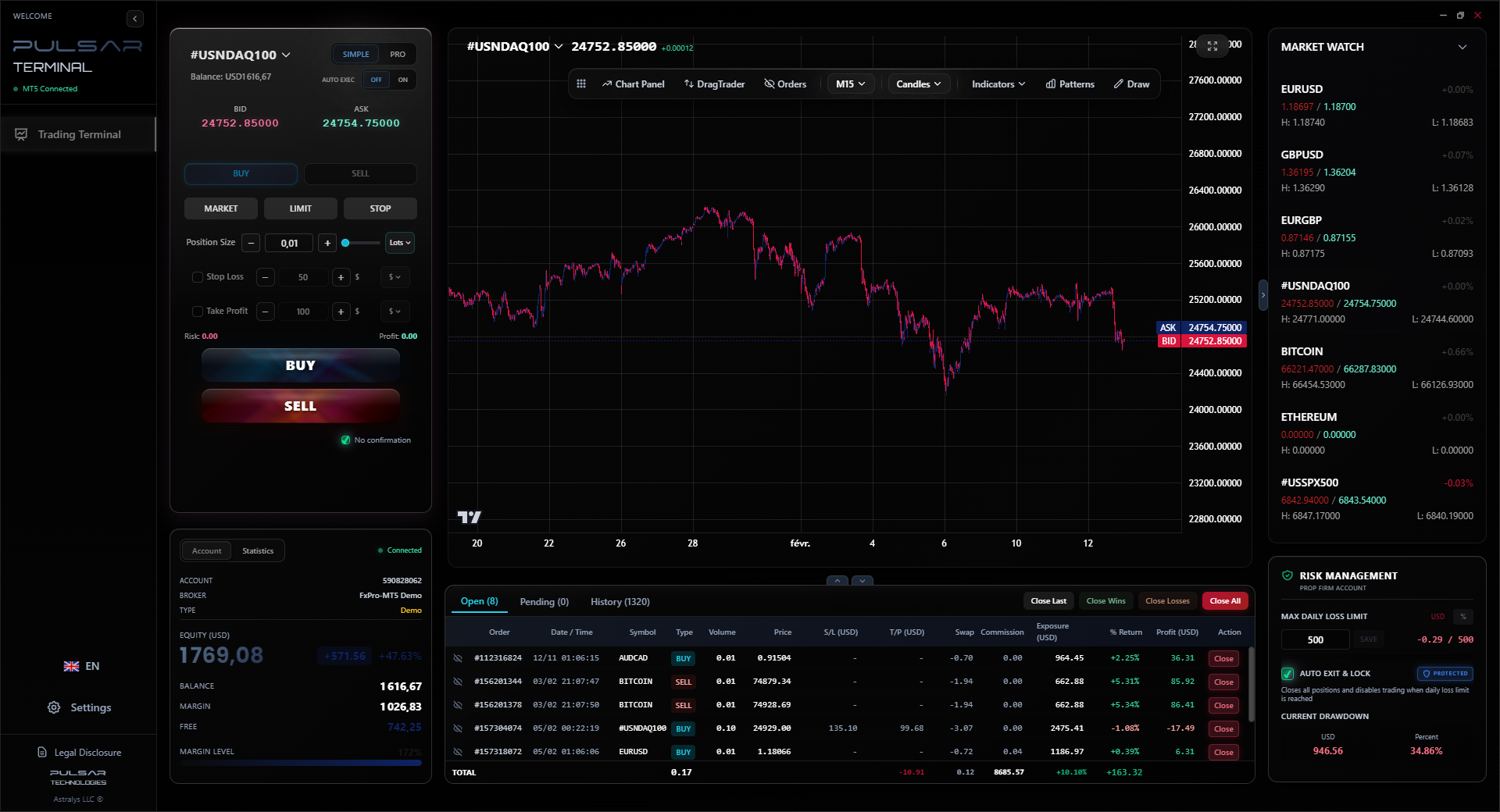
Building a top trader's discipline means automating your rules, and Pulsar Terminal lets you set multi-level take-profits, trailing stops, and daily loss limits directly on your MT5 charts to remove emotion.
Pulsar Terminal
The all-in-one MT5 companion: drag-and-drop orders, multi-TP/SL, trailing stop, grid trading, Volume Profile, and prop firm protection. Used by 1,000+ traders daily.
FAQ
Q1Who is officially the best forex trader in South Africa?
There is no official ranking or title. Regulatory bodies like the FSCA do not certify or rank traders. Any claims of being 'the best' are personal or promotional, not verified by a central authority. Focus on your own verified performance, not others' unverified claims.
Q2Is it legal to trade forex with international brokers from South Africa?
Yes, it is legal for South African residents to trade with international brokers. However, for greater protection, it is strongly advised to use a broker that is regulated by the South African FSCA. This gives you legal recourse under South African law if something goes wrong. Some international brokers (like XM) accept SA clients under other reputable regulators like CySEC.
Q3What is the safest way to fund my forex trading account in South Africa?
The safest methods are through regulated payment channels offered by your FSCA-regulated broker. This typically includes direct EFT (bank transfer), Visa/Mastercard, or established e-wallets like Skrill or Neteller. Avoid direct transfers to personal accounts or unconventional methods like cryptocurrency if the broker doesn't officially support it.
Q4Why are spreads on USD/ZAR so much higher than on EUR/USD?
The South African Rand (ZAR) is an exotic currency with lower trading volume and liquidity compared to major pairs like EUR/USD. This means fewer buyers and sellers at any given moment, so brokers widen the spread (the difference between buy and sell price) to cover their risk and cost of facilitating the trade. A 5-pip spread on USD/ZAR is normal, whereas EUR/USD can be below 1 pip.
Q5How much money do I realistically need to start trading forex in South Africa?
You can technically start with as little as $5 (roughly R90) with some brokers. But realistically, to practice proper risk management (e.g., risking 1-2% per trade), you need enough capital so that your position size is meaningful. A more practical starting point is R2,000 - R5,000. This allows you to trade micro lots (1,000 units) and absorb a few losses without blowing your account while you learn.
Q6Do I pay tax on my forex trading profits in South Africa?
Yes. The South African Revenue Service (SARS) views net profits from forex trading as taxable income. You must declare it in your annual tax return. It's crucial to keep detailed records of all your trades, deposits, and withdrawals for tax purposes. Consult with a tax professional familiar with trading income.
Prof. Winston's Lesson
Key Takeaways:
- ✓The only verified 'top 5' list is of FSCA-regulated brokers.
- ✓Risk a maximum of 2% of your capital on any single trade.
- ✓ZAR pairs have wide spreads (5-14 pips); factor this in.
- ✓A strategy with a 60% win rate and 1:1.5 risk-reward is a real edge.
- ✓Tax applies to your net trading profits. Keep every record.
How useful was this article?
Click a star to rate
Weekly Trading Insights
Free weekly analysis & strategies. No spam.
About the Author
David van der Merwe
Emerging Markets Trader
Johannesburg-based trader with 11 years in emerging market currencies. Specializes in ZAR pairs, FSCA-regulated trading, and South African market analysis.
Comments
Risk Disclaimer
Trading financial instruments carries significant risk and may not be suitable for all investors. Past performance does not guarantee future results. This content is for educational purposes only and should not be considered investment advice. Always conduct your own research before trading.
You Might Also Like

Cara Trading Forex Sukses: 7 Prinsip dari Trader Profesional
Cara trading forex sukses dengan 7 prinsip trader pro: manajemen modal, disiplin, journal trading, backtest. Data nyata, bukan janji profit palsu.
Jam Trading Forex Terbaik untuk Trader Indonesia: Panduan Lengkap dengan Tabel Waktu
Panduan jam trading forex untuk trader Indonesia. Tabel 4 sesi dunia, jam emas 20:00-00:00, sesi mana yang harus dihindari. Data akurat + tips dari trader berpengalaman.
Top 5 Sàn Forex Uy Tín Nhất 2026: Review Jujur dari Trader Indonesia
Top 5 sàn forex uy tín 2026 untuk trader Indonesia. Review jujur: spread, deposit, withdraw, dukungan lokal. Exness, XM, IC Markets & lebih.
Get Pulsar Terminal
All these calculators are built into Pulsar Terminal with real-time data from your MT5 account. One-click position sizing, automatic risk management, and instant calculations.
Get Pulsar Terminal